Tuesday, August 24, 2010

Marv Jenkins at the Rubaiyat Room “Good Little Man”

Here is a long forgotten piano-trio treasure that mixes the soulful jazz piano of Oscar Peterson and Ramsey Lewis with the gospel/popular stylings of Gene Harris or Les McCann. The third of four albums known to be issued by pianist Marv Jenkins is this fine record that goes under both titles Good Little Man and Marv Jenkins at the Rubaiyat Room.

Marvin Lee Jenkins was born on December 8, 1932, in Aultman, Ohio. His mother played piano and his brother, Obie, led bands in Canton, Ohio. Marvin, who was also known as Marv, studied music from the age of ten and while he specialized in piano, he also played organ, clarinet and notably flute.

Jenkins played in his brother’s band (1946-54) and the Army band (1954-56) before relocating to the West Coast where he won the Intercollegiate Jazz Festival award with the LA State College Quintet in 1959. This led to gigs with guitarist Barney Kessel, where he was featured on piano and flute in performance and on record between 1959 and 1961.

The pianist taught privately during this time and debuted with his own record, Marv Jenkins Arrives (Orovox, 1960), a piano-trio record issued on CD – and probably now long out of print - in the 90s by the Spanish Fresh Sound label. Another trio record, A Tribute To My People (Reprise, 1961) followed on Frank Sinatra’s Reprise label, followed by Good Little Man (Reprise, 1963).

Shortly after, Jenkins waxed the all-star Big City (Palomar, 1965), featuring such West Coast lights as Carmell Jones, Buddy Collette, Richard “Groove” Holmes, Charles Kynard (who later covered the album's title song under his own name) and Ray Crawford. While Marv Jenkins went onto play and tour with singer Della Reese, little, if anything, was heard from Jenkins thereafter until he appeared on Marvin Gaye’s landmark Let’s Get It On (Tamla, 1973).

Arthritis forced him to retire from music in the 1980s and take up teaching permanently, but several hardships such as the loss of his son, Marvin, Jr., and his wife of 25 years, Anne Heywood-Jenkins, continued to afflict his life. Up until his retirement in 2002, he’d worked steadily as an accompanist to the Baldwin Hills Baptist Choir. Then, finally, Marvin Jenkins died on March 4, 2005, at Huntington Memorial Hospital in Pasadena, California. He was 72. He died of natural causes, according to his family, most of whom still resided in Ohio.

On Good Little Man, Marv Jenkins is assisted by bassist Stanley Gilbert (who went on to play with Les McCann, Vince Guaraldi, Cal Tjader, Kenny Burrell, Gerald Wilson and Hubert Laws) and drummer Kenny Dennis (Sonny Stitt, Johnny Griffin and his one-time wife, Nancy Wilson). The trio does an immaculate job on a too-short program of Jenkins originals (“Blues Cha Cha,” “Trane’s Message,” ‘Blues Message” and the superb cooker “Good Lil’ Man”) and jazz standards (“Time After Time,” “My Man’s Gone Now,” “What’s New” and the lovely Ray Charles tribute of “I’ll Drown In My Own Tears”).

The originals are little more than basic blues, with tantalizing and uniquely understated flourishes that indicate Jenkins was a man of ideas that might not have squared with the record industry of the day. Like Bobby Scott, Patti Bown or any number of other talented and interesting jazz pianists of the day, Jenkins didn’t seem to have the overwhelming panache or overstatement that would lead to his being a piano jazz star. Thank god.

But there’s something magical and personal about his playing that certainly raises the music well above the cocktail-lounge pianisms of so many others of the time – including much of the music emanating from the Argo, Columbia, Sue or Blue Note hit-attempt factories that produced countless recordings from, respectively, the Ramsey Lewis Trio, Roy Meriwether, Ray Bryant or The Three Sounds.

The album’s shining moment comes at the very end, with the gospel marcher, “Good Lil’ Man,” which I first heard on a sampler called Portraits in Jazz: The Sounds of ‘63 (Reprise, 1963). It was about 1986 and this was definitely something that caught my attention then. Every time I hear it now, it renews and reawakens in me the spirit of what jazz piano can accomplish – and what a good player can do in his own right.

The pianist himself is said to have counted the Marv Jenkins at the Rubaiyat Room album Good Little Man as his personal favorite. And it’s not hard to hear why – even if, like me, you haven’t heard the others. There is something special in the scandalously brief 32 minutes of this album’s wonderful playing time. It’s pleasant and provocative all at once, but never so much in either direction to make it easy to ignore.

Perhaps the good folks at Collectables or Wounded Bird might one day consider pairing this album with, at least, A Tribute To My People to share the magic of pianist Marv Jenkins with a world who probably wouldn’t even know the guy outside of Let’s Get It On.

Queen of Crime: How Agatha Christie created the modern murder mystery

The New Yorker
A Critic at Large
"Queen of Crime: How Agatha Christie created the modern murder mystery."
by Joan Acocella
August 16, 2010

Abstract: The detective story was invented by Edgar Allan Poe, but he wrote only four of them before he lost interest. The first “career” practitioner of the genre who is still important to us today is Arthur Conan Doyle. Agatha Christie, who began publishing detective fiction thirty-three years after Conan Doyle, elaborated upon the traditional rules of detective fiction, in sixty-six novels published between 1920 and 1983. According to a number of sources, her books have sold more than two billion copies, making her the most widely read novelist in history. In the past year, two books on Christie have emerged: “The Duchess of Death: The Unauthorized Biography of Agatha Christie” (Phoenix; $25.95), by Richard Hack, and “Agatha Christie’s Secret Notebooks: Fifty Years of Mysteries in the Making” (HarperCollins; $25.99), by John Curran. Christie was born in 1890 and grew up in a seaside resort in Devon. She married Archie Christie, a member of the Royal Flying Corps, just after the First World War began. After the war, the couple settled in a London suburb, and Christie began writing novels. Describes a mysterious episode where Christie disappeared from home for ten days. In Christie’s novels, the murder that sets the plot in motion is rarely shocking. Furthermore, the victim is ordinarily someone with whom we do not sympathize. Christie created two famous detectives: Hercule Poirot and Jane Marple. In Curran’s “Agatha Christie’s Secret Notebooks,” the notebooks in question are school exercise books in which Christie worked out her plots. She made lists of possible victims, culprits, and M.O.s. Then she picked the combinations that pleased her. The writer thinks this shows Christie’s willingness to work by formula, and thereby to forego depth in favor of the puzzle. This practice exposed her to the contempt of some critics. The tradeoff is that Christie’s work is funny. A year after Christie’s divorce from Archie, she met an archeologist, Max Mallowan, in Iraq, whom, soon afterward, she married. In her mid-forties, she began to weary of writing, and she turned to drama—and then to film and TV—for which she adapted her novels and stories. She died in 1976, at eighty-five. For today’s readers, one pleasure of Christie’s books is her portrait of the times: the period between the two world wars, and, above all, the changes that took place after the second war.

Read the full text of this article in the digital edition of The New Yorker magazine (subscription required).

Sunday, August 22, 2010

“See Saw” by Idris Muhammad

Today's disco discovery: After recording two soulful funk albums for Prestige (where he’d done similar work at the time for other leaders) in 1970 and 1971 and then four rather more interesting albums for Kudu between 1974 and 1977, the great drummer Idris Muhammad recorded three disco-oriented albums for the San Francisco-based Fantasy label between 1978 and 1980.

“See Saw” comes from the first of these albums, You Ain’t No Friend of Mine! (Fantasy, 1978). Guitarist Hiram Bullock wrote the album’s title song and provides vocals and guitar to that song. But as the title is affixed to Idris Muhammad’s entire album – even over the catchier “Disco Man,” which opens the album – it’s interesting to guess at who the “you” of the album’s title might be. I have my thoughts.

Even so, the album’s title just doesn’t square with the manner or method of Idris Muhammad, who has gigged successfully with just as many soul-jazz superstars as avant-garde jazz heroes – and, quite memorably, as of late, with the great pianist Ahmad Jamal.

Still, the focus here is on the album’s second song: the great disco jazz of “See Saw,” written by the ludicrously mysterious “G. T’nig.” That name, which I can’t decipher, certainly must be a pseudonym for the great writer and arranger William S. Fischer, who is credited here as the record’s producer and player of occasional bells, synthesizer and, on this particular occasion, celeste. Oddly, there is no reference here to Fischer being the arranger. But surely, who else could it be?

“See Saw” is an intoxicating brew of dance exotica that samples an intriguing variety of sounds that feature the magisterial second line of Idris Muhammad on drums with Cecil Bridgewater and Jeff Davis on trumpet, Earl McKintyre on trombone, Joe Ford on flute (solo), Ed Xiques on baritone sax, Cliff Carter on keyboards, Hiram Bullock on guitar (solo), Lincoln Goines on bass, Bill Summers on congas, Zakir Hussain on table and the elusive Bill Fischer on celeste.

Listen to the drums. Listen to the horn charts. Listen to the exotic accents (tabla, celeste, flute) – sounds that didn’t often grace the dancefloors of the day. Just listen to it all. It gets more interesting upon repeated listens too.

A classic!

Thursday, August 19, 2010

Patti Bown Plays Big Piano

Pianist Patti Bown (1931-2008) is best known for her work on a number of Quincy Jones records, starting with The Birth of a Band (Mercury, 1959) through Quincy Jones Plays Hip Hits (Mercury, 1963) and was notably part of the troupe of American musicians that accompanied Jones on the ill-fated European tour of Free and Easy.

Patti and Quincy were apparently childhood playmates and Jones, who of course went on to become a top-tier composer and arranger in New York’s studio scene in the fifties, first covered Bown’s “G’won Train” on his seminal I Dig Dancers (Mercury, 1961) and then again on Quincy Jones and his Orchestra at Newport ‘61 (Mercury, 1961), also with Patti Bown.

In his obituary, Paul de Barros, Seattle Times jazz critic wrote, “Born Patricia Anne Bown in Seattle in 1931, Bown was one of five daughters and two sons raised in the Central District [of Seattle] by Augustus and Edith Bown, who moved to Seattle in 1921. Music and culture were central to her upbringing. Her mother took her see Marian Anderson, Katherine Dunham and Arthur Rubenstein, and the Bown household was known for its weekend ‘at-homes,’ where people played music, and discussed books and politics.

“Miss Bown's sister, Edith Mary Valentine, became a concert pianist in an era when it was difficult, if not impossible, for African Americans to enter the classical field. Millie Russell, another sister, recalled Patti at 3 years old astonishing their parents by copying on the piano what she heard Duke Ellington play on the radio.

“In 1949, Miss Bown won a music scholarship to Seattle University, and in 1952 she performed with the Seattle Symphony. She later transferred to the University of Washington, then moved to New York in 1955. Because of her excellent sight-reading and improvising skills, she was soon in demand in recording studios.”

Bown went onto record with jazz greats Dinah Washington, Bill Coleman, Cal Massey, Curtis Fuller. Oliver Nelson (Afro/American Sketches, Fantabulous and Jazzhattan Suite), Billy Eckstine, Gene Ammons, Billy Byers, Etta Jones, Don Goldie, Cal Tjader (Warm Wave, Hip Vibrations), Gary McFarland (Soft Samba), James Moody, Illinois Jacquet, Pee Wee Russell, Sonny Stitt and Roswell Rudd as well as blues guys like Oscar Brown, Jr., Jimmy Rushing, Eddie “Cleanhead” Vinson and Big Joe Turner and pop stars such as Leon Redbone while actively working in Broadway pit bands and performing live in Greenwich Village clubs.

Either Bown stopped her busy studio recording schedule around 1968 or, mysteriously, her name no longer appeared on records on which she appeared.

Patti Bown Plays Big Piano (Columbia, 1960), a terribly gimmicky title that can only be meant as a play on the pianist’s initials (“PB plays BP”), was the only record ever issued under Bown’s own name.

Recorded during three sessions between September and October 1959 with bassist Joe Benjamin and drummer Ed Shaughnessy, the album mixes several of Ms. Bown’s groovy, gospel-like originals (“Nothin’ But The Truth,””Waltz de Funk,” “Head Shakin’,” the original version of “G’won Train”) with some pleasingly off-beat tunes by some well-known composers.

The number of apostrophes in the originals should give you a clue as to what you’re in for: “head shakin’, foot tappin’, finger-snappin’, happy, melodic jazz.” Horace Silver and Oscar Peterson would seem to be the most obvious influences on Miss Bown’s playing and there’s little doubt of Duke Ellington’s pianistic persuasion.

But Miss Bown strongly calls to mind such contemporaries as Bobby Timmons, Gene Harris and Ramsey Lewis and would perhaps have touched upon some of their fame had she taken or been offered more consistent solo recording opportunities.

The covers reveal Miss Bown’s already well developed interest in show tunes: the effectively blues-drenched “It Might As Well Be Spring” (from the 1945 film State Fair), “I’m Gonna Wash That Man Right Out of My Hair” (another Rodgers & Hammerstein staple from the 1949 musical South Pacific), the fractured waltz of “Sunshine Cake” (from the 1950 film Riding High),the spunky, Oscar Peterson-like ”Give Me The Simple Life” (from the 1946 film Wake Up and Dream), the spiky, near Brubeck take on “I Didn’t Know What Time It Was” (from the 1939 musical Too Many Girls) and the spunky “Always True To You In My Fashion (from the 1948 musical Kiss Me Kate).

Here, she sounds more like a particularly muscular cocktail pianist, playing pretty enough to be enjoyed but with enough forceful originality to warrant attention. Miss Bown’s reluctance however to explore the jazz canon here indicates a pianist who is more eager to entertain than enlighten. And that’s just fine.

Patti Bown Plays Big Piano is superbly entertaining piano trio jazz and offers not only the original version of the bluesy “G’won Train” – which has been considered a descendent of sorts of Ellington’s “Happy Go Lucky Local” (aka “Night Train”) – but several of Miss Bown’s similarly interesting originals.

Wednesday, August 18, 2010

Gene Page “Hot City”

The first of two albums arranger/conductor Gene Page (1939-98) waxed for Atlantic Records, Hot City dates from 1974 and was made at the height of Barry White and Love Unlimited Orchestra’s success.

Page, who had already scored the funky Blacula (1971) and helmed many Motown sessions as well as any number of others for The Everly Brothers, Barbra Streisand, The Mamas and the Papas and Dionne Warwick, was providing the ultra-lush arrangements for White and his various groups at the time, when they were scoring their biggest hits. White repays the favor by providing Page with half an album’s worth of songs – including a slightly rougher edged take on LUO’s “Satin Soul” – and front-page production (“Gene Page Produced by Barry White”).

Hot City , one of the only fully instrumental albums issued under Gene Page’s name, features much of what makes so much of the composer and arranger’s work so interesting.

While Page could get unnecessarily syrupy – particularly on soulful ballads – his arrangements more often than not spring forth with dynamic ideas, inventive counterpoints and some of the most deliciously jazzed-up flourishes heard in popular music. It’s a majestic combination of everything from R&B and jazz to orchestral soul and classically-influenced easy listening – something Page was doing before those folks in Philadelphia got famous for the same thing.

All this is amply displayed on the three excellent compositions featured here: Page’s brilliantly funky “Jungle Eyes,” and the two songs Page co-wrote with frequent musical partner, brother Billy Page, “Cream Corner (Get What You Want)” and “To the Bone.”

On board here are many of the same musicians who played on Stanley Turrentine’s Pieces of Dreams (Fantasy, 1974), which was produced the same year by Gene and Billy Page, and include Ernie Watts on flute and sax solos; Clarence McDonald, Gene Page and Barry White on keyboards; Ray Parker Jr., Dean Parks, Melvin (Wah Wah) Ragin and David T. Walker on guitar; Wilton Felder (of The Crusaders) on bass; Ed Greene on drums; Joe Clayton on congas; Gary Coleman on percussion; and strings arranged and conducted by Gene Page.

Tuesday, August 17, 2010

Lalo Schifrin South of the Border

With the recent release of Mambo in Paris (Harkit, 2010), an obscure collection of Latin-styled dance recordings captured in Paris in the mid fifties, that mostly feature the probable participation of Lalo Schifrin in some capacity under the auspices of bandleaders Eddie Warner (who later fronted a disco library recording called Turbulence that was produced by Lalo Schifrin) and Lolo Martinez, it’s worth noting those better-known occasions when the Argentinean native went exploring these Latin dance styles he knew so well in his own very personal and ultimately intoxicating way.

The Harkit disc does contain a number of fascinating Schifrin originals that have not been heard anywhere else before - or since - including “Aprieta” for Eddie Warner and “Brincando,” “Lamento” and “Batucada en si Bémol” for Lolo Martinez, the entirety of the Schifrin originals featured on the ultra-obscure Martinez LP Dinner in Rio that also supposedly features violinist Stephane Grappelli. These are all of interest. But none contain Schifrin's compositional voice or, for that matter, much that is ultimately memorable.

The following, however, do. Surely, the titles speak for themselves:

”Roulette Rhumba” from Once A Thief (Verve, 1965) and also as part of the CD compilation The Cincinnati Kid: Lalo Schifrin Film Scores Volume 1 (1964-1968) (FSM, 2010). “Roulette Rhumba” was originally written for a January 1965 The Man From U.N.C.L.E. episode called “The Fiddlesticks Affair” and can be found in its original incarnation on the first volume of the FSM soundtrack CD. DJ Rodriguez also sampled “Roulette Rhumba” for the equally wonderful “By the Light of the Moon.”

”Fiesta” (listen to the marimbas!) and ”Charanga” (which I swear David Arnold copped for Die Another Day’s “Welcome to Cuba”) from Sol Madrid (MGM, 1968) and also as part of the CD compilation The Cincinnati Kid: Lalo Schifrin Film Scores Volume 1 (1964-1968) (FSM, 2010).

”La Columna” and ”Recuerdos” (recycled for Rock Requiem’s “Agnus Dei”) from Che! (LP = Tetragrammaton, 1969 and CD = Aleph, 1997).

”Latin Slide” (which Schifrin used as a source cue during a particularly disturbing scene in the wild 1971 film Pretty Maids All in a Row) and “Cocoa Leaf” from La Clave (LP = Verve, 1972, CD = Dusty Groove, 2007).

”Hotel Nacionale" from Voyage of the Damned (LP = Entre’Act, 1977 and CD = Label X).

Latin Jazz Suite (Aleph, 1999) - a masterful celebration of the diverse and colorful sounds and feelings that Latin forms add to the jazz vocabulary. It is also a reflection of the composer's successful contributions to the Latin musical language over the last four decades. This enthralling, consistently engaging six-piece suite - recorded live over two nights of its June 1999 premiere in Cologne, Germany suggests a sort of jazz symphony. The invention of Schifrin's conception interacting with the wit and verve of the players protect against any kind of museum-quality stodginess too. As it unfurls, it reveals itself as a most entertaining work. When it's over, it lingers in the mind and the heart as a real work of art.

Any others I’ve forgotten?

Wednesday, August 11, 2010

Orchestral Jazz – The Sixties

The jazz orchestra was born in the United States in the early years of the 20th century with large groups of musicians assembled to play popular music in dance halls and auditoriums. It wasn’t until 1922 or 1923 when the great pianist and composer Fletcher Henderson (1897-1952) combined several smaller quintets and sextets to form a “big band” dedicated to jazz (or swing) that the jazz orchestra was born.

Inspired by Paul Whiteman’s orchestra, the Henderson big band was set alight by the arrangements of Don Redman – not to mention a soloist by the name of Louis Armstrong – then later by Benny Carter and still later by Henderson himself. Around the same time Duke Ellington moved to Harlem and began building up his own aggregate of exceptionally talented soloists at Harlem’s Cotton Club in the late 1920s and 1930s.

By the 1930s orchestral jazz was thriving. It became the popular music of its day, with many “big bands” playing swing for many appreciative audiences. The major African American bands of the 1930s included the Ellington band, Earl Hines, Cab Calloway, Jimmie Lunceford, Chick Webb and Count Basie. But it was the "white" bands of Benny Goodman, Artie Shaw, Tommy Dorsey, Shep Fields and, later, Glenn Miller that far eclipsed their "black" inspirations in terms of popularity from the middle of the decade.

With the advent of bebop, an outgrowth of some of big-band jazz’s greatest soloists, and rock and roll in the 1950s, the big bands had lost a lot of their luster. The major bands were still performing and recording, but sales and interest in orchestral jazz was sliding downhill rapidly.

Not only were very few bands – with the exception of possibly Stan Kenton, Sun Ra or the Miles Davis recordings with Gil Evans – doing much that was innovative or new in orchestral jazz, but club owners and record companies found it much easier and more affordable to hire or house jazz trios, quartets or quintets.

While Ellington went into the sixties doing some of his very best work - Afro-Bossa, The Far East Suite and Latin American Suite quickly spring to mind - big bands had died out pretty much everywhere except the New York studios. Coincidentally, a whole new stream of young arrangers inspired by the big-band sounds they grew up with caught attention with their lively arrangements for key soloists.

Here are several notable examples of orchestral jazz that came out of the 1960s. Each program is mostly if not exclusively original to the album (hardly any covers or re-imaginings are present, which unfortunately forced out the marvelous Bill Evans Trio and Symphony Orchestra) and in all cases the albums I’ve singled out below are noted for the entirety of their presentation, not just one or two songs (which leaves out many great Don Sebesky arrangements I would have liked including). Please feel free to share any others in the comments section.

Gillespiana - Dizzy Gillespie and His Orchestra (Verve, 1961): Dizzy Gillespie recorded Gillespiana in November 1960. At that time, Lalo Schifrin, a 28-year-old Argentinean, was his pianist and musical director. Gillespie had first heard him in 1956 - he was struck by Schifrin's writing and asked the young musician to compose something for him. This was the start of Gillespiana, which was described in the original album notes as a "suite form in a concerto grosso format." It is a definitive work, surely one of the composer’s greatest full-scale compositions and, more arguably, the trumpeter’s very pinnacle of performance. It is also one of the finest examples of orchestral jazz ever presented. The five-part suite assigns solo duties within Gillespie’s working quartet: Leo Wright on flute and alto sax, Schifrin, Art Davis on bass and Chuck Lampkin on drums. But it is Gillespie, as it should be, who shines brightest here. The trumpeter occasionally performed the orchestral suite as part of his quintet, notably on November 25, 1960, for the Europe 1 label, but Schifrin’s “Blues” became a staple of the trumpeter’s performances right through to the end of his career. Lalo Schifrin’s The New Continent, recorded by Dizzy Gillespie in 1962 for a 1965 Limelight album (reissued recently on CD in Japan), is another one of the very best orchestral jazz endeavors of the 1960s – one I find I enjoy and appreciate far more and more often than even Gillespiana. Schifrin’s other work from this period continues to rank at the forefront of orchestral jazz and includes such notable titles as Cal Tjader’s Several Shades of Jade (Verve, 1963), Jimmy Smith’s The Cat (Verve, 1964) as well as his own New Fantasy (Verve, 1964).

Focus - Stan Getz (Verve, 1961): One of Stan Getz’s most unusual albums and surely his very best. Composer Eddie Sauter, arranger of many works by Benny Goodman, Artie Shaw and Woody Herman and co-leader of the Sauter-Finegan Orchestra in the fifties, provided Getz with a suite of nine pieces that unleash a stunningly unique musical and rhythmic framework from a small group of string players (Getz’s drummer Roy Haynes factors only on the excellent “I’m Late, I’m Late”). Getz, who commissioned the work himself, couldn’t have been more inspired. Sauter’s suite was designed to “draw something out of [Getz] and show him off.” And indeed it does, to a nearly perfect degree. Getz seems to understand with acute accuracy the locus of jazz and classical structures that formed the then emerging “third stream” consciousness. It’s easy to hear here how “third stream” could have become a viable musical genre, despite the fact that neither Getz nor Sauter were at the forefront of this musical movement. Focus is one of the genre’s very best examples of third stream: sensible and structured like so much classical, yet playful and improvisational like the very best of jazz. Getz and Sauter were re-teamed four years later for the soundtrack of the Warren Beatty film Mickey One (MGM, 1965) and then again for some performances in 1966 with Arthur Fiedler and the Boston Pops. Getz, of course, worked with all the major arrangers during the sixties (Lalo Schifrin, Claus Ogerman, Richard Evans, Johnny Pate and, most memorably, Gary McFarland on 1962’s Big Band Bossa Nova) , producing a great body of orchestral jazz that was far more artistically satisfying than his best-selling, though pleasant, albums of bossa nova. But none are as superbly delivered as the enduringly beautiful and shockingly timeless Focus.

The Gary McFarland Orchestra with Special Guest Soloist Bill Evans (Verve, 1963): A stirring, beautiful score and, ultimately, one of Gary McFarland's finest achievements. McFarland’s painterly talent to evoke specific moods succeeds most brilliantly here. The album is like a soundtrack celebrating the excitement of a big urban wonderland. The compositions are first rate, McFarland's occasional vibes playing is simple and perfect and the backgrounds, composed of a string quartet, the reeds of Phil Woods and Spencer Sinatra and a rhythm section featuring Jim Hall on guitar, Richard Davis on bass and Ed Shaunessy on drums, is poetically sublime. Bill Evans buoys the event with his graceful, individual style, lending a signature that makes this work remarkably moving. The whole album is perfect; a beautiful moment in jazz. McFarland has a number of other orchestral jazz classics to his credit, including Stan Getz’s Big Band Bossa Nova as well his own Profiles (Impulse, 1966), The October Suite (Impulse, 1967) and the underrated Scorpio and Other Signs (Verve, 1968). But he hardly ever touched the sheer graceful beauty of this lovely recording again in his all too-brief career.

Moment of Truth - Gerald Wilson Big Band (Pacific Jazz, 1963): A classic no matter how you slice it. The second of arranger Wilson’s Pacific Jazz titles and probably the greatest work he’s ever done in a career rife with great work, Moment of Truth features some of the best West Coast players of the time and some of Gerald Wilson’s finest writing. Included on this program of mostly originals is the classic “Viva Tirado” (with solos by Carmell Jones, Teddy Edwards, Joe Pass and Jack Wilson), which was later turned into a pop hit by El Chicano, “Moment of Truth,” the modal “Patterns” (with solos by Wilson, Jones, Pass and Harold Land), “Latino” – all exceedingly memorable in their structure and immortal in their performances. Also notable: Feelin’ Kinda Blue (Pacific Jazz, 1966).

Kenyon Hopkins – Perhaps this particular entry is a bit unfair since it’s not one album, but four, and all four albums are soundtrack recordings. Even though Kenyon Hopkins never really made a jazz album, all of his music is imbued with great jazz writing - from scores to films like Baby Doll (1956) to his novelty albums recorded under the aegis of Creed Taylor – and all feature the cream of New York’s finest jazz players, often allotted space, however brief, for improvising in their signature style. Some may dismiss a lot of this evocative music as simply film jazz. But Kenyon Hopkins’ music, especially these four forgotten albums (never issued on CD), is the epitome of emotional grandeur that the best orchestral jazz often achieves.
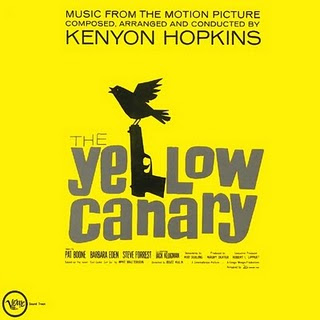
The Yellow Canary (Verve, 1963) is Hopkins’ tremendous orchestral jazz score to a forgettable Pat Boone starrer, notable as much for its great music (“The Yellow Canary,” “The Spindrift,” “On the Roof,” “Santa Monica Blues,” “Deserted Canary”) as its memorable performances from star jazz players including Clark Terry, Joe Newman on trumpets, Zoot Zims on tenor sax, Lalo Schifrin on piano and Kenny Burrell on guitar – all of whom get features throughout.

East Side/West Side (Columbia, 1963) is a short-lived New York City-based TV show starring George C. Scott that ran for one season in 1963-64. Hopkins’ music shares much in common with the jazz styles Henry Mancini introduced to television audiences in Peter Gunn. Hopkins scores with a swinging jazz beat, rife with New York studio players that give the whole affair a very East Coast jazz-based sound, particularly the nice but brief features for Phil Woods’s alto sax.

The Reporter (Columbia, 1964) is Kenyon Hopkins’ jazz inflected soundtrack to a short-lived TV show starring Harry Guardino as the titular character, Danny Taylor. Hopkins scores ten pieces here for a 21-piece jazz orchestra (sometimes enhanced by strings) and captures a sound that is much more Ellingtonian than the Mancini-esque East Side/West Side, another “streets of New York” story. There is much effervescent swing and remarkably diverse phrasings throughout and despite such jazz lights as Zoot Sims, Jerome Richardson and Joe Newman in the horn section and Barry Galbraith, George Duvivier and Ed Shaughnessey in the rhythm section, Phil Woods is effectively spotlighted throughout. Nothing at all wrong with that.


Mister Buddwing (Verve, 1966) is Kenyon Hopkins’ eclectic orchestral jazz score to a 1966 drama starring James Garner as a man on a quest to regain his memory and find his identity. Surprisingly for Hopkins, the score itself seems to be searching for an identity, traversing various strains of jazz popular in its day, not unlike Quincy Jones’ breakout jazz score to The Pawnbroker (Mercury, 1965) – to which several themes here bear striking similarity. No song really connects with the one that came before it, indicating different players, all of whom are unknown, were allotted for each performance. It’s also surprising that none of the players are named here. Each song seems to feature various sounds and players that producer Creed Taylor was working with at the time, making this as much Taylor’s program as Hopkins’. The oft-sampled “Hard Latin” sounds like it features possibly Freddie Hubbard on trumpet, Kenny Burrell on guitar (who probably reappears on “Memory Montage” and “Fiddler’s Walk”) and Larry Young on organ (same goes for “West Side Radio” – but could it possibly be Jimmy Smith here?). Sounds pretty clearly like Grant Green and Larry Young on “R and B 12 (Blues)” but could that be Donald Byrd on trumpet? The vocalists who hum the lines of “Fiddler’s Walk,” “Mister Bee” and “Mirror” sure sound like the singers from the Taylor-produced Up with Donald Byrd. “Lunch Room” sounds like Taylor-produced Kai Winding (who may also be playing here) with Paul Griffin on organ and the Prevailing Winds on vocals. Regardless, it’s a compelling document made whole by Hopkins’ overriding spirit of staying within the jazz tradition and crafting something that swings even though its intention may be otherwise. Best tracks: “The Bridge,” “Hard Latin,” “Fiddler’s Walk,” “Mister Bee,” “West Side Radio,” “R and B 12 (Blues)” and “12/8 Theme.”

The Soul of the City - Manny Albam (Solid State, 1966): The last album Manny Albam (1922-2001) recorded under his own name was probably his very best. Albam had arranged for many jazz orchestras including those of Charlie Barnet, Stan Kenton, Woody Herman, Count Basie, Coleman Hawkins and Joe Newman (who is featured here) and he certainly knows how to swing a big band. An all-original program, The Soul of the City is a musical ode to New York City, featuring some of the city’s best jazz players and studio musicians. Soloists include J.J. Johnson on trombone, Freddie Hubbard and Joe Newman on trumpet, Frank Wess on tenor sax, Phil Woods on alto sax, Jerome Richardson on flute, Hank Jones on piano, Richard Davis on bass and Mike Manieri on vibes. The rhythm section features Jones on piano, Davis (or Ron Carter) on bass and Mel Lewis on drums – many of the same folks who would make up the earliest formation of the Thad Jones/Mel Lewis Orchestra. Albam’s program mixes some dynamic charts with occasional street noises (not unlike Kenyon Hopkins’ similar but not as successful “Creed Taylor Orchestra” album from 1959, The Sound of New York) for jazz orchestra with occasional string embellishments. Highlights abound and include “The Children’s Corner” (featuring Richardson, Manieri and Woods), “Museum Pieces” (featuring Woods, Manieri), “A View From the Outside” (featuring Woods, Burt Collins and Johnson), “A View From the Inside” (featuring Newman and Johnson) and “El Barrio Latino” (a brief gem balancing expert horn writing with supple strings) , though the sound effects can be a little overwhelming and annoying at times (“The Game of the Year,” “Tired Faces Going Places” and “Ground Floor Rear”). Reissued in full on the bargain-basement CD Sketches of Jazz – Music From the Book of Life (LRC, 1998).

Nine Flags - Chico O’Farrill (Impulse, 1967): After crafting distinctive works for Machito (Afro-Cuban Jazz Suite with Charlie Parker, 1950) and Benny Goodman (Undercurrent Blues) and arranging for Dizzy Gillespie (the original “Manteca”) and Stan Kenton and more popular oriented fare for Count Basie (Basie Meets Bond, Basie’s Beatle Bag) and Cal Tjader (Along Comes Cal), Impulse gave Chico O’Farrill a chance in 1966 to craft ten pieces “inspired by Nine Flags fragrances.” Of course, nobody even remembers the wacky line of smells. But in an amazing case of marketing cross promotion that outlives the product, the Nine Flags album, which contains ten pieces, not nine(!), is a particularly elegant study in beautiful orchestration and great jazz fortitude. Although it has yet to appear anywhere on CD, the all-original program includes some deliciously beautiful arrangements and a dazzling array of star-studded soloists, from J.J. Johnson (“Live Oak,” “Aromatic Tabac,” “Dry Citrus”), Art Farmer (for whom he arranged the 1959 Aztec Suite - “Aromatic Tabac,” “Royal Saddle”), Clark Terry (“Dry Citrus,” “Panache,” “Green Moss,” “Manzanilla”), Larry Coryell (“Green Moss”) and Frank Wess (“The Lady From Nine Flags”) to Pat Rebillot on piano and Seldon Powell on various woodwinds. The titles have particularly sensorial origins that seem to match perfume varieties, at best, or paint samples, at worst. But they go far into providing particularly enlightening inspiration to the inventive composer and his pen of many colors. The players provide a gorgeous tapestry that lends the soloists a splendidly colorful backdrop worthy of the sexy models featured on the album’s front cover. Highlights include the Latinesque lilt of “Manzanilla” (featuring a phenomenal flute front line and George Duvivier’s tangy bass work), the tremendously spunky Basie-like “Green Moss,” lifted bodily by a spectacular blues solo from Larry Coryell, the brassy yet brief “The Lady From Nine Flags” and the Asiatic exotica of “Patcham”

Jazzhattan Suite - Jazz Interactions Orchestra (Verve, 1968): Oliver Nelson crafted some of the era’s finest and most memorable orchestral jazz, so it is quite the task to choose only one of his records as something to be called the best. But Jazzhattan Suite surely ranks at the front of Nelson’s best and most fully realized full-scale orchestral jazz efforts. Commissioned in honor of “Jazz Day,” October 7, 1967, in New York City (and performed in its entirety twice that day, once in Central Park and once at the Metropolitan Museum of Art), this six-piece suite is an outstanding orchestral portrait of an exciting city and its variety of pulsating rhythms. A studio recording of the suite was issued on the Verve label in 1968 under the pseudonymous Jazz Interactions Orchestra, a collection of studio musicians that apparently caused some consternation among certain groups at the time. Oliver Nelson, composer of the jazz standard “Stolen Moments,” had already written some of his best compositions by this point. But he seems to have written some of the very best material of his career for this suite and he reveals a sinewy sense of part writing here, one of the last full-on jazz dates he took part in before immersing himself fully in Hollywood: “A Typical Day in New York,”: “The East Side-The West Side” (featuring Phil Woods on alto sax), the near-standard “125th Street and 7th Avenue” (site of many street-corner speakers, including Malcolm X – featuring Jimmy Cleveland on trombone, Marvin Stamm on trumpet, Jerry Dodgion on alto sax and Zoot Sims on tenor sax), “Penthouse Dawn” (featuring Woods), “One for Duke” (featuring Patti Bown on piano, Zoot Sims on tenor sax, Joe Newman on trumpet and George Duvivier and Ron Carter on bass) and “Complex City” (featuring Woods, Bown, Sims and Newman). Jazzhattan Suite is featured in its entirety on the Mosaic box set Oliver Nelson: The Argo, Verve and Impulse Big Band Studio Sessions. Also worth noting are Nelson’s Afro-American Sketches (Prestige, 1961), Fantabulous (Argo, 1964), The Kennedy Dream (Impulse, 1967) and Black, Brown and Beautiful (Flying Dutchman, 1969) – not to mention Nelson’s lucrative work with Jimmy Smith throughout the sixties, particularly Bashin’ (Verve, 1962), Hobo Flats (Vere, 1963) and, most notably, Peter and the Wolf (Verve, 1966).

Machinations - Marvin Stamm (Verve, 1968): After a short stint in Stan Kenton’s band, trumpeter Marvin Stamm landed in New York City in 1966 and quickly found favor in the Thad Jones/Mel Lewis Jazz Orchestra (1966-1972) and the Duke Pearson Big Band (1967-1970) as well as earning a place among first-call studio players for some of jazz’s biggest names: Quincy Jones, Oliver Nelson, Cal Tjader, Thad Jones, Wes Montgomery, Stanley Turrentine, Patrick Williams, Kenny Burrell, Frank Foster, George Benson and Gary McFarland. He also played the solo in the original hit version of Paul McCartney’s “Uncle Albert/Admiral Halsey.” In his solo recording debut, 1968’s Machinations, he is given a jazz-on-the-cusp of rock big band sound by the far too-little known Johnny Carisi (The Birth of the Cool, Gerry Mulligan Concert Band, Into the Hot). With a rhythm section featuring Dick Hyman on piano, Joe Beck on guitar and Chet Amsterdam on bass and a horn section with some of the brightest lights of the New York studios (Urbie Green, Garnett Brown, Jerome Richardson, etc.), Machinations is mostly a program of Carisi originals with intoxicating highlights including “Eruza” (featuring Mortie Lewis on flute and Urbie Green on trombone) and “Jes’ Plain Bread” (featuring a totally funked out Joe Beck). Also great here is Al Kooper’s “Flute Thing,” “Machinations” and “Bleaker Street.” Not enough people know about this great record which, sadly, has never appeared anywhere on CD. Marvin Stamm didn’t record under his own name again until 1983’s Stammpede.

Wave - Antonio Carlos Jobim (A&M/CTI. 1968): There has seldom been a sound lovelier in jazz than this remarkably beautiful album. It’s not exactly bossa nova, MPB or even what a good friend I greatly respect calls “new age for the sixties.” Jobim practically invented this sort of thing and displayed it effectively elsewhere. On the albums he recorded for producer Creed Taylor, of which Wave is the second of four, Jobim stuck pretty close to jazz. And while Jobim’s piano, guitar and harpsichord (on “Antigua”) do the singing here, the mood is furthered by the empathic direction provided by arranger Claus Ogerman – the best of all arrangers who ever worked with Jobim. It’s as much Ogerman’s show as Jobim’s. Ogerman highlights throughout with delicately employs strings and piquant breezes of flutes (Ray Beckenstein, Romeo Penque and Jerome Richardson) and trombones (Urbie Green, who solos, and Jimmy Cleveland). It’s a sound that so perfectly accompanies Jobim’s simple flourishes on his intricately constructed and palpably memorable compositions. Indeed, Jobim frequently allows Ogerman’s arrangements to carry the melody and what he does with it is simply magical. Few albums have the power to emote this wonderfully and even though Wave can be - and has been – used as background music, it seldom stays there. It’s the kind of album that always captures attention – even in its lilting lull – and curiously suits every mood. While there is not one low on Wave, highlights on this all too brief album include “Lamento” (featuring Jobim’s only vocal here), “Triste,” “Mojave,” “Antigua,” “Captain Bacardi” and, of course, the title track, which has deservedly become a standard – one of the greatest melodies to come out of the sixties.

Coming soon: Orchestral Jazz – The Seventies!

Tuesday, August 10, 2010

Brubeck gets nod from another jazz great

By CHARLES J. GANS
The Associated Press
Monday, August 9, 2010; 7:24 PM

NEWPORT, R.I. -- Jazz legend Dave Brubeck turns 90 on Dec. 6, but the birthday celebrations got off to an early start on the closing day of the CareFusion Newport Jazz Festival.

With Wynton Marsalis' quintet playing "Happy Birthday" to a New Orleans beat, festival producer and founder George Wein led the audience in serenading the pianist.

Brubeck was a late addition to a festival program that included performances by Herbie Hancock, Chick Corea, Ahmad Jamal and Chris Botti on the main stage at Fort Adams State Park.

Wein made a special effort to get Brubeck to this year's festival to sit in with Marsalis' band for the birthday tribute. Brubeck has appeared at Newport more times than any other artist, starting in 1955, the festival's second year.

"It was a very emotional moment because Wynton always has such respect for the older players," said Wein, interviewed backstage after Sunday's performance.

"And Dave was afraid to play with Wynton. He said, `He's a genius, can I play with him?' I said, `Come on, Dave, you could play with anyone, what are you talking about?'"

Marsalis said he didn't hesitate to accept Wein's invitation to perform with Brubeck. "I said, `All of us love Dave so we would be honored to play with him. And it was an honor for us."

The first time the two jazz stars had ever played together was at the 2005 Newport festival when Marsalis sat in with Brubeck's quartet, and this year Brubeck returned the favor.

Introducing Brubeck, Marsalis told the audience that the pianist was more than a jazz legend, but "a man who has represented the very essence of what is American greatness." With Brubeck at the keyboard, Marsalis's band appropriately played the pianist's composition "Blues For Newport," which was introduced at the 1971 festival. Brubeck and Marsalis then performed a tender trumpet-piano duet on the standard ballad "These Foolish Things."

Brubeck expressed his sentiments musically by playing a solo version of his piece "Thank You," the Chopin-inspired composition he wrote and dedicated to the Polish people at the end of his 1958 State Department-sponsored tour of communist Poland at the height of the Cold War. The mini-set closed with Brubeck and Marsalis' band playing a rousing version of the Duke Elllington band theme song, "Take the `A' Train."

"Wynton played so beautifully and all the guys in his band," said Brubeck after the set. "It was a nice thing and I appreciated everything they did."

After their set, Brubeck and Marsalis both spent time greeting and answering questions from several dozen members of the middle school jazz band from the Kipp Amp Charter School in Brooklyn, who were brought to the festival by Jazz'd 4 Life, a nonprofit organization founded by Brubeck's daughter, Catherine.

Saturday, August 07, 2010

Cedar Walton “Animation/Soundscapes”

Who says you can’t always get what you want?

A while back I wrote about the two little-known Cedar Walton albums on Columbia, Animation (Columbia, 1978) and Soundscapes (Columbia, 1980), decrying in my usual fashion that all of this forgotten music had not been made available on CD and was unlikely to ever see life in the digital age.

Well, in a nice way of proving me totally wrong, Britain’s always reliable Soul Brother Records paired up the composer/keyboardist’s two most provocative albums on one CD that’s now available for all the world to hear.

My CD player registers this music at an amazing 82 minutes and 57 seconds, a number I’ve never seen any single disc register. Everything is here – Animation represents tracks 1 through 8 and Soundscapes represents tracks 9 through 14 - sounding pristine and especially well-preserved.

It's essential listening for anyone interested in high-quality fusion of the 70s and, of course, anyone interested in the fantastic musical universe of one of jazz’s very best composers and certainly among the idiom’s finest pianists.

Sound Insights List: Rocked Up

The always insightful Marc Myers recently listed 8 Hip Rockers on his invaluable JazzWax blog, a list of his eight favorite jazz versions of rock hits that are sure to provoke much commentary.

Marc's eight favorite jazzed up rock tunes are The Doors’ “Light My Fire” by Wynton Kelly, The Beatles’ “I Want To Hold Your Hand” by Grant Green, The Fifth Dimension’s “Up Up And Away” by Sonny Criss, Rolling Stones’ “Mother’s Little Helper” by Joe Pass, Bob Dylan’s “Mr. Tambourine Man” by Gerry Mulligan, Chicago’s “Does Anybody Really Know What Time It Is” by Grant Green, Simon & Garfunkle’s “So Long, Frank Lloyd Wright” by Paul Desmond and Skeeter Davis’s country hit “End of the World” by Bud Shank.

Surely an interesting selection, particularly the Grant Green covers…but none are highlights in my book.

“Jazz versions of rock hits usually bomb,” Marc writes. “In most cases, the results sound like music played at a wedding reception, convention center or worse.” I couldn’t agree more. But the reason for this was often because these jazz guys were forced to record this music to sell records. The Gerry Mulligan album title says it all: If You Can’t Beat ‘Em, Join ‘Em.

Jazz players in the late 1960s had little choice but to record rock covers. Their records, as the major labels convinced them, wouldn’t have sold otherwise. Keep in mind, this is when the whole “jazz is dead” debate began and not only were jazz sales declining but record companies quickly discovered what was selling. It was rock and roll.

So they all did their take on a type of music that either had no appeal to them or just didn’t make sense to them. Duke Ellington recorded AM radio hits of the day. Count Basie recorded a whole album of Beatles covers and another whole album of James Bond songs. Thelonious Monk actually walked out on a lucrative contract at Columbia Records because he refused to do an album of Beatles covers. I bet Brubeck parted ways with Columbia after years of hits at the label for pretty much the same reasons.

But some jazz players of the 1960s actively liked and embraced rock and roll. These were usually the younger players and the ones that recorded some of the finest covers of the music. They weren’t doing it for the money (at least not at the time). They were doing it because they believed in the music and truly thought they could do something with these new standards. And most of these players simply felt that passé bop and too oft-covered Tin Pan Alley hits no longer had any meaning to this new generation of music listeners.

With that in mind, here are eight of my choices for the best jazz versions of rock hits. But I think it’s worth pointing out that these aren’t just decent covers of basic three-chord songs. They are imaginative considerations of some beautifully melodic material, all of which was very strong in the first place:

Hang On Sloopy (originally performed by The McCoys on Hang On Sloopy) – Ramsey Lewis from Hang On Ramsey (Cadet, 1965), with Ramsey Lewis (p); Eldee Young (b); Issac “Redd” Holt (d) also Golden Hits (Columbia, 1973), with Ramsey Lewis (p, key); Cleveland Eaton (b); Morris Jennings (d).

A Day In The Life (originally performed by The Beatles on Sgt. Peppers Lonely Hearts Club Band) – Wes Montgomery (A&M/CTI, 1968), with Wes Montgomery (g); Herbie Hancock (p); Ron Carter (b); Grady Tate (d) Ray Barretto, Jack Jennings, Joe Wohlez (perc) and orchestra arranged and conducted by Don Sebesky

Ferris Wheel (originally performed by Donovan on Sunshine Superman) - Gabor Szabo from Dreams (Skye, 1968), with Gabor Szabo, Jimmy Stewart (g); Louis Kabok (b); Jim Keltner (d); Hal Gordon (perc); Tony Miranda, Ray Alonge, Brooks Tillotson (fhr); Gary McFarland (p,arr); Julius Schacter (vln); George Ricci (cello).

Both Sides Now (by Joni Mitchell, popularized by Judy Collins on Wildflowers) – Gabor Szabo from Gabor Szabo 1969 (Skye, 1969), with Mike Melvoin (org); Gabor Szabo, Francois Vaz (g); Louis Kabok (b); Randy Cierly (el-b); Jim Keltner (d,perc); George Ricci (cello); Gary McFarland (arr).

Get Back (originally performed by The Beatles on Let It Be) – Gary McFarland from Today (Skye, 1970), with Hubert Laws (f); Curtis Fuller (tb); Sam Brown (g); Ron Carter, Chet Amsterdam (b); Grady Tate, Sol Gubin (d); Airto (perc); Gary McFarland (vib, vcl); George Ricci (cello).

Guinnevere (originally performed by Donovan on Sunshine Superman) – Miles Davis from the 1979 LP Circle in the Round and the 1998 CD The Complete Bitches Brew Sessions, with Miles Davis (tp); Wayne Shorter (ss); Bennie Maupin (bass cl); Joe Zawinul, Chick Corea (el-p); John McLaughlin (g); Dave Holland (el-b); Khalil Balakrishna (sitar); Billy Cobham, Jack DeJohnette (d); Airto (perc).

It’s Too Late (originally performed by Carole King on Tapestry)-Johnny Hammond from Breakout (Kudu, 1971), with Danny Moore (tp); Grover Washington, Jr. (ts,arr); Hank Crawford (as); Johnny Hammond (Smith) (org); Eric Gale (g); Johnny Williams (el-b); Billy Cobham (d); Airto Moreira (perc).

Stones Medley (Backstreet Girl/Lady Jane/Mother’s Little Helper) (originally performed by Rolling Stones)-Charles Lloyd from Geeta (A&M, 1973), with Charles Lloyd (ts); Blackbird (g); Celestial Songhouse (b); Transcending Sonship (d, perc).

For more contemporary fare, it shouldn’t be forgotten that both pianist Brad Mehldau and organist Dr. Lonnie Smith have repeatedly provided bracing covers of some of rock’s lesser known gems.

Brad Mehldau’s programs in particular are artful concoctions that balance originals and standards with old rock classics (The Beatles, Paul Simon) and some of its newer lights (Radiohead). To sample the genius of it all, check out Largo (Nonesuch, 2002), Anything Goes (Nonesuch, 2004) or Day Is Done (Nonesuch, 2005).

Dr. Lonnie Smith has also proven to work miraculous wonders on unusual and well-done rock covers, from his two brilliant Jimi Hendrix cover albums Foxy Lady (Venus, 1994) and Purple Haze (Venus, 1994) to his appearances on Javon Jackson’s cover of Frank Zappa’s “Zoot Allures” (from the 1996 Blue Note album A Look Within) and Cyrus Pace’s cover of The Beatles’ “Taxman” (from the 2004 CD Straight From The Source).

Friday, August 06, 2010

O Samba Transcendental de Marcos Ozzellin

Like a cool breeze from the south on a stifling summer’s day, comes Brazilian singer Marcos Ozzellin’s refreshing recording debut O Samba Transcendental de Marcos Ozzellin (JSR). Ozzellin brings his heady talent to bear by simplifying old-school samba, boss nova and MPB (Brazilian Popular Music) using only his attractive baritone voice and a small number of supporters – mostly acoustic guitar and some percussion – including such guests as Azymuth’s José Roberto Bertrami (“Como Será O Ano 2000”) and Ithamara Koorax (“Bocoché”).

A native of São Bernardo do Campo, in Greater São Paulo, Ozzellin began his career in Sampa during the 1990s before moving to Rio de Janeiro by way of Portugal. He eventually met up with Koorax, who mentored him and has featured him in many of her shows.

For Marcos Ozzellin’s recording debut, producer Arnaldo DeSouteiro fashioned a traditional program, what he calls “probably the most traditional album I ever produced.” But it’s not what’s come to be known as traditional Brazilian music nor is it presented with the typically jaundiced industry eye on inserting a new artist into any sort of standard repertoire.

The program presented here was chosen with care and a great deal of wit.

As a producer, DeSouteiro has helmed a number of Brazilian classics by Luiz Bonfá, Dom Um Romão, Eumir Deodato, João Donato and Ithamara Koorax’s latest jewel, Bim Bom: The Complete João Gilberto Songbook (JSR). But he is also a renowned music scholar, helming reissue programs for RCA and King Records and supervising releases for Columbia, Universal and other labels.

So it’s no surprise that O Samba Transcendental de Marcos Ozzellin, a title right out of the early 60s, speaks of another time or another place – someplace less complicated, perhaps even a happier place (memories are like that). It also tells of samba’s lighthearted face, positive moods, beautiful melodies and unique harmonies.

Here, the program is so varied and unexpected as to be remarkably engaging and ultimately enjoyable. Ozzellin delivers each number with such a verve of personality as to render each tune his own, but many of these tunes have been around for a very long time.

The disc opens with Donato’s delightful “Sambou...Sambou” (1962) and closes some breezy fifty minutes later with Egberto Gismonti’s “Saudações” (1974), which Donato’s fellow pre-Bossa Nova jazz pianist Johnny Alf was the first to record.

Between the two rather more contemporary pieces, there are several classic sambas from the thirties and forties, beginning with “Treze de Ouro” (1949), originally recorded by the male vocal group Anjos do Inferno and more recently performed by Donato’s and Alf’s 1950s pal, João Gilberto.

One of Brazil’s first international stars, Carmen Miranda, is represented here with several of her hits, including Dorival Caymmi’s “O Dengo que a Nega Tem” (1940) and “Samba Rasgado” (1938). Ozzellin also reaches way back to Noel Rosa’s songbook for both “Com Que Roupa?” (1930) and “O ‘X’ do Problema” (1936), then to Ary Barroso (famous for his standard “Brazil”) with “Quando Eu Penso na Bahia” (1937), also made popular by Carmen Miranda. Jumping up to the fifties, Ozzellin covers “In The Mood ‘Edmundo’,” a Portuguese version of Glenn Miller’s 1939 hit originally done in 1954 by Aloysio de Oliveira, leader of the Bando da Lua that used to play for Carmen Miranda.

Jumping to the 1960s, Ozzellin performs two little known Baden Powell/Vinicius de Moraes songs, “Deixa” (1963) and the Afro-samba “Bocochê” (1966). From the 1970s emerges perhaps this disc’s most contemplative samba, Candeia’s “Preciso Me Encontrar,” immortalized by Cartola in 1976, with the help of Dino Sete Cordas and bassoonist Aírton Barbosa.

Ozzellin visits the 1980s with Padeirinho’s sad, yet hopeful, “Como Será o Ano 2000?” (1983) and finds more optimism in Nelson Angelo’s “A Vida Leva” (1994), a manifesto for living life with joy, passion, and generosity, leaving utopias aside.

Everything about O Samba Transcendental de Marcos Ozzellin speaks to a time when the samba was new. Recall, if you will, “bossa nova” means “the new thing.” At some point, of course, the music wasn’t new anymore.

But, refreshingly, Marcos Ozzellin makes bossa nova feel new again – a cool breeze from the south that offers a respite from the edges we like about jazz, rock or even pop. He could easily cover an album of standards. But O Samba Transcendental de Marcos Ozzellin proves he can do more.

“Spiderman” by Peter Griffin

Today’s disco discovery: Peter Griffin (1939-2007) apparently owned and operated a night club called Griffin’s in the seventies in Baden-Baden, located – oddly enough – in the western foothills of Germany’s Black Forest.

He began scoring Euro dance tracks of his own starting with a cover of Australian John Paul Young’s weird “I Hate The Music” in 1977 (Young himself was later famous for his international pop hit “Love Is In The Air”).

Griffin, whose name – and fame – was eclipsed many years later by TV’s Family Guy, recorded a number of disco tunes that never really broke out of Germany. “Spiderman,” though, is a good example of what the guy can do. It suggests a curious cross between Donna Summer’s Pete Bellotte/Harold Faltermeyer/Keith Forsey-penned “Hot Stuff” (1979) and Frenchman Patrick Hernandez’s even better “Born To Be Alive” of the same year (which came first - who knows - but Griffin somehow reuses the same two songs to craft his 1980 tune "I'll Be Your Fireman," even adding a touch of American Gigolo to round things out).

But if you’ve ever heard Griffin’s great 1981 single “Inside Out” it suggests – and predates! – Laura Brannigan’s (not bad) 1982 hit “Gloria.” The point is that everybody borrows from everybody. “Step by Step” is another one of Griffin’s great dance classics that suggests things that will sound familiar to any listener of disco.

It’s hard to believe Peter Griffin was 40 at the time he made “Spiderman.” He looks and sounds nearly half his age. It’s rather amazing he didn’t become more famous.

To my knowledge, there are no sets on CD or iTunes that have made Peter Griffin’s curiously addictive dance music available. But fortunately you can scour YouTube to hear more of Peter Griffin’s fun and funky work.

Tuesday, August 03, 2010

Covering the Music of Paul Simon

There have been surprisingly few jazz covers and still fewer jazz tributes to Paul Simon’s literate yet always melodic music. Listeners discovered Paul Simon when Simon & Garfunkel had their first hit in 1965 with “The Sounds of Silence” (known later as “The Sound of Silence”), which was inspired by the 1963 assassination of President John F. Kennedy.

The post-folk simplicity of the song masked an intelligent and philosophical depth unusual for pop music at the time. But like any great pop song, the insistent melody was exceedingly hummable and instantly memorable – which seems to have made it a natural for covering by jazzers aiming or being forced to increase sales by covering The Beatles and Burt Bacharach.

“The Sounds of Silence” was immediately covered by Hugh Masekela on his audacious 1966 pop record Hugh Masekela’s Next Album (the album's producer, Tom Wilson, was also producing S&G at the time), but hardly anybody else in jazz bothered to pay any sort of attention to the song. As Simon & Garfunkel scored more hits in the late sixties, surprisingly few jazz people paid any notice to anything other than the most poppy (the silly "The 59th Bridge Street Song," which pianist Eric Reed covered nicely in 1998) or anthem-like of the tunes, such as “America” and “Bridge Over Troubled Water” (another title that has variations with its plurality).

Even as Paul Simon began to pursue a solo career in 1971, his music continued to explore various styles with a unique melodicism that most jazz players could have easily found inspiring enough to explore further. And, for the most part, they really haven’t.

Here are two particularly good Simon & Garfunkel covers that certainly reveal how successfully imaginative jazz players and arrangers can represent Paul Simon’s music – though, to be fair, Simon merely “adapted” these two particular pieces, both of which are European traditional songs.

The first is "Scarborough Fair" from Sergio Mendes & Brasil ‘66’s album Fool on the Hill (A&M, 1968), featuring Mendes on electric piano (solo), piano and vocals with John Pisano on guitar, Rubens Bassini and Sebastian Neto on percussion, Dom Um Romão on percussion and drums and Lani Hall and Karen Philipp on vocals, in a gorgeously breezy arrangement for strings and winds by Dave Grusin:

Next up is "El Condor Pasa" from Paul Desmond’s all-Simon program Bridge Over Troubled Water (A&M, 1969), sporting a title, cover and program reproduced almost exactly by flautist Hubert Laws’s Simon tribute CD recorded in 2002 and only issued in Japan. Desmond leads beautifully with his inimitably velvety alto sax accompanied by Herbie Hancock (who also recorded “Scarborough Fair” many years later) on electric piano, Sam Brown on guitar, Ron Carter on bass and Airto Moriera, Bill Lavorgna or João Palma on percussion in a haunting and evocatively lush arrangement for strings, horns and percussion by Don Sebesky (who also nicely arranged “Scarborough Fair” for Wes Montgomery and Soul Flutes around the same time):

It’s a shame there isn’t more like these. I can think of plenty of Simon songs that deserve expert jazz treatment: “American Tune,” “Cecilia” (which Stan Getz covered), “Take Me to the Mardi Gras” (which Bob James, who was producing and arranging for Paul Simon at the time, covered so famously), “I Do It For Your Love,” “Still Crazy After All These Years” (which deserves all the coverage Billy Joel’s “New York State of Mind” got), “Late in the Evening” (whose original featured Eric Gale’s scintillating guitar work and Dave Grusin’s excellent horn arrangement), “Diamonds on the Soles of Her Shoes,” “Under African Skies,” “The Coast,” “Born at the Right Time” and so many others.

Sunday, August 01, 2010

Jazz at Lincoln Center Orchestra with Wynton Marsalis “Vitoria Suite”

I’ve never been a big fan of Wynton Marsalis or his approach to music. But he’s probably more talented than a lot of his pious views about music would indicate. If he – or his handlers – would just shut up and let the music speak for itself, maybe the music might be more interesting.

Then again, maybe not. Too much of Marsalis’s music is just too derivative. This is fine if you like any of the jazz legends he’s so relentlessly copping from. But, this day in age, if you want the Miles Davis Quintet of the sixties or the Duke Ellington Orchestra of the thirties, you can buy it or download it all easily enough.

The point is you don’t need an imitation. The real thing’s easy to get.

After more than three decades as a leader, the one-time new hope of jazz has done little more than cop several prestigious industry awards. He’s written neither one standard nor one hit. And when has anyone swooned over anything he’s done? Certainly, no one is likely to agree on one great Wynton Marsalis album or even one significant Wynton Marsalis phase. That’s probably because there never really was one of either.

I like listening to Wynton Marsalis. I just don’t often respect where he comes from. My tastes lean toward Wynton’s earlier records - Hot House Flowers (Columbia, 1984), Black Codes (From The Underground) (Columbia, 1985), J Mood (Columbia, 1986) and, most of all, Thick in the South (Columbia, 1991) - when the trumpeter was more concerned with making a name for himself, rather than imposing his views on the music (which he was still doing to a slightly lesser degree, even then).
Some of his classical recordings from this period are even better examples of his playing and his performing technique – and that might have something more to do with the rebellious student learning his place in music (especially one who has never achieved any of the greatness of the work he’s covered).

Then I heard his tremendously invigorating and inviting tribute to post-Katrina New Orleans, Congo Square (2008), with the Jazz at Lincoln Center Orchestra and African drum master Yacub Addy and I had to reconsider some of my own too-strongly held beliefs about Wynton Marsalis.

Congo Square, which has never been issued on CD but rather as a live performance DVD recorded at the Montreal Jazz Festival, was a real eye opener and an ear opener. It was something new and different and something very few people would have thought Wynton Marsalis capable of doing.

It is very much worth seeing – like a great jazz theatre piece – so it may explain why, sadly, it has not yet appeared on CD. It’s a magnificent performance and Marsalis himself seems happy enough to let Addy and the exceptionally talented JALC soloists take the spotlight – much like the great bandleaders of yore did before.

This leads me to recommend very highly the bracing listening experience that is Vitora Suite, a 12-part program Wynton Marsalis composed in tribute to the Vitoria-Gasteiz Jazz Festival, the city of Vitoria-Gasteiz in Spain and the culture of the northern Basque Country of Spain. While he was asked to compose a single blues for the festival, Marsalis responded with these 12 pieces, a structure inspired by the 12 measures of the blues.

A promotional video for Vitoria Suite using the suite’s third movement, the jaunty “Jason And Jasone,” featuring Victor Gardner, Chris Crenshaw and Eliot Mason on trombones and Victor Goines on clarinet.

Marsalis uses the impulse of the blues as a foundation to jointly explore the music of two worlds and two cultures: the jazz and blues of North America and the indigenous Basque music and flamenco of Spain. Granted, there’s a lot of cultural territory in between them, such as the whole of Africa, the Caribbean, and South America, but Marsalis shows how much the two locations have common, musically if not geographically. Wynton notes that, “As outsiders, it’s not possible for us to play this music in the same way that a Spanish musician would, so instead I’ve tried to take elements of the music of the region and translate that into the sound of jazz.”

While composition has never been Wynton Marsalis’s strong suit, several of these pieces stand out more than his music ever has before. That’s probably due to some gorgeously varied phrasing he provides to his orchestra. It’s still mostly Ellingtonian. But the Spanish inflections into the rhythm section provide a refreshing angle of exotica recalling Morton Gould's classic orchestral presentations of Ernesto Lecuona's compositions that is well worth hearing and bears repeated investigation.

The 90-minute program, which expands luxuriously over two discs, is dramatically assembled to feature the JALC’s star performers in some remarkably swinging features (Marcus Printup, Vincent Gardner, Victor Goines, Ryan Kisor, Ted Nash, Sherman Irby and Dan Nimmer) and Wynton Marsalis (“Blood Cry,” “Iñaki’s Decision” and “Mendizorrotza Swing”) as well as such guests as Paco de Lucia (“Buleria El Portalón,” “Deep Blue”), Chano Dominguez, Israel Suarez, Tomas Moreno and Blas Cordoba.

While the whole program sounds good from start to finish, stand-out tracks include “Jason And Jasone,” “Buleria El Portalón,” “Iñaki’s Decision,” “Dato Street Fiesta” and “Mendizorrotza Swing.”

Vitoria Suite affirms that there just might be some greatness in Wynton Marsalis after all.