Monday, March 07, 2011

Method of Defiance "Incunabula"

Method of Defiance (MOD) is one of bassist / producer / conceptualist Bill Laswell’s most recent – and perhaps most significant – musical projects. Apparently Method of Defiance is a “musical, sonic, aesthetic, mind and body experience, at once structured, spontaneous, precise, random, brash, beautiful and above all unforgivable.”

This could be Bill Laswell’s entire musical aesthetic: a no-bounds, no-holds barred assault that – like the best in jazz (electric and otherwise) – goes where his heart and spirit take us. Sometimes it falls within some sort of genre classification. But if it does, it sure doesn’t stay there long. Sometimes there’s a melody. Sometimes there’s a groove. But life isn’t always melodious and it isn’t always groovy. Neither is Bill Laswell’s music.

MOD is structured to be a conspiracy, an antidote to the “business of music” that locates trends and manufactures the most lucrative product. It’s crafted to be malleable and never easily pegged as one thing or another, at least not for long. The obvious reference point is the dub music that Laswell has long expressed a fondness (and a signature) for. But there’s enough jazz, funk, rock, avant garde and any number of other easily marked genres to keep listeners alert and occupied.

Method of Defiance is a Bill Laswell collective that started with Inamorata (OHM Resistance, 2007), a Laswell concept that teamed such drum n bass superstars as Submerged, Paradox, Fanu and Evil Intent with jazzers John Zorn, Byard Lancaster, Craig Taborn, Dave Liebman, Pete Cosey, Graham Haynes and Nils Petter Molvaer.

By the time of MOD’s next disc, the little-known Nihon (RareNoise, 2009), Laswell solidified the concept into a group project featuring himself on bass, former P-Funk man Bernie Worrell on keyboards, the remarkably interesting Toshinori Kondo on electric trumpet, Guy Licata on drums and Doctor Israel on vocals, electronics and dub.

While Worrell and Kondo had appeared on the earlier Inamorata, MOD seemed to be a solidified version of Laswell’s inspired Tokyo Rotation, also occasionally featuring Kondo, and a grouping (in its many forms) that – at least as far as I am aware – has not yet recorded as Tokyo Rotation (though plenty of videos of the group in performance can be seen on YouTube).

In October 2010, MOD issued Jahbulon, the first recording on Laswell’s recently launched MOD Technologies label. The album consists of ten tracks, led by vocalists Dr. Israel and Hawkman, combining Laswell’s trademark penchant mix of rock, dub, reggae and electronica. A month later, MOD Technologies issued Incunabula, said to be an instrumental version of Jahbulon, but really an album unto itself and far superior to its more-strongly oriented dub brother.

Amazingly, Incunabula reunites the MOD of Nihon, enhanced only by adding the turntables of DJ Krush, and comes up with something just as good, if not better (Nihon featured a seven-song studio set enhanced by an even better live performance of the group on DVD).

Opening with Bernie Worrell’s “Code Woo – Condensed Fiction/Volunteered Slavery,” a solo piece for organ and electronic keyboard effects, there is a strong sense of the way Elton John began his epic Goodbye Yellow Brick Road with the powerful opus “Funeral for a Friend.” It’s a magnificent way to announce what’s to come.

(As an aside, “woo,” which is enticing someone to get what you want, has long been a Worrell theme, developed on his first album, the 1978 P-Funk production All The Woo in the World, and even used as part of Worrell’s “Woo Warriors” touring band. Also, Rahsaan Roland Kirk’s uncredited “Volunteered Slavery” dates back to Worrell’s 1990 Funk of Ages album, coincidentally produced by Bill Laswell, and can also be heard briefly on Nihon.)

What comes next is the explosive and decadently hard-edged “Anachronizer (Asteroid B449),” a rip roaring, kick-ass jam credited to Laswell, Kondo and Worell. Seemingly an updated variant of the Miles Davis/Joe Zawinul classic “Great Expectations,” “Anachronizer (Asteroid B449)” finds this group at its best with each of the players providing worthy electric and fetchingly electrified commentary.

A pleasant surprise on this track (only) is hearing the gorgeous electric piano improvisations of Herbie Hancock, who with Chick Corea was one of the two electric pianists on the original 1969 recording of “Great Expectations” (issued on the Miles Davis album Big Fun and included as part of The Complete Bitches Brew Sessions).

Herbie Hancock, of course, also crafted the 1983 hit “Rockit” with Bill Laswell’s assistance and Laswell went on to oversee many of Hancock’s records (Future Shock, Sound-System, Village Life, Perfect Machine and Future 2 Future), feature Hancock on productions for Manu Dibango, Sly & Robbie, Mick Jagger and Mandingo and even spotlight the pianist on Last Exit’s The Noise of Trouble (“Blind Willie”) and MOD’s Inamorata (“Panepha”).

“Quantum Echo” returns MOD to its dub heritage with a strong lead right out of an Ennio Morricone western and a fairly intoxicating trumpet solo from Kondo that again suggests Morricone’s plaintive trumpet work on Un uomo da rispettare (1972) and even Frantic (1988). “Codeplan Armoured (Stimulation Assassination)” isn’t terribly dissimilar, funking up what sounds like an outtake from a dub remix of a Morricone theme. But MOD give a weighty significance to the music with some inspired and interesting interplay, proving these guys are a good working unit – not just some cover band or a bunch of guys that exploit other people’s talents to cover a lack of their own.

“Umi No Soko” is a quiet reminisce of Miles Davis and Gil Evans’ 1960 classic Sketches on Spain imaginatively reimagined, not entirely unlike Miles Davis and Marcus Miller’s 1987 soundtrack to Siesta. The moody instrumentation here even closely resembles Siesta. But it should be said that Kondo, Laswell and Worrell bring something to this re-envisioning that make it worthwhile and, perhaps, even more of a notable contender for a sketch on Sketches than Davis himself provided on his own Siesta.

Bernie Worrell’s closing “Shadows of Woo (Re-Entering)” features the keyboardist alone again, naturally, on electric piano providing a surprisingly sweet melody that is as soulful as it is bluesy, but ends just as it seems to turn into something for the band to do something with. And surely at 40 minutes, Incunabula seems to end far sooner than a typical CD today would. It certainly finishes well before any listener would think this band had said everything it had to say.

It’s a little uneven, suggesting whole separate discs of “Anachronizer” styled jams, another of “Quantum Echo” or “Codepkan Armoured” dub and another of “Umi No Soko” jazz. And it’s surprisingly short for a band with such talent and great ideas. But Incunabula is certainly worth tracking down, even if it feels like it’s just not enough of any one thing.

Sunday, March 06, 2011

Kahil El’Zabar’s Ethnics featuring Nona Hendryx “It’s Time”

Chicago-based percussionist and multi-instrumentalist Kahil El’Zabar, a leading member of the AACM (Association for the Advancement of Creative Musicians) since the 1970s, has become well-known for the huge and fascinating body of work crafted in his groups Ethnic Heritage Ensemble and the Ritual Trio.

In addition to aligning himself with edgier jazz lights Wadada Leo Smith, David Murray and Archie Shepp, he has also played with Cannonball Adderley and Dizzy Gillespie, toured with (and designed outfits for) Nina Simone and even worked in such rock bands as Poi Dog Pondering.

With It’s Time (Katalyst Entertainment), Kahil El’Zabar convenes a new outlet for his restlessly creative spirit with Ethnics, an “electric improvising dance band” offshoot of the acoustic improvisational unit that is the still thriving Ethnic Heritage Ensemble. It’s an inspired mix that finds the leader indulging in a soulful brand of house music that far too many jazz leaders dismiss out of pocket.

El’Zabar insists he’s been playing this sort of music since the early days when it was known as disco. But It’s Time is hardly the first time he’s lodged a good groove. It’s just the first time it was all about the groove. He’s got a true feel for crafting fine dance music. And why shouldn’t he? Many a great jazz percussionist from Candido and Willie Bobo to Ray Barretto and King Errisson, dabbled in disco to dazzling effect.

Here, Kahil El’Zabar expands upon the groove with the help of Chicago-based trumpeter Corey Wilkes, who filled Lester Bowie’s seat in the Art Ensemble of Chicago and recorded with the Ethnic Heritage Ensemble on Mama’s House Live (2008); Chicago tenor man Kevin Nabors, who is also in Wilke’s Abstrakt Pulse band; the keyboards of Robert “Baabe” Irving III - who is best known for his work with Miles Davis from 1980 to 1990 and has also appeared with the percussionist on David Murray’s The Tip (1994) and Jug-a-Lug (1995); and the propulsive synth bass and percussion enhancements of Shannon Harris. Interestingly, Irving and Nabors are also heard with Wilkes on the trumpeter’s 2008 album Drop It (Delmark).

The leader raises the bar several notches here by adding the spectacular vocal talents of Nona Hendryx, veteran of Labelle, Talking Heads, Material and a sensational series of solo records issued between 1977 and 1992, the best of which remains the superb Nona (RCA, 1983). Hendryx apparently first met up with the percussionist on an unissued date from the 1990s that also included Jamaaladeen Tacuma and David Murray – and the two vowed they would work together one day.

Nona Hendryx makes this project sound like something different and rather better-than-average special, lending a surprising soulfulness to the proceedings that just about any other vocalist would be hard pressed to come up with.

It’s not the typically drippy ballad work of the faded guest star or the trying-to-prove-something screeching that so many divas think means soul. Like any other instrument in the ensemble, Nona Hendryx provides another “voice” in the group in her wondrously signature timbre, working with her collaborators to come up with something that ultimately delivers a good groove. Her interplay is sensational. It’s not a jazz singer keying off changes or scaling off bebop riffs. She provides something different, but something you want to hear and something that makes Ethnics click.

The program features five Kahil El’Zabar originals and three Nona Hendryx originals (“It’s Time,” “Love is a Flame” and “Same River Twice”), but it’s not so easy to tell whose pieces are whose. Each sounds like a work of group collaboration. The emphasis is on the groove, which is solid throughout. But, sadly, there is little up-front prominence on improvisation or the group dynamics that define so much jazz. Still, jazz is not the point here. There is improvisation…just not enough of it.

The set’s opener, “It’s Time,” is a spiritual groover in the Pharoah Sanders mold, mixing the saxophonist’s Impulse-era acoustic sounds (complete with Kahil El’Zabar’s Leon Thomas-like vocalisms, which also appear on this set’s “Dance in the Spirit”) with his later Verve-era electronic grooves. Interestingly – and not surprisingly - Kahil El’Zabar’s Ritual Trio recorded with Pharoah Sanders in 2000 for the Katalyst album Oooh Live!.

“I Follow the Sun” slows things down a bit more than expected and practically borders on that brand of romantic music now dubbed Northern Soul, with Irving’s organ bouncing around in provocative ways, suggesting some of Lonnie Liston Smith’s great space jazz of the mid 1970s on Flying Dutchman.

The set picks up with the out-and-out house groove of “Love is a Flame,” the first evidence of a real “song” here (one that could be as easily appreciated on radio as on the dance floor), offering some of Irving’s great keyboard virtuosity. From here, we traverse to the gospel groove of “Same River Twice,” another of the disc’s two or three highlights with Nona Hendryx channeling Mavis Staples and Robert Irving laying down some of the best piano he’s ever played (he rocks on “It’s A Good Day” too). The set closes with the band’s signature tune, “Paradise,” a strong tune that could be even better if it was turned into more of a song but one that offers some classically-styled horn work and good soloing from Irving and Wilkes.

The disc’s only real weakness is the quasi-rap of “Giant Steps,” which riffs on the legend of John Coltrane and is the one piece that Nona Hendryx is not even heard on. It’s sort of like that unbearable thing that Miles Davis experimented with on the terrible “Doo Bop,” which I always wondered whether Miles would have ever issued had he lived long enough. Kahil El’Zabar’s percussion is most prominent on “Giant Steps,” which makes it interesting. But it’s hard not to be bothered by the tune’s rather unnecessary vocals, which celebrates Coltrane’s legacy in words rather than song.

However, squabbles aside, It’s Time offers a mostly exciting program that one hopes promises even more great things from Kahil El’Zabar’s Ethnics featuring Nona Hendryx.

Friday, March 04, 2011

Tom Scott “The Nine Lives of Fritz the Cat”

The 1974 sequel to Ralph Bakshi’s bizarre 1972 animated film Fritz the Cat is this equally wacky film, confusingly dubbed The Nine Lives of Fritz the Cat. Directed by Robert Taylor – a storyboard artist who has since gone onto things like The Flintstone Kids, Ducktales (1988) and The Rugrats Movie (1998) – this sequel is a trip, both as a story and as a film. And like many trips, it depends whether you consider it a good one or bad.

Substance abuse can certainly help give this supposed message – “this is about the worst life I’ve ever had” – some sort of significance.

The characters and the peculiar characterizations come from Bakshi’s original – a raunchy animated tone poem to the era’s more permissive mores – but are actually based on the creations of Robert Crumb, who was so infuriated by Bakshi’s film that he killed the cat off in his comic books. No nine lives for this Fritz.

Here the sex-crazed, too cool for his own good Fritz the cat is married and has a son. He survives by living off welfare and getting high all day long. While his infant son masturbates, his wife screams at him about how much of a loser he is. Oddly, it’s hard to see how she’s wrong. But since we’re supposed to side with Fritz, we journey with him as he tunes out her screaming in trippy daydreams and sexually, racially, socially and politically-oriented fantasies/flashbacks/delusions/what have you.

The score to The Nine Lives of Fritz the Cat was provided by Tom Scott, son of film and TV composer Nathan Scott (Twilight Zone, Lassie), in his fourth outing for a theatrical film and delivered by the saxophonist’s fusion group of the time, Tom Scott and the L.A. Express. It’s an excellent score, filled with some of Scott’s funkiest blues and some great playing not only from Scott but from everyone involved. Anyone who likes Scott’s two L.A. Express albums from the mid-1970s will certainly dig this film’s music.

The film is actually packed with music. Indeed, entire sequences unfold without dialogue, allowing Scott’s funk to add zest to the rather bland visuals. But while the film’s main title credits indicate that a soundtrack was available on Ode Records, no soundtrack album for The Nine Lives of Fritz the Cat was ever released.

It’s a shame, because there’s a lot of really good, funky music in the film, including bits this listener recognized as “Keep on Doin’ It’,” “Dirty Old Man,” "Backfence Cattin’,” and possibly even the great “Sneakin’ in the Back.”

A single was, however, issued in July 1974 – presumably for “promotion only,” so copies of the record are probably exceedingly scarce – featuring “Jump Back” (aka “Jumpback”), with Merry Clayton on vocals, backed with the dazzling Max Bennett instrumental “T.C.B. in E.”


Tom Scott and the L.A. Express performing “Jump Back,” written by Tom Scott and Dave Palmer, with lead vocals from Merry Clayton.

“Jump Back,” which is much longer in the film than on the 45 (and even starts off with a riff that Scott later worked into his 1995 tune “Night Creatures”), accompanies a scene of Fritz, dressed in top hat and tails, sporting a cane, walking through many real images from the 1930s. The song’s lyrics are by Dave Palmer, a former vocalist with Steely Dan who contributed lyrics to Carole King’s 1974 Ode album Wrap Around Joy and its huge hit, “Jazzman,” featuring none other than Tom Scott.

The tremendous Merry Clayton, a former Raelette and the one who duets with Mick Jagger on the Rolling Stones' “Gimme Shelter,” helms “Jump Back” with assured aplomb: cool like the best of the jazz singers and funky like the best of the soul divas (she also was heard much on the radio in 1974 singing background vocals on Lynyrd Skynyrd’s “Sweet Home Alabama”). The song hovered at the low end of Billboard's Soul chart for about five weeks, disappearing from lack of interest (or, most likely, lack of proper promotion) completely from the radar in August 1974.

“T.C.B. in E” is the film’s terrific main theme, heard during the main titles sequence and each time Fritz drifts back to his nagging-wife reality. “T.C.B” could stand for “Takin’ Care of Business” or “Tom Cat Blues” – who knows.


Tom Scott and the L.A. Express performing “T.C.B. in E,” written by Max Bennett.

Considering Tom Scott wrote the film’s score, it’s surprising that L.A. Express bassist Max Bennett, an old-school player who came out of the Stan Kenton band and the thriving L.A. studio scene and a talented player/composer who could do any kind of music admirably well, pens the main theme. But “T.C.B. in E” is an exceptional piece of electric improvisation and something that deserves even better than its high-cult reputation. Scott himself waxed a live remake of the tune for his 1999 album Smokin’ Section - curiously without Bennett, though.

Dave Palmer added lyrics to “T.C.B. in E” and came up with the film’s end titles sequence, “In My Next Life.” Presumably, Merry Clayton sings this too.


The vocal version of “TCB in E,” called “In My Next Life,” which was not issued on record.

It’s unlikely any of this music will ever see the light of day on CD. While the promotional 45 – and, presumably, the unissued LP – were the property of Lou Adler’s Ode Records, owned at the time by A&M Records, Ode was acquired several years later by Sony Music. So it’s probably unclear who even owns the rights to the music (my guess is Sony). But Tom Scott has neither the historic place in jazz – or film music, for that matter – today that he deserves nor one that would ensure anyone doing something to rescue this music for public appreciation.

Thanks to Tom Scott and the L.A. Express, The Nine Lives of Fritz the Cat has far more value as an audible pleasure than a visual one.

Wednesday, March 02, 2011

Kermit Driscoll "Reveille"

Bassist Kermit Driscoll is best known for his work in the 1990s behind such downtown luminaries as Bill Frisell (1987-96) and John Zorn (1988-94). He was also co-founder of the Knitting Factory collective New and Used, featuring trumpeter Dave Douglas, which waxed several records in the nineties.

But the bassist, who studied under Jaco Pastorius, has also performed with a wide swath of musicians from jazz greats Chet Baker and Toots Thielmans and pop stars Ben E. King and The Pointer Sisters to classical ensembles such as The New York Philharmonic and the American Composers Orchestra. He’s also a veteran of more than two dozen Broadway plays and spends much time in academia as well.

Driscoll (b. 1956) began by playing piano and only took up the bass when he was 13. He offers an approach that is not only uncommon to his instrument, but something that is remarkably refreshing. Kermit Driscoll is among the most supportive of bass catalysts – almost to a fault as he sometimes barely registers in the mix – but he has a minimalist sense of decorative spirit that is in turns lively and inspired as it is humorous and fun.

This is not to say he’s not a serious player or a player not to be taken seriously. On the contrary, he manages to convey a real love of what he’s doing with a sense of adventure that shows how much he really loves his work. There have long been too many bassists in jazz who want to scream their own importance as to dominate the music and thereby create something that is not at all musical. Kermit Driscoll is not one of them. He’s all about being part of the ensemble. He doesn’t rely on shopworn standards to prove it.

On the “better late than never” debut under his own name, Reveille (19/8 Records), Kermit Driscoll immerses himself in the utterly unique company of fellow Berklee College of Music grad, former boss and his acknowledged influence Bill Frisell on guitar, pianist Kris Davis (who, like Driscoll, often performs in drummer John Hollenbeck’s Large Ensemble) and the ubiquitous drummer Vinnie Colaiuta (Frank Zappa, Joni Mitchell and many GRP dates).

It’s a surprisingly cohesive unit that waxes and wanes on eight Driscoll originals, the questionably traditional “Chicken Reel” and a remarkably electric (in all senses of the word) take on Miles Davis and Joe Zawinul’s heady “Great Expectations,” credited here only to Zawinul and known from the 1969 recording heard on Miles Davis’ 1974 album Big Fun.

Driscoll’s compositions, such as they are, function more as sketches for improvisation than memorable melodies. The inspiration is often taken up most remarkably – and most predictably – by the guitarist, who sounds spectacular throughout, notably on the swampy blues swagger of “Boomstatz,” the straight blues of “For Hearts,” the lyrical “Farm Life,” the near melodic “Martin Sklar” (presumably named for the head of Walt Disney Imagineering) and the title track.

“Reveille,” the set’s closer, offers what is perhaps the group’s most effective interchange and surely some of Frisell’s loveliest playing. There is a nice sense throughout much of this 2009 recording of the creative improvisation that only happened in the late 1960s and early 1970s.

It’s a willingness to embrace the wild freedoms of what rock promised in the context of the exploratory improvisation jazz offered: no sound is out of bounds and no note can be misplaced. There’s also an understanding of a world outside of jazz and the cliché quotes of standard tunes and, thankfully, a sphere of listening that goes well beyond pop radio.

While Bill Frisell never recreates the sounds or styles he made on his own records with Kermit Driscoll, which ended some 15 years ago, it is interesting to note just how different Frisell sounds here compared to his appearances on other bassist/leader’s records like Marc Johnson (Bass Desires, Second Sight and The Sound of Summer Running), Viktor Krauss (Far From Enough), Gary Peacock (Just So Happens) and Ron Carter (Orfeu) – or even earlier recordings by Eberhard Weber, Arild Andersen and Gavin Bryars.

It is probably a warmer sound; almost bluesy at times. So fans of the guitarist’s storied appearances on drummers Jerry Granelli (A Song I Thought I Heard Buddy Sing) and Joey Baron’s (Down Home, We’ll Find Out Soon) albums will certainly want to check this out.

Sadly, pianist Kris Davis often seems either buried deep down in the mix or not featured near as much as she should be. Her dynamic lyricism strikes a fanciful meeting between what Steve Kuhn and Paul Bley were reaching for many years ago in their attempts to merge their thing with rock (peppered with Marilyn Crispell’s free-thinking romanticism thrown in for good measure) and is heard to prominently good effect on the marvelous “Hekete” and “Martin Sklar” only. One senses that pianist probably dominates the live performances of these tunes more than she does here.

Reveille may not be the call to arise that it was intended to be. But it certainly is cause to take note of Kermit Driscoll, who seems to have more to say on his first disc than its late appearance might suggest. More, Kermit, more.

Monday, February 28, 2011

The George Shearing Quintet: All About Jazz Playlist

All About Jazz's My iTunes Playlists are designed to help music lovers compile their own "best of" iPod playlists or CDR compilations. Here is the playlist I constructed to help introduce new listeners to what I consider to be the best of the classic George Shearing Quintet’s best available recordings.

The great pianist George Shearing (1919-2011) helmed a classic jazz quintet from 1949 through 1978. The best of these recordings were made while Shearing was contracted with Capitol between 1955 and 1969. Here is a sample of the finest of the George Shearing Quintet's recordings.

The original playlist can be found at All About Jazz.

1. “Strange” from The Shearing Spell
2. “Yesterdays” from The Shearing Spell
3. “Out Of This World” from The Shearing Spell
4. “Cuban Fantasy” from The Shearing Spell
5. “Round Midnight” from Velvet Carpet
6. “If I Should Lose You” from Black Satin
7. “You Don't Know What Love Is” from Black Satin
8. “Nothing Ever Changes My Love For You” from Black Satin
9. “Cali Mambo” from Latin Lace
10. “The Story Of Love” from Latin Lace
11. “Serenata” from Latin Lace
12. “Tu, Mi Delirio” from Latin Lace
13. “Rondo” from Latin Lace
14. “To The Ends Of The Earth” from Latin Lace
15. “Mambo #2” from Latin Lace
16. “Mine” from Burnished Brass
17. “Let's Call The Whole Thing Off” from Latin Affair
18. “Afro No IV” from Latin Affair
19. “Magic” from Latin Affair
20. “It's Easy To Remember (Mississippi)” from Latin Affair
21. “Mambo Balahu” from Latin Affair
22. “Little Niles” from Shearing On Stage
23. “Nothing But De Best” from Shearing On Stage
24. “I'll Take Romance “ from White Satin

Gabor Szabo: All About Jazz Playlist

All About Jazz's My iTunes Playlists are designed to help music lovers compile their own "best of" iPod playlists or CDR compilations. Here is the playlist I constructed to help introduce new listeners to what I consider to be the best of Gabor Szabo’s readily available recordings.

Guitarist Gabor Szabo (1936-82) made a big noise in the early 1960s as part of Chico Hamilton's quintet. Szabo, who had one of the most unique sounds in jazz, later went on to play in Charles Lloyd’s first quartet and as part of Gary McFarland’s group before making a splash on his own. He became especially famed when Carlos Santana covered his "Gypsy Queen" to great acclaim in 1970. These are some of his finest performances.

The original playlist can be found at All About Jazz. My comprehensive Gabor Szabo web site can be found here.

1.“Gypsy' 66” from Gypsy' 66 (1966)
2. “Gypsy Jam” from Gypsy' 66 (1966)
3. “Spellbinder” from Spellbinder (1966)
4. “Gypsy Queen” from Spellbinder (1966)
5. “Cheetah” from Spellbinder (1966)
6. “Krishna” from Jazz Raga (1967)
7. “Raga Doll” from Jazz Raga (1967)
8. “Sophisticated Wheels” from Jazz Raga (1967)
9. “Ravi” from Jazz Raga (1967)
10. “Mizrab” from The Sorcerer (1968)
11. “Bacchanal” from Bacchannal (1968)
12. “Ferris Wheel” from Dreams (1968)
13. “Both Sides Now” from Gabor Szabo 1969 (1969)
14. “My Mood Is You” from Lena & Gabor (1970)
15. “Breezin'” from High Contrast (1971)
16. “Fingers” from High Contrast (1971)


I feel some need to defend my choices as being superb examples of Gabor Szabo’s immaculately iconoclastic playing under his own name. I have always been surprised that others don’t hear his magnificently musical thinking on such pieces as “Cheetah,” “Ferris Wheel,” “My Mood Is You” and “Fingers.” There are certainly other examples under the leadership of others. And there are even more great pieces on Szabo’s undervalued catalog, much of which remains out of print and unavailable.

But this is a good place to start any appreciation of the great guitarist Gabor Szabo.

"Habanera" by Sergio Puccini

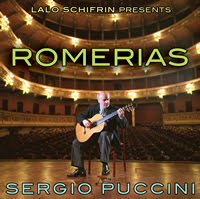
Spanish guitarist Sergio Puccini’s recent record Romerias features Lalo Schifrin’s title piece, a suite of nine solo guitar pieces that the composer was commissioned to write in 1986 by famed guitarist Angel Romero.

Puccini’s remarkable performance here marks the first time this suite has been recorded in its entirety. The guitarist plays as if he knows exactly what the composer is aiming for – guitar artistry that touches on both classical structures and jazz inflections.


Puccini takes the piece and his performance utterly seriously. But he never forgets the fun that goes into constructing and witnessing such a performance.

The guitarist, whose Romerias CD was issued on Lalo Schifrin’s Aleph label in September 2010, is in the process of producing a performance DVD of the “Romerias” suite. He has recently completed filming the suite’s penultimate piece, “Habanera,” which I am pleased to be able to share here. To find out more about Romerias, check this out.

Miles Davis "Bitches Brew Live"

Many years ago when there was evolution and revolution in music, change was palpable. Today, too much music is just churned out by the latest technology. Only the faces change. The music machine is fueled by “product” and (or) stuff that sounds too much like something that’s already been done before.

But as the 1970s dawned, jazz was losing a lot of its audience to indifferent music and the onslaught of rock. Miles Davis, keenly aware of this transformation, watched as his audience dwindled. He discovered the sounds of Jimi Hendrix and Sly and the Family Stone and it could hardly escape his attention that their audiences were significantly larger than his.

Over two days in August 1969, Miles Davis waxed Bitches Brew, a historic double album that could be considered his magnum opus had he not waxed several others of this caliber before. But there was nothing like Bitches Brew. No one had ever heard anything like Bitches Brew. Although it wasn’t the first record that fused jazz with rock, it is considered the first successful union of jazz and rock. When it was released in early 1970, it became the jazz trumpeter’s fastest-selling album and was one of the first jazz records to “crossover” and find pop chart success.

This “fusion” of jazz and rock was bubbling beneath the surface in Miles’ live performances before and after the birth of Bitches Brew. At the time, Miles Davis hardly ever “previewed” or rehearsed songs before he recorded them and, oddly, rarely performed material from his latest records. But he must have sensed that he was doing something different with Bitches Brew and maybe he sought to test the waters with something that sounded like nothing he’d ever played before.

Bitches Brew Live chronicles two live performances that Miles Davis gave during this period that have never been officially released before.

The first of these two performances originates from an appearance Davis made at the Newport Jazz Festival on July 5, 1969 – three weeks before the release of In A Silent Way and six weeks before the recording of Bitches Brew – with a line-up including Chick Corea on electric piano, Dave Holland on bass and Jack DeJohnette on drums (Wayne Shorter was supposed to appear but got stuck in traffic).

The audience, mixed with old-school jazz fans and a much younger rock crowd, probably had no idea what to expect. But it was electric in every sense of the word.

The brief set features one of the earliest known recordings of “Miles Runs the Voodoo Down,” sounding considerably different here than it would for the final studio version, Wayne Shorter’s “Sanctuary” and “It’s About That Time,” oddly rounded out for a brief few seconds by Miles’ standard set-closer “The Theme.”

The band is tight and generates as much excitement on disc as is evident among the crowd. No doubt inspired by such bands on the bill that day as John Mayall, Frank Zappa and the Mothers and Gary Burton (one of the earliest progenitors of mixing jazz with rock), the band is really tuned in to not only this new direction in music but to its audience as well.

Without Shorter’s counterpoint, Davis solos more than he is known to. But he trades off solos as if to provide his own counterpoint. Chick Corea is simply magnificent on electric piano, personifying the instrument in a way very few could. Dave Holland and Jack DeJohnette are, predictably, outstanding, rhythmically omnipotent and definitely providing something new to the section that wasn’t there when Ron Carter and Tony Williams were in it.

Miles and company (with Shorter) would take the show to Switzerland for the Montreux Jazz Festival later that month (a performance that has been bootlegged), mixing these tracks with some of Miles’ older repertoire, before waxing Bitches Brew. In November of that year, the quintet would perform a mostly Bitches Brew program in Paris (bootlegged) and Copenhagen. The last of these sets was captured on DVD and included as part of last year’s brilliant Bitches Brew 40th Anniversary box set.

Quite a number of other performances of the Bitches Brew material were captured thereafter, but usually as medleys given different names and with varying personnel.

After the release of Bitches Brew, the band changed dramatically. Wayne Shorter left the group and was replaced by Gary Bartz. Keith Jarrett’s organ (!) was added as a counterpoint to Chick Corea’s electric piano and Brazilian percussionist Airto Moriera added his exotic flavor to the soundscape.

This band performed at Tanglewood in Lenox, Massachusetts, on August 18. 1970, a terrifically exciting performance also included on the aforementioned Bitches Brew 40th Anniversary box set.

Miles Davis then jetted off to England for the third (and last) Isle of Wight music festival, performing on a bill that boasted Joni Mitchell, Emerson, Lake and Palmer, The Doors, The Who and Sly and the Family Stone. Acknowledged as the largest music festival of the time – attracting even more patrons than Woodstock – the Isle of Wight festival presented one of Miles Davis’ most long-sought after shows.

Many bootlegs of Miles’ Isle of Wight performance surfaced and the performance can be seen on the 2004 Eagle Rock Entertainment DVD Miles Electric: A Different Kind of Blue. Bitches Brew Live represents the first time the entire Miles Davis live at the Isle of Wight performance has ever been made officially available on CD. And it’s worth the wait.

This is a sensational performance; as assured and creative as it is searing and searching and as eclectic and sensible as it is electric and natural. The European audience, which seems to know what to expect – and is also probably better integrated among its seemingly different fan bases than the American audience – clearly approves.

The 38-minute performance was delivered as one long medley, treating the various “songs” as little more than themes to improvise upon. Starting with Josef Zawinul’s “Directions,” the band melds into “Bitches Brew” (the longest single exploration here) to “It’s About That Time,” through a brief bit of Wayne Shorter’s “Sanctuary” to Spanish Key” and winding up with the obligatory “The Theme.”

This required a specific chemistry for each of the seven musicians. It’s clearly evident that each player is attuned or musically connected to every other one in the group. Each is led without any trepidation whatsoever into differing directions by Miles’ whims. But whim is probably the wrong word. There is a telepathic understanding here of when enough is enough and exactly when it’s time to move to some other plane of now. Such telepathy is evident today in band member Keith Jarrett’s trio with fellow traveler Jack DeJohnette.

On top of that, everyone is at their best here – strong and strong-willed, communal and communicative and genuinely excited and exciting.

Producers Richard Seidel and Michael Cuscuna have beautifully enhanced the sound quality of this exceptional performance without breaking any of the medley into its individual parts. The CD, however, does identify each of the individual themes, coding program breaks between each, without ever breaking up the performance.

It’s a remarkable set, beautifully packaged with insightful annotation by author Michael Azerrad as well as excellent discographical information from the producers and many never before-seen color photographs of Miles Davis. It is the perfect companion to last year’s spectacular Bitches Brew 40th Anniversary box set and contains one of Miles Davis’ very best electric concert performances with the bonus of an additional like-minded concert of a very high caliber.

Wednesday, February 23, 2011

Lalo Schifrin screens 'Dirty Harry' & 'Cool Hand Luke' Tonight

Lalo Schifrin lit fuse of many composers
By Susan King
Los Angeles Times
February 23, 2011

Famed writer of 'Mission Impossible' theme and others blended orchestral music, jazz, funk and rock.

Lalo Schifrin describes himself simply as a "music maker."

"I do music by taking a baton and conducting it or by writing it or by playing the piano," said the 78-year-old composer, who perhaps is best known for his Grammy-winning, jazz infused score for the classic TV series "Mission: Impossible."

But Schifrin is being unduly modest. The Argentine-born composer helped change the sound of movie scores, earning six Oscar nominations. Among his movie scores are 1965's "The Cincinnati Kid," 1967's "Cool Hand Luke," for which he earned his first Oscar nomination, 1968's "Bullitt," 1971's "THX 1138 and "Dirty Harry," 1979's "The Amityville Horror," for which he was also Oscar-nominated and the three "Rush Hour" comedies.

"He is one of the first composers to come along who could effectively combine traditional orchestral music with jazz, rock and funk," said film music historian Jon Burlingame.

On Wednesday evening, Schifrin will discuss his film career at the American Cinematheque's Egyptian Theatre with "Ed Wood" screenwriter Larry Karaszewski, between screenings of "Cool Hand Luke" and "Dirty Harry."

On a recent sunny afternoon, Schifrin is relaxing in his office at his Beverly Hills home. The room is filled with a piano, plaques celebrating his Oscar nominations, his Grammys and numerous photos and memorabilia from his career.

"Director Stuart Rosenberg asked me to go on location," for "Cool Hand Luke," Schifrin recalled. "That was his modus operandi to invite a composer to the location. I got a feel for the movie."

The two collaborated three more times on 1970's "WUSA," 1976's "The Voyage of the Damned" and "The Amityville Horror."

Burlingame said that the scores of "Cool Hand Luke" and "Dirty Harry" are among Schifrin's most influential work. "'Cool Hand Luke' is partly blue grass, partly country, partly orchestral, partly blues," he said.

"Dirty Harry," Burlingame added, "is the one of the most important scores of its time. People don't recognize this, but 'Dirty Harry' combines orchestral, elements of jazz, rock and funk and synthesizers."

Schifrin was born into a musical family in Buenos Aires. His father, Luis Schifrin, was concert master of the Philharmonic Orchestra of Buenos Aires at the Teatro Colón. At the age of 6 he began studying piano. His first teacher was Enrique Barenboim, the father of pianist-conductor Daniel Barenboim. When he was a teenager, he discovered modern American jazz. "I realized that the music of Charlie Parker, Theolonis Monk was complicated in terms of harmony. I realized that the modern composers in the 20th century had a great relationship with jazz-Ravel, Debussy, even Stravinsky and Bartók."

One of his teachers suggested he apply for a scholarship to attend the Paris Conservatory. "The scholarship didn't pay for much-the journey from Buenos Aires to France. I made money by working at jazz clubs with some of the best European musician doing jazz. That was a good school for me."

Upon returning to Buenos Aires when he was 24, he was offered by the head and TV and radio in the country to start his own jazz band to do concerts, TV and radio.

Schifrin's life changed when Dizzy Gillespie came to Buenos Aires in 1956 on a state department tour. "He had some of the best jazz musicians in the United States. Quincy Jones was his fourth trumpet. He played for one week every day. I went to all of his concerts. He was doing exactly what I liked."

One evening a reception was held for Gillespie that Schifrin and his orchestra played at. At the end of the evening, the famed musician asked him to come to the United States with him. "I couldn't believe it," Schifrin said. I thought it was a joke. He meant it."

So he left for New York soon after that and began playing the piano for Gillespie and writing for him, including the large-scale compositions "Gillespiana," and "The New Continent."

"I worked with Dizzy for three years and then I got an offer to come to Hollywood to do movies [in 1963]," Schifrin said. "My first movie was called 'Rhino.' It was a low-budget movie, but it was the beginning."

--------------------------------------

Lalo Schifrin at screenings of 'Dirty Harry' / 'Cool Hand Luke'

7:30 p.m. Wednesday

American Cinematheque Egyptian Theatre, 6712 Hollywood Blvd., Hollywood

Admission: $11

Information: http://www.americancinemathque.com
or (323) 466-3456. Copyright © 2011, Los Angeles Times

Essential CTI: All About Jazz Playlists

All About Jazz's My iTunes Playlists are designed to help music lovers compile their own "best of" iPod playlists or CDR compilations. Here are three playlists I've constructed to help introduce new listeners to what I consider to be the essential CTI records.

Founded by legendary producer Creed Taylor in 1970, CTI Records achieved a legacy that is unrivaled in jazz. CTI produced records that were not only commercially successful but many that were superbly and artistically satisfying. Some of them are immortal.

The original playlists can be found at All About Jazz: Part 1 | Part 2 | Part 3. My CTI Records site can be found here.

Part 1 - These are the first-choice CTI classics that belong in any collection of CTI.

1. "Red Clay" - Freddie Hubbard from Red Clay
2. "Sugar" - Stanley Turrentine from Sugar
3. "Fire And Rain" - Hubert Laws from Afro-Classic
4. "It's Too Late" - Johnny Hammond from Breakout
5. "White Rabbit" - George Benson from White Rabbit
6. "Also Sprach Zarathustra" - Deodato from Prelude
7. "Concierto De Aranjuez" - Jim Hall from Concierto

Part 2 - These are among the best CTI performances in the entirety of CTI catalog.

1. "So What" - George Benson from Beyond The Blue Horizon
2. "The Rite Of Spring" - Hubert Laws from The Rite Of Spring
3. "Gibraltar" - Stanley Turrentine from Salt Song
4. "Inner City Blues (Make Me Wanna Holler)" - Grover Washington Jr.from Inner City Blues
5. "Mercy Mercy Me (The Ecology)" - Grover Washington Jr. from Inner City Blues
6. "First Light" - Freddie Hubbard from First Light
7. "Rock Steady" - Johnny Hammond from Wild Horses Rock Steady
8. "Sky Dive" - Freddie Hubbard from Sky Dive
9. "Don't Mess With Mister 'T'" - Stanley Turrentine from Don't Mess With Mr. T

Part 3 - These continue to be some the most notable performances in the CTI catalog.

1. "Sunflower" - Milt Jackson from Sunflower
2. "Corazón" - Hank Crawford from Wildflower
3. "Too High" - Joe Farrell from Penny Arcade
4. "Catch My Soul" - Johnny Hammond from Higher Ground
5. "Nautilus" - Bob James from Bob James One
6. "Loran's Dance" - Idris Muhammad from Power Of Soul
7. "Mister Magic" - Grover Washington Jr. from Mister Magic
8. "It Feels So Good" - Grover Washington Jr. from Feels So Good
9. "Westchester Lady" - Bob James from Bob James Three

It's probably worth pointing out that these are not necessarily my favorite CTI tracks, even though quite a few of them are. Many people could highlight their own CTI favorites (mine would certainly include George Benson's "Cast Your Fate To The Wind," for example, and I'd want separate lists for the best on CTI of arrangers Don Sebesky, Bob James and David Matthews too). But what is here is a good first step to hearing and understanding the importance and the value of the CTI legacy.

Thursday, February 17, 2011

Rediscovery: Stony Island

This little-known and even less seen film is about a bunch of poor kids from Chicago’s roughest neighborhoods trying to make it as musicians. Sure, this 1978 film suggests any number of more successful films that followed, notably both the Alan Parker films Fame (1980) and The Commitments (1991). But for some reason the world wasn’t ready for this sort of thing in the glitzy days of Grease and Saturday Night Fever - or even Rocky - all similarly like-minded hard-luck stories of the lower classes fighting their way out of their condition with the talent they possess.

The film was directed and co-written by Chicago native Andrew Davis, who went on to direct a bunch of popular action flicks starring Harrison Ford (The Fugitive), Steven Seagal (Above the Law, Under Siege) and Arnold Schwarzenegger (Collateral Damage). Davis’s co-writer here is Tamara Hoffs, mother of The Bangles’ Susanna Hoffs and later to become a producer and director in her own right.

Included in among the cast is a number of real Chicago musicians – whose lives probably mirrored the roles they played – as well as Rae Dawn Chong (daughter of Cheech and Chong’s Tommy Chong) in her feature film debut, Andrew Davis’s songwriter brother Richard Davis (as Richie Bloom) and even 19-year-old Susanna Hoffs, in her film debut, predating her Ming Tea performances in the Austin Powers films by nearly two decades.

A soundtrack to the film was issued by the Florida-based T.K. Records subsidiary “Glades” (7516). The Henry Stone-owned T.K. Records, it should be remembered, was one of the high houses of disco back in the day, hosting a myriad of successful acts including K.C. and the Sunshine Band, T-Connection, Jimmy “Bo” Horne, Peter Brown and several crossover jazz acts on the T.K.-distributed LRC label, including Lonnie Smith, Jimmy McGriff and Joe Thomas.

The soundtrack, which doesn’t acquiesce to disco as one might imagine, features a number of songs heard in the film, including the funky “Stony Island Band” (also the album’s single, credited here to Edward Stony Robinson but credited elsewhere as The Stony Island Band), “Song for Percy” (performed by Gene Barge), the grooving “Let’s Get It” (performed by Stevie Robinson), “Peace of Mind” (performed by Edward Stoney Robinson) and “Just a Closer Walk with Thee” (performed by Ronnie Barron).

The above noted pieces are all credited to the “Stony Island Band,” which is supervised by the legendary Gene Barge, an early R&B saxophonist and, later, a composer and producer who worked on many blues, jazz and gospel-oriented recordings on the Chess and Stax labels, before becoming hugely famous for producing some of Natalie Cole’s earliest hit recordings. He has since gone onto feature as a character actor (mostly in Andrew Davis films) and as one of the horn men playing behind the Rolling Stones on tour.

But the rest of the out-of-print and incredibly rare vinyl-only Stony Island soundtrack is probably rightfully considered the CTI album that never was. Chicago native Tennyson Stephens is one of the members of The Stony Island Band and actually features on Stony Island’s “Party Lights” and the Benard Ighner classic “Everything Must Change,” made famous the year before in a version recorded by former CTI guitarist George Benson.

Along with George Benson’s guitarist of the time, Phil Upchurch, Tennyson Stephens front-lined the 1975 CTI-distributed Kudu album Upchurch/Tennyson, which yielded a minor radio hit with “You Got Style.” Stephens had replaced Donny Hathaway in Upchurch’s group and the two often recorded on sessions together up through Natalie Cole’s 1977 album Unpredictable (Stephens later relocated to Hawaii and the two never really played together again).

The Stony Island score –accounting for the remainder of the songs on the soundtrack – was provided by David Matthews, who was at the time serving as CTI’s chief arranger, helming especially memorable albums by George Benson, Hank Crawford, Idris Muhammad, Art Farmer, Yusef Lateef, Grant Green, Jeremy Steig, Urbie Green, Grover Washington, Jr. and Nina Simone.

Matthews had recently recorded his magnificent Dune, the last of his own CTI albums, when he launched into this film score. Stony Island features a number of brief Matthews pieces including (the Dune sounding) “Gangster City” (2:17), the brilliant yet ironically titled “Chase the Train” (3:00 – featuring George Young), “Back to Business” (1:24), “High Speed Posters” (1:40), “Ride to Stony Island” (1:21), “Percy Fired” (2:03) and the captivating “Dream Ride” (2:49). It’s not a lot. But what’s here is worth hearing.

Musicians on the David Matthews pieces include Joe Shepley and Alan Rubin on trumpet, George Young on tenor sax, David Sanborn (a soloist on Dune) on alto sax, Dave Tofani on flute, Hiram Bullock or Joe Caro on guitar, Kenny Ascher on piano, Cliff Carter on keyboards, Mark Egan on bass, Jimmy Madison or Andy Newmark on drums, and David Friedman and Dave Samuels on percussion.

While Stony Island is neither a great nor an essential soundtrack, it is a terrific representation of David Matthews’s music and a decent stand-in for a late period CTI recording that should have been.

Wednesday, February 16, 2011

Agatha Christie’s Poirot - Series 12

Agatha Christie’s Poirot – An Introduction
Agatha Christie's Poirot - Series 1
Agatha Christie’s Poirot – Series 2
Agatha Christie’s Poirot – Series 3
Agatha Christie’s Poirot – Series 4
Agatha Christie’s Poirot – Series 5
Agatha Christie’s Poirot – Series 6
Agatha Christie’s Poirot – Series 7
Agatha Christie’s Poirot – Series 8
Agatha Christie’s Poirot – Series 9
Agatha Christie’s Poirot – Series 10
Agatha Christie’s Poirot – Series 11

1. The Clocks (first broadcast December 30, 2009): Sheila Webb, a typist at the Cavendish Secretarial Bureau, is called for an afternoon appointment at the home of Miss Pebmarsh at 19 Wilbraham Crescent. Upon arrival, Sheila discovers a dead man surrounded by six clocks, four of which are set to the time of 4:13 and one of which bears the name of “Rosemary.” Sheila runs out of the house screaming and into the arms of young Colin, a government agent wandering the street in search of 61 Wilbraham Crescent. Miss Pebmarsh, a blind lady, returns shortly thereafter and claims to not know anything about the dead man but also says she never requested any typist for any reason. Colin, involved in an investigation of his own, becomes interested in the baffling murder of the unknown man and, more importantly, of the young lady who discovered the dead body. An investigation begins and an inquest is held, determining the victim was murdered by a person or persons unknown. A public search of the man’s identity ensues and while one woman comes forward to claim the dead man as a husband who had left her many years before, another young girl from the Cavendish Secretarial Bureau is discovered dead in a phone box at Wilbraham Crescent. Perplexed, Colin consults an old family friend, Hercule Poirot, to help solve the mystery.

The Clocks was published in the UK in 1963 and in the United States the following year. Agatha Christie employs a partial first-person narrative here – for the first time in years (maybe the first since The Murder of Roger Ackroyd in 1926, a tale Poirot refers briefly to in Chapter 14 of this book) – which, because of unreliable narrators of the past, throws much suspicion upon poor Colin, working on a James Bond-like assignment that’s never made properly clear in the book. The plot is complex beyond belief and thus suggests a solution that Poirot surmises must be simple. Of course it is. The complexities come from some of the bizarre fictions Poirot studies and those that the Cavendish Secretarial Bureau is known for typing up. Christie seems to be looking for the bizarre in other author’s wacky plotting in order to conceive a story with more red-herring crime than any in her entire output. She seems to be parodying the form as much as pandering to readers’ needs for immaculately obscure plotting.

Unlike many of Poirot’s manor mysteries or Miss Marple’s village thrillers, The Clocks is especially notable as one of the author’s first (and only) suburban thrillers (mixing the aging old murder mystery with the then-in spy thriller); one where she suggests the differing evils that lurk behind the perfectly symmetrical houses in the now emerging suburban wastelands that were probably built up over the decaying mansions of the now bankrupt social elite of yore. Maybe it’s a bit too much evil. Sure, the dish is overcooked. But her commentary – and meta-commentary – here is perfectly valid. The book, which like Sparkling Cyanide (1945, the basis of which was the 1937 Poirot short story “Yellow Iris”), makes much of the name Rosemary having the meaning of remembrance (Chapter 12), was not one of Christie’s best-known books, nor one of her most critically well received.

ITV’s presentation of The Clocks is not surprisingly the story’s first filmed presentation and does a mostly adequate job of capturing the major plot points and many oblique obscurities as well. While the basic story, the murder victim, the murderer(s) and the modus operandi are retained, many other changes are made to move this story from its early 1960s London setting to a pre-WWII timeframe set in Dover (a coastal town, like the Hastings of Foyle’s War, considered to be the first point of British invasion by the Germans). Scripted by Stewart Harcourt (who wrote the Marple scripts for The Blue Geranium, Ordeal by Innocence, By the Pricking of my Thumbs and A Murder is Announced) in a copycat style to former Poirot scripter Anthony Horowitz’s operatic Foyle’s War scripts and directed in a surprisingly flat manner by Charles Palmer (who also directed the Marple films A Pocket Full of Rye and The Murder at the Vicarage) harking back to the unimaginative WWII espionage films of the forties, the film of The Clocks is probably even more dramatically overdone than the book.

Here, a whole MI-6 backstory is constructed to fill in Ms. Christie’s half-baked spy plot, something that only really explained Colin’s presence on the scene when Sheila discovers the dead body. Colin, the secret agent, whose book name is “Colin Lamb” (clearly a pseudonym for the son of one of Poirot’s old friends, often assumed to be Superintendent Battle). Here he is “Colin Race,” who then takes on the undisguised guise of son of Poirot’s old friend Colonel Race, who was previously portrayed in the ITV film of Death on the Nile by James Fox (the character was also supposed to appear in Cards on the Table but James Fox wasn’t available, so his charcter was replaced by Robert Pugh’s Colonel Hughes). “Miss” Pebmarsh gets an entirely different career – and sons! – to explain what it is she does. Sheila ends up having an unwanted affair with Professor Purdy she doesn’t have in the book. The pesky neighborhood boys are now girls, attended by a single father with a hated German nanny, rather than a single mother. There is no little girl here trapped in her room, a witness to all that goes on in the Crescent. Colin is more dimwitted here than in the book too. And so on and so on. Clearly Harcourt is trying to do away with much of Christie’s filler and filling in what was obviously some gaping plot holes that existed before, but ends up just throwing more confusion into what was already a needlessly confusing plot. And the surprisingly dull denouement hardly seems worthy of all the misleading decoupage (i.e., it’s hard to believe that such boring people with such boring lives would be able to conceive such an elaborate charade for what is essentially a boring crime) – a reality present in the book and, unfortunately, proved true in the film. Somehow, Christie’s prose makes it, if not believable, then somewhat acceptable. Seeing it all acted out makes the fever dream appear to be the play Poirot rolls his eyes at during opening scenes of The Clocks: unbelievable and ridiculous.

Tom Burke, who is surprisingly forced to portray Colin Race as unnecessarily emotionally challenged and wishy washy, is the son of David Burke (who appeared in the 1995 Poirot film Hickory Dickory Dock and is well known as Dr. Watson in the Granada Sherlock Holmes series) and Anna Calder-Marshall (who appeared in the 2006 Poirot film After the Funeral). Anna Massey (Miss Pebmarsh), daughter of actor Raymond Massey and one-time wife of Granada TV’s Sherlock Holmes, Jeremy Brett, portrayed Miss Christie in a TV film Agatha Christie: A Life in Pictures, which also featured The Clocks’ Stephen Boxer (Christopher Mabbutt). The Clocks also welcomes back several actors from previous Poirot films dating back to the series’ beginning, including Beatie Edney (Mrs. Hemmings, the cat lady – who was Mary Cavendish in the 1990 film The Mysterious Affair at Styles) and the lovely Frances Barber (Merlina Rival, wife of the mysterious dead man, who was memorably Lady Millicent Castle-Vaughan in the 1990 film The Veiled Lady and also appeared as Miss Hinchcliffe in the excellent 2005 Marple film A Murder is Announced).

2. Three Act Tragedy (first broadcast January 1, 2010): First Act: Poirot attends a dinner party hosted by famed actor Sir Charles Cartwright at which a local rector suddenly dies. The man had been drinking a martini shortly before he died but no poison was discovered in his glass. While some question the suspicious death, it is ruled as natural. In the absence of evidence to the contrary, even Poirot believes the death was accidental. Second Act: Sir Bartholomew Strange, a psychiatrist and one of the attendees at Cartwright’s dinner party, hosts his own dinner party with many of the same guests from the earlier dinner in attendance. Suddenly, he too is struck dead, himself the victim of poisoning from a glass that contained no poison. This time the death is ruled murder. Sir Charles Cartwright assumes the role of the detective and discovers that many of the same guests from his dinner party were in attendance at Strange’s dinner party. Cartwright also finds that a young man from the first dinner party, Oliver Manders, has mysteriously crashed his motorcycle outside Strange’s house just before that fateful dinner and a new bulter, Ellis, has strangely disappeared. Third Act: Poirot confesses that following Strange’s death, he must concede that the first death was murder too. He allows Cartwright to head up the investigation, with a little help from Poirot, and in the course of the investigation there is one more suspicious death. Poirot vows that the murders must stop, using his little gray cells to put the pieces together.

First published in the US in 1934 as Murder in Three Acts and in the UK in 1935 under its original title, Three Act Tragedy is a classic in detective-fiction misdirection. The story, for as little as it involves Poirot – even allowing the famed detective to permit others to do much of the mostly useless detective work (which takes up a great deal of the text, leading to quite a few more red herrings here than usual) – offers one of Christie’s more surprising and, ultimately, satisfying conclusions. As a twist on the classic don’t-trust-the-narrator text, Three Act Tragedy proposes the questionable role of “acting” among people, especially well-to-do individuals. To paraphrase a rather beautiful proclamation Hercule Poirot makes in Chapter 17 about the truth: “there is nothing so curious and so interesting and so beautiful” as good acting. Indeed, Three Act Tragedy, with its introductory credits (“Directed by Charles Cartwright” etc.), posits that inspired criminal detection is as much an art form of good acting as the actual commission of crime.

Intruiging as the story is and daring as the twist may be, Three Act Tragedy shares several notable plot points with other Christie novels. First, like the two Poirot novels which followed it, Death in the Clouds (1935) and The A.B.C. Murders (1936), Three Act Tragedy cleverly conceals the murderer by having Poirot deputize him or her as a supplemental detective. Secondly, like Appointment with Death (1938), One, Two, Buckle My Shoe (1940) and Sparkling Cyanide/Remembered Death (1945 – and the similarly plotted 1937 short story, “Yellow Iris”), Three Act Tragedy involves the murderer disguised as a servant (the disguised servant also occurs in The Mystery of the Blue Train, 1928, and After the Funeral, 1953). Finally, Three Act Tragedy curiously finds the guilty party among a certain profession that is especially adept at pulling such things off (almost) successfully as in Thirteen at Dinner / Lord Edgware Dies (1933), One, Two, Buckle My Shoe / The Patriotic Murders (1940) and the Miss Marple mystery The Mirror Crack’d From Side to Side (1962). Three Act Tragedy also reprises the character of Mr. Satterthwaite (from The Mysterious Mr. Quin stories), references travel by “the Blue Train” (Chapter 6) and specifically recalls The Mysterious Affair at Styles (Chapter 6) and “The Chocolate Box” (Chapter 17). Curiously, the play the book’s Miss Wills writes for Angela Sutcliffe, Little Dog Laughed (called Sin in Suburbia in the 2010 film), is another of Christie’s nursery rhyme titles – from “Hey diddle diddle” – and was the title used for an off-Broadway play by Douglas Carter Beane in 2006.

Three Act Tragedy was first filmed for American television in 1986 under the story’s American title, Murder in Three Acts, in an oddly contemporary story set mostly in Acapulco. Otherwise sticking pretty close to Christie’s original story, Murder in Three Acts featured Peter Ustinov as Hercule Poirot with Tony Curtis effectively portraying Charles Cartwright. Jonathan Cecil reprises his role here as the hapless Hastings from Dead Man’s Folly (1986) and Thirteen at Dinner (1985), replacing the book’s Mr. Satterthwaite.

The 2010 film presentation is magnificent on almost every level. Directed with a combination of astonishing period elegance and artfully ironic noir camera work by Ashley Pearce (who returns to the series from the well done Mrs. McGinty’s Dead and the not so well done Appointment with Death) and scripted with eloquently verbal precision by Nick Dear (who wrote the series’ Mrs. McGinty’s Dead as well as two of its best later entries, The Hollow and Cards on the Table), Three Act Tragedy is among the series’ very best entries. Relatively little was changed from the book – up to and including the book’s delicious last lines – other than the deletion (again) of the Mr. Satterthwaite character and a minor modification in the modus operandi of the crimes, necessitating the omission of “am worried about M” that, at least in the book, helps Poirot understand why the crimes are committed.

The Cornwall locations are superb. The interiors are immaculate. The plotting seems quite natural, especially given the amazing set of cicumstances that unleash the plot. And the actors are tremendously well cast for their parts.

First and foremost is the remarkable Martin Shaw (Inspector George Gently, Adam Dalgliesh, Judge John Deed and a bunch of other British TV detectives), who gives a magisterial performance of someone giving the performance of a lifetime. Martin Shaw had previously acted with David Suchet on a 1978 episode of The Professionals (“Where the Jungle Ends”) and their chemistry here is not only natural and acceptable thoughout, but so spectacular as to suggest the emotion of true friendship as the story progresses. It’s also fair to say that Martin Shaw has worked with most of the actors in this ensemble in his various roles elsewhere, making his casting (and theirs) artful perfection in itself.

The young and fiesty Kimberley Nixon as Egg (Cranford) is especially good here too, bringing much of the verve and vitality of the book’s young heroine to her part. But the script shortchanges the terrific Kate Ashfield (Shaun of the Dead, Collission), whose Miss Wills character is given something of a too short shrift. Even so, Ms. Ashfield does a lot with the little she’s given to do. Jane Asher, who is also not given much to do as Lady Mary, is well cast and has also appeared in the 2004 Marple film The Murder at the Vicarage, while the briefly seen young boy James Hurran also appeared in the 2007 Marple film Ordeal by Innocence. None of the other cast members have a Christie history, but are extrememly well cast, especially hunk Tom Wisdom, whose Oliver Manders absolutely embodies the good-looking shell of a hunk Christie wrote his part to be. The ever regal David Yelland also returns as the indefatigable George, Poirot’s valet, rounding out a superb cast to a superb telecast.

3. Hallowe’en Party (first broadcast May 26, 2010): While staying with a friend, Judith Butler and her daughter, Miranda, in the village of Woodleigh Common, writer Ariadne Oliver is engaged to help set up a children’s Hallowe’en Party at the neighboring home of Rowena Drake. As the preparations ensue, many are taken by Mrs. Oliver’s fame and the popular murder mysteries she writes, including a young girl, Joyce Reynolds, who says that she too once witnessed a murder. When asked why she never said anything about this murder, Joyce tells everyone that what she saw didn’t register as a murder at first. When asked when this “murder” occurred, Joyce says that it happened “years ago,” when she was still a child. Roundly dismissed as another of Joyce’s many stories, the party proceeds as planned. After the party is over, the young girl Joyce is discovered dead, drowned by force in a bucket of water used for an apple bob. The shaken Mrs. Oliver calls Hercule Poirot for assistance and the Belgian detective finds a long trail back into the past involving deception, forgery and murder in Woodleigh Common.

Hallowe’en Party was first published in 1969 and is the last of the Hercule Poirot novels Agatha Christie wrote (the final Poirot novel, Curtain, though published in 1975, was written some three decades before). The story is inspired by the American celebration of Halloween, following a trip Ms. Christie made to the states with husband Max Mallowan. The tale has kooky ambiance to spare and like Taken at the Flood (1948) is another of the author’s “murder from the past” puzzles. Indeed, Hallowe’en Party revels in much of Agatha Christie’s past, with specific recollections to Dead Man’s Folly (Chapters 1 and 4), Mrs. McGinty’s Dead (Chapter 5), Cat Among the Pigeons (Chapter 10), The Labors of Hercules (Chapter 11) and the slightly disapproving take on fads of the sixties present in Third Girl (including Mrs. Oliver’s reference to peacocks in Chapter 16) as well as an overall similarity to the earlier Poirot short story “How Does Your Garden Grow” (1935). Like “How Does Your Garden Grow,” the Hallowe’en Party solution also turns on a nursery rhyme; in this case “Ding dong dell, pussy’s in the well.” Here, Christie brings back Superintendent Spence from Taken at the Flood (1948) and Mrs. McGinty’s Dead (1952), here retired to the village of Woodleigh Common and anxious to help Poirot in his inquiries. It’s a complex story, layered with many interesting plot points, but ends up as one of Ms. Christie’s least satisfying stories. There are a few too many holes in the rather unwieldy plot (so many unsolved murders in a small village seems crazy) and some rather far-fetched occurances – including a blackmailing 10-year-old and a long-lost father willing to murder his own daughter – seem overdramatic in the extreme, as if the author is bowing to what she feels are the extremes of a generation of readers she just doesn’t understand.

Given the story’s many weaknesses, it’s not surprising that Hallowe’en Party had not been filmed before. What is surprising, though, is that ITV drafted and filmed Hallowe’en Party before Dead Man’s Folly (1956), a story that shares many similarities to this story and certainly preceeds the 1969 in many ways. Perhaps ITV will choose not bothering with Dead Man’s Folly, a very good story that was filmed for TV by director Clive Donner in 1986 with Peter Ustinov as Poirot. Like the book, the ITV film of Hallowe’en Party is especially ambient, mixing all the colors and moods of the spooky season into a witches brew of foreboding lights and shadow. Directed by Charles Palmer, who also directed The Clocks (as well as the Marple films A Pocket Fill of Rye and The Murder at the Vicarage), and scripted by actor/writer Mark Gatiss, who wrote the 2008 Poirot film Cat Among the Pigeons and starred as Leonard in the 2008 Poirot film Appointment with Death, Hallowe’en Party gets the mood and the story mostly right, mixing in appropriate – though somewhat overly obvious – references to Poe and Matthew Hopkins to amp up the nasty spookiness just a notch or two.

Many changes are made along the way, most notably the time period going from the late 1960s (doing away with a lot of obvious hippie references) to the period of time when Franlin D. Roosevelt was in office (1933-45). Quite a number of characters are done away with (Spence, Elspeth McKay, Joyce’s older sister Ann, Miss Emlyn, Harriet Leaman and the boy heroes, Nicholas Ransom and Desmond Holland) and several characters and character traits are added (notably, Mrs. Drake’s two mostly adult children and the unlikely homosexuality of two charachters). Leopold Reynolds gains a few years to better explain what it is he’s up to. But as in the film of The Clocks, Hallowe’en Party seems to take many short cuts to its conclusion, cutting out a bit too much of the plot’s admittedly skimpy humanity and replacing it with some overly dramatic moments that seem to apologize for the original story’s shortcomings.

Fenella Woolger (Miss Whitaker) returns to Poirot from her 2000 performance as Ellis in Lord Edgware Dies while Phyllida Law (mother of Sophie Thompson, who plays Mrs. Reynolds in Hallowe’en Party, and Emma Thompson), who plays Mrs. Llewellyn-Smythe, also appeared as Lady Carrington in the 1989 Poirot film The Incredible Theft. Timothy West (Reverend Cottrell) also appeared as Rex Fortescue in the 1985 Miss Marple film A Pocket Full of Rye as well as Lord Easterfield in the 1982 film Murder is Easy and Kenward in the 1979 film Agatha. Paola Dionisotti (Mrs. Goodbody) appeared memorably as Miss Hinchcliffe in the 1985 Miss Marple film A Murder Is Announced. Julian Rhind-Tutt (Michael Garfield) also appeared as Arthur Calgary in the 2007 Marple film Ordeal by Innocence. Ian Hallard, who plays Edmund Drake, also served as script consultant on this film (as well as the 2008 Poirot film Cat Among the Pigeons, was also featured in the 2006 Marple film The Sittaford Mystery. The always right-as-rain Zoë Wannamaker returns as Ariadne Oliver (also in Third Girl, Mrs. McGinty’s Dead and Cards on the Table), but is inexplicably kept in bed with a cold throughout (but gets the film’s best scare scene), while the always elegant David Yelland returns briefly as George, Poirot’s valet (Three Act Tragedy, Third Girl, Mrs. McGinty’s Dead and Taken at the Flood).


4. Murder on the Orient Express (first broadcast July 11, 2010): After he finishes resolving a case in Syria, Hercule Poirot is suddenly summoned back to England to conclude a case he began there earlier. He attempts to book passage on the Orient Express train in Yugoslavia back to London, but finds that all of the first-class accommodations are taken, a surprising turn of events since it is winter, an off-season for travelers. Remarkably, Poirot meets the train line’s director, M. Bouc, who helps the Belgian detective secure accommodations aboard the Orient Express. While on the train, Poirot encounters the many passengers who have filled the train, including Mary Debenham, an English governess; Colonel Arbuthnot, the strong, silent type; Mr. Samuel Ratchett, a mysterious American who has recently decided to spend his leisure years in travel; Hector MacQueen, Mr. Ratchett’s secretary; Edward Masterman, Mr. Ratchett’s valet; Antonio Foscarelli, an Italian who is thought to have suspicious connections; Princess Dragimiroff, a Russian grand dame; Greta Ohlsson, a Swedish nurse; Mrs. Hubbard, an American matron; Hildegarde Schmidt, the Russian Princess’s maid; and the Count and Countess Andrenyi. Aboard the train, Mr. Ratchett approaches Poirot to ask his protection from someone who is threatening him. Despite promises of “big money,” Poirot refuses to help Mr. Ratchett. During the night, the train is stopped by a large snowdrift between Vincovici and Brod. And then in the morning, Mr. Ratchett is discovered dead, the victim of multiple stab wounds. It is determined that the murder happened sometime during the night and a number of clues are discovered in Ratchett’s compartment, including the remains of a burnt note that indicates the ominous phrase “…member little Daisy Armstrong.” Poirot immediately knows the true identity of the victim. Ratchett is a man known as Casetti, an American who kidnapped and killed the daughter of a wealthy American family, the Armstrongs, and was moving throughout Europe, hiding from his would-be captors. Poirot understands that the murderer must be among the passengers on the train, because no one could have boarded and left the train during the snowstorm. As he begins to learn more about each of the potential suspects, he discovers that no one is telling the truth about whom they are and why they are traveling on the Orient Express.

First published in 1934, Murder on the Orient Express was presented in the US as Murder in the Calais Coach (the actual coach on the train where the action takes place) to avoid confusion with the 1932 Graham Greene book, Stamboul Train, which was published in the US as Orient Express. The interesting, though slightly disappointing, story is one of the author’s most popular and is based on two significant events: the kidnapping and murder of Charles Lindbergh’s young son in 1932 (and even the suspicion of the maid’s involvement and her eventual suicide) and the fact that an Orient Express train – which Agatha Christie had first traveled on in the fall of 1928 – was trapped for six days by a blizzard in Turkey in February 1929. It makes for a gripping read until the reader discovers, fairly late in the game, that not only no one person could have possibly committed the crime but, more importantly, the book is nothing but a recollection of lies, a preposterous number of alternate identities and too many clues that are all simply red herrings. Ingenious though it may be to craft such a riddle of a tale, so much misdirection cannot help but become confusing and tedious – especially given the surprise ending which renders nearly all of the preceding text practically meaningless.

While the everyone-did-it nature of Murder on the Orient Express is the complete opposite of the author’s most popular novel, the everyone-gets-killed And Then There Were None (1939), it could be said that the story shares the same conspiratorial framing device used for the Christie novels The Hollow (1946) and At Bertram’s Hotel (1965), where everyone lies for various reasons and the detective has to, more or less, guess at what’s really going on and, of course, gets it all right. Poirot’s initial deduction about the true identity of the murder victim is preposterous in the extreme, but allows the detective to reasonably piece together the real identities of the train’s other passengers – an unlikely assemblage of people from too many different walks of life to reasonably know each other and all of whom remarkably know Mr. Ratchett’s true identity when no one else does.

Murder on the Orient Express was first filmed in 1974 by director Sidney Lumet (12 Angry Men, Fail Safe and, later, Dog Day Afternoon, Network, The Verdict and the Agatha Christie-like Deathtrap) with an all-star cast including Sean Connery, Lauren Bacall (Appointment with Death), Ingrid Bergman, Jacqueline Bisset, Martin Balsam (who, coincidentally, starred in a 1976 TV film The Lindbergh Kidnapping Case), Jean-Pierre Cassel, John Gielgud (Appointment with Death, The Seven Dials Mystery, Why Didn’t They Ask Evans) , Wendy Hiller (Witness for the Prosecution), Anthony Perkins, Vanessa Redgrave (Agatha), Michael York, Colin Blakley (Evil Under the Sun), Denis Quilley (Evil Under the Sun), Richard Widmark as Mr. Ratchett and Albert Finney in a ridiculously overstated performance as Hercule Poirot. Remarkably, the elegantly-staged film represents the novel exceedingly well with a reverentially pitch-perfect script by Paul Dehn (Goldfinger, also with Sean Connery, The Deadly Affair, also by Sidney Lumet and several of the Planet of the Apes films) and was the first film adaptation Agatha Christie agreed to after years of what she considered to be poor adaptations of her work. The author, who attended the film’s 1974 premiere, apparently approved and even found Finney’s overdrawn performance as Poirot acceptable. Finney, who was the producers’ third choice for Poirot after Alex Guinness and Paul Scofield had both refused, declined a reprise of the role of Poirot for the 1978 film Death on the Nile due to the large amount of make-up the role required and the thought of filming in the arid climes of the story. Peter Ustinov took the role for the film and played Poirot in two more feature films and three contemporary TV films.

Perhaps the less said about the 2001 CBS-TV film version of Murder on the Orient Express - with Hercule Poirot portrayed by Alfred Molina (in un-pressed linen suits no less!) in present-day surroundings that allow the inclusion of cell phones, PDAs, laptops and the Internet as well as unnecessary references to Ross Perot (get it?), O.J. (!), Donatella Versace and Brad Pitt – the better. While Christie’s basic story is maintained, almost everything about the TV movie is, at a minimum, ill-conceived, and, at its worst, just plain bad.

The long-awaited 2010 film with David Suchet’s perfectly definitive Poirot is, surprisingly, quite a disappointment too. The elegance of the 1974 film is replaced here by director Philip Martin’s astonishingly average presentation. Filmed in Malta aboard an obviously inelegant train, Martin relies on an annoying overabundance of hand-held camera work obviously meant to provide a sense of documentary relevance and refracted imagery that doubles everything like a distorted view through beveled glass. Get it? The obvious symbolism merely masks what feels like a presentation lacking in many ways. Suchet’s performance is, as expected, magnificent, although for the first time, his presentation here suggests a certain weariness (or disgust?) with the part not present before. Even though his dark, gravely performance well outshines Albert Finney’s hysteric, near comic presentation some four decades before, Suchet’s Poirot has never appeared this pious, this angry or, frankly, this unbelievable.

As scripted by Stewart Harcourt, who wrote the wacky Marple films A Murder Is Announced (2005), By The Pricking of My Thumbs (2006), Ordeal By Innocence (2007) and The Blue Geranium (2010) as well as the 2009 Poirot film The Clocks, this Murder on the Orient Express is unusually heavy in the conflicted and conflicting philosophy of rough justice and, most regrettably, the religious overtones that unnecessarily weighted down the 2008 Poirot film of Appointment with Death. A lot of Christie’s meticulous detail – and the abundance of clues – is dropped in favor of some bizarre and heavy-handed dialogue about God and justice that do nothing to enhance the story. Indeed so much superfluous philosophy is inserted into this presentation that Poirot’s sudden dénouement laughably comes across as little more than divine guesswork.

One of the things the 1974 film is particularly notable for is presenting the whole Daisy Armstrong story up front (through a montage of blue-tinted newspaper headlines). This helps the viewer – particularly one so removed from the actual events that inspired the story so very many years ago – understand the following sequence of events. Like Christie’s novel, the 2010 film unwisely moves this information (presented through a montage of red-tinted newspaper headlines) back to Poirot’s revelation of Daisy Armstrong’s relevance following Ratchett’s murder. It’s a small point. But it reflects the lack of understanding the film’s producers have in presenting the story in visual terms appropriate for the medium and their lack of success in proffering a story of emotional retribution in strictly moral and religious terms.

The mostly unknown cast does a pretty decent job fulfilling its various roles, at least as they are written here. Like David Suchet’s Poirot, though, it is a grave injustice that they just weren’t given more or better material to work with – particularly for one of Hercule Poirot’s best-known adventures. Eileen Atkins (Princess Dragomiroff) also appeared in the 2007 Marple film Towards Zero. Hugh Bonneville (Edward Masterman) also appeared in the 2010 Marple film The Mirror Crack’d From Side To Side.