Wednesday, January 19, 2011

Mayo Bucher on ECM

ECM Records long ago established and has since maintained its own aural brand of musical definition, something that has rightly or wrongly come to be known as the “ECM sound” or what label hype in the 1970s called “the most beautiful sound next to silence.”

This “sound by design” is something that label founder Manfred Eicher has established after nearly two thousand records in the jazz, classical and less quantifiable streams of thoughtful music the label has captured since 1969.

One ECM record is very different from the next. But still there is a common thread of artistry running between the sound of ECM records that unites them all. It is as much the artistic vision of Manfred Eicher as it is the musical creativity he allows or inspires among the musicians and composers he captures.

By the late 1990s, after an amazing run of over two decades in the music business, Manfred Eicher also began to supervise the visual brand of ECM records, favoring a wide swath of monochromatic photography, much of which clouds focus into a blend of black and white shadows and light. It’s iconic, to be sure. Now, well into the label’s fourth decade, ECM is going strong with a compelling artist roster and some of the best – and best distributed – music currently available.

But so much of the art of ECM, which is more often than not striking and gorgeous or haunting and captivating, is almost far too static, reflecting more of the white noise of background radio so much ECM’s prodigious output has been of late.

On a few occasions this tendency toward monochromatic photography is broken up by a painting, something ECM covers really haven’t featured since the 1970s. In recent years, the few paintings featured on ECM discs have been by the graphic designer and (con)textual painter Mayo Bucher, one of the most striking artists working today (paintings by the equally notable Eberhard Ross have also recently featured on the sporadic ECM cover).

Bucher is a magnificent artist who works in colors, textures and geometric spaces like no other. Born in Zürich, Switzerland in 1963, Bucher studied graphic design at the Higher School of Art and Design (1981-86). His background allows him to marry his divergent interests in painting, design, architecture and music and create art that is painterly, designed, architectural and musical all at once. It’s a magical combination.

The graphic design journal Eye Magazine’s Adrian Shaughnessy provides such perfect commentary on Mayo Bucher’s work in a review of the artist’s book Open Sign (Lars Müller Publishers/ECM, 2006), that it’s worth quoting here:

“Bucher’s paintings combine two fundamentals of visual expression: abstraction and geometry. You might say the spiritual and the pragmatic; reality and unreality; silence and noise. It’s therefore hardly surprising that [ECM Records’ founder Manfred] Eicher should find a resonance in Bucher’s work, as these are the themes that define Eicher’s aesthetic endeavours as a music producer.

“Bucher’s canvasses are rich, textural exercises in colour and mood; occasionally dark and brooding, sometimes light and transcendent. Into his Rothko-like surfaces, Bucher occasionally gouges wire-thin lines. Sometimes only a single line of Klee-like purity is dragged across a canvas. Sometimes he makes more complex diagrammatic constructions that remind you of the sad beauty of dimly remembered school geometry textbooks.”

These forces conspire to make Bucher not only a perfect CD cover artist, but one especially suited to the music of ECM Records in work ranging from that which is entirely improvisatory (Keith Jarrett’s La Scala) and jazz like (Keith Jarrett and Charlie Haden’s beautiful Jasmine) to reverential classics (Ricercar – Bach / Webern) and striking contemporary work (Georgian composer Giya Kancheli’s Lament or Ukrainian Valentin Silvestrov’s Metamusik / Postludium).

Mayo Bucher’s work for ECM is often reminiscent in feeling and inspiration of the iconic work German-born and Bauhaus-bred Josef Albers (1888-1976), who did several of his own striking and memorable album covers for Enoch Light’s Command Records in the late 1950s including Persuasive Percussion , Provocative Percussion and Provocative Percussion Vol. III as well as the outstanding covers for the classical albums Pictures at an Exhibition – Mussorgsky / Ravel and Leonid Hambro and Jascha Zayde’s Mozart / Mendelssohn / Schubert.

While it seems that ECM has used Mayo Bucher’s work less over the last few years, despite the fact that his 1992 painting “Kopfbau” featured as the cover of Keith Jarrett and Charlie Haden’s critically acclaimed Jasmine, issued earlier last year, Eicher’s label has certainly given Bucher a number of nice features since 1997. Here they are:

The River - Ketil Bjørnstad / David Darling (ECM 1593, 1997)

Ana - Ralph Towner (ECM 1611, 1997)

Toward the Margins - Evan Parker Electro-Acoustic Ensemble (ECM New Series 1612, 1997)

Dolorosa – Shostakovich / Vasks / Schnittke - Dennis Russell Davies, Stuttgarter Kammerorchester (ECM New Series 1620, 1997) – from “Dolorosa” (1994)

Jean Barraqué - Sonate pour Piano - Herbert Henck (ECM New Series 1621, 1999)

Tactics - John Abercrombie / Dan Wall / Adam Nussbaum (ECM 1623, 1997)

Anton Webern / Dmitri Shostakovich / Emil Frantisek Burian - Rosamunde Quartett (ECM New Series 1629, 1997)


La Scala - Keith Jarrett (ECM 1640, 1997)

Lament - Giya Kancheli (ECM New Series 1656, 1999)

Klavierstücke – Arnold Schoenberg / Franz Schubert - Thomas Larcher (ECM New Series, 1667, 1999)

Zelenka – Trio Sonatas (ECM New Series 1671/72, 1999)

Flux - Erkki-Sven Tüür (ECM New Series 1673, 1999) – from “Black and blue Nr. 1” (1999)

Peter Ruzicka - Arditti String Quartet / Dietrich Fischer-Dieskau (ECM New Series 1694, 1999)

Achriana - Vassilis Tsabropoulos / Arild Andersen / John Marshall (ECM 1728, 2000)

Akroasis - Vassilis Tsabropoulos (ECM 1737, 2003)

In l’Usetesso Tempo - Giya Kancheli (ECM New Series 1767, 2005) from “Open ground” (1999)

Ricercar – Bach / Webern - Christoph Poppen / Münchener Kammerorchester / The Hilliard Ensemble (ECM New Series 1774, 2003) – from “Black and blue Nr. 2” (2000)

Valentin Silvestrov: Metamusik/Postludium - Alexei Lubimov / Radio Symphonieochester Wien / Dennis Russel Davies (ECM New Series 1790, 2003) from “Red over black” (2000)

Chonguri - Thomas Demenga / Thomas Larcher / Teodoro Anzellotti (ECM New Series 1914, 2006)

Jasmine - Keith Jarrett / Charlie Haden (ECM 2165, 2010) – from “Kopfbau” (1992)

For more information, visit Mayo Bucher and ECM Records.

Monday, January 17, 2011

Bill Evans His Piano and Orchestra Play Theme From The V.I.P.s and Other Great Songs

Like many controversial films or books that take some effort or expense to understand properly, some records are better known by their reputation than by their actual merit. This particularly unwieldy album, bearing a significantly unwieldy title, certainly ranks among these.

As a pianist, Bill Evans (1929-80) was seldom captured in orchestral situations. When he was, the records were – and unfortunately now more than before still are - unfavorably compared to his prodigious trio outings and occasional solo recordings.

This 1963 album, variously known (on the back cover) as Bill Evans His Piano and Orchestra Play Theme From The V.I.P.s and Other Great Songs and (on the record label) as The V.I.P. Theme [sic], was named, perhaps, for the most recent of the big-budget films this film-themed collection name checks as front cover artwork.

No doubt the pianist’s most devoted admirers regard this music as “sell out” pop fare, far beneath the dignity of such a great player as Bill Evans. But all that’s nothing but poppycock.

Everybody in jazz, particularly those at MGM (and the MGM-owned Verve Records) in the 1960s, covered themes from popular culture like these. In the days before The Beatles, many jazz players were looking for new hits to make their name with after the dearth of tunes everybody covered from Tin Pan Alley or any number of well-known and unknown stage musicals. Most turned to TV and the cinema.

Even Evans covered many film themes during his career, including such otherwise celebrated performances of “Spartacus,” “The Shadow of Your Smile,” “Emily” (from The Americanization of Emily), “What Are You Doing the Rest of Your Life” (from The Happy Ending) and “Theme From M.A.S.H.” and tunes from the pop-rock galaxy including Dionne Warwick’s “A House Is Not A Home” and Paul Simon’s “I Do It For Your Love.”

So, yes, while Bill Evans could easily wax yet another cover of “Nardis” or any be-bop staple he could play in his sleep, he could also be challenged to rise to the occasion of a new tune from the popular canon and make it worthwhile.

Recorded during two sessions in May and September 1963, one of the least documented years in all of Bill Evans’ recording career, between the well-known overdubbed solo album Conversations with Myself (Verve) and the historic Trio ‘64 (Verve), The V.I.P.s Theme is actually quite a pleasurable respite and catches the moody, often introspective pianist actually having a little bit of fun for a change.

The pianist fronts an unnamed orchestra arranged and conducted by a surprisingly uncredited Claus Ogerman (still going as Klaus Ogerman in those days). Even Ogerman dismisses this record – as he does much of his lively and wonderful pop work from the 1960s, including three rather entertaining records of his own on RCA –admitting in the November/December 2010 issue of Wax Poetics that “I regret that album.”

He continues “it wasn’t very good for Bill Evans’s reputation. He was in big trouble financially at the time, and his manager Helen Keane and Creed [Taylor, The V.I.P.s Theme producer] wanted to do something very commercial that radio stations that normally wouldn’t go near a jazz record would play. And this is why it sounded like easy listening. I never liked the album, but I was glad to make a little money from it. It’s not our masterpiece.”

When the album was first issued on CD in 2008, 45 years after the LP’s initial release, Ogerman insisted that producer and Universal Music head honcho Tommy LiPuma, long an Ogerman supporter (going back to their days together with the huge success of George Benson’s 1976 Breezin’), keep Ogerman’s name off the CD. Indeed, Ogerman’s name appears nowhere on the CD except as co-writer, with Bill Evans, on the “Thunderball” like original “Hollywood.”

From the first session in May, it appeared the intent here was just to get out a couple of 45s and garner some radio airplay for the pianist. The first of these was the Dimitri Tiomkin theme to the 1963 Nicholas Ray epic “55 Days at Peking” (issued on Verve 10293). This song, unlike its flip-side tune “On Broadway,” was not featured on the Bill Evans album (or the corresponding CD) but rather on a 1963 compilation LP called Twilight of Honor (MGM SE-4185).

The next single issued was “Sweet September” backed with “Theme from ‘The V.I.P.s” (Verve VK 10296). Despite never charting, the radio popularity of the Evans’ recording of “Sweet September” (originally titled “Sweet Tuesday” when it was used in the 1962 film The Boys) inspired a number of additional recordings by Freda Payne (Impulse), Pete Jolly (Ava), Jimmie Haskell (Capitol), Artie Butler (20th Century Fox), Joe Pass (World Pacific), Sylvia Syms (Columbia), Howard Roberts (Capitol) and, eventually a 1966 hit version for The Lettermen (Capitol).

When the Elizabeth Taylor-Richard Burton film The V.I.P.s became popular in the summer of 1963, Verve also attempted to push the 45’s b-side into popularity. The attention this 45 got probably prompted producer Creed Taylor to reunite Evans and Ogerman in the studio in September 1963 to record enough tracks to fill an album. The album, oddly issued on the MGM label , was issued in time for Christmas 1963, but never got the attention or the respect it probably deserved had it been given the serious, artistic touch Verve lent to many recording artists instead of the obvious “cash-in” touch MGM gave to this and many other albums of the day.

The album’s shining moments come on not one but three of Elmer Bernstein’s best and brightest themes: “The Caretakers Theme” (1963, which Ogerman had scored earlier in the month for a Creed Taylor-produced session for Ellingtonian alto saxist Johnny Hodges), “Walk on the Wild Side” (1962, which producer Creed Taylor had fashioned into a huge hit by organ great Jimmy Smith in an arrangement by Oliver Nelson) and “The Man With The Golden Arm” (1955, curiously the first jazz take of the tune by any MGM or Verve artist).

Additional highlights include “Laura” (David Raksin’s great theme to the 1944 film, which Evans recorded again in 1966 on A Simple Matter of Conviction), “On Green Dolphin Street” (from the 1947 film Green Dolphin Street, which Evans performed with Miles Davis in the 1950s and in many other performances in concert and on record throughout the remainder of his career) and the Evans/Ogerman original “Hollywood” (which strikingly prefigures the “Thunderball” theme”).

What make these performances work so well is a great amount of incisive, interpretive (and, frankly, expected and appreciated) playing from Evans, beautifully sweetened by Ogerman in just the right measure and tempered with a tremendous amount of swing from all concerned. Each of these makes the album worth the investment for anybody who even remotely appreciates the artistry of either Bill Evans or Claus Ogerman.

Oddly, the May recordings (the 45 features) are probably the weakest of the bunch, with Evans and Ogerman conspiring to achieve some sort of Ferrante & Teicher easy listening pabulum that justifies Ogerman’s acute disregard of this music. Block chords, heavy-handed strings and vocal choirs send things over the edge. But “Sweet September” really does justify the inspiration it prompted.

It’s worth noting that producer Creed Taylor had also overseen recordings of Lyn Murray’s TV theme “Theme From Mr. Novak” and a hit version of Riz Ortolani’s Mondo Cane theme “More” on two of trombonist Kai Winding’s Verve albums, the latter of which was presented in another arrangement by Claus Ogerman.

Bill Evans and Claus Ogerman would reunite under more critically sanctioned collaborations, including the wonderful Creed Taylor-produced Bill Evans Trio with Symphony Orchestra (Verve, 1966), a jazzed-up take on several classical themes, and the sensational two-movement Ogerman-composed Symbiosis (MPS, 1975).

But to disregard The V.I.P.s Theme unfortunately negates the origins of this inspired musical relationship and disallows the great and dedicated musicianship of those involved. This album also serves to remind us listeners that while sometimes music in search of artistry can be profitable, music in search of profitability can also still be artistic and worthwhile.

"Who's Afraid of Virginia Woolf? (Main Title)" by Alex North

One of the loveliest pieces of music ever heard in film is surely the Alex North theme to the 1966 film Who’s Afraid of Virginia Woolf.

Much of the work North (1910-91) did fell between the later phase of the Golden Age era of film music and the earliest part of the Silver Age era, and as a result sort of landed somewhere in between. North’s earliest successes included A Streetcar Named Desire and Death of a Salesman (both 1951) and Viva Zapata! and Les Miserables (both 1952). Several significant scores followed, but Stanley Kubrick’s Spartacus was a cause célèbre in 1960 as was the 1963 film Cleopatra, but for different reasons. North also scored a number of John Huston films, from The Misfits (1961) to such later films as Under the Volcano (1984), Prizzi's Honor (1985) and The Dead (1987).

The filming of Edward Albee’s 1962 Broadway play, Who’s Afraid of Virginia Woolf was another pivotal moment in film. Re-teaming Elizabeth Taylor with then-husband Richard Burton for the fourth of their 11 films together, it was also the directorial debut of former comedian Mike Nichols, who has since made a career out of filming stage plays and literary adaptations. The film also featured George Segal and Sandy Dennis as the younger couple invited back to the older couple’s place for drinks one night. It is a searing showdown and it makes for memorably searing cinema.

Given the venom and vitriol this story unleashes, it’s a wonder that such a gorgeous theme could emit itself from all the unspoken sadness and bitterness at the broken heart of it all. The simplicity of it is a marvel: solo guitar, harp and strings (and a subtle deployment of winds), in a perfect waltz that is fractured and flowing all at once.

It’s hard to name any exact emotion this theme conveys. Removed from the film, it is a lovely piece that could convey anything from happiness to sadness or fulfillment to emptiness or everything in between. I think that’s why it’s so endlessly fascinating. It fits just about anything. It’s human and classic. It’s timely (for all range of emotions) and timeless.

My ears register this as one the most beautiful pieces of music ever written, scored perfectly to any range of emotions.

The theme was included on an album containing bits of score and dialogue, issued on the Warner Bros. label in 1966. DRG released this album on CD in 2007. But the equally great Jerry Goldsmith (1929-2004), who recorded a number of Alex North tributes in the 1990s, including the full and previously unissued North score to Kubrick’s 2001, re-recorded North’s Virginia Woolf score on a now out-of-print CD for Varese Sarabande in 1997.

[For the record, the 1964 album and single by the great jazz organist Jimmy Smith called “Who’s Afraid of Virginia Woolf?” is not the same piece as the Alex North composition featured here. But that one, credited to Keith Knox and Don Kilpatrick is a heavy-duty swinger in its own right.]

Thursday, January 13, 2011

Windfall Light: The Visual Language of ECM

For those of us of a certain age, buying music was once considered something special. It wasn’t only just getting that one song you liked. It wasn’t even the excitement of owning someone’s latest album. Buying music in the last half of the 20th Century – for me, the 1970s and 80s especially – meant getting a record that introduced you to more songs and new kinds of music, with musician and songwriting credits to learn about others who might make more of the kind of music you might enjoy or learn to understand anew.

With the LP format, it also meant getting a nice package. Like those that produce books or magazines, even packaging for food and toys, music manufacturers recognized that many consumers do indeed judge records by their covers. So the best or most interesting music often had some of the nicest covers. Many of the best packaged rock and pop records always contained song lyrics too. Jazz and classical records often featured informed and illuminating liner notes sprinkled with session photography to show the musicians plying their craft.


In these days when individual songs are easily downloaded onto little hand-held devices that fit easily into a pocket or a purse, music no longer has that special something it once did. Even the stores that allowed you to see what was available have all disappeared. Sure, music has always been a commodity. But now music is mostly a commodity of (compressed) sound – something the almost extinct record industry has never found a way to properly tap into or control the way booksellers have – rather than the artful product of my youth.

One of the only record labels that has not only survived but thrived when nearly all others – including many of the major labels – have failed during this tumultuous period in musical history is ECM Records.

Founded in 1969 in Munich, Germany by Manfred Eicher as Editions of Contemporary Music, this fiercely independent label has contributed over fifteen hundred discs, over half of which are even more amazingly still in print, to the musical vocabulary, capturing a surprisingly wide and unpredictable variety of creative music that often defies easy categorization.

Eicher seems to have started the label off as a jazz outlet, allowing such American improvisers as Mal Waldron (whose Free at Last is the label’s very first record), Chick Corea, Paul Bley and Keith Jarrett creative flexibility to record in solo formats, something no American company would have allowed at the time. Eicher was also open to the free-jazz sounds of Anthony Braxton, Derek Bailey, Jan Garbarek, who has since recorded exclusively for ECM in many formats ranging from jazz and new age to classical and electronics, and others too.

As with others, Eicher gave American pianist Keith Jarrett a forum to pretty much do whatever he wanted and the two garnered a surprise hit with the 1975 solo-piano album The Köln Concert, which even today continues to be one of the label’s best-selling recordings. Jarrett remains the label’s star jazz player (Arvo Pärt might be said to be the label’s resident composer), having issued dozens of solo and trio jazz records and many classical dates for ECM over the years.

Manfred Eicher soon expanded to document many distinctive worldly soloists and some unusually unique aggregates, capturing and personifying a reflective, nearly Nordic music style (often described as “Northern” – but hard to fix that specifically) its promotional department called “the Most Beautiful Sound Next to Silence,” a phrase taken from a 1971 review of ECM releases in the Canadian jazz magazine Coda.

It’s easy to hear how these releases not only inspired the “New Age” movement of the 1980s but also the now defunct standard bearers of that sort of music, Windham Hill and Private Music – and, of course, quite a number of ECM musicians ended up recording for those labels too.

Even though ECM had released more classically oriented music by Keith Jarrett and Steve Reich in the 1970s, Eicher launched the “ECM New Series” in 1984 to concentrate on the more compositional works of classical and contemporary composers. These days, the ECM New Series generates as much product as the regular ECM line.

Since its very inception, Eicher has managed to keep much of the ECM catalog available, something which is a feat in and of itself. This is due, perhaps, to some of the best distribution arrangements possible (ECM is currently distributed by Universal Classics, allowing worldwide distribution and a wealth of resources, but the label had previously been distributed by such powerhouses as Warner Bros., Polygram and BMG). Interestingly, Eicher doesn’t license any ECM music to any other label (a lucrative thing most majors endorse), including his distributors, unless it’s specific music he’s chosen for a specific project he believes in.

Another aspect of ECM that has long made the label one of the jazz and classical genre’s most significant production houses is certainly its visual presentation. ECM has always attempted to bring its own vocabulary to package design. Unlike many other labels, ECM successfully survived not only the transition from the 12-inch LP to the 5-inch CD, but ever since the digital revolution, it has seemingly increased its CD output with iconoclastic sleeves that encase the CD jewel box in a cardboard wrap called an “O Sleeve” that adds a measure of distinction as well as the extra expense of production which indicates something significant like the heavily laminated, four-color gatefold sleeves of Impulse Records some half century before and the covers that CTI Records provided during the first half of the 1970s.

Curiously, there is very little that’s consistent about the art of ECM covers – especially during the first three decades of the label’s existence. The majority of ECM’s visual language is conveyed, it would seem, through photographs. Some of these are in color; most, though, are black and white, especially many of the ECM covers of the past decade.

Some photos are top-and-bottom banded, some are matted in differing degrees on all sides and some bleed off all four edges. Many are outdoor shots, some in focused detail and others showing the out-of-focus light and shadow of motion.

Some of the photos are from the artier echelons of the film world, including films by the great visualists Ingmar Bergman, Jean Luc Godard and Theo Angelopoulos. Of the photographs featured on ECM covers, hardly any feature shots of the musician. Such shots (in black and white) are often included behind the cover and inside the CD booklet, and, like the few ECM covers that picture the artist on the front cover, all unequivocally show the artist at their art rather than posed for some phony promotional effect.

Many ECM covers also feature varying works of art by the musician, their significant other, or paintings and sketches by an amazing amalgam of unusual talent. The more one considers these types of artwork, the more they have some resonant connection to the music or the musicians performing the music.

Designer Lars Müller captures much of this in his staggeringly beautiful book Windfall Light: The Visual Language of ECM, a tribute to the second half of a great music label’s life. This 448-page tome is a sequel to the gorgeous, though sadly out-of-print 1996 publication Sleeves of Desire, Müller’s first overview of ECM cover art (read Tyran Grillo’s recent and beautiful commentary on Sleeves of Desire here).

Windfall Light claims to present the ECM covers that were created since the publication of the earlier book, “arranged here in the form of a visual score that invites personal interpretations and individual discoveries.” Whatever your personal feelings about the music of ECM – and while it’s hardly monothematic, it’s certainly open to as much subjectivity diversity as any other art can bear and the diversity of music the label has actually produced – one cannot deny the truly amazing and historic presentation the ECM Records has made to the aural and the visual media.

From its earliest days, ECM relied on the talents of designers Burkhart and Barbara Wojirsch, whose work was always credited on ECM sleeves as “B&B Wojirsch.” Their first design for ECM was for the 1970 album Paul Bley With Gary Peacock (ECM 1003) – a terrific record that has seemingly always remained in print in one form or another – and the two worked together on a majority of the ECM covers until Burkhart’s death around 1975 (significantly, their last credited cover design is for Keith Jarrett’s The Köln Concert, ECM 1064/65, though only “B. Wojirsch” is credited for the “layout” on the ECM album that precedes this, Italian trumpeter Enrico Rava’s The Pilgrim and the Stars). One of Burkhart’s paintings was later featured by Barbara on Paul Bley’s album Fragments (ECM 1320, 1986).

Barbara, who trained as a painter and worked in advertising for a bit but got out because she felt she couldn’t lie about something to sell it, carried on, more or less defining the visual identity of ECM until her retirement in 1999 (Keith Jarrett’s Mozart Piano Concertos/Adagio and Fugue, ECM 1624/25, would seem to be her last contribution to the label).

In those years, Ms. Wojirsch oversaw many, if not most, of ECM’s designs, producing a wide variety of covers that highlighted the photographs and artwork of others and featuring a good deal of her own rather inspired work.

The stunning variety of Barbara’s original work ran the gamut from squiggle paintings (Pat Metheny’s Rejoicing, Jan Garbarek’s It’s OK to Listen to the Gray Voice) and runic gestures (Jan Garbarek’s I Took Up The Runes, Keith Jarrett’s The Cure) to font paintings (Gary Peacock’s December Poems, Pat Metheny’s 80/81 or First Light, Keith Jarrett’s Tribute) and type-only presentations (effective deployment of mostly Helvetica fonts on such covers as Jack DeJohnette’s Special Edition, Charlie Haden’s The Ballad of the Fallen, Chick Corea’s Children’s Songs and both volumes of Keith Jarrett’s Standards) – a style which continues periodically at ECM to this day (Keith Jarrett’s Up For It, Trio Beyond’s Saudades, Manu Katché’s Neighbourhood, many recordings by Michael Mantler and Arvo Pärt or any of the Selected Recordings compilations).

Dieter Rehm then joined the ECM fold right out of school in 1978 when he impressed Barbara Wojirsch with a photograph that ended up on the cover of Azimuth’s album The Touchstone (ECM 1130). Trained as a photographer, Rehm contributed terrifically iconoclastic photos to many ECM covers and, starting with Pat Metheny’s New Chautauqua (ECM 1131), also contributed to the design of quite a number of ECM covers as well.

Rehm’s best ECM moments include Richard Beirach’s Elm (EC M 1142), John Clark’s Faces (ECM 1176), Marc Johnson’s Bass Desires (ECM 1299), Werner Pirchner’s EU (ECM 1314/15), Gary Burton’s Whiz Kids (ECM 1329), John Abercrombie’s Animato (ECM 1411) and many, many others. Rehm gradually worked more on design only at ECM and seems to have quietly departed from the label at about the same time as Ms. Wojirsch to pursue his interest in painting.

It is said that Manfred Eicher personally oversees the selection of all aspects of artwork for the ECM releases. That may be so, and given the individual brand that ECM has created over the years, it is probably to be believed. But whether this level of product management began in earnest before or after Rehm and Ms. Wojirsch’s departure is anyone’s guess. Chances are Eicher has always been intimately involved in the packaging of ECM’s music.

Certainly, the look of ECM that has developed over the last decade or so had begun several years before Rehm and Wojirsch left ECM. Things at ECM are now certainly far more consistent in ideology and sensibility – to say nothing of design and typography – in the previous dozen years or so than it ever was at during the label’s first three decades.

For the record, Rehm still occasionally contributes to ECM, having done some marvelous covers for Stephan Micus, Steve Tibbets, Steve Kuhn and John Abercrombie’s ECM discs of recent years. But the great Sascha Kleis seems to have since come in for some of the more dramatic color photography featured on so many ECM discs of late, not to mention a sizable number of the striking monochromatic shots the label is known for as well. Many of the ECM covers, though, are of stark “Northern” scenes captured in black and white by any number of tremendously interesting photographers and, of course, filmmakers from Godard to Pasolini.

Personally, I was pleased to discover in this book the ECM covers that bear the signature of Swiss artist Mayo Bucher (b. 1963), who contributed some of my favorite cover designs here: Keith Jarrett’s La Scala (ECM 1640), the Shostakovich/Vasks/Schnittke program Dolorosa (ECM 1620), Rosamunde Quartett’s Webern/Shostakovich/Burian (ECM 1629), Giya Kancheli/Gidon Kremer’s Lament (ECM 1656), Zelenka’s Trio Sonatas (ECM 1671), Erkki-Sven Tüür’s Flux (ECM 1673), Giya Kancheli’s In l’istesso tempo (ECM 1767), the Bach/Webern program Ricercar (ECM 1774), Valentine Silvestrov’s Metamusik/Postludiumm (ECM 1790), the Demenga/Larcher/Anzellotti Conguri (ECM 1914) and Keith Jarrett/Charlie Haden’s most recent Jasmine (ECM 2165). These remind me of the signature work that the great Josef Albers did for Enoch Light’s Command label in the late 1950s – covers that stand for art as great as the music contained within.

Another of Eicher’s favored artists, the great German conceptualist of “organic geometry,” Eberhard Ross (b. 1959), has also recently begun contributing commendably to the label with an intriguing swath of inspired artistry that one can only hope will continue, including covers for Stefano Bollani’s Stone in the Water (ECM 2080), the gorgeous cover to Jan Garbarek Group’s Dresden – In Concert (ECM 2100/01), Christian Wallumrød Ensemble’s Fabula Suite Lugano (ECM 2118), Terje Rypdal’s Crime Scene (ECM 2041) and Food’s Quiet Inlet (2163). (There’s a wonderful film short called The Space Between focusing on Ross, scored by Keith Jarrett’s ECM music from Sun Bear Concerts).

Windfall Light does an above average though sadly less than ideal job of presenting all of this. The book’s layout masterfully matches many of the stark sleeve (and subsequent booklet) designs of the ECM CDs. Five essays are presented, commenting on the importance of ECM’s visual artistry. The most incisive and illuminating of these, “Landscapes and Soundscapes,” is by author, pianist and ECM record artist Ketil Bjørnstad. Geoff Andrew also provides an interesting essay, “Luer musique: Eicher / Godard – Sound / Image” on the relationship Eicher hears and sees between music and film.

The text is generous with never-before seen photos of Manfred Eicher, ECM artists and ECM-ish nature photography and also features about 183 CD-sized ECM covers, each on their own page and mostly produced since 1996 (Keith Jarrett’s very first ECM disc, Facing You, is also included here as well as the Jean Luc Godard DVD ECM issued).

Finally, the book’s last 85 pages catalog each and every one of ECM’s thousand plus releases, up to and including Keith Jarrett’s 2009 solo outing Testament – Paris/London (ECM 2130-32). While it’s nice that all of these pages register each cover appropriately in color or in correct black and white, 12 sleeves are compacted to fit on each page, presenting each cover as little larger than 1.25 x 1.25 inches – something altogether too small to allow for proper appreciation.

Sleeves of Desire presented the catalog with six covers per page (on pages of about the same size as these) – not perfect, but much more preferential than Windfall Light, which suggests a full catalog of ECM covers in an appreciable aspect ratio might be too much to hope for at this point in just one book.

Another oddity of debatable importance is that while the book’s catalog presents the CD cover of Keith Jarrett/Jack DeJohnette’s Ruta and Daitya (ECM 1021) and not the original LP cover, it presents the LP covers of both Bennie Maupin’s The Jewel in the Lotus (ECM 1043) and Arild Andersen’s A Molde Concert (ECM 1236), but not the entirely different CD covers each received. There are certainly other such violations here.

While Windfall Light is a gorgeous tribute to one aspect of ECM’s glorious legacy and a much coveted treatise to the powerful visual vocabulary of one particular label, particularly during its more definitely branded later years (the 2007 text Horizons Touched: The Music of ECM touches on the label’s musical contribution), it is probably not the best one could hope for.

It is like my own personal relationship with ECM. I find myself periodically drawn to and fascinated by the music and the artistry of ECM as I can be otherwise put off by it. There are times when I dive into it all like an ocean, wishing I could savor the untold hours of each and every one of the label’s multifarious releases. But the deeper I go, the salty taste and sometimes chilly ambiance beckons me to get out of the water and seek something different. It takes me a while to come back to it. But I always do.

Windfall Light provides an aspect of ECM, not the complete picture. That may be a good thing. It’s like watching the day or night for the right sort of light. You go looking for something you want to see (or hear) and you end up seeing (hearing) it. It’s not the whole picture, but it’s beautiful none the less.

Monday, January 10, 2011

Just Jazz!

Like many “lost” jazz albums, there is a convoluted story behind this album. But the result, certainly as presented on this Jazz Beat CD, is worth the telling.

The Audio Fidelity label had helped revolutionize stereophonic recordings in 1957. By April 1962, the label commissioned the great Benny Golson, who was then at the helm of The Jazztet with Art Farmer, to arrange a recording combining a jazz group playing jazz standards, counteracted with strings and horns playing “pop” versions of the songs the jazz tunes were originally based on. The idea, which was probably pretty revolutionary for the time, is that the jazz music would come out of one speaker of a then cutting-edge stereo system while the “pop” music would come out of the other speaker.

The result was a strange record with the generic title of Triple Play Stereo and also known by the weird (and awful) cover design’s secondary title, Pop + Jazz = Swing.

Golson not only wrote ten interesting charts, but assembled an incredible aggregate to fulfill the jazz part of the equation, including Eric Dolphy on alto sax, Wayne Shorter on tenor sax, Freddie Hubbard or Bill Hardman on trumpet, Curtis Fuller or Grachan Moncur on trombone, Bill Evans on piano, Ron Carter or Paul Chambers on bass and Charlie Persip or Jimmy Cobb on drums.

The “pop” section was filled out by Jerome Richardson on flute, Bob Northern and Ray Alonge on French horn, Lou Cranston on tenor sax, the recently deceased Danny Bank on flute and baritone sax with Julius Held, Harry Lookofsky, George Ockner, Gene Orloff on violin, Harold Coletta on viola and Charles McCracken on cello.

The program included such standard nuggets as “Moten Swing” (with “You’re Driving Me Crazy”), “Out of Nowhere,” “Groovin’ High” (with “Whispering”), “Autumn Leaves,” “Donna Lee” (with “Indiana”), “Quicksilver” (with “Lover Come Back to Me”), “Stella by Starlight,” “Ornithology” (with “How High the Moon”), “If I Should Lose You” and “Walkin’” (with “St. Louis Blues”).

Hardly surprisingly, the album, which seemed to have no concept of its audience, had failed. It was withdrawn shortly after its release and almost entirely forgotten by the few people who even knew it existed. Then, following Eric Dolphy’s June 1964 death, anybody who ever captured the reed player on a session scrambled to release (!) or reissue music featuring anything Dolphy blew during his all-too short life.

Around 1965, the folks at Audio Fidelity opted to reissue the Triple Play Stereo album without the seemingly conflicting and overwhelming strings and horn overdubs, leaving just the jazz players to do their thing. The album, bore a new title – the generic, yet sensible (when you knew why) configuration Just Jazz! - and more colorful, less confusing cover art. Somewhere along the way, the Spanish Fresh Sound label issued the jazz-only tracks on CD (mistakenly indicating the recording date as November 1957).

But this release of Just Jazz! on the Jazz Beat label (seemingly affiliated with the Fresh Sound people) combines the entirety of the jazz-only tracks – in stereo! – of Just Jazz! with the entirety of the jazz and pop (strings and horns) charts of Triple Play Stereo for a classic 75-minute outing of pure, beautiful jazz experimentation.

It’s a terrific musical experience that is highlighted by some of jazz’s greatest players, playing particularly well together and providing some distinctively lovely, albeit brief, solos throughout.

Oddly enough, the few jazz listeners who have heard this music don’t have much good to say about it. Most of the time, they lob barbs like “the music doesn’t live up to the personnel” at Just Jazz!.

Maybe people were expecting an event on the scale of Oliver Nelson’s 1961 classic Blues and the Abstract Truth (which also featured Hubbard, Dolphy, Evans and Chambers) or even Freddie Hubbard’s terribly disappointing The Body and the Soul of the following year (also featuring Hubbard, Dolphy, Fuller in arrangements by Wayne Shorter with many of the string players heard on the Triple Play portion of the album). It’s worth noting that Hubbard, Fuller (a frequent Golson collaborator) and Shorter were together in Benny Golson’s former boss Art Blakey’s Jazz Messengers at the time too.

"Out of Nowhere" from the Triple Play Stereo portion of the Just Jazz! CD with solos by Curtis Fuller on trombone and Wayne Shorter on tenor sax. Arrangement by Benny Golson.

Many others never have anything good to say about “jazz with strings” dates that make up Triple Play Stereo. Even Bernard Lee, the notes writer of this issue of the Just Jazz! CD, thinks it was too much. That does Golson’s genius for this sort of thing a major disservice.

Sure, most would prefer to listen to the Just Jazz! tracks of this CD as I do over and over again. But what Golson achieves with melodic counterpoint on the original date has to be at least inventive if not notably historic. This is beautiful music – jazz for people who don’t like jazz and creative enough for those who understand jazz enough to at least like the music or appreciate the significance of the contributors heard here.

It’s especially worthwhile noting the soloists here, all of whom are surprisingly even identified on the Jazz Beat CD: “Moten Swing” features Wayne Shorter and Bill Evans, “Out of Nowhere” features Curtis Fuller and Wayne Shorter, “Groovin’ High” features Eric Dolphy and Grachan Moncur, “Autumn Leaves” features Freddie Hubbard, Curtis Fuller and Bill Evans, “Donna Lee” features Bill Hardman and Eric Dolphy, “Quicksilver” features Eric Dolphy, Bill Hardman and Grachan Moncur, “Stella by Starlight” features Freddie Hubbard and Wayne Shorter, “Ornithology” features Eric Dolphy and Bill Evans, “If I Should Lose You” features a remarkable outing by Eric Dolphy, and “Walkin’” features Bill Hardman, Curtis Fuller and Wayne Shorter.

Anybody with any interest in any one of these players will not be disappointed in Just Jazz!. The arrangements swing nicely, if a bit conservatively, and the group is peopled by players who not only know these be-bop staples inside out and backwards but know how to play well in a section. Each one, of course, knows how to cut a rug with a meaningful solo, no matter how brief, too.

Just Jazz! also deserves to be considered a feather in the cap of the talented and prolific Benny Golson, who will turn 82 in a few weeks and, as of this writing, is still going strong as a jazz player and great musical thinker.

Sunday, January 09, 2011

Joe Farrell CTI Classics Now on CD

During the 1960s, reed player Joe Farrell (born Joseph Carl Firrantello) had logged many hours and waxed many sides with Maynard Ferguson, Charles Mingus, Jaki Byard, the Thad Jones-Mel Lewis Orchestra and Elvin Jones, with whom he had the greatest opportunity to prove his mettle as a fine soloist. Still, despite these notable associations, hardly anyone outside of New York music circles knew who he was.

Farrell (1937-86) had also made the rounds as a New York studio musician in the sixties, playing on sessions for jazz stars like Stanley Turrentine, Jimmy Smith, James Moody and Herbie Hancock and even on many popular albums by Santana, the Rascals, The Band and Aretha Franklin.

The legendary producer Creed Taylor had already recorded albums by George Benson (Tell It Like It Is, I Got A Woman (And Some Blues)) and Antonio Carlos Jobim (Tide, Stone Flower) that featured Joe Farrell in the section and must have heard something special that no other producer or record company had before. My guess is twofold. Perhaps Taylor heard not only a “sleeping giant” of a saxophonist in Joe Farrell but recognized a fluent flexibility in the reed player to adapt his style – and his instrumentation – to the musical needs at hand.

Creed Taylor produced Joe Farrell’s debut solo album, Joe Farrell Quartet (aka Song of the Wind, Super Session) for CTI Records in 1970 and produced something unique and very special. Coming off the failure of launching the careers of Kathy McCord, Flow and Fats Theus, Taylor launched into Joe Farrell Quartet at the same time he waxed the classic CTI debuts of both Freddie Hubbard (Red Clay) and Stanley Turrentine (Sugar).

Notable for pairing the nearly unknown Farrell with four avatars of Miles Davis’ contemporaneous and controversial electric group – pianist Chick Corea, guitarist John McLaughlin, bassist Dave Holland and drummer Jack DeJohnette - Joe Farrell Quartet is an excellent example of surprisingly straight-ahead jazz that showcased Creed Taylor’s belief in the reed player to hold his own as a leader among distinguished personnel, all of whom were or would be prominent leaders in their own right.

“Mr. Farrell,” wrote critic John S. Wilson, “builds broiling, jabbing solos that flow in an essentially melodic fashion despite a steady interjection of startling turns and quirks. At times, his lines pile up in such quicksilver fashion that he sounds like an entire band in himself.”

While Farrell never became the jazz star he deserved to be, he went on to record six more albums as a leader for CTI records including Outback (1971), Moon Germs (1972) and Benson & Farrell (1976, with George Benson), all of which have been issued at one time or another on CD, and features on 21 other CTI titles including Airto’s Free (1972), a template for Chick Corea’s Return to Forever, of which Farrell was an early member, while continuing a steady stream of session work throughout the early 1970s.

But three of Joe Farrell’s consistently excellent CTI albums have somehow been forgotten about, completely eluding release on CD, even in Japan, and considered lost to the saxophonist’s fans. Until now.

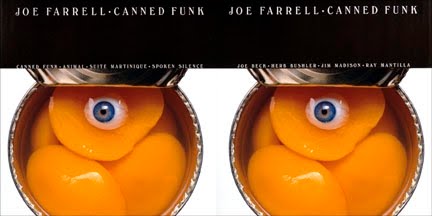
Wounded Bird, the great cult CD reissue label that has issued Freddie Hubbard’s forgotten CTI albums Polar AC (1974) and The Baddest Hubbard (1975) as well as Joe Farrell’s two post-CTI albums for Warner Bros., La Catedral Y El Toro (1977) and Night Dancing (1978), has released on CD for the very first time Joe Farrell’s CTI classics Penny Arcade (1974), Upon This Rock (1974) and Canned Funk (1975). All three albums, licensed from Sony Music, owners of the 1970-80 CTI catalog, are superb examples of first-class small-group jazz in the seventies, expertly recorded by legendary engineer Rudy Van Gelder and each cover featuring one of photographer Pete Turner’s striking images.

Penny Arcade showcases Joe Farrell with Herbie Hancock, who featured on Farrell’s previous CTI album Moon Germs and would come back for two numbers on Farrell’s 1978 album Night Dancing, on piano and electric piano, Joe Beck on guitar, Herb Bushler on bass and Steve Gadd, who first played with Farrell on several Gap Magione dates and would go onto play with the saxist on several Chick Corea albums and on Farrell’s La Catedral Y El Toro, on drums . The five-song program includes Joe Beck’s frenetic title song, which was edited for issue as a promotional single, Farrell’s “Hurricane Jane” and “Geo Blue” (all with Farrell on tenor sax), Farrell’s lovely Latinate “Cloud Cream” (with Farrell on flute and Don Alias added on percussion) and the album’s signature piece, a wondrous and definitive 13-minute reading of Stevie Wonder’s “Too High” (featuring Farrell on soprano sax). With great solos by Farrell, Hancock on electric piano and Bushler, “Too High” is not only one of the very best covers of this well-covered gem, it surely ranks as one of CTI’s finest moments. Hancock also solos magnificently on acoustic piano for “Cloud Cream” and on the “Maiden Voyage”-like derivation “Geo Blue.” Beck takes a rockish solo on “Penny Arcade” and beautifully trims “Geo Blue” with a lush solo that is jazzier than anything the guitarist was known to do at the time. Joe Farrell’s playing throughout is superb and reveals, yet again, that he could construct very interesting jazz compositions that inspire notable improvisation. “I Won’t Be Back,” a terrific Joe Beck bossa fusion that features Joe Farrell on flute (quoting “A Love Supreme”!), was recorded during these October 1973 sessions, but appears on Farrell’s next CTI recording, Upon This Rock.

Upon This Rock captures Joe Farrell on record with his own 1974-75 quartet, featuring guitarist Joe Beck, bassist Herb Bushler and drummer Jim Madison. The piano-less assemblage is considerably more rock oriented than previous Farrell outings, no doubt inspiring the album’s title, and driven home by Joe Beck’s consistently rock-edged guitar attack. Still, it’s a quartet that not only sounds comfortable mixing good rock ideas with solid jazz figures, but one that coalesces especially well together. Assembling at Rudy Van Gelder’s studio in March 1974, the quartet waxes three numbers included here, the leader’s “Weathervane” (featuring Farrell on soprano sax), the 12-minute funk-rock opus “Upon This Rock” (featuring Farrell on tenor sax and Beck, channeling Jimi Hendrix, overdubbing guitar parts) and Beck’s boogaloo “Seven Seas” (again with Farrell on tenor sax). The album’s title track in particular allows all four of the quartet’s members to contribute interesting commentary and is probably a highlight on an album brimming over with highlights. Upon This Rock is rounded out by Beck’s excellent 10-minute bossa fusion, “I Won’t Be Back,” recorded during the Penny Arcade sessions and nicely featuring Farrell on flute, Hancock sublime on piano and Beck, splendid on guitar.

Canned Funk finds Joe Farrell and his quartet, enhanced by Ray Mantilla’s percussion, providing the funk-rock sequel to Upon This Rock. While the “funk” in the title is as apt as the “rock” in the previous title was, the groove here is a bit more forced, or “canned” than it was before too. Whether by choice or by force, Farrell and company still lean heavily toward the rock side of things here. But the music, recorded at Rudy Van Gelder’s during November and December 1974, is a little less imaginative than it was before. Curiously, too, it is Farrell’s first full album of Farrell originals. But the rock back-beat takes over here and renders the music into near total dullness until the soloists come in to liven things up with a little interesting improvisation. The oft-sampled title track is probably familiar to anyone who knows anything about Joe Farrell or even CTI. The tune itself is not much, but the improvisations provided by Farrell (on tenor sax) and Joe Beck (on guitar) are worthy enough. “Animal” too has a clunky riff-based melody that the leader plays on tenor and overdubbed baritone sax that eventually yields to decent solos. Farrell, who never got the recognition he deserved as one of jazz’s finest and most distinctive flautists (check out Benson & Farrell and George Benson’s own CTI classic Good King Bad for further proof), doubles up flute parts for the looping “Suite Martinique,” but here again the overpowering backbeat nearly completely overwhelms the flautist’s fine solo. Things take a slight turn toward the “Midnight at the Oasis” pop-disco of the day with the album’s closer, “Spoken Silence.” Farrell returns here to tenor sax, very strongly suggesting another Farrell, Pharoah Sanders, in full spiritual regalia. That is until Beck and company chime in with a regrettably dated wakka-wakka rhythm guitar part and lots of stick work on the high hat. Beck does get inspired to provide his own spiritually beautiful solo here, though; something that brings him – and Canned Funk - back to the jazz these guys could do so well.

In all fairness, jazz music was experiencing a major shift in May 1975, when Canned Funk was released. Rock based jazz fusion had said just about all it was going to say – to be sure, Joe Farrell didn’t record this way again – and disco was then driving the market. Sure enough, the Joe Farrell quartet disbanded and Joe Beck successfully (or popularly) helped CTI go in that direction. Farrell himself would go this way when he accepted a million-dollar contract with Warner Bros. in 1977, recording disco and covering pop tunes by the Bee Gees and Rod Stewart, something he’d never done before. Canned Funk surely marks the end of an era.

Wednesday, January 05, 2011

Tom van der Geld "Path"

Although not billed as such, this album is the third of what has become known as American ex-pat vibraphonist Tom van der Geld’s four “Children at Play” recordings, captured between 1973 and 1980. Path was recorded in Ludwigsburg, Germany a year and a half after van der Geld’s previous Patience, during February 1979, with a trio consisting of the leader on vibraphone, Roger Janotta (returning from the earlier record) on flute, soprano sax and oboe and the surprising addition of Bill Connors on guitar – in his only recorded appearance with van der Geld.

Each of the Children at Play recordings has a completely different configuration and this one, featuring Bill Connors, showcases the group’s most famously prominent player. Bill Connors (b. 1949) provides a distinctively different foundation for Path than the previous two van der Geld records experienced. And “foundation” seems a particularly apt summation as Connors’ is not only the most dominant voice heard on the record, but his personal style of the time most often directs the unfolding of the music’s proceedings.

Connors, who made a name for himself – rather too briefly – as the guitarist in Chick Corea’s Return to Forever (Hymn to the Seventh Galaxy), tired of rock and similarly-styled electric eclectics by 1974 had set out to learn and study classical guitar.

The guitarist specialized in mostly quasi-classical acoustic sounds thereafter, as heard on his first solo album, the classic Theme to the Guardian (ECM, 1974). Connors recorded several more ECM records under his own name and as part of Jan Garbarek’s band before coming to Tom van der Geld’s Path, and finds a particularly suitable match for his unusually interesting guitarisms.

Unlike Patience, which seemed to emanate from the quietude of unspoken human emotion, Path is imbued with more of an organic or elemental sense of environment, something that is more perceptive and reactive and less expressive of some deeply held thought or emotion.

Like so many other ECM recordings in particular, this is that brand of music so often considered, rather unfairly, to be that “chilly” Euro-style that’s not quite jazz, not quite classical and not quite so easily pigeonholed as to be a genre unto itself, unless “ECM-like” damns with faint praise in that general direction.

Calling the five extended pieces featured here “compositions” is stretching the point a bit. Tom van der Geld is credited as a composer on “One” (on which he is barely audible), the pretty “Eevee” (dominated by Jannotta’s poetic flute intonations), the nearly Flamenco-like “Michi” and “Joys and Sorrows,” while Bill Connors is credited as composer on “Joujou.” None of the tunes has a striking melody or even the barest hint of a melodic refrain. But melody is rather less of a point here than musical invention.

To these ears, chemistry and improvisation are beside the point here too. While there are certainly elements of both on display, in the end, neither contribute forcibly to solidify the music. Often it seems to be one or two of the players stating their piece, seeking a reaction from one or two of the others. Very rarely are all three instrumentalists heard at once, and never in a predictable format.

The improvisation seems so controlled as to be written (no doubt, the classical influence) and as stark a contrast to the free-flowing “compositions” as you can get. What these three remarkably conversant players are doing is blurring the lines of demarcation – forcing the listener to reconsider that which is composed and that which is created on the spot.

It’s a “path” that takes several talented hands and considerably open minds to forge and that “road less traveled” is certainly well appreciated by listeners who can think outside of standard, scripted genre classifications.

Path is not available on CD or digital download and has been unavailable on LP for many years. Like Patience, Path can be heard - for the moment - at the Book of Prayer blog.

Tuesday, January 04, 2011

Tom van der Geld and Children at Play "Patience"

Patience is the second of four of Tom van der Geld’s “Children at Play” albums recorded between 1973 and 1980. The group’s first record, Children at Play (issued 1975), and the last, Out Patients (1980), were issued by the West German JAPO (“Jazz by Post”) label that has something to do with ECM Records (several of the JAPO titles have been reissued by ECM). Patience, the group’s second record, and Path, the group’s third recording, were issued by ECM.

Each of the four “Children at Play” records has an entirely different group structure and a suitably differing sound. On Patience, vibraphonist Tom van der Geld completes a quartet of fellow American ex-pats including Roger Jannotta on various reed instruments, Kent Carter on bass and Bill (aka Billy) Elgart on drums.

Not coincidentally, all four participating musicians came out of the Berklee School of Music - van der Geld and Jannotta lectured there during the early 1970s – and, more interestingly, both Carter and Elgart, who played together in Lowell Davidson’s band after attending Berklee themselves, were a vital part of New York’s thriving free-jazz scene during the mid-1960s.

Even more curiously, all four musicians left the United States shortly before this recording and have not since returned. Not surprisingly, all four found Europe to be a greater bastion of musical and artistic freedom than the United States proved to be. While musical fads have come and gone since then, these four have held steadfast to their musical beliefs. Thankfully, all four musicians are still actively performing. But Tom van der Geld and Bill Elgart are now better known in Germany than the United States, and both are probably more famous as academicians than musicians.

Tom van der Geld was born in Boston in 1947 and since 1974 has resided in Germany. Currently he lives and works in Cologne. He also factors on Kenny Wheeler’s 1979 ECM recording Around 6 and several recordings with longtime German resident and Hungarian ex-pat, clarinetist Lajos Dudas.

Reed player Roger Jannotta, who appears on all four of the “Children at Play” records, was born in Chicago in 1943, and since 1978, has been a resident of Munich. He can also be heard on many of Carla Bley’s big band recordings like The Very Big Carla Bley Band, Appearing Nightly, The Carla Bley Big Band Goes To Church and Big Band Theory as well as Michael Mantler’s The School of Understanding and Hide and Seek.

Bassist Kent Carter was born in 1939 in New Hampshire, though he grew up in Vermont, and currently resides in the south-west region of France. Carter has led many of his own groups, performed and recorded as a soloist and played with many groups including the Jazz Composer’s Orchestra and as part of Paul Bley’s Touching and, most notably, as Steve Lacy’s bassist from 1965 to 1982.

Drummer Bill Elgart, who appears on CaP’s Patience and Out Patients as well as Paul Bley’s Mr. Joy, was born in 1942 in Cambridge, Massachusetts. He has been in Europe since 1976 and currently resides in Ulf, Germany.

Recorded in May 1977 in Ludwigsburg, Germany, Patience requires a bit of, ah, patience to appreciate. But like its title, such virtue helps one to enjoy what the participants aim to achieve and rewards in a creative musical experience that requires more than one or two cursory listens would ever provide.

Make no mistake. This is creative, mostly all improvised music. It is not the angry out-and-out exploratory music free-jazz players plied during the 1960s, but rather the investigative music of inward journeys; reflective and collective in the sense of certain attainment and enlightenment, what many neatly label now as “spiritual.” Here, the players combine to achieve a particular sonic end, not proclaim any sort of protest. Some may find that indulgent. But after all, most any form of creative music is indulgent. It’s up to the listener to choose the road less traveled and accept the beauty of what he or she experiences along the way.

Patience blossoms with beauty. A vibes-led quartet has great appeal and ECM had earlier done much featuring Gary Burton in such settings and, later, did so with David Friedman. Tom van der Geld is an interesting, though not outstanding, player. He’s certainly not constructed your typically rhythmic jazz event. Indeed, one could argue that music like this and other such explorations that Paul Horn had begun dabbling in at the time gave birth to the surprisingly un-jazzlike “New Age” craze that arose in the 1980s. At the time of Patience, improvisation could still attain a purity of beauty that was assuredly creative and not as easily reckoned as New Age.

The program on Patience consists of five rather longish explorations: two by van der Geld (the Debussy-like “Patience” and the lovely ballad “Alison,” which seems to require further exploration), two by Jannotta (“Golden Stabs,” and the seemingly Dolphy-inspired “Celia”) and one (“And Then…”) credited to the entire group. The “melodies,” such as they are, seem more like the spontaneous creations Keith Jarrett, Gary Peacock and Jack DeJohnette are now justly celebrated for on such ECM outings as Changes, Changeless, Always Let Me Go and Inside Out.

The tunes are neither hummable nor as immediately memorable as one might hope for or expect. Like many ECM records of the period, this is about what happens when a group of musicians comes together to collaborate and see what results – the genesis of all great jazz. Check your expectations at the door. Producer Manfred Eicher always prefers collaborations like this of the unexpected. And Patience delivers.

These four have an articulate chemistry together that is almost telepathic. A sense pervades that the collage of sound the quartet has assembled here reflects or refracts a sort of scenic particularity, a rain-streaked soundtrack of a gray-ish day: beautiful, but not pretty; messy, but not without reason. It’s like telling your kid they shouldn’t do something you know they need to do: children at play.

I would describe the mood here as one that is mysteriously contemplative. The titles don’t often lend themselves to descriptive progressions the musicians take to journal their individual or collective journeys. But the trip is well worth the experience anyway. All the musicians seem to listen as much, if not more than, respond in kind to the abundant imagination the others display. Each one seems to be on the other’s wavelength. Each one knows where the other is coming from.

The album’s very best moments are its jazziest. First there is Jannotta’s almost fusion-y “Golden Stabs,” the most composed sounding piece heard here. It is also the most rhythmic and seemingly coordinated piece too. Jannotta leads on soprano sax and buffers van der Geld’s best solo on the record with a gorgeous ostinato on bass clarinet, no doubt inspired by Bennie Maupin. Carter, who is resplendently inspired, and Elgart are terrifically animated here as well.

The quartet comes to life again on the ten-minute group improvisation “And Then…”, suggesting a jazz take on one of Steve Reich’s mallet-oriented compositions as if phase-shifted through Herbie Hancock’s Mwandishi band (interestingly, ECM captured Mwandishi members Bennie Maupin and Julian Priester’s initial solo forays several years earlier). Again, the ostinato provides an enticing framework for some inside, or “outside within,” improvisation. But the high level of playing suggests that there was a unity of feeling and emotion in the sounds this quartet was striving to achieve.

Perhaps alienation loves company. But such alienation may also explain why Patience has yet to show up on CD or digital download. It’s certainly worth tracking down on vinyl. Patience is, indeed, its own reward.

Sunday, January 02, 2011

Charles Fambrough - R.I.P.

After a long bout battling kidney failure, the great jazz bassist Charles Fambrough died of a heart attack on Saturday, January 1, 2011. Fambrough was on dialysis for five years and had been awaiting a transplant match. Several musical tributes were held in Philadelphia over the last year or two to help Fambrough and his family pay the bassist’s outrageous medical expenses.

Philadelphia resident Charles Fambrough was born on August 25, 1950. Fambrough studied classical piano throughout his elementary and high-school years. He gravitated to bass at the age of 13, attempting to imitate Paul Chambers, the first jazz bassist he ever heard. He began studying classical bass in the seventh grade but gave it up in 1968 to begin working in the pit bands for such theatrical productions as You Can’t Take it With You and Bye-Bye Birdie and, by day, playing on The Mike Douglas Show.

In 1969, Charles began working with a cover band called Andy Aaron’s Mean Machine that also featured a young saxophonist by the name of Grover Washington, Jr. A year later, Charles joined Grover Washington’s road band, staying with the saxophonist during his popular CTI years. In 1975, Fambrough joined Airto Moreira’s band, where he stayed for two years until joining legendary pianist McCoy Tyner’s group, playing on Tyner’s Focal Point (1977), The Greeting (1978) and Horizon (1979), as well as Rahsaan Roland Kik’s Boogie Woogie String Along For Real (1977) – his earliest known recordings.

Upon leaving Tyner’s group, Fambrough hooked up with Art Blakey’s Jazz Messengers at about the same time Wynton Marsalis was part of the group, recording with the great jazz drummer from 1980 until 1982 and featuring on the pivotal Album of the Year (1981). Fambrough once said “McCoy showed me how to play with endurance. Art gave me refinement.”

He continued, “With McCoy, the gig is about speed and strength. He plays so much stuff that you’re lucky if you’re heard, so you struggle to keep up with him. But with Art it was a lot different. He heard every note you played and if there was anything raggedy, he immediately let you know about it. He really taught you how to play behind a horn player, how to develop in a rhythm section.”

Surprisingly, Charles Fambrough made his own solo recording debut on Creed Taylor’s famed CTI Records in 1991 with The Proper Angle, an excellent, star-studded affair featuring Wynton Marsalis (who featured Fambrough in his first band in 1982) and Roy Hargrove on trumpet, Branford Marsalis and Joe Ford (who first met Fambrough on a McCoy Tyner gig 13 years earlier) on sax, the late, lamented Kenny Kirkland on piano, Jeff “Tain” Watts on drums (both Kirkland and Watts featured with Fambrough in a trio at the time dubbed “Jazz From Keystone”) and Steve Barrios, Mino Cinelu and Jerry Gonzalez on percussion. The record is the first bassist-led date on CTI Records since the legendary Ron Carter in 1976 and it’s clear that Fambrough, like Carter, was a bassist who could lead an interesting jazz record of his own. It also ranks among the very best the label issued during its 1989-98 resurgence.

The Proper Angle was not only one of CTI’s only straight-ahead albums of the time, it also showcased some of jazz’s best young lions at the top of their game. It surely proved that Fambrough was a tremendously capable leader adept at helming a band of great improvisers who worked beautifully well together and it introduced the bassist’s amazing facility for interesting composition (“The Dreamer,” “Sand Jewels,” “Broski,” the bassist’s nickname from his Jazz Messenger days, “Dolores Carla Maria,” named for Fambrough’s wife and widow, a singer of great renown in her own right, “Earthlings,” “The Proper Angle,” “One for Honor,” originally written for McCoy Tyner’s Horizon, and the beautifully titled “Our Father Who Art Blakey,” named for the drummer who had passed away the year before).

Fambrough issued two more records on CTI, The Charmer (1992), featuring Roy Hargrove on trumpet, Kenny Garrett on alto sax, pianists Bill O’Connell, Kenny Kirkland and Abdullah Ibrahim (!), drummers Jeff “Tain” Watts, Billy Drummond and Yoron Israel (!) on drums and a reunion on three tracks with Grover Washington, Jr., and the splendiferously excellent live album Blues at Bradley’s (1993) featuring Donald Harrison, Steve Turre, Joe Ford, Bill O’Connell, Bobby Broom, Ricky Sebastian and Steve Berrios. These records remain the undisputed highpoint of CTI in the nineties.

Several other discs under Charles Fambrough’s name also appeared, including Keep of the Spirit (AudioQuest, 1995), City Tribes (Evidence, 1995), Upright Citizen (NuGroove, 1997) and Charles Fambrough Live @ Zanzibar Blue (Random Chance, 2002). The bassist also continued to appear on a wide array of discs by others, including Pharoah Sanders (Crescent with Love), Bill O’Connell (including the pianist’s great CTI album Lost Voices), Ernie Watts (Reaching Up), Kevin Mahogany (My Romance) and the jazz-rock cover bands Beatlejazz and Stonejazz.

In recent years, health problems prevented Charles Fambrough from participating as much as he once had on the recording scene. But he continued playing around his hometown as much as possible and was one of the bassists featured on drummer/composer Lenny White’s 2010 album Anomoly (Abstract Logix).

A fellow musician and Fambrough friend, pianist, composer and educator George Colligan, said on his jazztruth blog today that “Charles had health issues for many of his last years, but it never seemed to deter him from his passion for music. He talked about his condition like it was a minor nuisance. He seemed determined to press on despite his health.”

There was something undeniably special about the sound Charles Fambrough made. While you never got the sense that his bass was leading the music’s charge, you often stopped to wonder exactly what drove the music he was port of to be as magnificently magnetic as it was. Simple consideration reveals just how emphatic and empathic his role in the music was.

Fellow bassist Ron Carter has stated that he doesn’t like his playing to be considered an anchor, something that holds a vessel from moving. Bassists hear that kind of thing all the time, and it’s no wonder Carter resents it.

When listening to Charles Fambrough, it’s clear that a good bassist propels the music where it needs to go. It’s a shame that the music will no longer be propelled by Charles Fambrough, an inventive and imaginative bassist and one of the finest of “the young lions” who emerged in jazz’s new traditionalism of the early 1980s.