Saturday, December 11, 2010

Shearing in the Sixties - Part 4

Old Gold and Ivory - George Shearing (Capitol, 1963/1964 – issued 1965): During the 1960s, many Capitol albums contained helpful-to-retailers “File Under” headings at the top of the record. This one dismisses itself as “Background Music” even though it is one of those fairly remarkable Shearing-with-strings-and-woodwinds records like White Satin or Black Satin issued some half a decade earlier that compromise, compel and mix jazz and classical music all at once. It is the kind of thing other records often get celebrated for – third stream, fusion, whatever. And it’s worth considering that the rightfully commendable Bill Evans Trio with Symphony Orchestra record wasn’t released until a year and a half after this record came out. This one somehow eluded celebration and Old Gold and Ivory is definitely worth celebrating. Recorded over a period of at least five sessions between late 1963 and early 1964, Old Gold and Ivory derives its title from a series of “golden” and well-known classical themes rendered here by George Shearing’s tinkling “ivories.” It’s a great idea, extremely well arranged by the pianist himself and orchestrated and conducted by Milton Raskin, who had previously conducted Shearing’s previous orchestral effort, Touch Me Softly. The program includes themes that the pianist not only studied and probably knew by heart and certainly better than most jazz players, but some he also quoted as often as possible in his popularly-considered music. These include themes by Pyotr Ilyich Tchaikovsky (“None but the Lonely Heart”), Edvard Grieg (“Solveig’s Song” from Peer Gynt), Frédéric Chopin (“Prelude No. 20,” “Fantaisie Impromptu”), Manuel de Falla (“Ritual Fire Dance” from El Amor brujo), Ernesto Lecuona (“Malagueña”), Nikolai Rimsky-Korsakov (“Scheherazade”), Cyril Scott (“Lotus Land”),Gabriel Fauré (“Pavane”) and Percy Grainger (“Country Gardens”). Everything here is wonderfully well considered and superbly executed but highlights include the percussion fiesta “Ritual Fire Dance;” “Variations on a Theme of Paganini,” containing much exciting orchestration and terrific piano work from Shearing (and a great sense of the Quintet too); and the lovely “Lotus Land.” And while it’s hard to imagine anyone having anything reasonably interesting left to say about “Malagueña” or “Country Gardens,” George Shearing succeeds here rather magnificently too. Old Gold and Ivory was issued on CD by EMI Europe as part of a two-fer with Deep Velvet, but the CD is unfortunately out of print.

Out of the Woods - The George Shearing Quintet with Woodwind Quintet (Capitol, 1963/1964 – issued 1965): This “striking study in modern music,” as Capitol snidely regards it, was recorded during two sessions, on December 26, 1963 – a session that also yielded “Malagueña” and “Ritual Fire Dance” for the Old Gold and Ivory album – and on May 25, 1964, long after Gary Burton left George Shearing’s Quintet to join Stan Getz. The second session was done at Shearing’s insistence, determined that Capitol allow the Quintet to do an album of Burton originals. This was unusual for several reasons. For one thing, Capitol discouraged originals on Shearing Quintet records and had certainly never before allowed the pianist a full album by any one composer. For another, it’s highly unusual for Gary Burton, who has never been known as much of a composer, even for his own groups, to provide so much original music to any one program. Even Shearing states in his notes that Out of the Woods is “a rather unusual one for us.” Indeed it sounds nothing like the Shearing Quintet had before or since. With so many of the 12 pieces deriving from classical sources, the inevitable comparison to John Lewis’ Third Stream style is appropriate, although the jazzier numbers (“Six-Nix-Quix-Flix,” “Doblado Samba”) recall the influence of Gary McFarland, who arranged part of a 1964 album for fellow Berklee alum Gary Burton. The group includes Shearing and Burton with John Gray on guitar, Ralph Peña or Gene Cherico on bass and Shelly Manne on drums and the album gets its punning title from the addition of woodwind players including Abe Most, Justin Gordon, Jules Jacobs and Paul Horn. While it’s terrific hearing Shearing and company break out of their usual schtick, too much of this music sounds far too academic. Burton writes as if trying to impress a college professor, not a jazz audience. His ideas are interesting enough, but only explored enough to prove some sort of compositional point such as ‘honor thy forefathers.’ There is very little jazz feeling here and far too little interesting improvisation. It’s certainly easy to understand Shearing’s fascination with the music. He often quotes Bach, Mozart and even jazz composers in performance. But too much of this seems far too contrived and, frankly, uninteresting. Shearing can be heard playing harpsichord on “Opus for Mozart” and the oriental-sounding “Lyric Ballad” while Burton plays lyre on “Lyric Ballad” and piano on (at least) “Improvisation on Fugue X” and “Dialogue for Two Pianos.” Shearing’s piano is best served by “J.S. Bop,” “Doblado Samba,” “Drum Fugue” and “Dialogue for Two Pianos” – but only briefly at best. Out of the Woods is the sort of jazz-meets-classical offering that Claude Bolling’s far more interesting Concerto For Classical Guitar and Jazz Piano is. Curiously both Shearing and Manne appear on the 1979 Angel recording of Bolling’s work to much more notable degree. Out of the Woods was reissued in 1984 on the Tall Tree label (a short-lived division of Palo Alto Records) as Bright Dimensions and credited (appropriately) to George Shearing & Gary Burton “with Shelly Manne” also billed on the cover.

Deep Velvet - George Shearing with Quintet and Woodwind Choir (Capitol, 1964): Shearing had always had great success with his romantic mood music, often telegraphed by the presence of “velvet” or “satin” in the titles. This outing, which comes nearly a full decade after Velvet Carpet, finds Shearing’s quintet surrounded by a woodwind choir arranged by the pianist and orchestrated by Bobby Hammack, Julian Lee and Milt(on) Raskin. It’s all pleasant and enjoyable, but not nearly as catatonic as some of the pianist’s orchestral strings records like Concerto For My Love had become. The winds add some welcome muscle – except during some brief and inexplicably hammy passages that flutter with cliché – that make this set a refreshing change of pace for anyone who might have started getting bored with this particular type of format. The program highlights some lovely standards, including “Here’s That Rainy Day” (which Shearing’s trio would record again in 1977 for MPS), “Sentimental Journey,” “Willow Weep for Me,” “Slowly,” “Spring Is Here” (which Shearing’s Quintet recorded once before in 1953 for MGM) and “My Heart Stood Still” (which Shearing would later record with Joe Williams). There is also an unusually high degree of lesser-known numbers, including “Passing By,” “Would You Like To Take A Walk,” Irving Berlin’s “I Used To Be Color Blind,” Leonard Feather’s “Signing Off,” orchestrators Milton Raskin and Julian Lee’s “One Love” and Benny Carter’s “Nightfall.” While the record seems somewhat out of touch with the record-buying public of the day, it does not dissuade the loveliness of the approach or the undeniable joy the pianist has in delivering it. Highlights include “Sentimental Journey” “Would You Like To Take A Walk,” “Willow Weep For Me” and “My Heart Stood Still.” Deep Velvet was issued on CD by EMI Europe as part of a two-fer with Old Gold and Ivory, but the CD is unfortunately out of print.

Latin Rendezvous - The George Shearing Quintet (Capitol, 1961-65 – issued 1965): This is the first of the Shearing Quintet’s Latin-themed albums since Mood Latino (1961) and, significantly and sadly, the last. It is little more than a collection of previously unissued Latinates that Shearing’s quintet waxed over four years: “Barandanga,” “Mambo at the Blackhawk,” “Just Goofin’” and “Tie Me Donkey” date from the April 1961 Mood Latino sessions. “Mambo Serenade,” “All Through The Night,” which Shearing concludes with a Chopin prelude, “Yours Is My Heart Alone” and “I Wished on The Moon” date from a Quintet performance featuring Gary Burton (probably) recorded the night before the February 1963 Jazz Concert album. And “More,” “I Left My Heart In San Francisco,” “With Feeling” and “Quiet Nights (Corcovado)” date from a March 1965 session that produced two tracks for That Fresh Feeling!. But it all sounds remarkably cohesive and is surely a welcome respite from the many orchestral recordings Shearing had been obliged to do at the time. Latin percussionist Armando Peraza contributes four originals to the program including “Barandanga” (which he’d recorded with Mongo Santamaria in 1960 on Our Man in Havana), “Mambo Serenade,” “Tie Me Donkey” and “Mambo at the Blackhawk” – all terrifically enchanting and, not surprisingly, the album’s most festive highlights. Unfortunately, just about all of the tunes featured here, none of which of even gets to three minutes of playing time, are far too short and don’t allow for some of the energy and verve the performances generate to materialize properly. This surely won’t satisfy many jazz listeners. But it will satify fans of the Shearing Quintet that like to hear the band in this context. For my tastes, Latin Rendezvous is a joy. Even though it was probably rush released to capitalize on the brief Latin spell that swept through jazz in 1965, a trend led by the popularity of Cal Tjader, whose band was then being driven by Armando Peraza. While Latin Rendezvous has never appeared on CD, the live material featured here (which doesn’t sound live) is surprisingly not included on the Mosaic box set either.

That Fresh Feeling! - George Shearing (Capitol, 1965 – issued 1966): This peculiarly titled collection highlights “all-time Shearing favorites newly recorded by the Quintet with strings and woodwinds.” Shearing had emigrated to the United States in 1947 and formed the first George Shearing Quintet in 1949. It was at about this time that the pianist began recording for MGM records, where he initially cut most of the tunes featured here. Many of these songs introduced the British pianist to the American public in the early 1950s and became popular staples in Shearing’s riveting performances. That Fresh Feeling! revisits such Shearing favorites as “I’ll Be Around” (first waxed by Shearing in 1950 – then again in 1960 for San Francisco Scene), “The Continental” (1949), “When Your Lover Has Gone” (1950), “Don’t Blame Me” (1951) and “We’ll Be Together Again” (1951) – all of which Shearing waxed again for his superb 1975 MPS “Quintet + Amigos” album Continental Experience. Also featured here is “Changing with the Times” (1950), “The Breeze and I” (1951), “Pick Yourself Up” (1950 – and later with Nat King Cole, 1961), “For You” (1950 – and again in 1989 on the pianist’s solo album Piano) and two never-before recorded Shearing originals, “Waltz for Sheba” and “Measure for Leisure.” It’s a noble and genuinely engaging program with Shearing back in the saddle again and at the very top of his game on such pieces as “The Continental,” “Changing with the Times,” “The Breeze and I” and “Pick Yourself Up.” One senses Shearing’s true love of this music – not that he’s fulufilling some sort of contractual obligation – and the energy he displays throughout is contagious. Surprisingly, though, two of Shearing’s most notable early successes, “September in the Rain” and his jazz standard “Lullaby of Birdland,” are not part of this program. But That Fresh Feeling! is probably one of the best quintet-with-strings records George Shearing ever made – it swings with the passion Shearing always delivered in concert and is just as pretty as any of the Quintet’s albums were meant to be. That Fresh Feeling! has not yet been issued on CD.

Continue to Shearing in the Sixties – Part 5

Shearing in the Sixties - Part 5

Here & Now - The George Shearing Quintet with String Choir (Capitol, 1965): Following Shearing Bossa Nova, Here & Now is only the second of Shearing’s 1960s albums that reveals itself to be of its time. As the title trumpets, this is the quintet (with strings, the Quintet’s first strings record since 1963’s Touch Me Softly) covering then-recent “standards” from such composers as Henry Mancini (“Days of Wine and Roses,” “Dear Heart,” “Mr. Lucky”), Antonio Carlos Jobim (“The Girl From Ipanema”), Anthony Newley (“Who Can I Turn To,” “What Kind of Fool Am I” – which Shearing performed solo on his 1972 album Music to Hear), Jules Styne (“People”), Jimmy Van Heusen and Sammy Cahn (“Call Me Irresponsible”), Bert Kaempfert (“Love”) and former Quintet member Toots Thielmans (“Bluesette”). Shearing again provides the arrangements, orchestrated by Julian Lee, for a larger-than-usual string section of twelve violins, four cellos and four violas. While it’s nice to hear the pianist tackling some more contemporary material than usual and give these now quite-well known songs the Shearing treatment, the arrangements are surprisingly dull and too frequently syrupy. For example, it’s simply amazing how Shearing drains just about all of the jazz juice out of the three Mancini pieces presented here. The effect is more like Percy Faith or Andre Kostelanetz (poorly) attempting to mimic the Shearing Quintet rather than Shearing trying to swing his way through these mostly strong melodies. Shearing’s occasional and always wonderful pianism comes to the fore on the more Quintet-sounding takes of “Love,” “The Girl from Ipanema,” the Andy Williams hit “Almost There” and, of course, the delightful but far too brief “Bluesette.” Here & Now was issued on CD in 2002 by EMI Europe as part of a two-fer with New Look!, but the CD is unfortunately out of print.

New Look! - George Shearing (Capitol, 1966 – issued 1967): The second of George Shearing’s four “today’s sounds” records of the 1960s, New Look! features “the Quintet and the new sounds of his multi-colored orchestra.” The program covers the lighter side of the then-contemporary pop spectrum including The Beatles’ “Yesterday”(which the pianist would cover again on his 1972 album The George Shearing Quartet) and “Michelle” as well as “On A Clear Day You Can See Forever,” “Strangers in the Night,” “You’re Gonna Hear From Me,” “Call Me,” “The Shadow Of Your Smile,” “What The World Needs Now Is Love” and “Once In A Lifetime.” Also included here are two songs co-written by lyricist Johnny Mercer: Gene Di Novi’s “Have Heart,” covered by Nancy Wilson on her 1965 album A Touch of Today, and Shearing’s own delightfully-conceived “Too Good To Be True.” Shearing’s arrangements for strings, woodwinds and brass (orchestrated again by Julian Lee) are appealingly imaginative and a bit brassier here than usual but pleasantly perkier than what was presented on Here & Now. The program, which is presented as if to bring the music into jazz (rather than dumb it down for the evermore disinterested romantic-moods crowd), recalls something of Neal Hefti’s sparkling and swinging film scores of the period. Shearing stumbles when he tries to add typical classical flourishes to such travesties as “You’re Gonna Hear From Me” and “Once In A Lifetime,” But he truly champions some inventive jazz inspiration on such swinging surprises as “On A Clear Day You Can See Forever,” “Yesterday,” “The Shadow of Your Smile” (where he adds a tastefully considered refrain on harpsichord) and “What The World Needs Now Is Love.” The Quintet sound occasionally rears its pleasant little head, but only in a “should be seen and not heard” sort of way. It’s a shame, because George Shearing might have been on to something here. New Look! was issued on CD in 2002 by EMI Europe as part of a two-fer with Here & Now, but the CD is unfortunately out of print.

Shearing Today! - The George Shearing Quintet (Capitol, 1968): Here, The George Shearing Quintet meets the day’s industry-perceived conceits of rock ‘n’ roll (a story in itself!), killing not only a decently conceived idea (the Shearing Quintet) but laying to rest something that had probably long outlived its usefulness. Shearing Today! is a bit of a shock, mixing the Quintet’s pop melody statements with (pop) rock-ish electric guitars, electric bass (!), a strings section and a surprisingly out-of-kilter group of male and female vocalists (the piano is mic’ed rather strangely here for a Quintet recording too). The program includes tuneful radio favorites of the day like “Goin’ Out of My Head,” “A Time For Love,” “I Say A Little Prayer,” “Don’t Sleep In The Subway, “By the Time I Get To Phoenix,” “Love is Blue,” “Theme from ‘Valley of the Dolls’” and “Never My Love.” But there is a stilted quality to all of it. The arrangements have a nagging tick-tock quality that evinces someone’s dislike for this material. The otherwise beautiful melodies of “Love is Blue” and “Never My Love” seem to suffer most with stringent performances that ooze with a bizarre resentment. Other than Shearing’s Percy Faith-like “Morse Mode,” only the presence of former Quintet vibist Emil Richards’ on these sessions is notable for any reason.

The Fool on the Hill - George Shearing (Capitol, 1968-69 – issued 1969): After nearly 15 years, pianist George Shearing waxed his final album for Capitol Records in 1969 and came up with as much of a winning document of its time as his 1955 Capitol debut, The Shearing Spell, was in its day. The thing is, though, hardly anyone knows about this fantastic record. The “Latin Stylings” here are more appropriately Brazilian than the south-of-the-Border approach of the 1955 album. But Shearing was long destined to make an album like this and, as expected, he is simply spectacular. More disappointingly, he didn’t make more records like this. The Fool on the Hill is, if anything, not only a successful follow-up to 1962’s Shearing Bossa Nova, it is also one of the pianist’s finest outings for the label. Here, the pianist covers such notable Bossa Nova gems as “The Gentle Rain,” “Wave,” “Meditation” and “Somewhere in the Hills (Favela)” and adds some Brazilian flavor to the Cole Porter classics “Easy to Love” and “I Concentrate on You” and such pop favorites as “Promises, Promises,” “A Man And A Woman” and The Beatles’ title track. The pianist also offers his own clever little Bossa Nova in his own “Simple Sideman,” not only confirming his ever-clever use of wordplay but his always clever musical panache. For the most part, Shearing is perfectly featured in a quartet (!) that features the pianist with an unnamed acoustic guitarist, bassist and drummer. Four tracks (“The Fool on the Hill,” “Promises, Promises,” “The Gentle Rain” and “A Man and a Woman”) rekindle the Shearing Quintet with vibes and Latin percussion for an effect that is positively warm and glowing as well as sensible and appropriately romantic. One senses there was much more music from these sessions. Hopefully one day someone will look into it all and share the lovely music featured here and any other secret little gems Shearing may have concocted for this extraordinarily fine release. Despite its odd and oddly misleading title, The Fool on the Hill is one of George Shearing’s best albums and deserves not only more attention but warrants attentive rediscovery. This record is truly outstanding.

George Shearing left Capitol in 1969 (whether it was his decision or Capitol’s, Shearing felt the label wasn’t doing enough to promote his music) and formed his own mail-order label, Sheba. A handful of records were released on the Sheba label. But these little-known records actually looked and felt more like bootlegs, even though they featured Shearing recorded exceedingly well – under his own direction, for the first time in his career – in a variety of contexts. Seven Sheba albums were issued between 1970 and 1973.

These albums featured Shearing a little differently than he had been featured at Capitol and included Shearing playing solo (1970’s Out of this World - first issued in 1971 - and 1972’s Music to Hear), in a trio (1972’s The George Shearing Trio), in a quartet with organ (!) (1972’s The George Shearing Quartet and 1973’s GAS), reprising the quintet (1972’s As Requested) and, most famously, paired with singer Joe Williams (1971’s The Heart and Soul of Joe Williams and George Shearing). All of these were rescued from obscurity by the Koch label in the earlier part of this decade for CD.

Shearing then went onto to wax some magnificent work for MPS (nine albums between 1974 and 1979: Shearing once said of MPS that he was delighted to be with a label that “puts music before money”), Concord (1979-89, including several Grammy Award winners with Mel Tormé) and Telarc (1992-2000), where among other things, he re-convened his Quintet for several records after many, many years.

George Shearing published an autobiography in 2004 (Lullaby of Birdland) and issued a lovely trio disc, Like Fine Wine in 2005 but, due to health reasons, has since retired altogether from music. There is a great wealth of great Shearing music out there. So here’s hoping that the great bounty of Shearing’s recordings will help keep this wonderful musical legacy alive forever.

Friday, December 10, 2010

James Moody - R.I.P.

James Moody, Jazz Saxophonist, Dies at 85
By PETER KEEPNEWS
New York Times, Dec. 10, 2010

James Moody, a jazz saxophonist and flutist celebrated for his virtuosity, his versatility and his onstage ebullience, died on Thursday in San Diego. He was 85.
His death, at a hospice, was confirmed by his wife, Linda. Mr. Moody lived in San Diego.

In November 2010, Mr. Moody revealed that he had pancreatic cancer and had decided against receiving chemotherapy or radiation treatment.

Mr. Moody, who began his career with the trumpeter Dizzy Gillespie shortly after World War II and maintained it well into the 21st century, developed distinctive and equally fluent styles on both tenor and alto saxophone, a relatively rare accomplishment in jazz. He also played soprano saxophone, and in the mid-1950s he became one of the first significant jazz flutists, impressing the critics if not himself.

“I’m not a flute player,” he told one interviewer. “I’m a flute holder.”

The self-effacing humor of that comment was characteristic of Mr. Moody, who took his music more seriously than he took himself. Musicians admired him for his dexterity, his unbridled imagination and his devotion to his craft, as did critics; reviewing a performance in 1980, Gary Giddins of The Village Voice praised Mr. Moody’s “unqualified directness of expression” and said his improvisations at their best were “mini-epics in which impassioned oracles, comic relief, suspense and song vie for chorus time.” But audiences were equally taken by his ability to entertain.

Defying the stereotype of the modern jazz musician as austere and humorless (and following the example of Gillespie, whom he considered his musical mentor and with whom he worked on and off for almost half a century), Mr. Moody told silly jokes, peppered his repertory with unlikely numbers like “Beer Barrel Polka” and the theme from “The Flintstones,” and often sang. His singing voice was unpolished but enthusiastic — and very distinctive, partly because he spoke and sang with a noticeable lisp, a result of having been born partly deaf.

The song he sang most often had a memorable name and an unusual history. Based on the harmonic structure of “I’m in the Mood for Love,” it began life as an instrumental when Mr. Moody recorded it in Stockholm in 1949, improvising an entirely new melody on a borrowed alto saxophone. Released as “I’m in the Mood for Love” (and credited to that song’s writers) even though his rendition bore only the faintest resemblance to the original tune, it was a modest hit for Mr. Moody in 1951. It became a much bigger hit shortly afterward when the singer Eddie Jefferson wrote lyrics to Mr. Moody’s improvisation and another singer, King Pleasure, recorded it as “Moody’s Mood for Love.”

“Moody’s Mood for Love” (which begins with the memorable lyric “There I go, there I go, there I go, there I go ...”) became a jazz and pop standard, recorded by Aretha Franklin, George Benson, Van Morrison, Amy Winehouse and others. And it was a staple of Mr. Moody’s concert and nightclub performances as sung by Mr. Jefferson, who was a member of his band for many years. Mr. Jefferson was shot to death in 1979; when Mr. Moody, who was in the middle of a long hiatus from jazz at the time, resumed his career a few years later, he began singing the song himself. He never stopped.

James Moody — he was always Moody, never James, Jim or Jimmy to his friends and colleagues — was born in Savannah, Ga., on March 26, 1925, to James and Ruby Moody, and raised in Newark. Despite being hard of hearing, he gravitated toward music and began playing alto saxophone at 16, later switching to tenor. He played with an all-black Army Air Forces band during World War II. After being discharged in 1946, he auditioned for Gillespie, who led one of the first big bands to play the complex and challenging new form of jazz known as bebop. He failed that audition but passed a second one a few months later, and soon captured the attention of the jazz world with a brief but fiery solo on the band’s recording of the Gillespie composition “Emanon.”

Mr. Moody’s career was twice interrupted by alcoholism. The first time, in 1948, he moved to Paris to live with an uncle while he recovered. He returned to the United States in 1951 to capitalize on the success of “I’m in the Mood for Love,” forming a seven-piece band that mixed elements of modern jazz with rhythm and blues. After a fire at a Philadelphia nightclub destroyed the band’s equipment, uniforms and sheet music in 1958, he began drinking again and checked himself into the Overbrook psychiatric hospital in Cedar Grove, N.J. After a stay of several months, he celebrated his recovery by writing and recording the up-tempo blues “Last Train From Overbrook,” which became one of his best-known compositions.

In 1963 he reunited with Gillespie, joining his popular quintet. He was featured as both a soloist and the straight man for Gillespie’s between-songs banter, sharpening his musical and comedic skills at the same time. He left Gillespie in 1969 to try his luck as a bandleader again but met with limited success; four years later he left jazz entirely to work in Las Vegas hotel orchestras.

“The reason I went to Las Vegas,” he told Saxophone Journal in 1998, “was because I was married and had a daughter and I wanted to grow up with my kid. I was married before and I didn’t grow up with the kids. So I said, ‘I’m going to really be a father.’ I did much better with this one because at least I stayed until my daughter was 12 years old. And that’s why I worked Vegas, because I could stay in one spot.”

After seven years of pit-band anonymity, providing accompaniment for everyone from Milton Berle to Ike and Tina Turner to Liberace, Mr. Moody divorced his wife, Margena, and returned to the East Coast to resume his jazz career. His final three decades were productive, with frequent touring and recording (as the leader of his own small group and, on occasion, as a sideman with Gillespie, who died in 1993) and even a brief foray into acting, with a bit part in the 1997 Clint Eastwood film “Midnight in the Garden of Good and Evil,” set in Mr. Moody’s birthplace, Savannah.

The National Endowment for the Arts named him a Jazz Master in 1998. His last album, “Moody 4B,” was recorded in 2008 and released this year on the IPO label.

Mr. Moody, who was divorced twice, is survived by his wife of 21 years, the former Linda Peterson McGowan; three sons, Patrick, Regan and Danny McGowan; a daughter, Michelle Moody Bagdanove; a brother, Louis Watters; four grandchildren; and one great-grandson.

For all his accomplishments, Mr. Moody always saw his musical education as a work in progress. “I’ve always wanted to be around people who know more than me,” he told The Hartford Courant in 2006, “because that way I keep learning.”

Thursday, December 09, 2010

Hugh Masekela “Jabulani”

With Jabulani (Gallo, 2010), the iconic and legendary South African trumpeter Hugh Masekela has not only issued his very best recording since his 2002 album Time, but may have finally released one of the best and most singularly important musical documents of his entire career.

According to Bra Hugh himself, when he was a boy in South Africa weddings were always celebrated with many songs.

“The betrothed’s young neighbours, friends and relations,” says Masekela in his liner notes, ”would conduct a nightly wedding songs choir practice from dusk until close to midnight, marching up and down the street, singing the most beautiful songs accompanied by occasional, very intricate choreographed moves which were a pure joy to witness.” Although these sorts of traditions have long since disappeared, Masekela concludes that “(t)his is a tribute to the township weddings of yester year. I pray that these kinds of wedding celebrations can come back into our lives.”

One listen to Jabulani makes it easy to understand why. These are beautiful, joyous songs, filled with hope, great happiness and a positive sense of love that is life affirming. It’s everything that so much of Hugh Masekela’s best music has always strived for. It’s also the most comfortable and inspired the trumpeter (who is on flugelhorn throughout here), vocalist and musical Svengali has ever sounded on record – from the very first track to the last.

It’s a rare occasion that Hugh Masekela has set out to do something exactly the way he wanted to do it, without regard for corporate or commercial considerations. I can think of only a few times this has ever occurred – and succeeded – namely on Grrr (1965), Hugh Masekela and the Union of South Africa (1971), Home Is Where The Music Is (1972), I Am Not Afraid (1974), Tomorrow (1986), Sixty (1999) and Time (2002) [Note: this is not to say that there aren’t plenty more notable recordings sprinkled throughout Hugh Masekela’s discography. But these I’ve named rank among Masekela’s most completely satisfying statements. To these I would add Africa ‘68, but this is unfortunately not appropriately credited solely to Hugh Masekela.] Jabulani now ranks among the most significant of Hugh Masekela’s recordings.

Here, Hugh Masekela reunites with producer Don Laka, who produced and contributed greatly to the trumpeter’s 1998 album Black to the Future, a number of songs from which ended up appearing on the 2000 semi-compilation Grazing in the Grass: The Best of Hugh Masekela (aka Greatest Hits). The two also worked together on the Umoja: The Spirit of Togetherness (2001) soundtrack.

Without great pretense or artifice, Laka and Masekela concoct a program of eleven dynamic tunes. Two of these, “Bambezela” and “Rosie My Girl” feature vocalist Gugu Shezi, who has worked with Mafikizolo, Ringo Madlingozi, Judith Sephuma and Sibongile Khumalo, while “Tsoang Tsoang” features “The Village Pope” and long-time Masekela aide-de-camp Tshepo (also Tsepo) Tshola (Masekela produced and participated on two really great Tshola discs, Winding Rivers and Waterfalls and New Dawn) .

Much of the music, as you’d expect, is traditional and some of it may even be familiar to those who enjoy South African mbanqanga music. Each song sounds familiar and timeless and Masekela and Laka don’t allow too much technology to come in and fuss it all up. Masekela not only provides the vocals on each track but allows plenty of space for his flugelhorn throughout too. And he’s rarely sounded this good or this enthusiastically driven on his horn.

Many are the highlights on this fine and often exciting record. But for special attention, I would call out “Sossie,” “Fiela,” “Bambazela” (which Masekela brilliantly worked into his 1984 medley “The Seven Riffs of Africa” from Techno-Bush), “Iph’ Indlela” (probably best known to American ears by the stunningly gorgeous version Harry Belafonte did on the Grammy Award winning album from 1965, An Evening With Harry Belafonte and Miriam Makeba), “Tsoang Tsoang,” “Makoti (Bride)” (which Miriam Makeba sung with the Skylarks in 1959 before leaving South Africa), “Mfana” (which Masekela cut in 1968 as part of an American studio group called The Johannesburg Street Band as “No Passport” for the album Dancin’ Through The Streets - it was later re-titled “Awe Mfana” when it was included on the 2006 CD compilation Hugh Masekela Presents The Chisa Years – 1965-1975 (Rare and Unreleased)), “Uyeyeni” and a surprisingly effective Asiatic take on “No Harvest (Asilimanga)” (which Miriam Makeba performed so memorably in 1968 on her miraculous Makeba album, which also featured a cover of this disc’s “Iph’ Indlela”).

Some of the press coverage I’ve seen considers Jabulani, which was issued in South Africa at the end of September (I know of no plan to issue the album in the U.S. or Europe), Hugh Masekela’s 28th studio album. While I count 33 studio releases (including the two albums Masekela co-led with Herb Alpert in the late 1970s), it makes no difference. Coming a full half century after some of Hugh Masekela’s very first recordings, the magnificent Jabulani is one of his very best.

Jabulani is available from One World and Kalahari.net.

Hank Crawford “Tico Rico”

One of my very favorite Kudu albums is alto saxophonist Hank Crawford’s 1977 album Tico Rico. It’s also one of Hank Crawford’s best albums too. Coming at the end of CTI’s glory days, it is often lost in the shuffle and has subsequently never been considered for a CD release in the U.S. or Japan.

But it is a tremendous record, helmed by the great arranger David Matthews on one of his very best days (he provides four originals here, “Tico Rico,” “Lady Soul,” “Lament” and “Funky Rooster”) and provides one of the baddest arrangements ever for The Beatles’ “I’ve Just Seen A Face.”

The band here is magnificent. Hank Crawford has always been surrounded by great musicians on his studio recordings. There’s no exception here. Musicians backing Hank Crawford on alto sax here include Randy Brecker and Jon Faddis on trumpet, Michael Brecker on tenor sax, Jeremy Steig on flute, Cliff Carter on keyboards, the late great Eric Gale on guitar, the late great Gary King on bass, the phenomenal Steve Gadd on drums, the legendary Nicky Marrero on conga, Sue Evans on percussion with, of course, David Matthews arranging it all.

Fortunately, some kind soul named Calicard, also a fan of the album, has posted much of the album on YouTube. I am pleased to be able to share these pieces here in hopes that someone might consider giving Tico Rico a shot on CD.

Tico Rico:

Lady Soul:

Lullaby of Love:

I’ve Just Seen A Face:

Lament:

Funky Rooster:

Wednesday, December 08, 2010

Eddie Henderson “For All We Know”

Exactly four decades after making his recording debut as part of Herbie Hancock’s forward-thinking Mwandishi band, trumpeter Eddie Henderson waxes more traditionally and reflectively on For All We Know (Furthermore Recordings). Recorded in New York City on September 23, 2009, For All We Know is Henderson’s first disc since 2006’s Precious Moment (Kind of Blue).

Henderson, who left music in 1980 to practice psychiatry full time, returned to the jazz scene in the late 1980s as more of a derivative stylist than the maverick he had started out to be. Ever since then, he’s produced a number of very traditional-sounding discs that have not really had the impact his earlier recordings on Capricorn, Blue Note and Capitol from the 1970s did.

With one particularly notable exception, For All We Know isn’t much different.

The mostly unremarkable program here includes a handful of unexceptional originals (“Sand Storm,” “Popo” and wife Natsuko’s “Be Cool”), the already overplayed “Jitterbug Waltz” and some fairly well-conceived takes on such ballads as “For All We Know” and “By Myself.” Of note here is drummer Al Foster’s “Missing Miles” (Foster was Miles Davis’ drummer from 1972 to the end of his life). Henderson had guested with the Foster quartet, of which bassist Doug Weiss was a member, for a 2007 performance (issued on DVD as New Morning: The Paris Concert) that included this pensive number as well as “Cantaloupe Island.” With odd arrangements and a seeming level of disinterest among the players, both “Missing Miles” and the oddly unfocused and surprisingly unfunky take on former boss Herbie Hancock’s “Cantaloupe Island” here seem like little more than missed opportunities.

No doubt the most notable aspect of For All We Know is the band. Here, Henderson fronts a piano-less quartet featuring guitarist John Scofield, who had only been heard with the trumpeter on a 1995 Kenny Barron album, bassist Doug Weiss and drummer Billy Drummond, who was part of the Henderson quartet that produced 1998’s Reemergence (also known in Japan as Dreams of Gershwin) and 2001’s Oasis.

Despite a weak program, what makes this thing work particularly well is the positively sublime sound this quartet produces together. Buffering the leader’s mostly muted trumpet – no doubt intended to call up the ghost of Miles Davis – are Billy Drummond’s bracing sensitivity to the occasion and the graceful, bird-like way Doug Weiss keeps things lilting and light on its feet.

But what’s truly extraordinary here is guitarist John Scofield. Not only has Scofield, himself a veteran of the Miles Davis band, always been one of jazz’s most interesting improvisers, he can be one of the most beautiful players of his instrument whenever he wants. Over the last few years, he’s chosen a rougher sounding funk/jam-band sort of thing that he, thankfully, abandons here. He made the right decision. Scofield hasn’t sounded this great in years. The last time I remember him sounding this good on someone else’s record – and such an integral part of the program’s success – was with Joe Henderson on the late tenor saxophonist’s own Miles Davis tribute, So Near, So Far (1993) – ok, Scofield was pretty fine with Chris Potter on Unspoken (1997) and John Patitucci on Now (1998) too. For All We Know is worth it just to hear Scofield on “For All We Know,” “By Myself,” “Missing Miles” and “Popo.”

For the record, Eddie Henderson works up a nice bit at the end of “Jitterbug Waltz,” “For All We Know” and “By Myself” as well - all longer than standard jams that allow for all to provide some witty and expressive improvisation. It’s a shame that more of For All We Know wasn’t like this. But what a treat to hear this quartet play together.

Tuesday, December 07, 2010

“MMMBop” by Hanson

This one completely eluded me at the time. Written (!) and performed by the kid-rock band Hanson and appearing on their 1997 album Middle of Nowhere, “MMMBop” is said to be one of the biggest debut singles of all time and just about one of the most loved and reviled songs ever. It was a number one song in many countries and the tune, surprisingly, topped critics’ polls at Rolling Stone, Spin and even – gasp! – my cultural bellwether, The Village Voice. The song was also nominated for two Grammy Awards in 1998.

I recall hearing the song once or twice at the time, thinking, “huh, catchy song.” Good vocals, too. I really didn’t pay too much attention to it at the time. But, I must have been the only one. Then, the song had an oddly auspicious recurrence – a baker’s dozen years after the fact – on a recent episode of Family Guy (“Baby, You Knock Me Out” – Season 9, Episode 5). It reminded me how much I liked the damned thing and how wonderful the song was all along.

The bizarre lyrics, which are barely intelligible, have something to do with picking the right friends: people who will love you when you lose all your hair. Apparently the concept of “MMMBop” has something to do with a short period of time. In other words, friends come and go in an “MMMBop” but, ah, love(?) lasts forever? Who knows? Guess it’s just supposed to be a bit of fun. And it is.

The energetic joy with which the Hanson boys deliver this tune is catchy. The playful video, which captures the boys at a much different stage of life than wherever they are at today, shows these kids really did contribute to the music that’s heard here. The cute little one, on drums, is frighteningly good. And he really seems to be playing exactly what is heard. The middle one, on vocals, has an energy and vocal talent (and a smile) that is exceptionally noteworthy. The older boy seems to anchor it all with a musical maturity that is staggering.

This may be clever pop by clever kids. But there is something different here. It seems like the kids really did much of this themselves. I don’t know enough about Hanson to be sure (I’ve seen them – older and handsome as hell – do this for gaggles of satisfied girls...just as impressively – again anchored by the eldest Hanson’s guitar). Yet it’s hard to dislike what these three boys have accomplished here. Enjoy!

Ulf Wakenius “Notes from the Heart”

Like the 1999 tribute As Long As You’re Living Yours: The Music of Keith Jarrett, this 2006 CD offers yet another surprising tribute to pianist and composer Keith Jarrett. Here, the tribute is delivered by a guitar trio and the guitarist helming it all is the masterful Swedish guitarist Ulf Wakenius, best known as Oscar Peterson’s guitarist from 1997 until the pianist’s death in late 2007 (their last recording together is the tremendous A Night in Vienna, which was issued on CD and DVD in 2004).

You wouldn’t think Oscar Peterson’s guitarist would be all fired up to score a tribute to Keith Jarrett. But there are interesting parallels between the two pianists that help clarify the logic and passion Peterson’s guitarist might have for Jarrett’s music.

Both pianists are considered the very finest interpreters of the American songbook of standards – Peterson in the 1950s and Jarrett since the 1980s. Both pianists reigned over the best, most highly regarded and most prolifically recorded jazz trios of their day. Both pianists had exceedingly encouraging sponsors that did much to help the trios establish their significance and promote their importance: Oscar Peterson had Norman Granz and Keith Jarrett has long had Manfred Eicher, who has recorded the pianist in many, many additional settings as a soloist and interpreter of such composers as Bach, Handel and Mozart.

The two pianists are also inveterately interesting composers, Peterson more toward the last half of his career (the Vienna concert noted above is, significantly, made up of nothing but Peterson originals) and Jarrett, more toward the early part of his career. Jarrett, of course, still composes and some of his more structured improvisations are actually turned into compositions. But neither pianist is widely considered a composer and, as such, very little of either composers’ originals get much coverage by other jazz artists.

That’s what makes Ulf Wakenius’ positively wonderful tribute, Notes from the Heart such an essential document. He not only understands and properly reflects the melodies Keith Jarrett has established but is able to explore further dimensions of the titular emotions or moods the composer has proposed. It’s exactly what the Jarrett trio does when they explore standards. That in itself is an achievement.

Ulf Wakenius

The guitarist, together with bassist Lars Danielsson and drummer Morten Lund, reflects upon an exceedingly well-considered program of Jarrett originals, alternating evocatively contemplative ballads offering titles like “Innocence” and “Prayer” with several of Jarrett’s heady yet often critically-dismissed vamps (always my favorites on any Jarrett album) with titles like “Dancing,” “The Cure” and U-Dance.”

The program consists of “Memories of Tomorrow” (a title derived from the final part of Jarrett’s 1974 solo triumph The Köln Concert), “Dancing” (originally heard on Jarrett’s Changeless), “Innocence” (Nude Ants, Personal Mountains), “The Windup” (Belonging), “My Song” (My Song), “Mon Coeur est Rouge” (Concerts), “Everything That Lives Laments” (The Mourning of a Star, Mysteries), “The Cure” (The Cure), “So Tender” (originally recorded by Jarrett for a 1972 Airto album on CTI, but first heard on Jarrett’s 1984 trio album Standards, Vol. 2), “U-Dance” (Tribute) and “Prayer” (Death and the Flower).

Wakenius sticks to acoustic guitar throughout and sounds, well, simply magnificent. He’s a sensitive player who plays what he means. He never adds any more notes than are necessary. He never riffs off an idea without purpose (I hear hints of “My Romance” in “Mon Coeur est Rouge” and both Rodrigo and “Django” in “Prayer”) or inserts a quote to be clever. There’s none of that. He’s always playing with an emotional sincerity that earns the disc its title.

His best moments come on “Dancing,” the surprisingly Django Reinhardt-like take on “The Windup” (which must have given the composer something to smile about), “Everything That Lives Laments,” “The Cure,” the warm samba of “So Tender” and the perfectly infectious “U-Dance.” Danielsson occasionally adds piano (“Dancing,” “Mon Coeur est Rouge”) or cello (“Everything That Lives Laments”). But he is a masterful bassist: not merely a competent accompanist, rather a melodic driver who is able to suggest rhythm in much the way Jarrett’s Standards Trio bassist, Gary Peacock, does (it’s no coincidence that Lars Danielsson has also led quite a number of his own albums).

Lars Danielsson

Interestingly, both Wakenius and Danielsson were first recorded together for the guitarist’s 1991 disc Venture, an album whose drummer was none other than Jarrett’s Standards Trio drummer, Jack DeJohnette (the bassist also had DeJohnette on his own album Fresh Enough, also recorded in New York at about the same time). Since Venture, Wakenius and Danielsson have collaborated often and they sound truly in-synch with each other’s ideas and can even presage one another’s exploratory patterns. At points, there is enough musical invention to suggest that this trio is nearly as conceptually creative a unit as Jarrett’s Standards Trio is. Kudos, too, to the telepathic Lund for the rhythmic interest and diversity he provides throughout.

It will come as no surprise to anyone that hears this sumptuously well-captured disc that Notes from the Heart was recorded by none other than the legendary Jan Erik Kongshaug, the engineer behind so many of ECM’s finest albums and the man who recorded Keith Jarrett himself on such albums as Belonging, My Song, Personal Mountains, Standards, Vol. 2, The Cure, Tribute and Changeless (all noted above).

Notes from the Heart is a pleasure on every level. It suggests not only that Ulf Wakenius is one of the finest jazz guitarists of his generation, exuding a fine personal style and exceptionally exquisite taste, but that Keith Jarrett’s compositions warrant further exploration and evince particularly interesting jazz commentary.

“The Windup” from Notes from the Heart:

Monday, December 06, 2010

Happy Birthday, Dave Brubeck!

Let’s take some “time out” to wish a very happy birthday today to the great pianist, composer and legendary jazz icon, Dave Brubeck. Mr. Brubeck, who turns 90 today, has contributed greatly to the jazz canon and has contributed the following jewels to my own musical collection:

• Dave Digs Disney (1957) – With Paul Desmond, Norman Bates and Joe Morello. Classic songs from Disney films, all delivered elegantly by the Brubeck Quartet, years before Disney tributes became fashionable.

• Time Out (1959) – The ultimate Dave Brubeck Quartet classic. “Take Five” and “Blue Rondo a la Turk” (also featured in Brubeck’s unissued score for the 1984 cable TV film Ordeal by Innocence) are the best known pieces here. But, chances are, everyone knows and loves everything here. Included as part of a recent five-disc Original Album Classic set and also as part of the 2004 five-disc set For All Time.

• Time Further Out – Miro Reflections (1961) – With Paul Desmond, Eugene Wright and Joe Morello. The first sequel to Time Out is this magnificent outing of Brubeck originals including the famed “It’s a Raggy Waltz” and “Unsquare Dance.”

• Countdown: Time In Outer Space (1961) – With Paul Desmond, Eugene Wright and Joe Morello. A superb sequel in Brubeck’s time signature series featuring a tremendous selection of Brubeck originals, one by Desmond (“Eleven Four”), Eugene Wright (“Why Phyllis Waltz”) and another inventive take on “Someday My Prince Will Come.”.

• Jazz Impressions of Japan (1964) – With Paul Desmond, Eugene Wright and Joe Morello. Another incomparable set of Brubeck originals, with one theme from Mr. Broadway and a 1960 recording of Leon Pober’s “Zen is When” (with lyrics by Bud Freeman!).

• Jazz Impressions of New York (1964) – With Paul Desmond, Gene Wright and Joe Morello. An absolutely sterling collection of Brubeck originals, including several themes the pianist wrote for the short-lived TV program Mr. Broadway.

• Blues Roots (1968) – With Gerry Mulligan. Jack Six and Alan Dawson.

• Live at the Berlin Philharmonie (1970) – With Gerry Mulligan. Jack Six and Alan Dawson.

My collection is probably missing Bossa Nova USA (1962) and Carnegie Hall (1964). But any jazz collection worth its salt has at least one version of Brubeck’s exquisite standard “In Your Own Sweet Way” in it. Here is a transcendently lovely 1964 performance of the tune by the Brubeck quartet with Paul Desmond that is just one reminder of the tremendous impact Dave Brubeck has had on jazz in his 90 years:

Viva Dave Brubeck!

Sunday, December 05, 2010

As Long As You’re Living Yours: The Music Of Keith Jarrett

An album devoted to the music of Keith Jarrett interpreted by others? Nothing could be more unlikely. Certainly this little-known 1999 disc, As Long As You’re Living Yours: The Music of Keith Jarrett (RCA) is one of the most unlikely of the ungodly number of unnecessary tribute discs out there and may very well be, quite unpredictably, one of the better ones ever conceived.

Why so unlikely? Pianist Keith Jarrett is not considered as a composer – even though he’s credited with many compositions, particularly early in his career – as much as he is more well regarded as one jazz’s great improvisers and as a first-rate interpreter of other’s material. What’s more, Jarrett’s compositions hardly get covered by anyone. Even former musical associates, who must have had some affinity with this music, avoid Jarrett’s material for some reason.

Then, the set’s producer, Milan Simich (who has overseen many of Lenny White’s all-star outings on Atlantic and Hip Bop), brings in the most unlikely gang of Jarrett-ophiles. You would never guess any of these people would either know or care about Keith Jarrett: Bruce Hornsby, Chucho Valdes, John Scofield Bob James, Mike Mainieri and Joe Lovano. Bill Evans, maybe. Keith Jarrett, no.

The program seems eclectic in the extreme, like the ground-breaking and unlikely tributes Hal Wilner helmed for such unlikely tributaries as Monk, Rota, Weill, Disney and Mingus. But one listen to this Jarrett set proves otherwise.

Simich’s reverence for Jarrett borders on worshipful. “That Keith Jarrett is one of the greatest artists of the last half of the 20th Century is, by now, a given,” writes Simich in his liner note. “That he has achieved this stature by mastering the different genres of jazz and classical music, and his uncategorizable improvisations, is nothing short of astounding. Keith Jarrett’s music, very much like the American standards to which he has devoted his jazz performing in the last two decades, is witty, hummable, rhythmically infectious and structurally solid.”

Such high praise is too reverential by far. But such enthusiasm warrants attention. And the collection Milan Simich has put together is undoubtedly a fascinating and worthy tribute.

Bruce Hornsby (with Jason Marsalis on drums) starts things off with a seemingly appropriate New Orleans swagger to “Backhand,” originally performed by Jarrett’s “American Quartet” on his 1975 Impulse album Backhand. This is probably the one piece here that goes too far afield of what’s expected and might not have been the best choice to kick off a Keith Jarrett tribute – unless the point was to show how flexible Jarrett’s music is.

Chucho Valdes (piano) and Jay Rodriguez (baritone sax) rip through the joyous “U Dance,” originally performed by Jarrett’s Standards Trio on their Tribute album.

Guitarist John Scofield, together with Dennis Irwin (bass) and Ralph Peterson (drums), beautifully cover the little-known “Coral,” which Jarrett wrote for Gary Burton for his 1973 album The New Quartet, originally featuring Mick Goodrick on guitar. Burton has since recorded the tune with Pat Metheny.

Tenor saxophonist George Garzone in an Ornette Coleman-like trio with Massimo Biolcati (bass) and Bob Gullotti (drums) works through Jarrett’s “Innocence,” performed by the pianist’s “European Quartet” on 1979’s Nude Ants (the song also appears on Personal Mountains, recorded in 1979, but not issued until 1989).

Two pieces of Jarrett’s 19-part clavichord opus “Book of Ways” (1986) are reflected upon here: “Book of Ways #9” is magisterially performed by Bob James (whose 2002 album Morning, Noon & Night was produced by Milan Simich) on electric piano (!) with Nadja Salerno-Sonnenberg on violin and “Book of Ways #10” is notably helmed with muscular regard by the game Flux Quartet with Tom Chiu and Cornelius Dufallo on violin, Kenji Bunch on viola and Darrett Adkins on cello.

A group calling itself Nueva Rumba, with Eddie Bobè on percussion, Edgardo Miranda (gorgeous) on guitar and Tony Batista on bass, delivers a lovely and lilting Latin reading of “So Tender.” The song, probably one of the strongest compositions on the entire set, was first recorded by Jarrett during the sessions for Airto’s classic 1972 CTI record Free (with Joe Farrell and Hubert Laws playing the flute leads and George Benson providing a lovely guitar solo) but not issued until Free’s first American CD release in 1988. In the meantime, Jarrett recorded the song with his Standards Trio for the 1983 album Standards, Vol. 2.

The great vibist Mike Maineri, who certainly maintains his own strong identity here but can’t help but call up the mighty influence here of Gary Burton (who recorded a terrific album with the pianist in 1970), perfectly captures the twinkling glow of “Starbright,” which Jarrett performed solo on his very first ECM album, 1972’s “Facing You.”

Jimmy Greene (soprano sax) and Lord Jamar (drum and keyboard programming) simplify Jarrett’s otherwise intoxicating vamp “The Cure,” the title track to the Standards Trio’s 1991 ECM album, to such a degree that it comes off as one of the disc’s weakest performances.

Joe Lovano (tenor sax) and Tom Harrell (trumpet) head an Ornette Coleman-styled quartet with Dennis Irwin on bass and Adam Nussbaum on drums for Jarrett’s “Shades of Jazz,” originally from the American Quartet’s 1976 album Shades (Impulse).

Clarinetist Don Byron, in partnership with bassist Drew Gress, delivers a lyrical take on “Somewhere Before,” the title track to Jarrett’s third solo album on Atlantic Records (while he was still with Charles Lloyd), a 1968 performance with Charlie Haden on bass and Paul Motian on drums.

One of the tribute disc’s nicest surprises is the organ trio featuring former Police-man Andy Summers on guitar, John Novello on organ and Joel Taylor on drums, covering “Prism,” first heard by Jarrett’s Standards Trio on the great 1983 album Changes (ECM), but first recorded by Jarrett with his European Quartet on the 1979 recording Personal Mountains (ECM) that was first issued in 1989. The Summers-Novello-Taylor triumvirate nicely recalls John McLaughlin’s great organ trio of the 1990s that featured Joey DeFrancesco and Elvin Jones. McLaughlin, as it should be recalled, played with Jarrett in Miles Davis’ 1970 bands. It would have been great to hear this trio tackle even more of Jarrett’s music here. Seems they would have really done something with the material.

Pianist D.D. Jackson delivers a gloriously ruminative solo piano performance of “Everything That Lives Laments,” first performed by Jarrett’s trio on 1971’s The Mourning of a Star (Atlantic) and again by the American quartet on 1976’s Mysteries (ABC Impulse). Jackson’s presence reveals the influence of Jarrett’s standard bearer The Koln Concert but is a indeed a tribute to the sorts of freedoms Jarrett helped foster on so many of his solo concerts of improvisation.

As Long As You’re Living Yours, which, strangely, does not include the great title song whose actual title is “Long As You Know You’re Living Yours” (from the European Quartet’s 1974 album Belonging), seems to beg for more. Much more. But this CD, issued to little acclaim over a decade ago and now long out of print, doesn’t seem to be the spark to make that happen.

See also: Guitarist Ulf Wakenius' Keith Jarrett tribute Notes from the Heart.

Tuesday, November 30, 2010

Three of Joe Farrell's Lost CTI Classics Finally Coming to CD in January

During the 1960s, reed player Joe Farrell (born Joseph Carl Firrantello) had logged many hours and waxed many sides with Maynard Ferguson, Charles Mingus, Jaki Byard, the Thad Jones-Mel Lewis Orchestra and Elvin Jones, with whom he had the greatest opportunity to prove his mettle as a fine soloist. Still, despite these notable associations, hardly anyone outside of New York music circles knew who he was.

Farrell (1937-86) had also made the rounds as a New York studio musician in the sixties, playing on sessions for jazz stars like Stanley Turrentine, Jimmy Smith, James Moody and Herbie Hancock and even on many popular albums by Santana, the Rascals, The Band and Aretha Franklin.

The legendary producer Creed Taylor had already recorded albums by George Benson (Tell It Like It Is, I Got A Woman (And Some Blues)) and Antonio Carlos Jobim (Tide, Stone Flower) that featured Joe Farrell in the section and must have heard something special that no other producer or record company had before. My guess is twofold. Perhaps Taylor heard not only a “sleeping giant” of a saxophonist in Joe Farrell but recognized a fluent flexibility in the reed player to adapt his style – and his instrumentation – to the musical needs at hand.

Creed Taylor produced Joe Farrell’s debut solo album, Joe Farrell Quartet (aka Song of the Wind, Super Session) for CTI Records in 1970 and produced something unique and very special. Coming off the failure of launching the careers of Kathy McCord, Flow and Fats Theus, Taylor launched into Joe Farrell Quartet at the same time he waxed the classic CTI debuts of both Freddie Hubbard (Red Clay) and Stanley Turrentine (Sugar).

Notable for pairing the nearly unknown Farrell with four avatars of Miles Davis’ contemporaneous and controversial electric group – pianist Chick Corea, guitarist John McLaughlin, bassist Dave Holland and drummer Jack DeJohnette - Joe Farrell Quartet is an excellent example of surprisingly straight-ahead jazz that showcased Creed Taylor’s belief in the reed player to hold his own as a leader among distinguished personnel, all of whom were or would be prominent leaders in their own right.

“Mr. Farrell,” wrote critic John S. Wilson, “builds broiling, jabbing solos that flow in an essentially melodic fashion despite a steady interjection of startling turns and quirks. At times, his lines pile up in such quicksilver fashion that he sounds like an entire band in himself.”

While Farrell never became the jazz star he deserved to be, he went on to record six more albums as a leader for CTI records including Outback (1971), Moon Germs (1972) and Benson & Farrell (1976, with George Benson), all of which have been issued at one time or another on CD, and features on 21 other CTI titles including Airto’s Free (1972), a template for Chick Corea’s Return to Forever, of which Farrell was an early member, while continuing a steady stream of session work throughout the early 1970s.

But three of Joe Farrell’s consistently excellent CTI albums have somehow been forgotten about, completely eluding release on CD, even in Japan, and considered lost to the saxophonist’s fans. Until now.

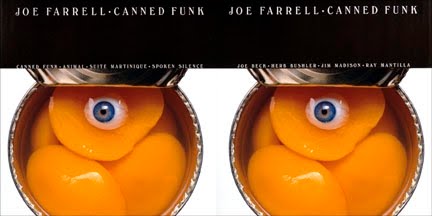
Wounded Bird, the great cult CD reissue label that has issued Freddie Hubbard’s forgotten CTI albums Polar AC (1974) and The Baddest Hubbard (1975) as well as Joe Farrell’s two post-CTI albums for Warner Bros., La Catedral Y El Toro (1977) and Night Dancing (1978), has announced that in late January it will release on CD for the very first time Joe Farrell’s CTI classics Penny Arcade (1974), Upon This Rock (1974) and Canned Funk (1975). All three albums, licensed from Sony Music, owners of the 1970-80 CTI catalog, are superb examples of first-class small-group jazz in the seventies, expertly recorded by legendary engineer Rudy Van Gelder and each cover featuring one of photographer Pete Turner’s striking images.

Penny Arcade showcases Joe Farrell with Herbie Hancock, who featured on Farrell’s previous CTI album Moon Germs and would come back for two numbers on Farrell’s 1978 album Night Dancing, on piano and electric piano, Joe Beck on guitar, Herb Bushler on bass and Steve Gadd, who first played with Farrell on several Gap Magione dates and would go onto play with the saxist on several Chick Corea albums and on Farrell’s La Catedral Y El Toro, on drums . The five-song program includes Joe Beck’s frenetic title song, which was edited for issue as a promotional single, Farrell’s “Hurricane Jane” and “Geo Blue” (all with Farrell on tenor sax), Farrell’s lovely Latinate “Cloud Cream” (with Farrell on flute and Don Alias added on percussion) and the album’s signature piece, a wondrous and definitive 13-minute reading of Stevie Wonder’s “Too High” (featuring Farrell on soprano sax). With great solos by Farrell, Hancock on electric piano and Bushler, “Too High” is not only one of the very best covers of this well-covered gem, it surely ranks as one of CTI’s finest moments. Hancock also solos magnificently on acoustic piano for “Cloud Cream” and on the “Maiden Voyage”-like derivation “Geo Blue.” Beck takes a rockish solo on “Penny Arcade” and beautifully trims “Geo Blue” with a lush solo that is jazzier than anything the guitarist was known to do at the time. Joe Farrell’s playing throughout is superb and reveals, yet again, that he could construct very interesting jazz compositions that inspire notable improvisation. “I Won’t Be Back,” a terrific Joe Beck bossa fusion that features Joe Farrell on flute (quoting “A Love Supreme”!), was recorded during these October 1973 sessions, but appears on Farrell’s next CTI recording, Upon This Rock.

Upon This Rock captures Joe Farrell on record with his own 1974-75 quartet, featuring guitarist Joe Beck, bassist Herb Bushler and drummer Jim Madison. The piano-less assemblage is considerably more rock oriented than previous Farrell outings, no doubt inspiring the album’s title, and driven home by Joe Beck’s consistently rock-edged guitar attack. Still, it’s a quartet that not only sounds comfortable mixing good rock ideas with solid jazz figures, but one that coalesces especially well together. Assembling at Rudy Van Gelder’s studio in March 1974, the quartet waxes three numbers included here, the leader’s “Weathervane” (featuring Farrell on soprano sax), the 12-minute funk-rock opus “Upon This Rock” (featuring Farrell on tenor sax and Beck, channeling Jimi Hendrix, overdubbing guitar parts) and Beck’s boogaloo “Seven Seas” (again with Farrell on tenor sax). The album’s title track in particular allows all four of the quartet’s members to contribute interesting commentary and is probably a highlight on an album brimming over with highlights. Upon This Rock is rounded out by Beck’s excellent 10-minute bossa fusion, “I Won’t Be Back,” recorded during the Penny Arcade sessions and nicely featuring Farrell on flute, Hancock sublime on piano and Beck, splendid on guitar.

Canned Funk finds Joe Farrell and his quartet, enhanced by Ray Mantilla’s percussion, providing the funk-rock sequel to Upon This Rock. While the “funk” in the title is as apt as the “rock” in the previous title was, the groove here is a bit more forced, or “canned” than it was before too. Whether by choice or by force, Farrell and company still lean heavily toward the rock side of things here. But the music, recorded at Rudy Van Gelder’s during November and December 1974, is a little less imaginative than it was before. Curiously, too, it is Farrell’s first full album of Farrell originals. But the rock back-beat takes over here and renders the music into near total dullness until the soloists come in to liven things up with a little interesting improvisation. The oft-sampled title track is probably familiar to anyone who knows anything about Joe Farrell or even CTI. The tune itself is not much, but the improvisations provided by Farrell (on tenor sax) and Joe Beck (on guitar) are worthy enough. “Animal” too has a clunky riff-based melody that the leader plays on tenor and overdubbed baritone sax that eventually yields to decent solos. Farrell, who never got the recognition he deserved as one of jazz’s finest and most distinctive flautists (check out Benson & Farrell and George Benson’s own CTI classic Good King Bad for further proof), doubles up flute parts for the looping “Suite Martinique,” but here again the overpowering backbeat nearly completely overwhelms the flautist’s fine solo. Things take a slight turn toward the “Midnight at the Oasis” pop-disco of the day with the album’s closer, “Spoken Silence.” Farrell returns here to tenor sax, very strongly suggesting another Farrell, Pharoah Sanders, in full spiritual regalia. That is until Beck and company chime in with a regrettably dated wakka-wakka rhythm guitar part and lots of stick work on the high hat. Beck does get inspired to provide his own spiritually beautiful solo here, though; something that brings him – and Canned Funk - back to the jazz these guys could do so well.

In all fairness, jazz music was experiencing a major shift in May 1975, when Canned Funk was released. Rock based jazz fusion had said just about all it was going to say – to be sure, Joe Farrell didn’t record this way again – and disco was then driving the market. Sure enough, the Joe Farrell quartet disbanded and Joe Beck successfully (or popularly) helped CTI go in that direction. Farrell himself would go this way when he accepted a million-dollar contract with Warner Bros. in 1977, recording disco and covering pop tunes by the Bee Gees and Rod Stewart, something he’d never done before. Canned Funk surely marks the end of an era.

Monday, November 29, 2010

Romolo Grano/Berto Pisano “Ho Incontrato Un’Ombra”

Digitmovies comes to the rescue of yet another fine and highly obscure Italian film score with this first-ever CD release of Ho Incontrato Un’Ombra, which translates as “I met a shadow” and is also known in English-speaking climes as A Blue Shadow. The 1974 RAI TV mini-series, directed by Daniele D'Anza and starring Giancarlo Zanetti, Beba Loncar, Laura Belli, Carlo Cattaneo and Renzo Rossi, is a romantic ghost story that had Italians “glued” to their television sets at the time.

Italian film music specialist, archivist and producer Claudio Fuiano credits the success of the drama to the film’s original soundtrack, which was written by Italian TV music composer Romolo Grano and beautifully arranged and conducted by Berto Pisano.

Pisano, himself a composer of some little renown for such internationally-known cult films as Kill (1970), La morte ha sorriso all’assassino (aka Death Smiled at Murder, 1973), Nude per l’assassino (aka Strip Nude for Your Killer, 1975), Malabimba (1979), Patrick Still Lives (1980) and Burial Ground (1981), sets a very nice mood here: romantic, yet haunting and lyrical, yet mysterious.

The surprisingly brief soundtrack to Ho Incontrato Un’Ombra, a mere 30 minutes, was issued as a promotional LP in Italy by the RCA-owned Pegaso label. So hardly anyone – even in Italy – has heard the entirety of this music, which was edited all sorts of different ways for the TV film, until now.

Pisano’s arrangement of the theme was issued as a 45-rpm record by the Italian Ricordi label, backed with “Tema di Silvia.” When “A Blue Shadow” turned into an Italian radio hit, a Berto Pisano album called A Blue Shadow was issued by Ricordi in 1974 featuring the two themes from the 45-rpm record and the film’s “Tema di Katerine” as well as several other Pisano performances and another Grano/Pisano TV movie theme, L’Edera. RCA even capitalized on the song’s hit potential by issuing their own 45 of the theme as performed by Romolo Grano’s own orchestra (this version is included on the CD).

Oscar Valdambrini’s plaintive and mournful trumpet elevates and elucidates the film’s lovely main theme, which gets additional variations on the soundtrack for solo guitar and harpsichord – not as many variations as so many other Italian soundtracks get of a main theme. But Pisano, who got his start as a jazz bassist, provides an intoxicating jazz groove to the proceedings that carries the score’s best themes. These include "The Anderson Tapes”-like “Tema di Katerine,” the Groove Holmes-esque “Night Shadow” and the funky “Working in the City” (undeniably a template for Pisano’s Nude per l’assassino theme), all featuring the great Valdambrini and some of Pisano’s most clever and alluring touches.

Such filmic compositions as “Waiting for Four,” “Tema di Silvia,” “Casa Abbandonata” and “Third Fear” all have an appealing Wait Until Dark (Henry Mancini) quality to them, offering a sort of tense romanticism or romantic tension that suits the story just perfectly. Interestingly, Pisano uses a Moog synthesizer to good effect on both “Tema di Katerine” and “Third Fear” to properly suggest the ghostly intervention that drives the story. The legendary Edda Dell’Orso lends her ethereal voice briefly to the most dramatic parts of “A Blue Shadow,” “Tema di Katerine” and “Tema di Silvia,” making these three themes pretty much the highlights of the overall soundtrack.

Ho Incontrato Un’Ombra surely ranks among some of the best soundtrack music produced in Italy during the 1970s and Digitmovies has done a superb job restoring this score – from the surviving master tapes – for CD release.

It is also another reminder of just how good one of the lesser lights of Italian film music, Berto Pisano, could be. Sure, Pisano could be derivative in the extreme. But even if his influences were obvious, it didn’t make it any less exciting to hear how well he could expand upon a riff or even improve upon a familiar theme.

Producer Claudio Fuiano has already bravely championed Pisano’s music by supervising all of the Berto Pisano soundtracks that have been issued on CD, including La morte ha sorriso all’assassino (1973) and La svergognata (1974) for Digitmovies.

Here’s hoping that the excellent restoration of Ho Incontrato Un’Ombra will prompt even more of Pisano’s music to see the light of day on CD. My vote includes the mid-70s material issued on Ricordi (A Blue Shadow, Ideas and the fantastic 45 of “Flowers,” from the Italian TV film La Traccia Verde b/w “Grey Moustache”) and, of course, the never issued soundtrack to Nude per l’assassino.