Saturday, July 10, 2010

Manny Albam "Jazz Goes to the Movies"

You couldn’t help being impressed listening to arranger Manny Albam (1922-2001) and many were, including Gerry Mulligan, Stan Getz, Coleman Hawkins, Joe Lovano, Dizzy Gillespie, and even Leonard Bernstein. The trouble is that not too many people have heard of Manny Albam, much less heard or even remember Manny Albam.

Sadly, while Manny Albam was a busy and active arranger in the 50s and 60s, he released very few albums under his own name. Even though all of Albam’s albums are studded with some of the greatest names in jazz and are speckled with some of the nicest orchestral jazz writing ever heard, sadly none of these records became enough of a hit to warrant much historical attention except to completists of certain players.

Fortunately, the tide has shifted recently with a number of Albam’s albums of the fifties seeing the light of day on CD, courtesy of the Spanish Fresh Sound label. Even if it’s only because ownership of the music has shifted into the “public domain,” there is something comforting about knowing this music is finally receiving the loving attention it so richly deserves.

Albam got his start as a baritone saxophonist in the orchestras of George Auld, Lee Castle, Herbie Fields and Les Elgart in the forties, eventually graduating to Charlie Parker’s notorious – and beautiful – “with strings” album in 1947. Soon the saxophonist took up arranging and worked with the bands of Charlie Barnet, Buddy DeFranco, Charlie Spivak and Stan Kenton. Albam showed a special predilection for vocalists, working with Ruth Price, Ella Fitzgerald and Jackie Paris.

Eventually Albam went on to work with Woody Herman, Count Basie, Al Cohn, Don Elliott, Joe Newman and Terry Gibbs before launching his debut album, The Jazz Workshop (RCA, 1955), with such old-hand compadres as Joe Newman, Nick Travis, Bob Brookmeyer, Billy Byers, Al Cohn, Sol Schlinger, Milt Hinton and Ossie Johnson.

In addition to launching a fairly active career of all-star dates for the RCA label as a leader and in-house arranger, this record set Albam on to even higher profile gigs with Gene Krupa, Johnny Mathis, Coleman Hawkins, Woody Herman, Terry Gibbs and Candido.

By the early 1960s, the world’s best jazz musicians were plying their trade in New York City. The majority of the great jazz labels were doing all their recording in New York, where the musicians gigged (for TV and Broadway), played all the famous clubs (Birdland, the Village Vanguard) and got paying sessions recording a myriad of jazz, pop, easy listening and (sometime) classical records. All the great arrangers were there too. And by 1962, Manny Albam was one of the veterans.

Impluse! Records, launched earlier the previous year by Creed Taylor who had already left the label to head up the legendary Verve Records, which had been recently sold by Norman Granz to MGM, offered Albam a one-shot deal (Impulse! didn’t do multi-record deals in its early days) to record an album of movie themes. The jazz-does-Broadway fad was quickly dying out – mostly because they were running out of memorable musicals to cover – and with MGM’s purchase of Verve, it was assumed that jazz for that label would help promote the film company’s movies…so jazz-goes-to-the-movies seemed like the logical next step.

Manny Albam was the man for the job. He assembled an utterly amazing, seemingly godlike cast of New York session superstars including Johnny Coles, Joe Newman, Clark Terry, Bob Brookmeyer, Urbie Green, Phil Woods, Gene Quill, Oliver Nelson, Jim Hall, George Duviver, Eddie Costa and George Devens to tackle some of the film “hits” of the day (while the films may have been “hits,” it’s a stretch to say that many of the film themes heard here were ever hits).

Spurred on, perhaps, by Eddie Harris’s surprise (and well-done) hit cover of Ernest Gold’s “Exodus,” Albam’s program opens with this unusually jazz-worthy theme, a crossing of 12/8 and 4/4 lines that predate the odd time signatures Don Ellis later proffered with his orchestra. Albam’s arrangement is a little more militaristic than Harris’s, but in a way that would not sound unfamiliar to the spy-jazz lovers of Mancini’s Peter Gunn, especially mid-way into things when Albam breaks the band into an all-out rocking full-tilt swing of great orchestral writing. Johnny Coles on trumpet, Phil Woods on alto sax and Eddie Costa on vibes all take exhilarating solos.

The only other “jazz” oriented theme here is Duke Ellington’s tremendous yet too-little known “Paris Blues” – whose original soundtrack recording from May of the previous year also included future film composer Oliver Nelson, who is heard here too (Nelson himself covered the tune later that year for his own album Full Nelson). Ruddered by Bob Brookmeyer’s sensual trombone, there is some fine “noodling” (Albam’s word), again, from Costa, Coles and Woods.

The remainder of the program is decidedly odd for a jazz setting. But Albam makes it work extraordinarily well. His horn parts are sublime, well-crafted and always swing with a pleasurable ease that the players take to like children to sweets.

Albam features film music of the classic “golden age” film composers and constructs a particularly lovely program that almost seems tailor-made for dancing, including Dimitri Tiomkin’s “High Noon” (1952), featuring Bill Crow’s bass, “The Guns of Navarone” (1961), featuring Bob Brookmeyer’s trombone and Oliver Nelson’s tenor sax and “Green Leaves of Summer” (from The Alamo, 1960), featuring Jim Hall’s acoustic guitar, Bob Brookmeyer’s trombone and Johnny Cole’s trumpet, Max Steiner’s exceptionally fiery “Majority of One” (1961), featuring Joe Newman’s trumpet, Nino Rota’s “La Dolce Vita” (1960), with Gene Quill’s alto sax and Clark Terry’s “Sweet life” flugelhorn, Miklos Rozsa’s “El Cid” (1961), featuring Cole’s trumpet, and David Raksin’s “Slowly” (from Fallen Angel, 1945), a marvelous slow burner highlighting Eddie Costa on piano and Jimmy Raney on guitar.

It’s Albam’s arrangements – most striking on the seemingly un-jazzy “Exodus,” “Majority of One,” “The Guns of Navarone” – and the tremendously high level of section playing and economical improvisation that make Jazz Goes to the Movies so worthwhile. It’s a too-brief achievement (totaling only half an hour of music) that never made much of a wave in the ocean of orchestral jazz of the period and, subsequently, has yet to find life in the CD generation but is worth tracking down for the high-grade of orchestral jazz it presents.

Albam went onto to work with Curtis Fuller, Coleman Hawkins, Zoot Sims and Oscar Peterson before becoming “musical supervisor” for Sonny Lester’s Solid State Records, which issued his follow up to Jazz Goes to the Movies, Brass on Fire (1966) and, his pièce de résitance, the even grander and more remarkable The Soul of the City (1966 – issued in full on the 1998 LRC CD titledSketches of Jazz: Music From The Book of Life, with 8 of the 12 tracks from Brass on Fire).

Manny Albam’s name sort of disappeared from records after this as he became much more engaged in education, though he continued actively arranging records for Solid State in the 1960s and Lester’s Groove Merchant label in the 1970s. Late in his career, he staged a comeback of sorts arranging for a variety of jazzers like Hank Jones, Bud Shank, Joe Lovano (Celebrating Sinatra) and The Danish Radio Big Band and such vocalists as Eileen Farrell and Nancy Marano.

Jazz Goes to the Movies is a winner.

Wednesday, July 07, 2010

“Work Song” and “Upright Man” by Bill Laswell

Just in case you forgot, Bill Laswell is one of the funkiest-ever bass players. No matter whether he’s playing jazz, pop, death metal, avant garde, ambient dub, whatever, this man can create a bass line that envelopes you to no end and makes you forget there’s even a name or a genre to the music you’re experiencing.

From very early in his multi-faceted career come these two funk-jazz classics which appear on his very first solo album Baselines (originally issued in the US in 1983 on the Elektra Musician label).

“Work Song” is a genuine classic. Aside from Laswell’s intoxicating lines on a number of different basses – which, taken together, has that unique something that Parliament’s “Flash Light” first suggested several years before – “Work Song” features Laswell’s fellow Materialist Michael Beinhorn on synthesizer and tapes, Ralph Carney (who I knew then as part of the great Waitresses aggregate) on baritone sax, George Lewis on trombone, the remarkable Phillip Wilson on drums and Daniel Ponce on congas. Beinhorn, Wilson and Ponce, of course, did many recordings with Laswell during this time. But “Work Song” ranks as one of their best.

“Upright Man” is another classic, recalling some of the better-known work of David Byrne and Brian Eno’s earlier My Life In The Bush of Ghosts. It features Michael Beinhorn on synthesizer and tapes , frequent Material collaborator Martin Bisi on drums and Daniel Ponce again on congas. “Upright Man” is a total downtown groover that suggests what would have happened if Chic, or at least Nile Rodgers and Bernard Edwards, had ever taken their groove into a progressive art-rock direction.

Baselines is a rewarding album that has even more exciting performances. It’s been issued by a few label on CD and should be easy enough to find on iTunes.

Tuesday, July 06, 2010

"Midnight Soul Patrol" by Quincy Jones

Here’s a great funk track from one of Quincy Jones’s least known albums, 1976’s I Heard That! Coming several years after the great composer, arranger, producer and svengali “resigned” from scoring films in 1972 and several years before he started working with Michael Jackson, I Heard That! began life as a monumental “evolution of black music” concept.

Somewhere along the way, either Q gave up or A&M got restless (it had been two years since his previous album, Mellow Madness, which was something of a hit in its day) and the double album that was finally issued featured two sides of new material and two sides of previously-recorded material – side three is called “Award Winning Side” ("Summer in the City," "Is It Love That We're Missin," "Body Heat" and "If I Ever Lose This Heaven") and side four is called “Grammy Winning Side” ("Killer Joe," the brilliant, but edited "Gula Matari" and "Walking in Space" from his CTI albums - also "Theme from 'The Anderson Tapes'"). The two sides of new material are hardly earth-shaking and certainly unlike anything evolutionary. But the new music, recorded in LA during three sessions in May 1976, contains much worthy material, including this lyrical little funk gem.

“Midnight Soul Patrol” was written by Quincy Jones, Louis Johnson and Dave Grusin(!), and features a stunning line-up of performers including Q himself on ARP String Ensemble, Dave Grusin on Moog synthesizer, George Duke on Fender Rhodes and Moog synthesizer, Louis Johnson on guitars and Fender bass, Stanley Clarke on piccolo bass, Alphonso Johnson on fretless bass, Billy Cobham on drums and synth drums plus a horn section featuring Snooky Young on trumpet, Jerome Richardson on flute and the Seawind horns (Jerry Hey on trumpet, Bruce Fowler on trombone, Larry Williams on tenor sax and Kim Hutchcroft on baritone sax).

My guess is that all three of the keyboardists solo here plus Louis Johnson is (probably) featured on bass and Jerome Richardson solos briefly on flute at the end. It’s a melodic jam piece that really allows the various players, many of whom are plugged in, just go for it, and rather nicely too.

I would have also liked to post the album’s title track, a brief Quincy Jones/Dave Grusin funk collaboration featuring Grusin on ARP synthesizer with guitarists David T. Walker and Carol Kaye, bassist Chuck Rainey, drummer Paul Humphrey and Richard Tee on clavinet, Snooky Young on trumpet and Q’s brief-lived vocal group The Wattsline (Charles May, Sherwood Sledge, David Fridgen, Rodney Armstrong and Mortonette Jenkins), but it hasn't made it onto YouTube yet.

Thursday, July 01, 2010

Agatha Christie’s Poirot - Series 10

Agatha Christie’s Poirot – An Introduction
Agatha Christie's Poirot - Series 1
Agatha Christie’s Poirot – Series 2
Agatha Christie’s Poirot – Series 3
Agatha Christie’s Poirot – Series 4
Agatha Christie’s Poirot – Series 5
Agatha Christie’s Poirot – Series 6
Agatha Christie’s Poirot – Series 7
Agatha Christie’s Poirot – Series 8
Agatha Christie’s Poirot – Series 9

1. The Mystery of the Blue Train (first broadcast January 1, 2006): American millionaire Rufus Van Aldin dearly loves his daughter, Ruth Kettering, but recognizes how unhappy she is with her philandering husband, Derek. Rufus then gifts Ruth with the fabulous Heart of Fire ruby and promises, with the help of his secretary, Major Knighton, to rid Ruth of her husband. Ruth, for her part, is secretly involved in an affair with the Comte de la Roche, with whom she is deeply in love. She plans to travel with her maid, Mason, to the South of France by the Blue Train to be with the Count. Meanwhile, Katherine Grey, an English companion, inherits a large fortune from the lady who was formerly in her charge. A long lost cousin, the wealthy and well-known Lady Rosalie Tamplin, invites the former servant girl to stay with her and her daughter at the fabulous Villa Marguerite on the Riviera. Katherine decides, after a lifetime of hard work, she would like to travel and sets about to the south of France via the Blue Train. Also aboard the Blue Train is the renowned detective Hercule Poirot. Following the journey and upon arrival, it is discovered that Ruth Kettering has been brutally murdered. While Poirot assists the authorities in their investigations, Major Knighton finds that he has fallen in love with Katherine Grey.

First published in 1928, The Mystery of the Blue Train is an expanded version of the 1923 Poirot short story “The Plymouth Express,” filmed in 1991 during the third series. The major characters are very similar in both stories, with quite a bit more backstory provided, naturally, for Blue Train. The two stories even share the name of one of the guilty co-conspiritors. Like Murder on the Orient Express (1934) – and 4.50 From Paddington (1957) for that matter – the murder happens aboard a moving train and like Murder on the Links (1923) and Death in the Clouds (1935), the murder happens in France. France is indeed more picturesque in the telling here than the actual journey on the titular train. The author evidently struggled with the novel for some time before and after her famously mysterious disappearance (later chronicled in the fictitious film Agatha), expressing dissatisfaction with it very shortly after publication and, later, considering it one of the least favorite of her own novels. It is, to be sure, only a marginally satisfying thriller and not the sort of thing that ranks among the author’s best. While many of the story’s characters have backgrounds that are far too unbelievably bizarre and connections to one another that are suspiciously coincidental, the murder victim, Ruth Kettering, has a striking lack of personality. Even her aggrieved father, who spoils her in life out of a deep love for her, seems to care less for her fate than in seeking a long-standing vengeance upon his detestable son-in-law. Like the worst Christie, The Mystery of the Blue Train is not about justice or compassion for the victim. It’s about a clever crime and its ultimately brilliant solution. One thing the story does do well, however, is to suppose that the murder and the theft of the rubies might be two crimes, committed separately. But even this points out the obvious question. Why bother to kill Ruth Ketterling at all? And all the rigamarole about the imitation stones is plotted with such obfuscation as to be ridiculous in the end.

The screenwriter, Guy Andrews, probably recognizing the novel’s weaknesses made quite a number of sweeping changes to the story, retaining only the names, the train, the murder and the guilty culprits of Agatha Christie’s original story. Andrews, who also wrote the screenplays for Taken at the Flood (2006) and Appointment With Death (2008), concocts a fanciful story that puts nearly all the cast on the train, which, like Orient Express, deliciously ups the number of potential suspects. Poirot, introduced much earlier in the film than the novel and meeting the murder victim before her demise, here volunteers to serve as Katherine Grey’s “avuncular.” There is an elaborate birthday bash for Ruth, which first brings most of the characters together and an elaborate backstory involving Ruth’s mother, neither of which is in the novel and the “dancer” Mirelle is here involved with Rufus rather than Derek. All of the complicated background involving “The Marquis” and Demetrius and Zia Papopolous is thankfully dismissed in favor of changing Charles “Chubby” Evans to Corky, involving Derek in a gambling debt to the Count, creating a huge party/sensation at Villa Marguerite where “everyone” is invited, having Corky find the imitation ruby and fashioning an unlikely murder attempt on Katherine. Here, Poirot is witness to certain events on the train that Katherine is witness to in the novel and Ruth coerces Katherine to switch compartments on the train, which leads the detective to publically surmise that Katherine may have been the intended victim.

This analysis only skims the surface of the changes the film makes to the novel. But it comes off pretty well, all in all, in the end. Andrews fashioned a reasonable script that simplifies the original in mostly appropriate ways. Directed by Heddie MacDonald, who directed the feature film Beautiful Thing (1996) as well as the 2008 Marple film Murder is Easy, The Mystery of the Blue Train benefits by a fair bit of attractive location shooting in Nice and some generally good performances from its exceedingly well-chosen cast. The train platform exteriors where shot in England at the same place that houses another blue train, Thomas the Tank! Unfortunately, the direction suffers from a bit too much handheld camera work, which was no doubt used to provide the spying sense that “you are there” while things are happening. After a while, though, the cut-off heads and jiggly-frame dynamics just become distracting and annoying.

The cast is well chosen and well highlighted by headliner Elliott Gould, the great American actor known for many films such as M.A.S.H., the Oceans films and, most notably, as Philip Marlowe in Robert Altman’s brilliantly seductive 1973 film The Long Goodbye - not to mention his numerous TV appearances. As Rufus, he brings the right amount of pathetic paternal love to his role, even if he seems not the type to have been the crafty possessor of the Van Aldin millions – the exact opposite of Vernon Dobtcheff, who portrayed the appropriately named pater familias, Simian Lee, in the 1995 Poirot film Hercule Poirot’s Christmas. The exquisitely handsome and exceptionally talented James D’Arcy, who is perfectly cast as the devilishly attractive Derek Kettering, also appeared in the 2006 Marple film The Moving Finger while Nicholas Farrell (Major Knighton) also appeared as Donald Fraser in the 1992 Poirot film The A.B.C. Murders and Lindsay Duncan (who plays Lady Tamplin perfectly like Absolutely Fabulous’s Edina Monsoon) also appeared as Marina Gregg (!) in the 2010 Marple film The Mirror Crack’d From Side to Side. Jane How (the unnamed, gossipy lady at the birthday party) also appears as Lady Veronica in the 2009 Poirot film Cat among the Pigeons.

2. Cards on the Table (first broadcast December 11, 2005, in the US, and March 26, 2006, in the UK): The mysterious and wealthy eccentric, Mr. Shaitana, proposes to host a dinner party and invites four acquaintances who he believes have escaped justice for their murderous crimes: Dr. Roberts, Mrs. Lorrimer, Major Despard and Miss Meredith. To this party Shaitana also invites four “detectives,” a police officer, a secret service agent, a writer of crime fiction and Hercule Poirot, who by his own admission, is the greatest detective in the world. A discussion of murder naturally ensues over dinner. Afterwards, Mr. Shaitana invites Dr. Roberts, Mrs. Lorrimer, Major Despard and Miss Meredith to the drawing room for a game of bridge. In another room, Shaitana sets up a bridge game for the other guests, but declines to participate himself. At the conclusion of the evening Mr. Shaitana is discovered dead in the drawing room, with a stiletto rammed clear through his heart. Clearly a case of murder, the detectives set about determining which of the four card players in the drawing room could have possibly committed the murder without detection. It emerges that the investigation will need to determine the validity of Mr. Shaitana’s claim that each of the suspects has a murder in their past and whether Mr. Shaitana’s murder was committed to keep this fact from emerging.

First published in 1936, Cards on the Table is one of Agatha Christie’s most clever and well-plotted novels. Perhaps it succeeds so well since, like Five Little Pigs, another one of the author’s best, there are only a limited number of suspects; in this case, four. Astutely constructed like a card game, the story presents the machinations of each character as if they’re players in a game. Bridge factors frequently throughout Agatha Christie’s work (“The Incredible Theft,” “The King of Clubs” and Evil Under The Sun) and the author is fond of using the psychology of card playing as a metaphor as she does in Thirteen for Dinner (chapter 14) and The Hollow (chapter 8). Here, though, there are literally and symbolically two games at play: one among the suspects and one among the detectives. The book’s title probably refers to the literal game among the suspects that disguises the story’s primary crime as well as the symbolic game among the detectives, where each gathers information using their own methods and puts their “cards on the table” for the benefit of the other investigators. Poirot’s method allows the others to do the legwork while he regards bridge scorecards and cunningly asks each suspect to describe the room where the murder occurred. This permits him to assess the character of the suspects, determine what kind of a killer each is and match Shaitana’s murder to his murderer.

Cards on the Table marks the very first appearance of Ariadne Oliver, who in chapter two is credited with writing a book called The Body in the Library, a title her creator would use for a 1942 Miss Marple novel. In this film, and later ones, Mrs. Oliver is perfectly portrayed by the wonderful Zoë Wannamaker. The novel also reintroduces Colonel Race, who first appeared in the author’s The Man in the Brown Suit (1924) and would later appear in Death on the Nile (1937) and Sparkling Cyanide (1945). As James Fox, who appeared as Colonel Race in the 2004 Poirot film Death on the Nile, was unavailable for this film, the character’s name was changed to Colonel Hughes and he was portrayed by actor Robert Pugh. The author also brings back Superintendint Battle from The Secret of Chimneys (1925) and The Seven Dials Mystery (1929) for his only foray with Hercule Poirot. Among the many sweeping changes Nick Dear’s screenplay makes to Christie’s characters, the stolid Battle for some reason here becomes Superintendent Wheeler of a suspiciously dodgy character. Aside from a reference to The A.B.C. Murders in chapter 2, it is interesting to note that the knife Poirot wants to show Rhoda Dawes in chapter 23 of the novel is the very knife used in Murder on the Orient Express (1934) – something the film is unable to reference since the series had not yet got around to this particular story. Agatha Christie also presents Shaitana, in many descriptions, as the polar opposite of Hercule Poirot – two different sides of the same coin – an interesting, though only speculative, idea of consideration.

Scripted by Nick Dear in his second Poirot outing, the 2005 film of Cards on the Table gets an interesting and mostly feasible overhaul. Without changing the story or Shaitana’s murderer, Dear changes quite a number of other facts from Agatha Christie’s original novel. Most notably, there are the name changes mentioned above and the introduction of a number of homosexual suggestions. There are also reasonable changes to the nature of relationships between Ann Meredith and Rhoda Dawes, Mrs. Lorrimer and Miss Meredith and Dr. Roberts and Mrs. Craddock. In all cases, Dear provides a great deal of sensibility that improves upon Agatha Christie’s structure, especially given Mrs. Lorrimer’s confession of guilt in the murder of Shaitana. The nature and methods of both Major Despard and Miss Meredith’s earlier crimes (making them both much more guilty than the film) and Mrs. Lorrimer’s remarriage (explaining the difference in the names in the film between her and her daughter) are also quite different in the film and, again, quite a bit more sensible than in the novel. Dear’s additions, however, don’t always succeed as proven by the absurd sleeping draught in Shaitana’s drink, the break-in at Shaitana’s home after his death, the suspicion (and the guilt!) thrown on the supervising investigator and the whole issue of suspicious photographs and the presence of the curiously flaming “art” photographer Serge Mureau (Douglas Reith). Fortunately, Dear provides wholly different fates for Mrs. Lorrimer and Miss Meredith than Agatha Christie originally conceived, - and leaves out the ridiculous “witness” Gerald Hemmingway – but leaves in quite a lot of the author’s witty dialogue, most prominently Poirot’s line to Mrs. Lorrimer, superbly delivered by Suchet with righteous indignation: “Always I am right. It is so invariable that it startles me.” But all of the best and most memorable dialogue – and delivery – here come from Zoë Wannamaker’s pristine Mrs. Oliver.

Cards on the Table was directed by Sarah Harding in her only Poirot outing. It is a handsomely mounted and most eloquent production, with several moments of artful grace, such as the gallery scenes and the scene of the four detectives as they alight from Shaitana’s home the morning after the murder. Funny to note here that Shaitana’s house is also the same house where Lord Edgware resides in Lord Edgware Dies. In only his second Poirot film, composer Stephen McKeon notably melds Shostakovich’s Jazz Suite No. 2 with notable Philip Glass-like highlights to create a most enchanting score that adds immeasurably to the proceedings.

The sterling cast suits Agatha Christie’s novel to a tee, from Zoë Wannamaker’s Mrs. Oliver to each of the four suspects. Alex Jennings (Dr. Roberts) also appears as Inspector Curry in the 2009 Marple film They Do It With Mirrors while Lucy Liemann (Miss Burgess) also appears as Sonia in the 2008 Poirot film Third Girl. Lyndsey Marshal (Miss Meredith) also appears as Amy Gibbs in the 2008 Marple film Murder is Easy while both Zoë Wannamaker (Ariadne Oliver) and Robert Pugh (Colonel Hughes) appear in the 2005 Marple film A Murder Is Announced.

3. After The Funeral (first broadcast March 19, 2006, in the UK, and March 26, 2006, in th US): After the funeral of Richard Abernethie, his family gathers for a reading of the will. Although Richard’s death was sudden, it was not unexpected, but everyone is shocked when Richard’s eccentric sister, Cora, suddenly announces that Richard Abernethie was murdered. While no one has seen Cora for many years, everyone still thinks she’s as “batty” as she was when she was younger, saying anything she felt, whether it was appropriate or not. But was Richard Abernethie’s death really murder? Even though every one in the family benefitted equally by Richard Abernethie’s will, each had very specific needs and wants for their portion of the vast estate and, subsequently, a motive for wanting the old man dead. The very next day, Cora’s companion, Miss Gilchrist, discovers that Cora herself has been brutally murdered. Since Cora’s death was clearly murder, an investigation begins. Shortly soon thereafter Miss Gilchrist receives a piece of cake laced with arsenic. She doesn’t eat enough of the poisoned cake to die, but Hercule Poirot begins to make sense of the maze of the murderous intention that infects the Abernethie family after Richard Abernethie’s funeral.

First published in 1953, After the Funeral was published in the United States that year as Funerals Are Fatal. It is a peculiar mystery that uses post-war Britain as a primary setting and one, notably, for criminal motivation. One could say the title might actually stand to represent England “after the fall.” Even though the author’s saga is set, as so many often are, among the gentry – or former gentry – it is clear that she means to communicate the very real toll the British people suffered after WWII. While After the Funeral is, sadly, one of the author’s less noteworthy efforts, a number of favored themes are revisited here, particularly in the use of disguise as deception and specifically that of a domestic disguised as the person they serve such as is portrayed in The Mystery of the Blue Train (1928) and Taken at the Flood (1948). After the Funeral also twists the author’s notion from Death in the Clouds (1935) that nobody pays attention to a servant. The issue Christie rasies with the nuns is a little confusing and questionably meaningless as presented here but the whole idea of mirrors reflecting and reversing clearly recalls the denoument of Dumb Witness (1937), though not 1952’s They Do It With Mirrors, as this particular title might suggest. The novel received its first film treatment with 1963’s Murder at the Gallop, replacing Hercule Poirot with Margaret Rutherford’s somewhat ridiculous Miss Marple and any suspense with sight gags and belabored slapstick comedy. The novel was also published under this title in 1963 to help promote the film.

The Granada film is markedly more faithful to Agatha Christie’s source novel than the previous film but benefits by a number of Christie-like embellishments that, rather remarkably, strengthen the basic story. Devilishy well-scripted by Philomena McDonagh in her only Poirot outing, After the Funeral is completely stripped of its post-war atmosphere by being set, as the bulk of the Poirot series is, in the mid 1930s. This refocuses attention away from the author’s overwhelming social commentary back to her skillfully derived murder mystery. The changes made to the story show that McDonagh knows her Agatha Christie quite well. References are made to other stories, in dialogue (“properly putting the cat among the pigeons”) and even in the story’s plotting. A will is forged (recalling “The Case of the Missing Will”), a question of paternity ensues (recalling They Do It With Mirrors, which, like After the Funeral, also has a theatrical angle, and Hercule Poirot’s Christmas) and papers go missing (“The Case of the Missing Will” again). Even the character of Susan changes here to Susannah, a missionary (similar to Taken at the Flood’s Lynn and a cross between Angela from Five Little Pigs and Violet from, again, “The Case of the Missing Will”). Other modifications the film makes to the book include changing Cora Lansquenet, a French man’s widow, to Cora Gillaccio, whose Italian ex-husband serves a role in the film given to Alexander Guthrie in the book. George Crossfield becomes George Abernethie, the private investigator, Mr. Goby, is left out altogether and Poirot’s deception as M. Pontarlier is well dispensed with here. The script also does away with sending Miss Gilchrist to her next “situation” at Timothy Abernethie’s and changes the hidden Vermeer painting to a hidden Rembrandt painting, probably because Rembrandt’s name has more cache than Vermeer’s to a contemporary audience.

Maurice Philips’ direction here is outstanding. Rife with wonderfully well-composed shots that offer much movement and energy, it would seem that this is one of the few Poirot films that was storyboarded. The gracefully choreographed tracking shot at the beginning of the film during the post-funeral scene at Enderby recalls Orson Welles’ still-stunning opening scene from Touch of Evil (1959). The camera swoops around the rooms, in between people and among conversations, like a bird taking it all in. Absolutely appropriate, that, as the scene’s central character, “Cora,” is not only described as “bird like” but flutters around like one and is considered cuckoo and batty by even her own family. Philips prominently plants the wax flowers in his mise-en-scene much as Christie plants all her significant clues for astute readers in the books and does a much more effective job of suggesting the importance of the nuns to the story than even Christie does in the book. Filmed on location at the uniquely magnificent Rotherfield Park mansion in Hampshire, which serves here as Enderby and has also served as Manderley in the 1997 film of Rebecca and as the site of the Scottish wedding in Four Weddings and a Funeral (1994), there’s a grand opulence that probably wasn’t right for suggesting a decaying, dysfunctional family such as the Abernethies. Still, it’s all very beautiful and Philips does a marvelous job taking full advantage of the home’s inner and outer beauty.

After the Funeral contains some commendably fine performances and an especially impressive cast that includes Geraldine James (Ghandi, Jewel in the Crown and Blott on the Landscape with David Suchet), Robert Bathurst, Michael Fassbender (300, Inglourious Basterds), Lucy Punch (Hot Fuzz) and Julian Ovenden (Foyle’s War). But no performance here matches or exceeds the excellent one Monica Dolan delivers as the mad-as-a-hatter Miss Gilchrist. The film probably shortchanges Ms. Dolan of some of the scatty dialogue she gets in the book: boring stories about her tea shop and always getting cut off when she begins to talk about her aunt. But Ms. Dolan’s delivery effectively conveys these misconnections with an economy of words. Simply listen to the astoundingly arch way Ms. Dolan says “sorry” each of three times. Monica Dolan’s performance, particularly during the shivery denoument, ranks among one of the very best in all of the Poirot films. It is a magnificent performance that leaves the viewer gaping with the same amount of utter shock as the Abernethie family. John Carson (Richard Abernethie) also appeared as Sir George Carrington in the 1989 Poirot film The Incredible Theft while Anthony Valentine (Giovanni Gallaccio) appeared in the 1982 TV film Murder is Easy and Benjamin Whitrow (Timothy Abernethie) appeared in the 1983 Agatha Christie’s Partners in Crime episode “Finessing the King.”

4. Taken at the Flood (First broadcast April 2, 2006): Major Porter tells Poirot the story of the wealthy Gordon Cloade who take a young wife, Rosaleen, herself the widow of an associate of Porter’s named Robert Underhay. Porter elaborates that just before Cloade’s family could meet Rosaleen, his London flat was decimated by a blast that killed Gordon Cloade and all his servants. Only Rosaleen and her brother, David Hunter, escaped the blast with minor injuries. Gordon Cloade had always devoted himself to taking care of all the financial needs of his brothers, sisters, nieces and nephews. But as Rosaleen and David have taken residence in Furrowbank, Gordon Cloade’s home, the Cloades, to their dismay, discover Rosaleen is completely under the control of her brother David, who refuses to give the Cloades any of the money they want or ask for. There are hints and hopes that Rosaleen’s first husband, Robert Underhay, isn’t dead as previously presumed and one of the Cloades engage Poirot to track down Underhay to invalidate Rosaleen’s marriage to Gordon so that the Cloades can gain control of Gordon’s vast estate. Suddenly, a man calling himself Enoch Arden contacts David Hunter suggesting that Robert Underhay is indeed alive and in need of costly medical attention. Arden proposes a blackmail scheme in order to keep the Cloades from knowing the truth of Robert Underhay’s existence. Hunter agrees to pay. Then Enoch Arden is discovered murdered, with his head bashed in. It is revealed that Enoch Arden is a false name and as it is a symbolic choice, it is surmised that the man is in fact Robert Underhay. At the inquest, Rosaleen confirms that Enoch Arden was not Robert Underhay. But Major Porter convinces the coroner that the man was indeed his friend, Robert Underhay. Since only David Hunter had a motive to kill Enoch Arden, he is arrested for the murder. But then Major Porter commits suicide. Poirot begins to untangle the web of death that is “all the wrong shape.”

First published in 1948 in the U.S. as There is a Tide and later that year under Agatha Christie’s originally preferred final title Taken at the Flood, this story’s two titles originate out of the same quote from Shakespeare’s Julius Caesar in a speech by Brutus in Act IV: “There is a tide in the affairs of men, which taken at the flood leads to fortune.” The quotation, spoken aloud by Poirot himself in Book II, Chapter 14 (and again in Chapter 16), philosophically muses upon the interaction of fate and free will. As both Agatha Christie and her American publisher have explicity referenced the text in the story’s title, the meaning relates specifically to a significant choice David Hunter has made and generally reflects upon the choices of each Cloade, who has sublimated responsibility for their own fates to the money Gordon has always provided. The American title, which was also one of the draft titles Christie herself used, simplifies the reference by suggesting the money everybody needs to “tide” themselves over – or, possibly, the overwhelming nature of “bad tidings” each of the characters have for one another - rather than enforcing the guesswork that might go into the artistic but abstruse nature of the British title. Like After the Funeral, the narrative of Taken at the Flood is very much affected by post-war Britain. But rather than war taking something away from the criminally minded as suggested by After the Funeral, Taken at the Flood postulates war providing opportunity for crime. While even Poirot recognizes the Shakespearean elements of the story, the nature of the Hunters also strongly evokes the Stapletons from Arthur Conan Doyle’s The Hound of the Baskervilles, a common reference point for many of Agatha Christie’s stories. The literary references don’t end there, though. The “Enoch Arden” character takes his name from the 1864 Tennyson poem where a man goes off to sea for many years and returns to find his wife, presuming he has died, has married his childhood rival (it has since assumed the name of a marriage law in the United States). Taken at the Flood is certainly one of Agatha Christie’s most intricately plotted murder mysteries and one of her most entertainingly perplexing reads. Although she peoples yet another dysfunctionally detailed family unit of the British well-to-do, she creates remarkably unique characterizations and recycles very little from previous plots except the question of Enoch Arden’s identity revisiting a “who is the corpse” question the author also successfully posed in the plot of One, Two, Buckle my Shoe (1940). The author also introduces here Superintendent Spence, who would again appear in Christie’s very next Poirot novel, Mrs. McGinty’s Dead (1952) and later returns for the Poirot adventures Hallowe’en Party (1969) and Elephants Can Remember (1972).

Scripted by Guy Andrews, who previously dramatized The Mystery of the Blue Train, Taken at the Flood feels remarkably faithful to the original text, but has endured many changes to Christie’s original. Most notably, in order to keep the Poirot films located in the 1930s, the blast that kills Gordon Cloade and others is caused by considerably different forces in the film than the book – resulting in a now pointless title and a far more evil criminal than even Agatha Christie conceived. But it does tie the murderer back to the murderer of The A.B.C. Murders, who murders many innocents to disguise the murder of just one person. The film does away with several deceased and unnecessary characters from the book and oddly changes “Kathy Cloade” to “Kathy Woodward,” making Kathy and Adela sisters, though both she and her husband, Lionel, are listed in the film’s end credits as Cloades, as they are in the book. Here, Lynn has had a long-standing relationship with Poirot, which acquaints the detective with the Cloade family, a relationship that did not exist in the book. Also added to the film are threatening phone calls to Mrs. Gordon Cloade, Rosaleen’s drug habit (which makes a great deal of logical sense to the story) and the nature of Rosaleen’s fate – though the individual responsible for her murder in the book is the same as the one who attempts to induce her to commit suicide in the film. Major Porter’s suicide is handled a little differently in the film, probably to make it easier for viewers to understand how Poirot arrives at the reason behind the suicide. But this “spelling it out” of Poirot’s methods is confounded by the script having the detective surmise about the identity of Enoch Arden and Eileen Corrigan without essaying any of the investigative background to substantiate his conclusions. Other “fixes” include the changes of the “clue” left in Arden’s room and who left it there, the budding but unrequited relationship between Rowley and Rosaleen, the young widow’s abortion, the phony threat David Hunter makes at the film’s denoument (not in the book) and Lynn leaving for Africa rather than reuniting with Rowley. Several of Andrews’ clever additions include the alibi of the two sisters playing the symbolic game of hangman – hanging punishes a murderer in the film who does not hang in the book – two important references to the music hall song “Your Baby’s Gone Down The Plughole” and some clever dialogue such as Poirot’s reply to Kathy’s assessment of “a lot of unresolved indigo in your aura”: “Yes, I know. It is a problem.” Andrews also finally introduces George(s), Poirot’s butler, in to the film series. George is portrayed by David Yellan, who previously played Laverton West in the 1989 Poirot film Murder in the Mews and would go onto play George in further Poirot episodes.

Taken at the Flood was directed by Andy Wilson, who also directed the earlier Death on the Nile, and concludes what is unequivocally the best series of Poirot on record. The four films that comprise Series 10 are among the best examples of what the Granada series has accomplished. The Wilson-directed Taken at the Flood marks a grand conclusion to this series with some subtle but astounding displays of virtuosity including a vertiginous set piece recalling Alfred Hitchock’s still-brilliant Vertigo (1958) where Lynn is shown to begin a dizzying and confusing freefall into love with David Hunter and flashbacks with a blood-red filter that recall the hazy dream sequence from the self-same Hitchcock film.

Another perfectly superb ensemble cast was assembled for Taken at the Flood, prominently highlighted by Elliot Cowan, perfectly cast playing the “dangerous and attractive” David Hunter. Cowan also appeared – very differently and far too briefly - in the 2009 Marple film They Do It with Mirrors. But the rest of the cast is flawless, at the peak of form – especially as a tremendously collective ensemble – and includes Penny Downie (Frances Cloade), Jenny Agutter (Adela), Pip Torrens (Jeremy Cloade), the excellent Celia Imre (Aunt Kathy) , the accomplished Patrick Baladi (Rowley Cloade) and the always perfect Tim Pigott-Smith (Dr. Lionel). Jenny Agutter, Pip Torrens (who also plays Major Rich in the 1991 Poirot film The Mystery of the Spanish Chest) and Celia Imre (who also has an uncredited role as a maid in the 1978 film of Death on the Nile) all appeared in the 2004 Marple film 4.50 from Paddington. Patrick Baladi also appeared in the 2010 Marple film The Blue Geranium. Tim Pigott-Smith also appeared in the 1986 TV film Dead Man’s Folly. Richard Durdan (Pebmarsh) also appeared in the 2004 Marple film The Body in the Library and as Dr. Pritchard in the 1993 Poirot film The Case of the Missing Will. Finally, Richard Hope reprises his role as Superintendent Spence in the next Poirot film, Mrs. McGinty’s Dead (2008).

Agatha Christie's Poirot - Series 11
Agatha Christie's Poirot - Series 12

Friday, June 25, 2010

“Mickey D’s” by People’s Choice

Here’s a great one by the short-lived Philly amalgamation called People’s Choice from the groovin’ and worthy album Boogie Down U.S.A. (TSOP, 1975). While the group itself said that “People’s Choice is…you. People’s Choice is…People,” People’s Choice was actually Frankie Brunson on definitive tenor lead vocals and keyboards (which lead here), David Thompson on percussion, Roger Andrews on bass and Guy Fiske on guitar.

The Kenneth Gamble-Leon Huff production team was at the helm and the track, written by Harry Coombs, Leon Huff and Frankie Brunson (arranged by Leon Huff and Frankie Brunson) was laid down, of course, at Sigma Sound Studios, engineered by Joe Tarsia and Jay Mark.

As was the case on about half of the album – reissued in full (plus several bonus tracks) on a worthy 1996 Collector’s Choice CD called Golden Classics whose cover replicates the group photo on the back side of the original LP - “Mickey D’s” is a refreshing take on the instrumental side of the magical Philly sound of the day. It’s jazzy in a funky way and funky in a Blaxploitation way and soulful in a magical way that sticks with you like a good musical meal.

While People’s Choice scored some minor hits with “Do It Any Way You Wanna” and “Party Is A Groovy Thing,” it’s amazing these guys never made it big - really big - and that their transcendentally soulful sound didn’t cross over into the big time like MFSB’s great signature number “TSOP (The Sound of Philadelphia),” aka the Soul Train theme. It sort of reminds me of Black Heat (and their great "Wanaoh"), another small soul group that tried to marry jazz with soulful funk and ended up with nothing in the way of the recognition they deserved.

There’s more to Boogie Down U.S.A. than I’m able to share here. But “Mickey D’s” is worth considering for its greasy groove and addictive appeal. Sounds like the “super size me” restaurant, doesn’t it?

Thursday, June 24, 2010

“A Street In Bombay” by Amancio D’Silva

The truly amazing Indian guitarist Amancio D’Silva (1936-96), who made a name for himself as a jazz player in London during the late 60s and early 70s, recorded several albums under his own name, including the tremendous Konkan Dance, which features this jewel of East-meets-West jazz, “A Street in Bombay.”

The song features the handsome and tremendously talented Amancio D’Silva on guitar, Don Rendell on saxophones, Alan Branscombe on flute, vibes and electric piano (none of which are immediately detectable here), the legendary Stan Tracey on piano, Toni Campo on bass, Clem Alford on sitar, (most likely) Doug Wright on drums and either Keshav Sathe or Mick Ripshar on tabla.


The original recording was laid down somewhere between 1972 and 1974 at Lansdowne Studios, London by the legendary British jazz producer Denis Preston (1916-79).


According to the Amancio D’Silva web site, this album was never released in its time, so to speak, which it says may have had something to do with Denis Preston’s passing. However, with the inclusion of the track “A Street in Bombay” on Gilles Peterson’s Impressed Volume 2, interest in the whole album began mounting during 2005. This led to a full release in February 2006 by British label Vocalion, with mastering by the renowned Mike Dutton.

“It's unlikely, as Record Collector magazine said, that “you will ever hear Anglo-Indian music as subtle or as beautiful as this.” Truly, more people need to hear this music.

Wednesday, June 23, 2010

“Born at the Right Time” by Paul Simon

Rediscovery: I have lately been fascinated with the bewitching melodies of Paul Simon and remembered this gorgeous song from the singer/songwriter’s follow-up to his 1986 worldwide (and worldly) hit Graceland, The Rhythm of the Saints (Warner Bros., 1990). The melody is tremendously lovely, the instrumentation is stupendous and the lyrics, while baffling to me (or quirky as he was wont to be at the time), contain this gorgeous chorus:

Never been lonely
Never been lied to
Never had to scuffle in fear
Nothing denied to
Born at the instant church bells chime
Whole world whispering "born at the right time"

Written, of course, by the singer himself, the song is performed wonderfully by Simon on guitar and vocals with Vincent Nguini and J.J. Cale on guitar, C.J. Chenier on accordion and Armand Sabal-Lecco and Bakithi Kumalo on bass and Felix Sabal-Locco on drums, with an orchestral percussion section featuring Ya Yo de la Nelson on chakeire, Sidinho on conga, bass drum and bottles, Dom Chacal on conga, Mingo Araujo on conga and go-go bells and the lovely choir of Florence Gnimganon, Charlotte Mbango, Felicite Fouda and Elolongue Mbango Catherine. Not sure exactly what it means. Just when you think he might be talking about something Biblical, he's off joking about spending "those Euro dollars." But it was certainly the very best song on the album.

“Born at the Right Time” was issued as a single in Europe (only, I think), but since it wasn’t issued in the U.S. as a single, it probably did not get the attention it deserves. It’s a beautiful pop song that deserves some of the cover attention from jazz players that a lot of Paul Simon’s earlier music received.

Garry Shider - R.I.P.

Garry Shider, the funk-rock guitarist and singer whose spacey but soulful and rhythmically powerful playing provided one of the pillars of the influential Parliament-Funkadelic sound of the 1970s and propelled him into the Rock and Roll Hall of Fame, died on Wednesday at his home in Upper Marlboro, Md. He was 56.

The cause was brain and lung cancer, said his son Garrett.

Onstage, Mr. Shider, known as Starchild or Diaperman (because of his fondness for performing dressed only in a loincloth), cut an outlandish figure, emphasized by his tie-dyed dreadlocks. But he delivered incendiary solos and impressively funky rhythm work on his guitar, most notably on the jam showpiece “Cosmic Slop.” With George Clinton, the founder of Parliament and Funkadelic, he wrote some of the groups’ signature songs, including “One Nation Under a Groove” and “Atomic Dog.”

Born in Plainfield, N.J., on July 24, 1953, Mr. Shider began performing as a child, singing and playing in a local family-based gospel group, the Shiderettes, and providing support for nationally known acts like Shirley Caesar and the Mighty Clouds of Joy. It was at this time that he met Mr. Clinton, who owned a barbershop near the church Mr. Shider’s family attended and led a doo-wop-inspired vocal group called the Parliaments, which would later evolve into the intertwined groups Parliament and Funkadelic, also known collectively as P-Funk.

As a teenager, Mr. Shider played in a band called U.S., short for United Soul, some of whose recordings were produced by Mr. Clinton and the keyboardist Bernie Worrell, later to be another important member of the P-Funk family. That led to his being asked to play on Parliament and Funkadelic recordings in the early 1970s and an invitation shortly afterward to join the bands.

Along with his fellow guitarists Eddie Hazel and Michael Hampton, Mr. Shider, his playing by now also incorporating the influences of Jimi Hendrix and Sly Stone, gave both punch and funk to hit P-Funk albums including “Standing on the Verge of Getting It On” and “Hardcore Jollies” and live performances throughout the remainder of the decade. He also played with the offshoot bands of other P-Funk members, especially those of Mr. Hazel and the bassist Bootsy Collins.

After Parliament-Funkadelic dissolved in the early 1980s, Mr. Shider continued his association with Mr. Clinton and served at times as musical director of the P-Funk All-Stars, a successor band. He also performed with other P-Funk members in the movies “PCU” and “The Night Before,” playing songs he helped write; appeared on records like the Black Crowes’ “Three Snakes and One Charm”; and had his earlier work sampled on hit CDs by rap performers like Dr. Dre, OutKast and Digital Underground. In 1997, he and the other members of Parliament-Funkadelic were inducted into the Rock and Roll Hall of Fame.

Benefit concerts to help pay Mr. Shider’s medical bills have been scheduled for July 10 in Plainfield and July 11 in Manhattan.

In addition to his sons, Garrett and Marshall, Mr. Shider is survived by his wife, the singer and songwriter Linda Shider.

Written by By LARRY ROHTER
Published: June 20, 2010, New York Times

Monday, June 21, 2010

“Be My Lover Now” by Philip Oakley and Giorgio Moroder

Today’s disco discovery: While I remember when this album came out in 1985, I must confess that I never heard “Be My Lover Now” before, well, now. Written and performed by the handsome leader of the Human League (on vocals) and Giorgio Moroder (in one of his best dance numbers), “Be My Lover Now” is a tremendous dance classic that seems to post-date what Vince Clarke took from Moroder to craft some of the historic music of both Depeche Mode and Yazoo (Yaz). It’s a shame that Moroder had to steal from the thieves who stole from him…but this one works.

“Be My Lover Now” was the third – and last – single issued from the album Philip Oakley and Giorgio Moroder, a partnership which began in 1984 with the song “Together in Electric Dreams,” the hit theme to the long-forgotten film Electric Dreams. Unfortunately, nothing after “Together in Electric Dreams,” including “Be My Lover Now,” performed particularly well and Oakley went back to the Human League, which also never performed as well as it had when it issued the great “Don’t You Want Me” way back in 1981!

The rather stark video that accompanied “Be My Lover Now” seems to borrow a little something from Robert Palmer’s much better-known “Addicted to Love,” but with some extremely weird twists. While it’s certainly worth watching, the instrumental of the song (featured below) is well worth hearing for an example of the glorious dance music Giorgio Moroder was capable of at even this late date.

Sunday, June 20, 2010

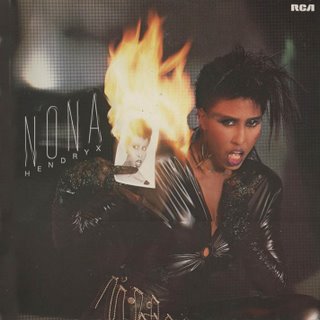
Nona Hendryx “Nona”

Like a cat, Nona Hendryx (b. 1944, Trenton, New Jersey) has had many lives. But she deserves much - much! - better. Nona Hendryx got her start while still in her teens as part of the vocal group the Del-Capris. That group eventually merged with Patricia “Patsy” Holte, who changed her name to Patti LaBelle and gathered initial acclaim as part of Patti LaBelle & The Bluebells with their first hit, “I Sold My Heart To The Junkman,” in 1962.

The group found middling success during the 1960s as a Motown-styled “girl group,” performing doo-wop numbers and typically “girl group” sorts of songs. But none of this was enough to warrant any sort of notice. Eventually, the trio of Patti Labelle, Sarah Dash and Nona Hendryx went to England and discovered rock. They then backed Laura Nyro on the singer/songwriter’s 1971 album Gonna Take A Miracle and, eventually, Alice Cooper on his 1973 album Muscle of Love.

Upon the advice of the group’s manager, Vicki Wickham, they remade the “girl group” concept into a “women power” groove. They changed their name to Labelle and started doing things on their own terms. They issued the albums Labelle (Warner Bros., 1971) and Moon Shadow (Warner Bros., 1972) to sadly little avail.

The group moved to RCA very briefly in 1973 and recorded the excellent Pressure Cookin’ (which was recently reissued on CD). Here, Nona Hendryx came into her own. She began to assert her strong songwriting abilities – and, indeed, the remainder of the Labelle albums are dominated by her music and Labelle came to be dominated by her compositions. Hendryx wrote seven of the nine tunes on Pressure Cookin’, including the great title track, “Sunshine” and “Goin’ on a Holiday” (which featured Stevie Wonder, who also wrote, produced and played on one of the album’s other great odes, “Open Up Your Heart” – though it’s hard to ignore Labelle’s excellent take on “The Revolution Will Not Be Televised”).

It was the trio’s next album, the Allen Toussaint produced Nightbirds (Epic, 1974), backed by The Meters, which yielded the group’s greatest hit “Lady Marmalade,” a justified funk classic written by Bob Crewe (The Four Seasons) and Kenny Nolan (“I Like Dreamin’”). While “Lady Marmalade” was hard to top, Nona Hendryx contributed half of the album’s songs, making it one of the more notable albums of the year, especially Hendryx's terrific title track and the funky “Are You Lonely.”

The Nightbirds follow-up, Phoenix (Epic, 1975), seemed to bring Nona Hendryx forward more in the group, particularly as a vocalist. Much of the album is due to Hendryx’s contributions. There are, inevitably, more than a few tips of the space cap to “Lady Marmalade” to no particularly useful avail. But the record is either lacking some of the magic of Nona Hendryx’s God-given sincerity or attempts to embellish her talents too much with unnecessary funky/soulful clichés. Still, “Messin’ With My Mind” sticks in the memory.

The last Labelle album, Chameleon (Epic, 1976), has a very different musical vibe than previous Labelle albums and one not unlike producer David Rubinson’s earlier productions for The Pointer Sisters, particularly noticeable on the album’s best tracks: “Who’s Watching The Watcher?” and “A Man In A Trench Coat (Voodoo),” Nona’s first solo feature in Labelle. Both, of course, are Nona Hendryx compositions.

When Labelle disbanded (due, among other things, according to Patti Labelle, Nona Hendryx’s emotional breakdown at the time), Nona Hendryx finally debuted with her own eponymous solo debut on Epic in 1977. The edgy rockish sister doing it for herself must certainly have confounded any number of potential listeners. Nothing like the soulful Labelle albums she made, Nona Hendryx is a pop album that very few women would have ever even have been allowed to make. While it’s not as out there or as remarkable as most descriptions – including mine – would have you believe, it was easy enough to do what just about everyone did with it: disregard it completely. It does boast Nona’s gripping “Problem” and a cover of Russ Ballard’s less-than-wondrous “Winning,” captured here four years before Santana made the song a hit (Nona Hendryx and Carlos Santana performed the song together several years later).

Following her solo album’s ridiculous lack of promotion and, ultimately, its terrible lack of success, Nona Hendryx issued several 45s on the British Arista label including “You’re The Only One I Ever Needed”/”Casanova” (1979), “Love It”/”King of Hearts” (1979) and a remake of The Supremes’ “Love Is Like An Itching In My Heart” b/w “X-Ray.” She also provided vocals as a studio musician in New York (David Johansen, Cameo) and ended up as part of the Talking Heads aggregate (Remain in Light, Speaking in Tongues and the tour which resulted in Stop Making Sense) and as part of the Material crew (“It’s A Holiday,” “Busting Out,” “Take A Chance” and the brilliant cover of Sly and the Family Stone’s “Let Me Have It All”), some of the most happening music coming out of New York at the time.

She issued a single called “Do What You Wanna Do,” as by The Cage featuring Nona Hendryx, in 1982 (also featured on the 1982 Summer Lovers soundtrack album) before she released what remains her single best slice of wax ever. Nona (RCA, 1983) is a beautiful mix of soul, new wave and rock that perfects everything the singer/songwriter unleashed before and, to date, has not been bested by this talented musical artist since.

Nona is one of the earliest starry Material (Bill Laswell) pop productions that predates Herbie Hancock’s Future Shock (“Rockit”), Yoko Ono’s Star Peace or even Mick Jagger’s She’s The Boss. The groups change out from song to song, as is typical on a Bill Laswell production, but each features some exceptionally talented musicians plying their trade for an effective and satisfying end – another typical trait of a Bill Laswell production.

Hendryx co-writes most of the material here, but it has her absolutely unique stamp all over it. She partners perfectly with B.J. Nelson (from Material) and Dolette McDonald (from Talking Heads) on background vocals and conceives a well-written, well-arranged program of great staples – among the best in her voluminous catalog.

The danceworthy “B-Boys,” is a made-to-order hit for 80s dancefloors, with the uber-talented Kashif (who more or less made Whitney Houston, an early Material discovery, a star) on the signature bass synthesizer. It’s not the best number on the album. But it’s a clever way to entice interest in what follows.

One of Hendryx’s very best confessional anthems, “Keep it Confidential,” which also appears on the recent CD compilation Disco Discharge – Disco Ladies, features a number of great performances – including one of Hendryx’s best vocal performances on the album – and above average support from Nile Rodgers on guitar, Kenni Hairston on keyboards, Kashif on synthesizers and Jamaaladeen Tacuma on bass.

“Design for Living” was originally written for a Labelle album that didn’t get issued because the group disbanded before the song could be released. Here, Nona Hendryx reconfigures the song into a “women power” anthem featuring a gaggle of great women musicians including Laurie Anderson, inspired on violin, Heart’s Nancy Wilson on guitar, the brilliant Valerie Simpson of Ashford & Simpson on piano, Talking Heads’ Tina Weymouth and Defunkt’s Kim Clarke on bass, The Go Go’s Gina Schock on drums, Carole Steel on percussion and Patti Labelle on background vocals.

The album’s best song comes at the beginning of side two with “Transformation,” a great track that mixes new wave with soul better than almost anything else that ever came out of the early 80s dance movement at the time. The song features Sly Dunbar on drums, “Wizard” on synthesizer and Steve Scales on percussion (who was also with the Talking Heads at the time that Hendryx was). Interestingly, “Transformation” was re-recorded recently as something of an anthem by Nona Hendryx with Pam Grier (Foxy Brown, Jackie Brown) and BETTY for The L Word: The Third Season soundtrack.

The remainder of the album features one of my favorites, the great and very One Down sounding “Run for Cover,” featuring Material-ists Bill Laswell on bass and Michael Beinhorn on synthesizer, the Reggae-esque “Steady Action,” featuring Olu Dara on “horns” and the very Talking Heads-like “Dummy Up,” prominently featuring Bernie Worrell, who also appears on “Living on the Border” and who also prominently featured at the time as part of the Talking Heads (a shame that David Byrne and company never asked Nona Hendryx to contribute material to their already wonderful program…she would have made some sparkling additions to be sure). So who is “The Headless Horseman” who sounds so wonderful on guitar?

Three singles were issued from Nona: “Keep it Confidential” b/w “Dummy Up” (the 45, RCA PB-13437, contains a 3:48 edit of “Keep It Confidential” while the 12-inch, RCA PD-13438, contains the album-length versions of both songs); “Transformation” b/w “Design for Living” (the 45 on RCA PB-13559 and the 12-inch on RCA PD-13560); and “B-Boys” b/w “Steady Up” (the 45, RCA PB-13643, contains a 4:04 edit of “B-Boys” while the 12-inch, PD-13644, has a longer take of “B-Boys” at 6:35 backed by a 6:52 instrumental version of the song). And while Nona has yet to be issued on CD – which, in my book, is something of a criminal offense – four of the albums songs (“Transformation,” “Keep it Confidential,” “B-Boys” and “Design for Living”) were issued on a Razor & Tie compilation CD in 1999 that has also been long out of print. Wrong, wrong. Wrong.

Nona Hendryx went onto record two more rather lackluster albums for RCA, The Art of Defense (1984 - also produced with Material) and The Heat (1985), then waxed the indifferent Female Trouble (EMI, 1987) and the new-agey Skindiver (Private Music, 1989). The singer, who never got the big hit she deserved, sort of faded back into session work thereafter for some reason. But Nona Hendryx has come back in a big way recently with her own musical stage play Blue, starring The Cosby Show’s Phylicia Rashad, and the recent Labelle reunion album Back To Now (Verve, 2008), for which she contributed the bulk of material (the notable tracks include “Roll Out” with Wycleff Jean, “The Truth Will Set You Free” and “Tears for the World”).

Since so much of Nona Hendryx’s music is now held by SonyBMG, it seems something of her work deserves some consideration. I would be glad to volunteer my services in recognition of this beautiful and talented lady. She is one of music’s greatest unheralded artists.

Thursday, June 17, 2010

Dimitri from Paris “Get Down with the Philly Sound”

DJ Dimitri from Paris, born Dimitris Yerasimos in Istanbul, Turkey, was born six months after me in 1963 and grew up, like I did, listening to disco. Unlike me, though, he claims in his notes to this worthy two-disc set that “disco sucks” and that he has always hated disco in favor of the non-white, non-suburban music of Barry White, James Brown and Shalamar which he considered “funk” not “disco.” Uh huh.

He claims that he only discovered the joys of “disco” after House music started sweeping DJs like him and dancers into its repetitively intoxicating groove in the late 80s. But he insists that only certain types of “disco” music qualify as music or, at least, worthwhile grooves.

When he tried to determine what kind of disco he actually liked, Dimitri found it all emanated from Philadelphia during the 70s. At that time, Philadelphia was home to the great Kenny Gamble/Leon Huff holy house of Philadelphia International Records (PIR) and a studio team of musicians, arrangers and producers that helped procure great recordings for almost everyone of note at one time or another like David Bowie, Stylistics, The Spinners, Dexter Wansel, Lou Rawls, O’Jays, MFSB, Salsoul Orchestra, Montana, The Jacksons, Dusty Springfield, Grover Washington, Jr., Gabor Szabo, Elton John and many, many others.

It’s simply amazing to consider the sheer volume of good and historically significant music that actually came out of Joe Tarsia’s Sigma Sound Studios, especially during the 1970s. Get Down with the Philly Sound does an adequately decent job of capturing a small fraction of this music. Inspired by innovative producer Tom Moulton’s classic Philadelphia Classics (Philadelphia International, 1977) – the world’s very first official remix set – Dimitri from Paris has compiled a two-disc set of Philadelphia sounds recorded for a variety of labels between 1973 and 1979.

For the most part, the two-disc set avoids the obvious. That’s the good news.

Disc one features 13 grooves from Teddy Pendergrass, Eddie Kendricks, Philly Devotions, Harold Melvin & The Blue Notes, The Jacksons, John Davis & The Monster Orchestra, Carl Bean (his classic “I am gay” proclamation “I Was Born This Way”), The Trammps, Charles Mann and T.J.M.

Disc two features Dimitri’s “reworks” of nine of the previous disc’s tunes. Dimitri does this in a highly commendable way that doesn’t obfuscate or change the original groove of the originals but, rather, actually enhances the jazz-like and soul symphony-like convention of the originals. On the other hand, the “Reworks” disc leans a bit too heavily on Teddy Pendergrass, with his sub-Marvin Gaye wailing and vocal intrusions overbearingly commanding a whopping five of the disc’s nine long tracks. Certainly there was more of the Philly Sound that Dimitri from Paris could have found without turning the whole thing into something of a Teddy Pendergrass tribute.

For my part, I dislike the use of the “disco” nomenclature throughout this set, particularly in Dimitri’s note and writer Al Kent’s otherwise thorough and wonderful notes. As a long-avowed disco fan, I have neither considered much of the Gamble-Huff oeuvre nor much of the many records issued by PIR (the bulk of material that Dimitri features in his "Reworks”) as “disco.” It’s very soulful material that is rich in rhythmic improvisation and beautifully-conceived string parts. Hardly anything else can touch the classy music that came from Philadelphia during this period. But, as disco, it’s kind of a stretch…whatever your definition.

If Motown was musical beer, the Philly Sound was musical champagne.

Still, it doesn’t make it disco. The Phillys probably wouldn’t even want to consider their music disco, unless they could take credit for inventing the musical form, which really came from out of the New York and Miami underground much more effectively – and differently – than what was coming out of Philadelphis.

And while there are many that might hear this music from Philly as “disco” or something better than “disco,” Get Down with the Philly Sound is not disco by definition and much more enjoyable on a number of different levels than the “disco” nomenclature would generally allow.

Gabor Szabo “Jazz Raga”

The estimable Light in the Attic (LITA) has taken it upon themselves to finally issue one of guitarist Gabor Szabo’s finest and least known albums, Jazz Raga. Among one of my very favorite of the guitarist’s records, this long-neglected album is aptly summarized by the LITA promotional text as “East meets West, guitar meets sitar, on this seminal 1967 Impulse Records jazz release.” It is a classic that has never properly gotten its due by jazz critics or even by those who admire Gabor Szabo’s better-known or more jazz-like music.

Jazz Raga is a brilliant, much-derided record featuring Szabo’s distinctive guitar and his overdubbed, slightly out-of-tune sitar playing. Too easily dismissed, the 34-and-a-half minute set contains some of Szabo’s best recorded guitar work: enchanting single-line runs mixed with jangled chords, repetitive riffs/drones and memorable, melodic solos. The short tunes (most under four minutes each) include Szabo staples like "Mizrab" and "Comin’ Back" and bring out Szabo’s ability to effectively compress good ideas. The core unit of Jack Gregg on bass and Bernard “Pretty” Purdie on drums contributes successfully to the real groove of the record (something new for Gabor Szabo) and even the odd-sounding sitar isn’t as obtrusive as is often suggested.

LITA gives Jazz Raga the respect it has long deserved some four and a half decades after the fact, reissuing the record on vinyl and, for the first time ever, on CD this month. The gatefold digipak CD (the LP release is forthcoming) is a stunning presentation, maintaining the original LP's front and back cover and even the orange and black Impulse spine. Included in the set is a positively overflowing 40-page color booklet that includes unseen photos (courtesy of brother John Szabo), interviews with Bernard "Pretty" Purdie, Rudy Van Gelder, Jack Gregg and Michael Shrieve and truly brilliant liner notes by Doug Sheppard (Ugly Things, Goldmine) revealing, among other things, that Larry Coryell was intended to be part of the sessions.

I am very pleased to have been able to provide LITA with much of the background and documentation to prepare the release of Jazz Raga and they have succeeded immeasurably by respecting the record with great reverence as a Psych classic and honoring its musical gravity with a properly beautiful package.

Jazz Raga is readily available now through LITA or, of course, from the good folks at Dusty Groove. It’s a must have for guitar fans and Psych listeners of all stripes.

Dave Grusin “Tootsie”

Like Quincy Jones, Lalo Schifrin, Michel Legrand and many others, composer and pianist Dave Grusin has a following among both jazz listeners and film-music fans alike. And like those jazz artists that also have a career in film, the two very different styles of musical artistry required for each medium rarely find a happy union among audiences with certain expectations.

Dave Grusin found a happy medium to wed both his jazz fusion magic with the prowess of film composition he’d already perfected in such Hollywood hits as The Graduate (1967), Murder by Death (1976), The Goodbye Girl (1977), Heaven Can Wait (1978) and On Golden Pond (1981) and memorable TV scores for The Girl From U.N.C.L.E., It Takes A Thief, Baretta and St. Elsewhere with his tremendously infectious score to 1982’s Tootsie.

The film starred Dustin Hoffman as an unemployed actor who dresses in drag to land a role on a soap opera. But when his outspoken feminist creation, “Dorothy Michaels,” becomes a media sensation, he grows desperate to stop leading a double life—and to confess his love for his colleague, played by Jessica Lange. With a masterful blend of drama, comedy, contemporary realism and social commentary, and brilliant supporting performances by Dabney Coleman, Teri Garr, Bill Murray, Charles Durning and director Sydney Pollack (as Hoffman’s apoplectic agent), Tootsie is justifiably a classic.

Tootsie went on to become a huge hit and one of the most highly regarded comedies in Hollywood history, with a love song (“It Might Be You”) that has become a pop standard. Yet the soundtrack has been virtually unavailable on CD—until now.

The pitch-perfect score to Tootsie was by Dave Grusin, Pollack’s longtime collaborator on films such as The Yakuza, Three Days of the Condor, Bobby Deerfield and The Electric Horseman (and later, Havana, The Firm and Random Hearts).

Tootsie’s unique combination of laughs with serious subject matter required an original approach, and Grusin elevated the film by using the modern jazz fusion style he had helped create in his career as a recording artist. Upbeat, energetic and contemporary, jazz fusion was the perfect choice for Tootsie, and Grusin himself performed the keyboards.

Issued between Grusin’s jazz-fusion albums Out of the Shadows (1982) and Night-Lines (1984) - a live album was recorded five months before Tootsie, featuring the Grammy Award winning “Summer Sketches ’82,” but not issued until after the soundtrack – the Tootsie album fits in remarkably well with the composer’s jazz-fusion work. It is something that easily satisfies both his jazz and film-music audiences.

The good folks at Film Score Monthly (FSM) have issued Tootsie for the first time on CD (outside of a brief release in Japan some two decades ago), presenting the ten songs from the 1982 Warner Bros. soundtrack album plus 18 additional tracks that constitute the entirety of the score Grusin provided for the film. Much of the music that appeared on the original LP was from Grusin’s original score, except for three tracks (“Don’t Let It Get You Down,” “Sandy’s Song” and “Out of the Rain”), re-recorded in New York City a mere two weeks before the official soundtrack album was issued in December 1982.

There are many highlights to the set, including “An Actor’s Life (Main Title),” “Out of the Rain,” “Don’t Let It Get You Down” and “Working Girl March,” and very much some of the best music Grusin produced in his jazz-fusion style. Even the classic and well-known “It Might Be You” benefits nicely by Grusin’s tremendous melody and lovely way of orchestrating with electric keyboards (much of Grusin’s acoustic piano work here, on the other hand, is gloriously suggestive of Richard Tee’s playing). The newly heard source cues, some of which were not even used in the film, reveal Grusin’s always extant ability to produce excellent straight-ahead jazz too.

The FSM set is a marvelous celebration of Dave Grusin’s music and is especially well packaged, featuring first-rate liner notes by the terrifically thorough Jeff Bond and Lukas Kendall, aided in some small measure by your humble narrator.

Tootsie is very highly recommended, particularly to those listeners who – like me – could not get enough of Dave Grusin’s magical jazz fusion from the period (1977-83) and it’s a welcome addition to the terribly slim catalog of available Dave Grusin scores.

For more of my musings on the tremendous music of Dave Grusin, please check out my posts Grusin’s Goodies and Dave Grusin’s Soundtracks.

Wednesday, June 16, 2010

“It’s A Holiday” by Material with Nona Hendryx

Today’s disco discovery: In between her Labelle years and her 80s solo onslaught, the great Nona Hendryx did a lot of session work in New York City. Eventually she hooked up with some of the Downtown crowd and wound up as part of the Talking Heads ensemble and as a favored vocalist with Bill Lasewell’s still revolutionary Material.

The 1981 “It’s A Holiday” is one of the earliest collaborations between Nona Hendryx and Material. The two would also collaborate on the brilliant dance-floor classic “Busting Out” as well as One Down album staples “Take A Chance” and a riveting cover of Sly and the Family Stone’s “Let Me Have It All.”

Here, Nona Hendryx is joined by Michael Beinhorn on synthesizers, pianos, clarinet, percussion, tapes; Bill Laswell on 4 & 6 string basses; Fred Maher on guitar, drums, rhythm box, percussion; and Cliff Cultreri on guitar. It’s an absolutely scintillating performance by all involved.

Shame on Madonna for either ripping this off or dumbing it down a few years later.