Wednesday, December 02, 2009

Even More Mancini in the Seventies

The Mancini magic – or madness – continues to infuse me. Please check out both of my earlier posts here and here to discover the highs and the lows of the brilliant composer, arranger, pianist, author, thinker and mentor to a whole generation of great film composers we now know so well, who released a slew of wonderful records during the 1970s.

Very few recording artists carried the clout of Henry Mancini during the 1970s and, more significantly, very few can claim to have had some three dozen records released bearing their name during the span of only ten years. The output is simply staggering – especially given all the other things he was doing at the time.

Unfortunately, things changed dramatically in the next decade (the death of vinyl, the rise of Top-40 soundtracks coupled with the decline of film-score albums, the vilification of easy-listening music, etc.) and far fewer Mancini records were made available to the buying public. Those that were often dominated by a bunch of crappy pop songs, lending Mancini only one or two slots for his own music. Henry Mancini virtually disappeared in the record buyer’s mind. It remained this way until his untimely 1994 death.

Fortunately, since then, Henry Mancini has enjoyed something of a mini-renaissance, with the Spanish Fresh Sound label issuing many of the composer’s 40-some RCA albums on CD, every label under the sun issuing some sort of Mancini compilation on CD and major talent releasing full-album tributes (daughter Monica Mancini, Dave Grusin, Joe Locke, James Moody, Oranj Symphonette and Mancini section progeny, Ted Nash) – most of which are just wonderful to behold, a testament to Henry Mancini’s enduring musical magic. (Not included here, but worth mentioning are the much earlier Mancini tribute albums recorded by Quincy Jones, Eumir Deodato, Sarah Vaughan and Bobby Hackett.) But still, much of the music I’ve covered remains generally unavailable.

There is much to enjoy here and elsewhere and it is with sincere appreciation that I hope to cover some of Mancini’s eighties recordings in a future post.

The Molly Maguires (Paramount, 1970): There’s more than a touch of Irish folk music in Henry Mancini’s score to this little remembered Martin Ritt film from 1970 starring Richard Harris, Sean Connery and Samantha Eggar, detailing the true story of Irish immigrants working in a nineteenth century Pennsylvania coalmine. As Mancini himself also came up in West Aliquippa, Pennsylvania, a steel town close to my hometown of Pittsburgh, this story probably resonated deeply within the composer. Evidence can be heard in the truly inspired main theme, vocalized by a plaintive recorder, offset by a lovely harpist and a mournful orchestral reprieve, contrasted by an accordion in the second refrain. Despite the film’s incredibly downbeat story (and box office failure), Mancini fashions a majestic score, loaded with all the colors of life – particularly those of an Irish life – and the resonant tones of immigrant existence in a strange, developing world (something that had and continues to have parallels in contemporary humanity). Mancini contributes two main themes, “Theme From The Molly Maguires,” which gets three variations, and “The Hills Of Yesterday,” both of which are significantly and painfully lovely, as well as obvious, though perfectly enjoyable Irish ditties (“Fiddle and Fife,” “Pennywhistle Jig”) and a number of gorgeously mournful pieces of underscore. The soundtrack album was issued on the short-lived Paramount Records label and once a while back on Japanese CD and is incredibly difficult to find in any format these days, but worthwhile nonetheless. Mancini again covered the film’s excellent main theme and “The Hills of Yesterday” on his 1970 album Theme From “Z” And Other Film Music and later resurrected the main theme and “Pennywhistle Jig” (often mis-titled inexplicably in a number of places as “Pennsylvania Jig”) on his terrific 1984 album with James Galway, In The Pink.

The Hawaiians (United Artists, 1970): This excellent soundtrack confounds any number of expectations. First, the musical vibe composer Henry Mancini provides here is distinctly more Japanese than what has come to be known as traditionally Hawaiian, which, no doubt, is part of the film’s storyline. Second, the film’s grand main theme – which numbers among one of Mancini’s most memorable themes – never became the hit it deserved to be and that so many of the composer’s other film themes had become earlier on. Finally, this soundtrack album probably would not exist were it not for Mancini’s well-deserved reputation: only the title song registers memorably. But, fortunately, for Mancini fans, this unusual score was made available in 1970 on the United Artists label. This is Mancini’s second significant soundtrack for a Charlton Heston film and while the main theme is particularly notable (and Mancini-esque), several other prominent themes emerge here as well, including the beautifully moody “Pineapple Pirates” (which, nearer than anything else Mancini ever did, recalls the gorgeous glories of “Lujohn”) and “Fumiko (Japanese Love Theme).” There are many traditional Asian instruments heard here, performed by such specialists as David Ming Yueh Liang (Cheng, Chinese Zither, and Hsun, Chinese Ocarina), Kayoko Wakita (koto), Patti Shirai (bass koto), Art Smith (Chinese flute) and LA sessioneers Emil Richards (Santure, oriental cymbalum) and Gene Cipriano (Hichiriki, Japanese oboe). All in all, The Hawaiians is a beautiful – though far too brief – musical treat and a rather unfortunately buried treasure that has yet to appear anywhere on CD. Mancini re-recorded the film’s beautiful main theme for his 1970 album Mancini Plays The Theme From Love Story.

Oklahoma Crude (RCA, 1973): Henry Mancini’s peculiar score to Stanley Kramer’s little-known 1973 film starring George C. Scott, Faye Dunaway, John Mills and Jack Palance (what a cast!) often comes across as little more than high-class cartoon music. Kramer’s brief liner note says “Mancini has given us nostalgia in the modern idiom,” as if that’s a compliment or even something that’s possible. Even the main theme is given the oddly appropriate title “Over The Top” in one of its variations. One IMDb writer, who likes the film, complains that Mancini’s score is inappropriate and “very goofy,” arguing that it “seems to have been designed to ‘lighten up’ violent action scenes, but which in fact just sounds silly and out-of-place." While it isn’t much of a rewarding listen to on record (especially for a listener who has never seen the film), one must imagine that Mancini’s music must have somehow aided the vulgar lightheartedness the film’s makers were aiming for. The more typically Mancini moments shine through all of the crudity on “Cleon and Lena” (titled for John Mills’s negligent father and Faye Dunaway’s feminist daughter), the almost too trite “The Big Climb” and the gentle instrumental version of “Send A Little Love My Way,” making this rather disastrous affair somewhat more of a pleasure than it otherwise is. “Oklahoma Crude” was issued as a 45-rpm single (b/w “Amazing Grace” from The Mancini Generation - though which song was meant to be the “A” side is anybody’s guess) and the instrumental version of “Send A Little Love My Way” was issued on the flip side of the 45-rpm single of Mancini’s “Hangin’ Out.” Anne Murray also covered “Send A Little Love My Way” at the time.

The Pink Panther Strikes Again (United Artists, 1976): By the time of the second of the three 70s-era Pink Panther sequels, the joke was wearing a bit thin and even the music was now beginning to sound like a joke losing its punch. The main title, which adapts “The Pink Panther Theme” to accommodate the animated parodies of Hitchcock, Batman, The Sound of Music and Singin’ In The Rain - while a joy to watch, and remarkably scored by Mancini – seems to indicate that everyone knew that there was not much left to say with this exceedingly tired comedy series. Mancini even composed a rather slight number called “The Inspector Clouseau Theme” for this film, which has confounded any number of fans who had long since thought of Mancini’s “A Shot In The Dark” as Clouseau’s theme. Still, the jokey theme, which seems to highlight some of Sellers’s worst comic tendencies, inexplicably became a Mancini favorite. Two rather lovely Mancini melodies, “Come To Me” and “Until You Love Me” are given incredibly hammy and unbearable vocal performances here; the first by Tom Jones and Peter Sellers in outrageous Clouseau mode and the second by someone named Ainsley Jarvis. Fortunately, both pieces give Mancini his due by getting appropriately instrumental performances. Both pieces, at least as melodies, are classic Mancini ballads and entirely worthy of the very first – and best – Panther soundtrack. Mancini presents several rather excellent cues of underscore (probably edited together to present something akin to fully developed compositions) that are given such oddly generic titles as “The Great Quasimodo Theme,” “Along Came Omar” and “The Evil Theme” one must wonder if someone wasn’t out to sabotage this production in every way. It’s one of those Mancini albums where you either have to program the CD player ahead of time or lift the needle of the turntable every other song or so. What’s good about The Pink Panther Strikes Again is very good. Unfortunately, what’s bad about it really drags it down. A 1998 Rykodisc CD release of the soundtrack included six additional titles that were not included on the 1976 United Artists LP and Mancini gave “The Inspector Clouseau Theme” another airing on his 1977 album Mancini’s Angels.

Just You And Me Together Love - Henry Mancini and his Orchestra, Narration by John Laws (RCA, 1977): Perhaps the most obscure of all of Henry Mancini’s records and also one of the most unusual as he is not known to have ever accompanied any other poet anywhere else. Accompanying the words and voice of Australian poet John Law, Mancini and his all-star Hollywood orchestra craft a rather lovely, yet seemingly anachronistic outing in the days of disco’s reign. This sort of thing had certainly become passé by this point, and Laws is a sentimentalist to be sure. But Mancini’s lush and lyrical backgrounds sound sincere and touching without ever dipping into the sugary sweetness the poetry seems to call for. These charts really deserve to be heard on their own, particularly with some of the talent involved, including daughter Monica, in one of her earliest recordings (whose occasional vocalisms, particularly on the title track, lend the proceedings a touch of Edda Dell Orso’s haunting vocals heard on so many Italian soundtracks), Mike Lang and Clark Spangler on keyboards, Dennis Budimir and Bob Bain on guitars, Chuck Domanico on bass, Tommy Vig on percussion, Dorothy Remsen on harp, Ronny Lang on sax and Shelly Manne on drums. After 40 some albums for the RCA label, this record – which most surely was Mancini’s indulgence for delivering for the label repeatedly over some 18 years – represented the composer’s penultimate RCA release. He became a free agent the following year, but sadly no other label ever stepped up to provide Mancini with the veritable outlet (or straight-jacket?) that RCA had provided him for years. Even though this sort of record would very rarely find its way into the mainstream in the future (outside of such “name” poets as William S. Burroughs and Allen Ginsberg) and such poetry readings are worthwhile, Mancini’s music certainly outshines the words it accompanies here and deserves to be heard on its own.

Monday, November 30, 2009

Ithamara Koorax & Juarez Moreira “Bim Bom”

The beautiful and most ethereal of all vocalists practicing their art today, Brazilian Ithamara Koorax (b. 1965), has achieved what ranks among her very greatest achievements with Bim Bom, a brilliantly conceived tribute to the Brazilian composer, guitarist and singer João Gilberto.

Here, the multi-lingual, multi-genre singer tackles a bracing set of lovely, lilting melodies written or co-written by fellow Brazilian legend João Gilberto, accompanied most perfectly only by the guitar of Juarez Moreira, who is acclaimed by no less an authority than Milton Nascimento as a "mix of every musical element from Brazil” who “interprets them in a majestic way."

João Gilberto, born João Gilberto Prado Pereira de Oliveira on June 10, 1931, in Juazeiro, Bahia, is a Grammy Award-winning Brazilian singer and guitarist. He is credited with having created what we now know as “bossa nova” and has rightly become known as the "Father of Bossa Nova." His seminal recordings, including many songs by Antonio Carlos Jobim and Vinicius de Moraes, established the new musical genre in the late 1950s, which gained huge significance throughout the world in the early 1960s.

After many American musicians (Herbie Mann, Stan Getz, Charlie Byrd) embraced his music, he lived in the United States during much of the sixties, eventually leaving to live in Mexico. He returned to Brazil in 1980 and currently resides in Rio de Janiero, where he lives out a somewhat reclusive lifestyle, though he tours occasionally.

Despite many deserving tributes to such bossa-nova forefathers as Antonio Carlos Jobim, this disc serves as a reminder of another of Brazil’s most prominent tunesmiths and musicians – thankfully while he is still alive to enjoy the significance of his influence and such a worthy celebration of his achievements.

Ithamara Koorax shows her remarkable range throughout, much more relaxed than usual, befitting the songs’ mostly easy-going nature. Surprisingly, her most outstanding performances occur when she’s not even singing the Portuguese or English lyrics the songs provide, as on the improvisations she provides for “Minha Saudade” or in the startlingly haunting way she hums out such instrumentals as “Valsa (Bebel),” “Glass Beads” (which was only recorded once by co-composer João Donato on his wondrous 1965 album The New Sound Of Brazil), “João Marcelo,” “Undiu” (where she does little more than repeat the title, but so hypnotically that it sounds like a full lyric).

Moreira’s beautiful accompaniment throughout is a joy to behold. As the only accompaniment heard here, he is outstandingly forward in his contribution, but never at a disservice to the melody or to his singing partner. When he solos on electric guitar, it is, fittingly, electrifying, as he does on “Voce Esteve Com Meu Bern,” “Valsa (Bebel)” and “Acapulco.” Koorax is out of “An Embrace To Bonfá,” a tribute to fellow guitarist Luiz Bonfá, which gives Moreira a chance to shine in this exceptionally lovely composition.

Those familiar with Gilberto’s work will miss some of the better-known numbers from the guitarist’s repertoire. But it’s difficult to argue with what is actually presented in this beautifully programmed 41-minute set.

Producer Arnaldo DeSouteiro provides a crisp, clear palette for the two artists to express themselves and, in his notes, a beautifully detailed summation of each song’s history and importance. While one could wish for more, it’s hard to best what is provided on the lovely Bim Bom, one of the most notable releases of 2009.

Friday, November 27, 2009

Eddie Izzard - Death Star Canteen

This is the funniest thing I've seen in a long, long time. Comic Eddie Izzard's extremely hilarious stand-up routine gets turned into an even more brilliant lego short. It still brings tears to my eyes. I thank my nephews for bringing it to my attention. Enjoy!


"I will have the Penne a l'Arrabiata."

"This is not a game of who the fuck are you."

"What's the Death Star?" - "THIS is the Death Star!"

"You're Mister Stevens?"

"I'm not Head of Catering!"

"Why, with the power of the Death Star, do we not have a tray that is fucking dry?"

"You have to form a que if you want food."

"I'm not Jeff Vader. I'm Darth Vader."

"And everyone in this canteen...death by tray it shall be."

Sunday, November 22, 2009

Happy 80th Birthday Rolf Kühn

Clarinetist Rolf Kuhn was born in Cologne, Germany, on September 29th, 1929. At the age of eight he learned to play the accordion and by the time he was twelve he was making an intensive study of the clarinet, piano and the theory of composition. Among his teachers was Hans Berninger, solo clarinetist in the Gewandhaus Orchestra at Leipzig, and responsible for musical theory was the director of music, Arthur Schmidt-Elsey.

However, the young musician did not feel suited for a career in classical music. Just before his seventeenth birthday, in June 1946, Kühn joined the Kurt Henkels Band as alto saxophonist and accordion player. Only a year later he was already standing out front improvising clarinet solos. His Amiga recording of “Rolly‘s Bebop“ won him a reputation as a rising star on his instrument, and then three years later, in 1950, his name shone out at the head of the list for top clarinet players in German jazz polls.

In 1952 Rolf Kühn moved to West Berlin and played for the first time in a quartet of his own at RIAS radio station. The way was paved to a successful musical career. Benny Goodman‘s musical expression had up to then formed his style but now Buddy DeFranco’s influence was on the ascendancy. In 1954 he got to know DeFranco personally during his stop at Berlin on the “Jazz Club USA” tour.

Meanwhile European jazz enthusiasts had time and again nominated Rolf Kühn as number one clarinetist. He set out for New York City, the jazz artist’s proving ground, in May 1956. Initial support for this venture was provided by the classical pianist, Friedrich Gulda, Benny Goodman‘s manager, Willard Alexander, and the critics Leonard Feather and John Hammond.

His career in the States started with quartet engagements in various jazz clubs. Then he appeared at the Hotel Pierre as soloist and musical director for internationally famed singer Caterina Valente, followed by an engagement in a program with Count Basie at Birdland.

It wasn‘t long before Benny Goodman took him into his own orchestra. The young man from Germany was to become the only other clarinetist that Benny Goodman would tolerate at his side: more than that, he actually entrusted him with the musical direction of the band during an illness.

In the summer of 1957 the triumphant tones of Rolf Kühn‘s clarinet were heard at the Newport Jazz Festival. A few months later he went on tour with the Tommy Dorsey Memorial Band. This was followed by further club engagements and recording dates, among them a Leonard Feather presentation on Metrojazz with an international sextet, a Verve production with a band featuring the vibraphonist, Eddie Costa and albums for Panorama and Vanguard under his own name.

Rolf Kühn returned to Germany in late 1961 and, as prodigal son and now something of an American jazz star, he set about on an ambitious recording and performing agenda. Where once, long ago, he might have been cast in the shadows of Buddy DeFranco or Benny Goodman, he had long since succeeded in developing his own voice and crafting a style that developed over increasingly more interesting albums on the Brunswick, Amiga, CBS, Impulse, Intercord, Metronome, Horzu, BASF and MPS labels.

In celebration of Rolf Kühn’s 80th birthday this year, the German arm of Universal Music is making five of the clarinetist’s most sought after and long out-of-print albums available for the first time ever on CD.

These collectable editions include such beauties as Rolf Kühn feat. Klaus. Doldinger (Brunswick, 1962), Transfiguration (Saba, 1967), Impressions of New York (Impulse!, 1967), Total Space (MPS, 1975) and Symphonic Swampfire (MPS, 1979).

The music runs the gamut from traditional jazz swing (Rolf Kühn feat. Klaus. Doldinger) and European free (Transfiguration, Impressions of New York) to free fusion (Total Space) and out and out jazz fusion (Symphonic Swampfire).

While there are many more albums the great clarinetist, composer and arranger participated in during this period, one can only hope that these few CD releases will reignite interest in the great and prolific Rolf Kühn and his extremely interesting musical career.

Rolf Kühn feat. Klaus Doldinger (Brunswick, 1962): One of Rolf Kühn’s first recordings in Germany after a long stay in the United States, this very engaging album recorded in late 1962 finds the clarinetist combining forces with future fusion pioneer Klaus Doldinger and his trio. The presence of organist Ingfried Hoffmann gives this group a flavor not unlike the Eddie Davis-Shirley Scott groups that recorded so prolifically around the time. But Rolf Kühn’s clarinet offers the proceedings an even more unique and likable essence. Anyway, how many other attempts at matching the clarinet with an organ group are there out there? A winner from start to finish. Features Rolf Kühn, clarinet, with Klaus Doldinger, tenor sax; Ingfried Hoffmann, organ; Herman Schoonderwalt, bass; Cees See, drums.

Transfiguration (Saba, 1967): A remarkably free session that finds brothers Rolf and Joachim Kühn sparring with a rather free-spirited European rhythm section featuring the young Karl Berger on vibes. Rolf dominates. But Joachim seems to be setting the agenda. Berger is a special guest indeed, befitting his “guest” status, even despite his lack of worldwide acclaim at this point. It’s hard to believe that Rolf’s early fans – or recent listeners – would go for this. But you have to respect the man for his chance-taking abilities. Features Rolf Kühn, clarinet, with Joachim Kühn, piano; Beb Guerin, bass; Aldo Romano, drums; Karl Berger, vibes.

Impressions of New York (Impulse!, 1967): After appearing at the 1967 Newport Jazz Festival in another aggregation, Rolf Kühn and his brother were offered the opportunity to record for the fabled Impulse! label by producer Bob Thiele, who was issuing any number of free-jazz records by the movement’s lead provocateur, John Coltrane (as well as Archie Shepp, Pharoah Sanders, etc.). The Kühn brothers are caught here in a quartet with Coltrane bassist Jimmy Garrison (and Italian drummer Aldo Romano), during the same period of time that Coltrane actually died. This free-wheeling session is one of the few ways that any Americans even knew of the Kühn brothers, particularly Rolf (Joachim lived in the United States in the mid to late seventies for a time, releasing a few fusion-oriented albums through some American labels). Features Rolf Kühn, clarinet, with Joachim Kühn, piano; Jimmy Garrison, bass; Aldo Romano, drums.

Total Space (MPS, 1975): Like a crazy Blaxploitation soundtrack album of the period, this unusual free fusion album exposes much of the period’s oddly contradictory elements of rabidly exploratory talent mixing with (somewhat) commercial and funky expectations. Like many a MPS album of the period, there is some tremendous improvisation to be heard here by some engaging soloists. It would be interesting to hear what the surving members of this group might do ten years after this – or today. Total Space has much to recommend and stands strong not only as one of the strong European jazz releases of the mid seventies but also as an enduring remnant of the fusion movement of the period. Featuring Rolf Kühn, clarinet, with Albert Manglesdorff , trombone; Gerd Dudek, sax; Joachim Kühn, keyboards; Philip Catherine, guitar; Bo Stief, bass; Kasper Winding, Daniel Humair, drums plus brass.

Symphonic Swampfire (MPS, 1979): Rolf Kühn had not issued an album since Total Space some four years before. Immersed in the orchestral worlds of film and television, he had desired the opportunity to release a jazz album with more orchestral elements. Not exactly the orchestral jazz piece that Verve would have released some 15 years before, this is, nevertheless, a wonderful piece of funky fusion jazz. A tribute to the Ibiza home he’d resided in during the summers of the seventies, Rolf Kühn devised a most engaging album, and probably one of the more approachable works he’d done in some time. I did the notes for this particular release. But it really is my favorite of all of the five albums in the Rolf Kühn 80th birthday Anniversary Edition. Features Rolf Kühn, clarinet/arranger, with Charlie Mariano, sax; Herb Geller, sax and flute; Joachim Kühn, Thilo Von Westernhagen, Claus-Robert Kruse, keyboards; Philip Catherine, guitar; Niels-Henning Orsted Pedersen, bass; Bruno Castelucci, drums plus brass and strings.

Tuesday, November 17, 2009

Honestly, Who Cares About Sarah Palin?

As a marketing person, I can understand publicity, yada, yada, yada. But ANY coverage of Sarah Palin is beyond ridiculous. Does anybody really care?

Even if you're more to the right than I am, how can you possibly take this stuff seriously?

As John Cleese once said, “Sorry, Michael, you’re not the funniest Palin anymore.” Why won’t this non-entity just go away?

And what's up with this bizarro cover on this week's Newsweek???

Monday, November 16, 2009

More Mancini In The Seventies

Composer, conductor and arranger Henry Mancini (1924-94) was riding a wave of success as he entered the seventies – particularly following the number one hit success of his cover of “Love Theme From Romeo And Juliet” – and was consequently writing and recording at a pace that belies the calm exterior he always presented.

But while the film work was plentiful, the popularity of the many films Mancini worked on during the period never found the audience or the musical popularity of such earlier successes as Breakfast at Tiffany’s or The Pink Panther - even though, to his credit, Mancini took real chances with his film choices and was constantly escaping the expectation to produce the sparkling and witty light jazz he trademarked years before.

For whatever reason – and many of them probably had little or nothing to do with the quality or quantity of Mancini’s music – fewer Mancini soundtracks were issued in the seventies. But Mancini’s label, RCA, kept cranking out one Mancini record after another. These cocktail collections, often classified as “easy listening,” a musical genre that was as good as dead at the time, found Mancini exploring even more divergent musical paths than he had even surveyed in the past (though the batch of records listed below isn’t as “hip” as some of the others explored earlier).

Most of the records feature covers of one or more of the Mancini film themes that didn’t get full soundtrack albums, forcing anyone who liked Mancini the film composer to at least sample the Mancini orchestral records made for popular consumption.

But it was often on these records that enterprising listeners could hear how insightful and enthralling an arranger of other people’s music Henry Mancini could be. Because so many of the tracks that Mancini covered on these records were so well-known (standards, pop hits and other composers’ film themes), astute listeners are obliged to consider Henry Mancini less as a spectacular songwriter and more, much more, as one of the most remarkable arrangers of the twentieth century.

This list is my second attempt to note more of Henry Mancini’s albums from the 1970s, a period when his music didn’t get a whole lot of critical – or popular – attention. The handful of records listed here may be even less familiar than those from the previous post. But you really must marvel at all of the great music that Henry Mancini produced during the seventies…

Mancini Country (RCA, 1970): Like the previous year’s A Warm Shade of Ivory and Six Hours Past Sunset (with the great title song), the focus on Mancini’s “first ‘Country Music’ album” is mostly on his own piano playing; this time, though, as it explores a genuine country music agenda. The program covers the predictable (“Release Me,” “I Can’t Stop Loving You” and “Stand By Your Man”) as well as the pleasantly unexpected (“Let It Be Me,” made popular by the Everly Brothers and also done for RCA by Chet Atkins, “Almost Persuaded,” first made popular by David Houston, “Make The World Go Away,” made popular by Eddy Arnold and “The End Of The World,” a hit for Skeeter Davis produced by Chet Atkins). Mancini’s only contribution to the program is the wholly appropriate “Phone Call To The Past,” a variation of Gunn’s “Theme For Sam” with lyrics (that aren’t sung here) by Johnny Mercer. Like Ferrante & Teicher, Mancini’s piano caresses the melodies a little too delicately here, his touch being a bit more lace than the leather that’s called for. Mancini also doesn’t do the record any favors with orchestrations that are far too rich for the material and incompatible with the occasional country & western flourish. The Nashville trimmings are provided by electric bassist Harold Bradley (Elvis Presley, Patsy Cline, Roy Orbison, Willie Nelson), organ player Beegie Cruser (Chet Atkins, Dolly Parton, Johnny Cash), steel guitarist Lloyd Green (Faron Young, George Jones, Warner Mack) and other Nashville studio pros like Pete Wade, Norbert Putnam and Jerry Carrigan. Bradley’s tic-toc electric bass in particular gives the album something of a Bert Kaempfert-goes-country sound that surprisingly negates Mancini’s otherwise dominant personality from the endeavor almost completely. Despite the pianist and arranger’s audible sincerity and the album’s genuine prettiness, Mancini Country is unlikely to appeal much to country music fans or convert those who never liked country music in the first place. (“Phone Call To The Past” is also featured as the B-side to Mancini’s 45-rpm single release of “Theme From Love Story.”)

Theme From “Z” And Other Film Music (RCA, 1970): Similar in nature to Mancini Plays The Theme From Love Story, which came out later in the year, this equally unimaginatively titled album is one of Mancini’s better collections of film themes. Mancini, “no newcomer to the film music scene,” as the album goes, here covers recent collaborator (on Me, Natalie) Rod McKeun’s moving “Jean” (from The Prime of Miss Jean Brodie), Alfred Newman’s surprisingly charming “Airport Love Theme,” a Basie-like version of Burt Bacharch and Hal David’s “Raindrops Keep Fallin’ On My Head” (from Butch Cassidy And The Sundance Kid), the inevitable “As Time Goes By” (from Casablanca) and Jerry Goldsmith’s somewhat out of place “’Patton’ Theme.” Mancini also provides two particularly beautiful themes from his score to The Molly Maguires (whose soundtrack was issued in 1970 on Paramount Records), the exquisite main theme and “The Hills From Yesterday.” Aside from the tremendously invigorating and variegated orchestrations Mancini provides throughout, this collection scores extra points for exploring movie themes written by non-American composers such as Mikis Theodorakis’s “Theme From ‘Z’,” Stelvio Cipriani’s “A Man, A Horse, And A Gun” (from the spaghetti western The Stranger Returns) and Antonio Carlos Jobim’s “Love Theme From ‘The Adventurers’.” Credited soloists include Ethmer Roten on flute (“Jean,” “The Hills Of Yesterday”), Dick Nash on trombone (“Airport”), Jimmie Rowles on electric calliope (“Raindrops”), Ted Nash on alto sax (“Airport,” “As Time Goes By”), Art Smith on recorder (“The Molly Maguires”) and Mr. Mancini himself on piano (“As Time Goes By,” “Love Theme From ‘The Adventurers’”). But no credit is given for the exquisite acoustic guitar work heard throughout (notably on “Jean”) or to the compelling sensitivity provided by the unnamed electric bassist – although it’s likely Carol Kaye who plays on the Cipriani track. Highlights include the two Mancini tracks, “Jean” and “Airport Love Theme.” (“A Man, A Horse, And A Gun” was issued in 1968 as a 45-rpm single. “Theme From ‘Z’” backed by “Theme From The Molly Maguires” was also issued in 1970 as 45-rpm single. “The Theme From “The Molly Maguires” was recorded again by Henry Mancini in 1984 with James Galway on the excellent In The Pink and in 1990 on Erich Kunzel’s Mancini’s Greatest Hits.)

Brass On Ivory - Henry Mancini/Doc Severinsen (RCA, 1972): Paired together for the first of two recorded occasions, composer, pianist and arranger Henry Mancini collaborates here with The Tonight Show trumpeter Doc Severinsen on a late-night set of sleepy ballads. Or should we say snoozey? The feeling is so laid back it’s nearly somnambulant. Both of these Hollywood mainstays were going for something mellow (hella-mellow), or what liner notes writer Tom Paisley calls “a ‘love’ of an album.” Presumably this is meant to refer to the respect the two had for one another and their musical chemistry seems compatible too. But Brass On Ivory just never quite clicks. The pair covers the spectrum of the day’s mellow hits (“Brian’s Song,” “If,” “Never My Love” and “We’ve Only Just Begun”), mellow jazz standards (“Willow Weep For Me,” “Poor Butterfly” and “Misty”) and mellow Mancini classics (“Dreamsville” and a solid reflection on “Soldier in the Rain”). Mancini also contributes the album’s seemingly incomplete title track, written especially for Doc Severinsen, and the pretty “Sometimes,” a lyric (not sung here) written for dad by daughter Felice and set to music by Mancini himself (the Carpenters recorded the song for their eponymous 1971 album and, later, Peggy Lee and Shirley Bassey recorded it as well). Mancini’s orchestral and choral embellishments are often backgrounded here in favor of letting the soloists speak their placid though pleasant piece. But the arrangements are uncharacteristically gloomy at times, with “Brian’s Song” and, strangely, “We’ve Only Just Begun” sounding like little more than funeral dirges. The orchestra does kick up a notch, however, on the nicely refreshing after-hours take of “Willow Weep For Me” and the tired big band sound – a la The Shining - of “Poor Butterfly” (an old Broadway standard long-time Mancini associate Julie Andrews reinvigorated a few years before in 1967’s Thoroughly Modern Millie). These two tracks and the two new Mancini contributions make Brass On Ivory notable but not essential. (“Brass On Ivory” was issued as a 45-rpm single, backed by “Poor Butterfly.” Brass on Ivory was issued on CD in November 2009 by Wounded Bird.)

Big Screen, Little Screen (RCA, 1972): This is the first Henry Mancini album to wisely split the concept between film and TV themes. Later such examples include 1977’s Mancini’s Angels and 1978’s The Theme Scene and, like Big Screen, Little Screen, none of these are as successful as their promising concept might suggest. This one finds “Henry Mancini, His Orchestra and Chorus” (come on, it’s 1972 already!) assembled to reflect on mostly forgettable or regrettable theme music. Mancini covers the predominantly unknown film themes from Nicholas and Alexandra, Summer of ‘42 and Kotch. He also adds an icky choral version of his own country-ish “All His Children,” from Sometimes A Great Notion, and a surprising, yet de rigueur and rather stiff reading of Isaac Hayes’s “Theme from Shaft.” Side two, or the TV side, thankfully dispenses with the chorus for the most part but serves up duds like “Cade’s County,” the nearly parodic “Johnny’s Theme” (from the Tonight Show, featuring a great Basie-like rhythm, Mancini’s brilliantly conceived flute chorus and nice spots for Larry Knechtel’s organ, Jack Sheldon’s trumpet and Jerome Richardson’s tenor sax) and a strange old-timey take on All In The Family’s “Those Were The Days.” Mancini contributes his well-known “Mystery Movie Theme” to the TV side of the program (used as is again on Mancini’s 1976 album The Cop Show Themes) and a remarkably stunning arrangement of Quincy Jones’s superb “The Ironside Theme.” Hailed to the fore with an attention-getting gong (suggesting TV’s Kung Fu), Mancini’s “Ironside” – which is much better suited to The Cop Show Themes than “Mystery Movie Theme” – is a bravura performance that bristles with action and adventure, skillfully re-arranged by Mancini to up the ante on the tune’s inherent excitement. Studio pro Larry Knetchtel, who at the time was a member of Bread, offers a dynamic organ solo and the song goes out with the heart-pounding race of tympani rolls (suggesting another of TV’s action shows, Hawaii Five-O) that leaves you breathless and wanting more. Despite the album’s incoherent mix of styles and unfortunate choice of tunes, Big Screen, Little Screen is especially notable for Mancini’s typically brilliant readings of “Johnny’s Theme” and “The Ironside Theme” but, sadly, little else. (“Mystery Movie Theme” backed by “Theme From ‘Cade’s County’” and “Theme From Nicholas And Alexandra” were issued as 45-rpm singles. A 45-rpm single of “All His Children” featuring Charley Pride on vocals was also issued. Although Charley Pride sings the song on the original Decca soundtrack album Sometimes A Great Notion, the singer probably overdubbed his vocal on top of the choral version re-recorded for Big Screen, Little Screen for the RCA single release. The single’s b-side, “You’ll Still Be The One,” is a Charley Pride performance that does not include Henry Mancini.)

Brass, Ivory & Strings - Henry Mancini/Doc Severinsen (RCA, 1973): The second of two pairings of pianist, composer and arranger Henry Mancini with Tonight Show trumpeter Doc Severinsen, this record continues pretty much along the same lines as the first one with the two soloists emoting as such overtop a bed of Mancini’s luxuriant strings and choral oohs and ahhs. With the exception of Mancini’s “Love Theme For Laura,” from the 1973 film The Thief Who Came To Dinner, the whole album could be nothing more than outtakes from the previous year’s record. Who knows? The mood, again, is mellow. But this time the feeling isn’t as dirge-like as before. Both Mancini and Severinsen ratchet up the pulse a bit here to something almost human like, with playing that sounds a lot more involved than before – not unlike a better Al Hirt record of the period. Again, there are covers of the mellow pop hits of the day (“Ben,” the very C&W take of “Help Me Make It Through The Night,” “Without You,” “Make It With You”), Mancini originals (“Theme for Doc” and “Love Theme For Laura”) and a surprisingly high quotient of mellow jazz standards (“Round Midnight,” “Lover Man,” “Wave,” and “I Can’t Get Started”). The uncredited trombonist – probably Dick Nash – takes several solos (“Lover Man,” “Wave”) that let you know you’re clearly in the lush, verdant fields of Manciniland. Mancini himself sounds stronger and more meaningful on his piano statements here than he did on the previous album. Doc Severinsen sounds pretty good throughout, if occasionally out of place (and possibly added after the fact), particularly on “Make It With You,” “Wave” and “Love Theme For Laura.” Together, as before, Mancini and Severinsen fare best on the jazz standards; material they obviously have more of an affinity and an affection for. It’s not entirely the dud the previous album was, Brass, Ivory & Strings is still not as wondrous an outing as this pairing of Hollywood’s musical kingpins would have you to believe was possible. But with its wakka-wakka guitar and near-Blaxploitation groove, Mancini’s almost completely out-of-place “Theme For Doc” is the best thing here – and elicits a fairly exciting solo from the Doc himself. Surprisingly, this song never found life outside of this little known album, either as a single or as a film or radio hit.

Visions Of Eight (RCA, 1973): An odd and seemingly incomplete soundtrack for a forgotten and obscure film, Visions Of Eight focuses on eight different aspects of the 1972 Olympiad directed by eight worldly and significant directors of the period including Milos Forman, Kon Ichikawa, Claude Lelouch, Juri Ozerov, Arthur Penn, Michael Pfleghar, John Schlesinger and Mai Zetterling. Mancini adapts his approach to the diverse demands of the varying directorial styles and different story aims and comes up with some interesting – though not consistently satisfying – music; much more in line with other composers who were certainly influenced by Mancini’s. The Euro-feel of “Pretty Girls,” the electronic “Spaced Out” (which sounds like a cue right out of The Night Gallery) and “Warm Up” gives this album a bracing charm that’s most unusual for the typical Mancini project, suggesting that Mancini was as influenced by those composers throughout the world he undoubtedly mentored in one way or another. Mancini’s “Olympic Village” gets one of Mancini’s sparkling and witty travelogue themes (re: “Mégève,” “Summer in Gstaad”), which stands in stark contrast to the horrific terrorist attacks that occurred there at the time. Some of the melodies presented here like “Soft Flight,” “The Race” and the circus-like “Hurdles and Girdles” suggest ground Mancini has trod well before – but proves that he was the right man for such a peculiar job as this (Mancini’s protégé, John Williams, would prove to be equally adept in later years). Regardless, Mancini comes up with some predictably strong themes here that include “Ludmilla’s Theme” (for the Russian gymnast Ludmilla Tourischeva), the march-like “Salute to the Olympians” and, most notably, the “Theme For The Losers,” which differs greatly from Mancini’s earlier – and quite beautiful – “Theme For Losers” (from Me, Natalie). An odd album, to be sure, but not without its peculiar and numerous charms. (“Ludmilla's Theme” was issued as a 45-rpm single, backed by “Pretty Girls." "Olypmic Village" was also issued as a 45-rpm single.)

Country Gentleman (RCA, 1974): Despite the fact that Country Gentleman was recorded entirely in Hollywood four years after Mancini’s previous attempt at country music, Mancini Country, which boasted contributions from many Nashville studio pros, this album feels more authentic – and interesting – than its predecessor. Mancini covers country-ish pop songs of the day (Helen Reddy’s “Delta Dawn,” John Denver’s “Take Me Home, Country Roads”), genuine country hits of the period including Red Steagall’s 1973 hit “If You’ve Got The Time,” which was derived from a well-known jingle for Miller beer, George Jone’s 1972 hit “A Picture of Me (Without You),” Ray Price’s 1970 hit version of Kris Kristoffersen’s “For The Good Times,” Roy Clark’s 1973 hit “Come Live With Me,” David Houston’s 1967 hit “With One Exception” and Tammy Wynette’s 1969 hit “The Ways To Love A Man” and a genuine country classic in Hank Williams’s “Your Cheatin’ Heart.” Mancini takes to the piano like a man on a mission, truly in the impassioned, gentlemanly spirit of the proceedings, nicely roused to a genuine country luster with the aid of James Burton’s guitar, Buddy Emmons’s steel guitar, Tommy Morgan’s harmonica and, most surprisingly, Larry Muhoberac’s organ. While Mancini’s lone contribution to the program is a country-fied movie medley including “All His Children” (from Sometimes A Great Notion), “Tomorrow Is My Friend” (from Gaily, Gaily) and “Dear Heart,” he contributes some dazzling arrangements to “Delta Dawn,” “A Picture of Me (Without You),” “Your Cheatin’ Heart,” “The Ways To Love A Man” and his own “All His Children.” The album’s highlight, though, is surely the funky “Delta Dawn,” featuring Crusader Larry Carlton’s fittingly wailing guitar, a version of the song that probably deserved to find life as a single. What Mancini displays on Country Gentleman is affection and devotion to a good melody and what he achieves is the blurring of the boundaries that genre classification often places on what is just a darned good tune.

W.C. Fields And Me (MCA, 1976): Even in Henry Mancini’s period-piece film scores, which seemed to become increasingly more prevalent in his Hollywood career, his sense of melodic invention could not be suppressed. Perhaps that’s why so many film producers wanted him for this sort of thing. This odd and obscure film, like Mommie Dearest several years later, is a biopic of a well-known actor out of the old Hollywood fighting personal demons while struggling with their evolving popularity in their chosen field. Mancini contributes three main themes here, of which this rather thin soundtrack album repeats several times too often with invasive and unnecessary scraps of Varlerie Perrine and Rod Steiger’s dialogue peppered throughout. Mancini’s main theme, heard here five times as an instrumental and once with lyrics (by Ray Evans and Jay Livingston” of “Mona Lisa” and “Dear Heart” fame) and a chorus under the title “The Joke’s On Me,” is a ravishingly gorgeous piece of music that deserves to be much better known. The waltz-like melody is carried by Willie Schwartz’s lilting clarinet, buttressed by Dick Nash’s signature trombone, and gets a melody by Mancini that suggests the past as much as it does the dichotomies of human nature the film strives to portray. The glitzy big band swing of “Welcome To Hollywood” gets two too many airings here – seemingly all the same – and the elegant “Carlotta’s Theme,” which also deserves to be better known, also gets three shots on the album. Mancini’s expert handling of the orchestral colors on “Carlotta’s Theme” is also evident on the brief cue “A Long Way From Philadelphia,” heard only once on the album. Despite too much repetition – and the needless and needless amount of dialogue – this little-known soundtrack album deserves to be heard to witness the beauty of Mancini’s main theme and “Carlotta’s Theme,” neither of which ever had much play elsewhere in Mancini’s discography or in the raft of Mancini covers performed by others. (“The Joke's On Me” was issued as a promotional 45-rpm single.)

Other records in Henry Mancini’s capacious seventies catalog include those previously covered here – Mancini Plays The Theme From Love Story (RCA, 1970), The Mancini Generation (RCA, 1972), The Thief Who Came To Dinner (Warner Bros., 1973), Hangin’ Out With Henry Mancini (RCA, 1974), The Return Of The Pink Panther (RCA, 1975), Soul Symphony (RCA, 1975), The Cop Show Themes (RCA, 1976), Mancini’s Angels (RCA, 1977), The Theme Scene (RCA, 1978), Who Is Killing The Great Chefs Of Europe? (Epic, 1978) and ”10” (Warner Bros., 1979) – as well as these (compilations and re-packages not included):

• Darling Lili (RCA, 1970)
• Sunflower (Avco Embassy, 1970)
• The Hawaiians (United Artists, 1970)
• The Molly Maguires (Paramount, 1970)
• Henry Mancini Live In Japan (RCA, 1971)
• Mancini Concert (RCA, 1971)
• Sometimes A Great Notion (Decca, 1971)
• Mancini Salutes Sousa (RCA, 1972)
• Oklahoma Crude (RCA, 1973)
• The Great Waldo Pepper (MCA, 1975)
• A Concert of Film Music (RCA, 1976)
• The Pink Panther Strikes Again (United Artists, 1976)
• Just You And Me Together Love with John Laws (RCA, 1977)
• Revenge Of The Pink Panther (United Artists, 1978)

Several of Henry Mancini’s soundtracks that were not originally issued at the time, but have later turned up on CD, include a suite from The Night Visitor featured on CD credited to Elmer Bernstein for Midas Run (Citadel, 1971), Silver Streak (Intrada, 1976) and Nightwing (Varese Sarabande, 1979).

Friday, November 13, 2009

Bernie Worrell with Talking Heads

Bernie Worrell had spent more than a decade with the P-Funk clan (Parliament, Funkadelic, Booty’s Rubber Band, etc.) when things started falling apart in 1980. “I finally left in the early ‘80s,” Worrell told waxpoetics in 2006, “’cause P-Funk was crazy, all over the place. Got complicated with George [Clinton]. Tired of the shit. I was doing sessions and got a call from Jerry Harrison; I didn’t know who the Talking Heads were. Went to Sigma Sounds [NYC], listened to some, and I liked it. I went with the Talking Heads for about four years.”

Under producer Brian Eno’s tutelage, the band had already begun exploring new sounds and textures and by 1980, their fourth album, the progressive Remain in Light, had found the Talking Heads advancing their detached, ironic and sometimes just plain pretentious sort of art rock into more interesting fields of polyrhythmic grooves. It was intoxicating – especially for what passed for rock music of the day – and made for a sound that most listeners had never heard before.

Still, Worrell found the Talking heads “[s]tiff! No rhythm, man.” What he brought to the group laid down a foundation of funky fire that had guided P-Funk throughout the outer reaches of the galaxy only several years before. “See,” says Worrell, “they used to sneak into P-Funk shows while they were still art students in Providence. I basically brought part of the band with me so that they would sound good. They knew who to call.”

In April, 2002, Worrell was reunited with Talking Heads in New York when the band was inducted into the Rock And Roll Hall of Fame (Parliament-Funkadelic had been inducted five years before and Worrell was part of that historic event as well). With Worrell back in place behind a bank of keyboards on the stage of Radio City Music Hall, Talking Heads performed show-stopping renditions of their classic songs “Burning Down The House” (Worrell's synthesizer work gave this remarkable Top 20 hit its definitive eerie quality) and “Life During Wartime.”

Here is an overview of Bernie Worrell’s brief tenure with Talking Heads.

The Red And The Black - Jerry Harrison (Sire/1981): Guitarist Jerry Harrison, the sexiest of the Talking Heads, was also the one in the band most interested in what funk could add to the group’s sound. A former member of Jonathan Richman & The Modern Lovers, Harrison is the Head who suggested the African polyrhythms, introduced Bernie Worrell into the group and made it clear on his terrific 1981 solo debut, The Red And The Black, that he intended to take the band in new, more interesting directions. The mere absence here of Brian Eno, who had produced the breakthrough Talking Heads albums Fear of Music (1979) and Remain In Light (1980), suggests that Harrison had his own ideas for the band and was more influential on the band’s direction than is commonly thought or acknowledged. Recorded during June of 1981, The Red And The Black is a jewel of the Talking Heads’ discography. Featuring some of the same musicians who would enhance the Talking Heads during their Speaking In Tongues tour such as Bernie Worrell, Steve Scales, Adrian Belew, Dolette MacDonald and Nona Hendryx, Harrison’s solo album serves as a blueprint for the Talking Heads that would become a popular phenomenon two short years later. The engaging album, which was issued on CD in 1996 and has long since been out of print, contains three songs featuring Bernie Worrell, all very much in the Talking Heads’ 1980-83 groove: “Slink” (with Worrell on organ), “Magic Hymie” (which Worrell co-wrote with Jerry Harrison and Nona Hendryx, with Worrell on clavinet and synthesizer) and “Fast Karma/No Questions” (with Worrell on clavinet). Again, Worrell’s presence is palpable and his direction provides some of the strength this album derives. These three tunes, which represent only one third of the album’s total music, are the strongest pieces on display, clearly a sign that Worrell’s contribution was clearly an asset that gave the Heads the edge they developed when Worrell joined their ranks. Even so, The Red And The Black is highly recommended and one of the great soloist records that emerged in the early eighties when arty rock band players went solo (former Magazine man Howard Devoto’s 1983 Jerky Versions of the Dream was another and ex-Policemen Stewart Copeland’s 1983 Rumble Fish soundtrack and Sting’s 1987 Nothing Like The Sun probably also qualify too).


The Catherine Wheel - David Byrne (Sire/1981): Talking Heads leader David Byrne mans his second solo album – after his collaboration with Brian Eno, My Life In The Bush of Ghosts, released earlier in 1981 – the score to Twyla Tharp’s Broadway production of The Catherine Wheel. The result is an effective continuation of what the Talking Heads began with on 1979’s Fear of Music (Eno also contributes here, though, rather minimally – so does multi-instrumentalist and co-writer John Cernoff, guitarist Adrian Belew, drummer Yogi Horton and fellow Head Jerry Harrison). It’s an arty soundtrack that nearly defines the “downtown sound” of the early eighties – a little rock, a little jazz and a little electric experimentalism that practically set the standard for this sort of thing. It’s an excellent soundscape that stands very well on its own as a musical testament to what was hip, cool and unlike just about anything else at the time. It’s clear here where the art in the Talking Heads was coming from. The Catherine Wheel makes it easy to hear. This is an excellent musical adventure, made with very few musicians outside of Byrne himself, who plays many of the instruments heard here. The majority of the album is made up of instrumentals, which sound pretty good (Wayne Horvitz and Adrian Belew, among others including Laurie Anderson, would later tread the very same paths Bryne stakes out here). There are a few “songs” here, which would fit comfortably on any Talking Heads album of the period (“His Wife Refused,” “Eggs In A Briar Patch,” “Poison,” “My Big Hands (Fall Through The Cracks),” “Big Business,” “What A Day That Was” and “Big Blue Plymouth” – most sung in Byrne’s traditional neurotic shout sort of singing). But Byrne adds a signature here that shows where the majority of influence in the Talking Heads was coming from. The original album, probably recorded during the summer of 1981, was originally issued with a black matte cover and contained 11 songs. The1990 CD release of The Catherine Wheel, issued with a red matte cover (inexplicably, there was a blue matte cover for the cassette version of the expanded score) adds a whopping 12 tracks, bringing the total time to a nearly seamless 73 minutes, which apparently comprises the complete score to Twyla Tharp’s production. Worrell appears on “His Wife Refused” (mini moog, piano), “Combat” (which was not on the original LP, on piano) and “Big Business” (clavinet). Worrell’s contribution isn’t that significant here apart from the otherwise brief and lightweight “Big Business.” But this music probably ranks among the best work David Byrne ever did under his own name. Excellent, no matter how you perceive it, and – more notably - The Catherine Wheel stands the test of time particularly well.

The Name Of This Band Is Talking Heads - Talking Heads (Sire/1982): Originally released as a double album in 1982 between Talking Heads’ magnificent Remain in Light (1980) and the breakout hit Speaking In Toungues (1983), this album catches three distinctly different phases of the band’s evolution as a performing entity. There is the raw, nervous energy of the 1977 foursome, the clearly evolving musicality of the 1979 unit and the mature intensity and dynamic showmanship of the expanded Talking Heads of 1980. The long-awaited 2004 CD release of this live extravaganza is greatly enhanced from the original LP with a whopping 12 previously unreleased selections and several more bonus selections previously issued in other obscure formats. It helps tell a more complete story of the development of this significant band, adding two tracks from the 1977 show, five tracks from two 1978 shows, a track each from two 1979 shows and six tracks from a 1981 show recorded in Japan. The evolution detailed here is nothing less than astounding. Simply compare the 1977 performance of “Psycho Killer” captured here with the newly added 1981 version to hear the musical maturity the Talking Heads – possibly even David Byrne alone - developed in concert (then listen to how the song evolves by the time of Stop Making Sense). The maturity and complexity in the songwriting becomes evident as disc two begins too. The Talking Heads clearly came into their own with songs like “Cities,” “I Zimbra,” “Once In A Lifetime,” “Crosseyed and Painless” and “Life During Wartime.” These are Bernie Worrell’s earliest recordings with the Talking Heads and, as such, he is credited on all 14 tracks of the CD’s second disc, recorded during 1980 and 1981, though he is only manning the rather anonymous clavinet and is pretty much audible only on “Drugs (Electricity),” “Houses In Motion,” “Once In A Lifetime,” (probably) “Animals,” “Born Under Punches” (briefly, toward the end of the song), “Crosseyed and Painless,” “Take Me To The River” (on organ?) and (probably) “The Great Curve.” It’s hard to get a sense of Worrell’s importance in the band from these recordings. He just seems like he’s going along for the ride or unwilling to lay his stamp on someone else’s music. Oddly, whether it was by choice or not, Worrell’s influence and significance in P-Funk had slowly and quietly receded during his last years with the Funk Mob to the point that he was nothing more than a name on the credits – not unlike his presence here. The Name Of This Band Is Talking Heads is certainly an outstanding musical document and required listening for Talking Heads fans but as a source of Bernie Worrell’s contribution to the band, for completists only.

Speaking In Tongues - Talking Heads (Sire/1983): At the time, this highly anticipated album seemed like a disappointment. It had been nearly three years since the Talking Heads’ progressive Remain in Light and anywhere they went after that would have to be sensational. High hopes aside, Speaking in Tongues initially sounded blatantly commercial and radio’s instant acceptability of the album’s first single, “Burning Down The House,” simply confirmed it. In hindsight, the album follows a consistent path of ascendency in the musical evolution of the Talking Heads and has become a significant landmark of eighties pop: catchy melodies, inane lyrics that actually sounded logical in the comfortable framework the Heads constructed for them and an undertone of soulful funk – guided here by former P-Funk architect Bernie Worrell (on synthesizer here), Shankar on violin, Steve Scales and David Van Tieghem on percussion and the redoubtable Nona Hendryx and Dolette MacDonald on background vocals. Bernie Worrell’s impact on the Talking Heads is at its greatest here, as evidenced by the near brilliance of the album’s show-stopping opening number, “Burning Down The House.” Listen to how remarkably Worrell’s synthesizer drives the funk engine of this rollicking number as well as gives its other-worldly quality – something he hadn’t been heard to do since “Flash Light” and “Aqua Boogie.” Worrell himself places “Burning Down The House” in that upper echelon of the greatest pop songs of all time. (It’s worth noting that the Talking Heads were all big P-Funk fans in the seventies and Bootsy’s Rubber Band, which included Bernie Worrell, was hot with “Jam Fan (Hot)” circa 1978 which has the line “burning down the house,” a popular chant at P-Funk shows of the time.) As a “synthesist” here, as the CD’s liner notes so perfectly states it, Bernie Worrell contributes significantly throughout Speaking in Tongues, offering definitive, unique touches – and solos! – to “Making Flippy Floppy,” “Girlfriend Is Better,” the tremendous “Slippery People” (covered beautifully by the Staple Singers, of all people, several years later), “I Get Wild/Wild Gravity,” “Moon Rocks” and the Tom Tom Club-like “This Must Be The Place (Naïve Melody).” Unfortunately, Speaking In Tongues was the pinnacle of the Talking Heads’ artistic achievement; a successful blending uniting art rock with funky underpinnings and artful aspirations with commercial appeal. After this came the extremely poppy/silly Little Creatures (1985), the rather ridiculous True Stories (1986) and whatever Naked (1988, their last studio album) was. Bernie Worrell was gone – and his influence was missed. Talking Heads was the shell of what it once was and they disbanded shortly thereafter.


Stop Making Sense - Talking Heads (Sire/1984): The surprise success of Jonathan Demme’s 88-minute documentary film Stop Making Sense is as much a tribute to the remarkable music and stage show the Talking Heads presented during its 1983-84 tour as it is to Demme’s notable achievement documenting a musical experience on film not only with skill and grace but also with a fan’s sense of wonder and appreciation. It is now considered by many to be the finest concert film of all time. I saw the Talking Heads in Pittsburgh during the summer of 1983 (in the third row, right in front of drummer Chris Frantz’s parents, who were also Pittsburgh residents at the time – and you can just imagine the roar when they sang “heard about Pittsburgh, P-A”) and I can say that this film perfectly captures the dazzling aura and exciting atmosphere the Talking Heads created in concert at the time. Compared to the film, however, the 1984 soundtrack album (and CD) was a huge disappointment. Containing only nine of the film’s 16 songs and totaling only 45 minutes, it seemed to be something of a cheat. And without the visuals, the music just seemed, well, redundant at this point. Too much of the excitement – and certainly the Heads’ dramatic programming – was missing. This situation was fortunately corrected in 1999 in a 15th anniversary “Special New Edition” CD which contained every song heard in the now classic film. As expected the majority of music featured in the film comes from the band’s recent album Speaking In Tongues (six songs). But Stop Making Sense also captures nearly all of the group’s highpoints, with one song from Talking Heads: 77, three from More Songs About Buildings and Food, two each from Fear of Music and Remain In Light and, surprisingly, one each from The Catherine Wheel and Tom Tom Club albums. The presentation is superb, with Byrne entering the stage alone carrying only a guitar and a boom box for “Psycho Killer” and one by one adding band members until the whole band is on stage for the sixth number, “Burning Down The House.” This is where Bernie Worrell enters the performance and he – as well as all the others – make their presence count. Worrell burns down “Burning Down The House,” surely one of the concert’s highlights, on synthesizer (and in solo), rocks the rhythmic clavinet on “Life During Wartime,” reverts back to synth and amplified piano for “Making Flippy Floppy” (with a wacky quote of “America The Beautiful” on his other-worldly siren-like synth) and pretty much sticks to synthesizer for “Swamp,” “This Must Be The Place,” “Once In A Lifetime,” “Girlfriend is Better” (awash with Worrell quotes) and “Take Me To The River” (the more conventional keyboard solos heard here are probably performed by Jerry Harrison, who stands next to Worrell at his own bank of keyboards for much of the second half of the concert). All in all, the band gives superior performances of “Psycho Killer (Byrne solo), “Slippery People” (Heads + singers + bongos), a smoking “Burning Down The House,” a thundering “Life During Wartime,” the fun “Genius of Love” (which name checks Funkadelic as well as James Brown, “still the Godfather of soul” and Bohannon) and an exceptionally funkified “Crosseyed and “Painless” (the encore), featuring a scorching guitar solo from Alex Weir. David Byrne is particularly charismatic here, performing tremendously throughout, most notably on “Pyscho Killer,” “Burning Down The House,” Life During Wartime” and “Once In A Lifetime,” “Girlfriend Is Better” (the song that offers the line “stop making sense” and the one where Byrne enters in the big suit). The 1999 DVD release of Stop Making Sense also includes bonus footage of “Cities” (without Bernie Worrell) and “Big Business (with Worrell on clavinet)/”I Zimbra” (with Worrell on synthesizers – doing a brief solo at the end that I swear quotes “The Little Drummer Boy”). A powerful performance that twenty-five years later is proving itself to be timeless too.

Tuesday, November 03, 2009

Joachim Kühn “Springfever”

Despite a prodigious recording career, very few of virtuoso pianist Joachim Kühn’s records have ever made their way to the United States. By the mid-1970s, however, the German native, late of Paris, had briefly relocated to Southern California and contracted with the German arm of the American Atlantic label. The deal yielded six albums between 1976 and 1981 (not counting the 1988 Situations, a solo piano record), of which only two (1978’s Sunshower and 1979’s Don’t Stop Me Now) were recorded in the United States and, more surprisingly, only two were actually issued in the U.S., the aforementioned Sunshower and this one, Springfever, the pianist’s 1976 American solo recording debut – a second “debut” after the very different Impressions of New York, Joachim’s 1967 Impulse! album with his older brother and frequent recording partner, clarinetist Rolf Kühn.

Something of a child prodigy, Joachim Kühn (b. 1944) formally gave up classical music for the freer climes of jazz in 1962 and by the mid sixties had become one of Germany’s leading proponents of free-jazz exploration. Even from his first recordings with brother Rolf Kühn, who in 1964 was already a veteran of the German and American jazz scenes, it was clear that Joachim had made a profound and lasting impact on his older brother’s musical thinking. As rock began to emerge as a dominant musical force by the late sixties, Kühn succinctly merged this aggressive music with free jazz in the groups of Barney Wilen, Don Cherry, Alan Silva, Jean Luc Ponty, his brother Rolf and on many of his own free-spirited albums. Upon joining the legendary Euro-fusion group Association P.C. in 1973, Kühn started turning his attention to electronic keyboards, immediately achieving a more singularly notable result than many of the other switch-hitting keyboardists of the day had ever achieved.

Coming off a long string of records for Hans Georg Brunner-Schwer’s legendary MPS label with his brother – some of which are being released on CD later this month in honor of Rolf Kühn’s 80th birthday this year – and on his own, Joachim Kühn heads his first Atlantic album with an exceptionally electrified quartet featuring Belgian guitarist Philip Catherine (who first worked with Kühn in Jean Luc Ponty’s group in 1971) and Americans John Lee on bass and Gerry Brown on drums (who, together, had already released two albums on Blue Note and had both previously worked with Kühn and Catherine on the 1974 album Toots Thielemans And Friends).

The program of eight Kühn originals, recorded in Munich during April 1976, is typically eclectic and agreeably unpredictable. Indeed, it takes a few listens for some of the paths Kühn chooses to make sense as the journey is guided more by an artistic European sensibility than – at least as far as fusion goes – a more predictable and commercial American formula.

The long opener “Lady Amber,” featuring Polish violinist Zbigniew Seifert and German drummer Curt Cress, is a splendid sampler of the different keyboard textures Kühn can arrange to set the proper effect. While Seifert’s violin states the melody and offers occasional counterpoint, suggesting the fusion Jean Luc Ponty was promulgating at that point, Kühn very clearly makes his case for a significant voice of the jazz fusion movement with a strong sense of melodic invention and an iconoclastic logic of compositional structure. The ballad “Sunshine” is equally layered, but features Kühn’s acoustic piano on top, where his busy fingers traipse over the melody the way such classically trained pianists as Keith Jarrett or Paul Bley might had they chose to handle this sort of thing.

The solo “Spring Fever” especially reinforces Kühn’s fraternity with Jarrett. But here Kühn adds all sorts of notes, arpeggios and glissandi that Jarrett probably would have tempered a bit more than Kühn is inclined to do. While it doesn’t diminish the piece’s appeal, an enjoyably reflective sort of gospel folk music, it is the album’s sole manifestation of showy technique (form) over practical function, something Kühn is often guilty of elsewhere.

On the other hand, the funky “Two Whips,” “Morning” and “California Woman” each dominated somewhat more by guitarist Catherine, show how tremendously Kühn can serve a melody’s purpose with highlights and accents on just the right keyboard at just the right time. Curiously, when he lets others – particularly those as strong as Philip Catherine – state the melody or the theme as is so often the case on brother Rolf’s records, Joachim Kühn is more inclined to offer substantially more interesting solos or even pitch-perfect counterpoint. “Mushroom” and “Equal Evil,” both indistinct but nonetheless listenable slices of the fusion pie Kühn serves here, round out the program as good presentations of Kühn’s electric eclectics.

Oddly, Joachim Kühn was not heard on many other records available in America during the period other than Joe Henderson’s Black Narcissus (recorded in Paris in 1974 and California in 1975 before Kühn relocated to California), Dutch guitarist Jan Akkerman’s eponymous 1977 album (also not recorded in the U.S. – but like Springfever, an American-issued LP made available on CD recently by Wounded Bird), Billy Cobham’s Magic (Columbia, 1978) and on one track from Larry Coryell and Philip Catherine’s Splendid (Elektra, 1978).

Perhaps the less said about Kühn’s American follow-up, Sunshower (Atlantic, 1978), the better. All Music Guide’s Thom Jurek summed it up best, saying it “is one to be avoided at all costs.” Kühn moved briefly to New York in the early eighties, where brother Rolf resided some twenty years before, and recorded the excellent Nightline New York (Inak, 1981) with Michael Brecker, Bob Mintzer, Eddie Gomez and Billy Hart.

But now the Internet makes it much easier to find and sample Joachim Kühn’s music, particularly the many CDs he’s recorded for many labels like CMP, Owl, ITM, Label Bleu, ACT and Verve since the mid eighties and, more specifically, this fine collection of jazz fusion.

Thursday, October 29, 2009

Mancini In The Seventies

Following the surprise success of TV’s first jazz soundtrack, Peter Gunn (1959), the brilliant Henry Mancini (1924-94) could do no wrong. Indeed he surpassed the two particularly well conceived and performed soundtrack albums produced for the 1958-61 television show with a seemingly endless batch of music that was even more clever, more delightful and more timeless than Peter Gunn.

During the early sixties, Mancini scored with great music from Mr. Lucky (1960), another jazz-oriented TV show, as well as a myriad of landmark film scores for High Time (1960, “The Second Time Around”), Breakfast at Tiffany’s (1961, “Moon River”), Experiment in Terror (1962), Hatari! (1962, “Baby Elephant Walk”), Days of Wine And Roses (1962 – although no soundtrack album was issued, the main theme still became a standard), Charade (1963), The Pink Panther (1963), A Shot In The Dark (1964, again no soundtrack album, though the main theme became a familiar staple of the Inspector Clouseau cartoons) and Arabesque (1966).

Mancini’s label, RCA also kept the composer/arranger busy in the studios, releasing one album after another of easy listening music – some focusing on the West Coast jazz light Mancini had single-handedly popularized and even more designed specifically for the upscale suburban market being courted by such space age popsters as Enoch Light, Percy Faith and Ferrante & Teicher. Even in the early sixties, Mancini released a near flawless collection of these non-soundtrack albums with such classics as The Mancini Touch (1960), The Blues And The Beat (1960), Combo! (1960), the essential Mr. Lucky Goes Latin (1962, with the original version of “Lujon”), Our Man In Hollywood (1963, featuring the “Days Of Wine And Roses” theme and a version of “Dreamsville” with lyrics), the big band Uniquely Mancini (1963) and Mancini Plays Mancini And Other Composers (1967, included here because this was the first place other than a 45 to get the theme to 1964’s A Shot In The Dark and the beautiful “The Shadows of Paris”).

By the late sixties, though, Mancini’s magical luster seemed to be waning. Prolific as ever, he waxed plenty of film soundtracks (The Great Race, What Did You Do During The War, Daddy?, Two For The Road, Gunn – Number One, The Party, Me, Natalie, Gaily, Gaily and Darling Lili, etc.), even more easy-listening and jazz-light records (the best of which are probably The Latin Sound of Henry Mancini, Mancini ’67 and The Big Latin Band of Henry Mancini) and still came up with a number of timeless classics. These all have their moments – and their fans – yet the sparkling musical wit and the lovely, lilting melodicism Mancini’s music had seemingly paled as the rock was dawning and a whole new generation of jazz-infused composers (Schifrin, Jones, Goldsmith, Fielding, Mandel, Legrand, etc.) made their stamp on Hollywood music.

Mancini’s pace never slowed as the seventies dawned. But things had changed and his music – or the style of music he perfected to an artful craft – seemed hopelessly out of fashion. Undeterred, Mancini persevered. Embracing the “pop” music which came to be known as M.O.R. (middle of the road) he seemed to grasp the new sort of touchy-feely popular music as well as seize upon the film and TV themes of younger composers, who could also be considered the progeny of the mentor maestro, Henry Mancini.

This list details an overview of some of Henry Mancini’s more notable albums of the 1970s, a period of Mancini’s music that didn’t get a whole lot of critical – or popular – attention. Fans have their favorites – and mine will certainly become evident here – but it’s unlikely to find consideration of more than one or two albums of Mancini 70s records in one place and I wanted to take a look at the bigger picture…

Mancini Plays The Theme From Love Story (RCA, 1970): A collection of “movie music with the Mancini sound” worthwhile only for Mancini’s intriguing and otherwise unissued theme to The Night Visitor (beautifully covered by Jimmy Smith and Oliver Nelson on a 1971 45) and the equally disquieting “Theme For Three” (from Wait Until Dark), which had only been issued before as the b-side to a 45 of the film’s title song (the dazzling theme is called “Main Title” on the 2007 FSM CD of the Wait Until Dark soundtrack). The Love Story album also includes Mancini’s “Theme from ‘The Hawaiians’,” “Tomorrow Is My Friend” (from Gaily, Gaily), “Loss of Love” (from Sunflower) and “Whistling Away The Dark” (from Darling Lili) as well as snoozy covers of themes by Claude Bolling (“Borsalino”), Leslie Bricusse (“Thank You Very Much” from Scrooge) and Francis Lai’s eponymous hit. Mancini notably opts to cover Ennio Morricone’s unfamiliar, almost experimental “The Harmonica Man” (from Once Upon A Time In The West) and dresses up Johnny Mandel’s otherwise soapy “Song from ‘M*A*S*H’” (aka “Suicide is Painless”) with a dopey funk vibe that doesn’t help it sound any better than the original.

The Mancini Generation (RCA, 1972): For the “soundtrack” to his brief-lived Lawrence Welk Show-like TV variety program, Henry Mancini returned to the big band sound he’d always favored but hadn’t recorded since Mancini ‘67 (earlier examples include 1960's The Blues And The Beat and 1963's Uniquely Mancini). Mancini’s intent here was to transcend musical generations, grafting contemporary arrangements on the classics and giving some classic big-band finesse to “today’s history makers.” Surprisingly, there are no pop or rock covers here nor any of the material from – or with – any of the show’s musical guests. The “classics” include Bach’s “Joy” (aka “Jesu, Joy of Man’s Desiring,” which got a rock-ish hit recording by Apollo 100 in early 1972), “The Masterpiece” (or the Rondeau from "Symphonies and Fanfares for the King's Supper" by French composer Jean-Joseph Mouret – the theme that launched the PBS TV series Masterpiece Theatre in 1971) and a reverential reading of the traditional “Amazing Grace,” which seems hopelessly out of place here. As for the “newer” material, Mancini covers Herbie Mann’s “Memphis Underground” with adequately funky touches and Benny Golson’s otherwise inviting “Killer Joe” (made famous by Quincy Jones’ 1969 orchestral cover of it on CTI), surprisingly, as something of a novelty tune. The composer contributes a lively march-like swinger for the show’s main theme, a new take on “Charade” (which reveals its Count Basie inspiration here more than ever) and Gunn’s “A Bluish Bag,” a terrific little groover that benefits by Jerome Richardson’s hypnotic soprano solo. Unfortunately, the album isn’t terribly memorable and at 31 minutes, feels like less than a well-prepared program of material. But its chief appeal is the quality of arrangements that Mr. Mancini provides throughout. Mancini orchestrates some especially fine flute parts for “Memphis Underground” and, more notably, “The Masterpiece” – a sequence which prefigures the excellent flute break he conceived for his brilliant cover of Mike Post’s “The Rockford Files” several years later; probably a thematic ode to the flute lead of the album’s title track. Both “Charade” and “A Bluish Bag” have been reconsidered substantially here and sound quite different than they did in their original incarnations and Stan Kenton’s “Eager Beaver,” with Jimmie Rowles on Fender Rhodes and Victor Feldman on vibes is an excellent example of just how effectively Mancini was able to modernize the big band sound for a new generation of listeners. The Mancini Generation was a good idea that just didn’t work. Chances are, though, had there been more like “The Masterpiece,” “A Bluish Bag” or “Eager Beaver” here, this generation would have been more memorable.
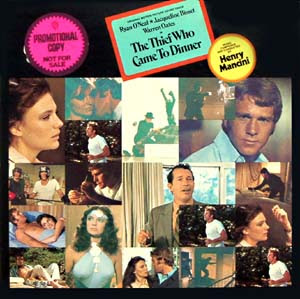
The Thief Who Came To Dinner (Warner Bros., 1973) Henry Mancini’s soundtrack to this 1973 Bud Yorkin film starring Ryan O’Neal, Jacqueline Bisset and Warren Oates was one of his best in some years and the first of his truly memorable seventies scores. The comic caper film was a natural for the man who perfected this sort of thing years before with The Pink Panther, Charade, A Shot In The Dark and Arabesque. But, unlike John Barry, who was forced to produce one James Bond score after another even for non-James Bond films, Henry Mancini delivers something new, even unique here. While the mood is light, there is enough tension to underscore the suspense of the action (some of it recalling Lalo Schifrin’s own 1973 Warner Bros. soundtrack to Enter The Dragon) and it’s all delivered with an appropriately funky groove at the bottom. The fact is, Mancini hadn’t ever delivered this much rhythm in the rhythm section before. The excellent main theme stands alongside some of Mancini’s best “mystery” themes and, of course, is orchestrated to perfection by Mancini using some already dated sounds that sound perfectly sensible and contemporary in Mancini’s handling. The boogie woogie of “Tail Gate” boasts some of Mancini’s fantastic string and horn writing. The heist cues (“Dog Eat Dog,” “First Job,” “The Patter” and “The Really Big Heist”) mostly begin by launching off some riff of the film’s main theme into more exciting, jazz-like explorations that find Mancini at the top of his game. Mancini’s sparkling wit is much in evidence on the easy listening numbers here (“Love Them For Lauara,” “Jackie’s Theme,” “Soft Scene”) – giving them something of a nice seventies spin, which makes them essential listening for fans who want to hear the best of Mancini during this period. FSM did a typically outstanding job issuing The Thief Who Came To Dinner on CD in 2009 by including all 12 tracks of the original 1973 Warner Bros. album – which represented the actual music from the film – with 12 bonus tracks (totaling 18 minutes) of previously unissued music from the film plus three country source cues used in the movie and two demo themes recorded but not used. The FSM CD also contains superb detailed notes by Scott Bettencourt and Lukas Kendall which, as expected, makes for exceptionally fascinating reading. Most highly recommended.

Hangin’ Out With Henry Mancini (RCA, 1974): This eclectic collection combines several instrumental pop covers of the day with a rag-tag assortment of mostly unremarkable film themes. Mancini’s covers of “Love’s Theme/TSOP (The Sound of Philadelphia),” “The Entertainer” and “The Stripper” (famed at the time for use in a Noxema commercial) depart surprisingly little from their original instrumental incarnations, though Mancini offers a nice string break to “The Entertainer” which gives it some of the personality the other covers lack and American reed player Don Menza, back from a long stay in Europe, delivers a delicious solo in “TSOP.” Hangin’ Out also features otherwise unissued Mancini film themes from The Girl From Petrovka, the beautiful The White Dawn and 99 and 44/100% Dead (the bawdy/goofy title track) and a recording of “The Thief Who Came To Dinner” (also issued on 45) with a wordless chorus of eight voices as Mancini intended to use for the film but did not. Mancini’s piano is in the foreground of the ballad covers of Andre Popp’s “Song For Anna,” Francis Lai’s “The Sex Symbol” (surprisingly, one of the 45s released from this album) and Milton di Sao Paulo’s little-known 1974 hit “Dolce.” But unlike 1969’s A Warm Shade of Ivory, it’s not enough to hang on to and as a whole, the album lacks that typical Mancini personality. Highlights: the otherwise limited availability of the “Theme from The White Dawn” and the provocative alternative version of the funkier-than-the-rest-of-this-stuff “The Thief Who Came To Dinner.”

The Return Of The Pink Panther (RCA, 1975): It had been eleven years since Blake Edwards’ previous Pink Panther film and this one, the third link in the chain, reportedly began life as a British TV series that never happened. Fortunately, the series’ three primaries – writer/director Blake Edwards, actor Peter Sellers as Inspector Clouseau and, of course, composer Henry Mancini – all returned to make what many consider to be the best film in the entire series, a series which ended in 1993 upon the death of perhaps its most important contributor, Henry Mancini. The animated title sequence is also among the very best in the entire series, scored by Mancini with a new true-to-the-original rendition of “The Pink Panther Theme” featuring the tenor sax of Tony Coe (in place of original Panther saxist Plas Johnson) and the uncredited trombone antics of (probably) Dick Nash. The film’s bravura sequence is surely the well-executed heist of the Pink Panther diamond from a Moroccan museum (why Morocco?). In a nice tribute to Hitchcock’s To Catch A Thief, the crime is allegedly committed by “The Phantom” (Sir Charles Litton, a role originated by David Niven, played here by Christopher Plummer). But the ten-minute sequence, put together marvelously by director Edwards and editor Tom Priestly, benefits by two of Henry Mancini’s strongest caper cues ever, here given the combined title “The Return of The Pink Panther, Part 1 and II.” Part one of the 5-minute and 12-second cue is Mancini’s elegant processional, contrasting the burglar’s professionalism and craftsmanship with the complicit viewer’s tension and anxiety. Part two is Mancini’s gloriously clever “chase music” as the heister successfully flees the museum guards (with guns!) in an Olympian flight through the museum and over the rooftops of the Morrocan night. Surprisingly, Mancini is not ashamed to deliver some of the cocktail music here that made the first Pink Panther film such a hit at the cinema and in record stores some dozen years before. Not surprisingly, though, the light stuff is remarkably well-conceived. Each is perfectly melodic and developed with a full sense of drama that can’t be appreciated as background music to a film – making a soundtrack album like this essential. The cocktail numbers are plentiful and include “The Greatest Gift” (the thoroughly anachronistic vocal version actually plays as a source cue in what is supposed to be a trendy disco!), “Here’s Looking At You, Kid,” the spritely “Summer in Gstaad” (which recalls earlier Mancini exotica like “Cortina” and “Mégève”), “So Smooth” and the lovely near samba of “Dreamy” (featuring Mancini leading, well, dreamily on piano atop the composer’s gorgeously arranged bed of strings). The remainder of the brief 33-minute soundtrack finds Mancini in top form with two appropriately, pardon the pun, Arabesque titles (“Naval Maneuver” and “Belly Belly Bum Bum”), one rockish piece called “Disco” (as it plays in the discotheque where the disguised Clouseau finds and “picks up” Lady Litton) and two Basie-like jazz numbers, “The Orange Float” and “The Wet Look” that both get excellent, compact solos by the unnamed electric piano, flute and vibes players. Highly recommended.

Soul Symphony (RCA, 1975): Quite simply, Soul Symphony is one of the two or three best – if not the best – Henry Mancini album of the seventies. There is little doubt that Mancini’s brand of music might have seemed old fashioned or hopelessly out of date by 1975. Surely at this point, most of the other “space age” popsters Mancini came up with during the fifties and sixties had faded into obscurity because of their failure or lack of interest to keep up with the times. It might have also been the increasing musical apathy of the fan base’s aging audience (which found new life among crate diggers some two decades later). But unlike nearly all the others, Mancini transcended all of that to produce one of the coolest middle-of-the-road (MOR) albums of the day. Start with the rhythm section. Mancini collected some of the very best of the young West Coast jazz players/soloists, including (Crusader) Joe Sample on keyboards, Abraham Laboriel on bass, Harvey Mason on drums, Dennis Budimer, Lee Ritenour and David T. Walker on guitars and Mayuto, Dale Anderson and Emil Richards on percussion. Then there’s the program. Mancini composed the dynamic title track for the occasion and significantly updated two of his classics, “Peter Gunn” (this was the version featured on his A Legendary Performer album issued a few years later) and “Slow Hot Wind” (a complete revamp of the great “Lujon” from Mr. Lucky Goes Latin). The remaining six tracks are among some of the best covers Mancini has ever chosen for one album: Herbie Hancock’s beautiful “Butterfly” (originally from the keyboardist’s exceptional album Thrust), Barry White’s “Satin Soul” (originally from the Love Unlimited Orchestra’s second album White Gold), “Pick Up The Pieces” (the excellent funk classic from the Australian Average White Band’s first album), “Sun Goddess” (originally from the Ramsey Lewis album of the same name), the weird but funky “Soul Saga” (originally from Quincy Jones’s Body Heat album) and Van McCoy’s “African Symphony” (from the composer’s pre-“The Hustle” album Love Is The Answer). Mancini’s outstanding arrangements are much in evidence and he allows plenty of improvisation over the near jazz fusion tunes by trumpeter Bud Brisbois, bassist Abraham Laboriel, keyboardist Joe Sample, Louise DiTullio (“Slow Hot Wind”), harmonica player Tommy Morgan (“Soul Saga”) and Mayuto on the kalimba (“African Symphony”). Outstanding throughout and an essential part of any Henry Mancini collection.

The Cop Show Themes (RCA, 1976): Another excellent Mancini collection with a perfectly timely theme. Cop shows pervaded television during the mid seventies and a staggeringly high percentage of these had memorable, timeless themes. Mancini covers quite a few of them here, and most would be very well known to anyone watching TV at the time, though one might wish for others as well (Lalo Schifrin’s “Mannix,” Tom Scott’s “Starsky & Hutch” and Jerry Goldsmith’s “Barnaby Jones” or “Police Story,” would be welcome for the Mancini treatment). Mancini offers his own themes for The NBC Mystery Movie (the familiar “Mystery Movie Theme,” an umbrella theme used during 1971-77 for the rotating presentation of such series as Columbo, McCloud, McMillian & Wife, Banacek and Quincy, M.E. - already featured on Mancini’s 1972 album Big Screen Little Screen) and the short-lived The Blue Knight (“Bumper’s Theme,” starring George Kennedy as Bumper). But Mancini’s aren’t the best themes represented here. What he does with other people’s catchy cop show themes is nearly miraculous and with a typically good cast of studio jazz guys to spice it up, most of the album delivers the usual suspects with a dose of high quality musicianship. Indeed, it was only on albums like this where you could hear a lot of these themes – and they do sound quite good together. Mancini beautifully covers Patrick Williams’ brilliant “The Streets of San Francisco” (featuring Artie Kane on electric piano), a medley of Billy Goldenberg’s “Kojak” and Barry DeVorzon’s tremendous and popular “S.W.A.T.” (featuring a great Mancini bumblebee string arrangement, Abraham Laboriel on bass, Graham Young on trumpet and Lee Ritenour on guitar), Mort Stevens’s definitive “Hawaii Five-O” (featuring Dick Nash on trombone) and the equally enigmatic but less known “Police Woman” (showing off how well Mancini can spar horns with strings). While the entire album is exceptionally good, Mancini’s takes on Dave Grusin’s “Baretta’s Theme” and Mike Post’s “The Rockford Files” – both outstanding compositions in their original form – are especially well conceived here. “Baretta’s Theme” gets a superb funk arrangement by Mancini, highlighted by Artie Kane’s beautiful Grusin quotes (right out of Three Days of the Condor). Abraham Laboriel’s bass pretty much drives the whole song, while Don Menza on flute trades solo licks with Oscar Brashear on trumpet. Notably, Mancini’s version of “Baretta” includes Lee Ritenour and Harvey Mason, who were both probably heard on Grusin’s original. Mancini’s remarkable take on “The Rockford Files” is probably the album’s single most significant moment. Mancini brilliantly rescores this song as a funky piece of baroque music, signaled by Artie Kane’s opening use of harpsichord, a mellifluous string section stating the melody (which makes the song sound less awkward than Post’s original) and Mancini’s own addition of a luminous, goose-bump inducing flute counter melody. Don Menza offers a soaring, melodious solo on tenor sax, buffered by Dennis Budimer’s rock guitar and Mancini’s supple string counterpoint. By the time the horn section enters with its triumphant refrain, Mancini has developed a magnificently dramatic piece of music out of Post’s mere TV theme that could be considered a modern concerto of melodic funk. Even if the rest of the album were forgettable (and it isn’t), “Baretta’s Theme” and “The Rockford Files” make The Cop Show Themes absolutely essential.

Mancini’s Angels (RCA, 1977): Similar in concept to Mancini’s 1972 album Big Screen Little Screen, Mancini’s Angels finds the composer/arranger tackling both film and TV themes of the day – surprisingly using one of the only “cheesecake” shots ever featured on a Mancini LP cover. Mancini offers his own cartoony “The Inspector Clouseau Theme” (from the film The Pink Panther Strikes Again and not “A Shot In The Dark,” which many of the Pink Panther cartoon watchers will consider the real Inspector Clouseau theme), the unexceptional “Silver Streak” theme (from the 1976 film whose soundtrack wasn’t issued until 2002 by Intrada), the goofy “What’s Happening!! Theme” and the little-known theme to an-star TV mini-series called “The Moneychangers” (broadcast in December 1976). Mancini also boards the inevitable disco train here for his covers of the well-known themes from Charlie’s Angels (as the original version had not been previously issued, Mancini’s cover was one of the 45s released from the album), Car Wash and a fairly inventive take on Rocky (“Gonna Fly Now,” featuring a nice electric piano solo from Ralph Grierson). The long Roots suite (“Many Rains Ago (Oluwa)/Theme From Roots”) sounds pretty good in Mancini’s hands and only slightly less ponderous than the originals, while Barbra Streisand’s “Evergreen” (from A Star Is Born) benefits by a sensitive piano solo performed by Mancini himself. Hardly a classic, Mancini’s Angels is worthwhile for the otherwise unavailable themes to “What’s Happening!!” and “The Moneychangers” as well as the somewhat interesting way Mancini handles “Gonna Fly Now” and “Music from Roots” only.

The Theme Scene (RCA, 1978): Like the previous year’s tepid Mancini’s Angels, The Theme Scene continues Mancini’s now well-known (and probably expected) tradition of film and TV theme albums. This too is a mostly bland and rather unnecessary review of such TV themes as Battlestar Galactica (Stu Phillips), Star Trek (Alexander Courage), Fantasy Island (which sounds so exotically otherworldly it could have come from “Star Trek!”), the dreadful Three’s Company (Don Nicholl/Joe Raposo – done up like one of Mancini’s own lounge themes from the early sixties) and the disposable Little House on the Prairie (David Rose). Also included here are film themes from the little-known The Children of Sanchez (Chuck Mangione), Heaven Can Wait (Dave Grusin), The Cheap Detective (Patrick Williams) done also, for the most part, just as tepidly. Mancini’s own “NBC Nightly New Theme” and “Once Is Not Enough” – neither of which are featured elsewhere – are included here. This one has the slight edge over Mancini’s Angels for the preferable melodic choices Mancini makes here. There is less – much less – concession to fashion here, which means, of course, disco rarely rears its overbearing head, and more of an effort to make one of those light Mancini albums of yore. One can only imagine how that might have gone over in 1978! Still, Mancini’s otherwise unavailable and un-newsy like “NBC Nightly New Theme” and the ultra lounge-y “Once Is Not Enough” (from Mancini’s score to the 1975 film based on a Jacqueline Susann novel) are worth hearing. Mancini’s relaxed, after-hours take on “The Cheap Detective” makes for some rather elegant late-night listening too. Something about the The Theme Scene’s utter lack of artistic and commercial success suggests the end of the road for this kind of album and this sort of music. Was this the end? Sure enough, Mancini receded into the occasional soundtrack album and “pops” covers of his old hits after this.

Who Is Killing The Great Chefs Of Europe? (Epic, 1978): Mancini’s orchestral score – recorded not in Hollywood but in England, which was what many of the Hollywood composers, including former Mancini pianist John Williams, were doing at the time – to a forgotten 1978 movie directed by Ted Kotcheff (First Blood, Weekend At Bernie’s) starring George Segal, Jacqueline Bisset and Robert Morley features many fine musical moments. Nothing funky or particularly lounge-y. This is simply the work of a magnificent composer doing what he does best, what is right for the film and coming up with a light-hearted score in the classic Hollywood tradition; something John Williams made de rigueur (again!) for Hollywood films following his ultra-popular scores to Jaws, Star Wars, Close Encounters of the Third Kind and Superman. Highlights here include the lovely “Natasha’s Theme” (with a piano solo by Henry Mancini himself – which gets slightly altered variations in “Bombe Richelieu,” “Natasha in Venice” and the “End Title”), the charming and delightfully scored “Pesce!” (Italian for “fish!”) and the baroque – though comic – march of the main title theme (recalling Mancini’s love of Sousa and the score to the 1975 film The Great Waldo Pepper), also heard in several variations. The eating cues (“The Moveable Feast,” “The Gathering” and “The Final Feast”) all have a comic edge that sound like something Mancini would have done in the fifties. Clearly he relishes doing it here again, a whole generation later. Not essential (only “Natasha’s Theme” is memorable), but fun nonetheless.

”10” (Warner Bros., 1979): Blake Edwards’ one-note romantic comedy “10” was quite a hit in its day and, more surprisingly, Mancini’s performance of French composer Maurice Ravel’s “Bolero,” featured in the film, became a huge hit too, making it one of those all-time iconic classical pieces that Richard Strauss’ “Also Sprach Zarathustra,” Carl Orff’s “O Fortuna” or Richard Wagner’s “Ride of the Valkyries” had become. The piece, titled “Ravel’s Bolero” here, is the centerpiece of the silly film’s unexpectedly terrible soundtrack album, even though – like an afterthought – it is the album’s final track. Otherwise, the soundtrack is a strange and unsatisfying mix of horridly corny ballads (“It’s Easy To Say,” a duet between the film’s stars, Julie Andrews and a very hammy Dudley Moore, the jokey Peter Sellers-like “I Have An Ear For Love,” sung by “The Reverend,” and the really awful “He Pleases Me,” sung straight by Ms. Andrews), overly sentimental background Muzak (“Something For Jenny,” two takes of “Don’t Call It Love” and two more takes of “It’s Easy To Say”) and strange disco funk (the perky “Keyboard Harmony” and the surprisingly clumsy “Get It On”). It’s hard to say why nothing really adds up here. Perhaps the magic of the long and successful collaboration of director Edwards and composer Mancini had finally run out of steam (though it revved back up again several years later with Victor/Victoria). Following three Pink Panther movies in a row (each one progressively worse than the one before), Edwards would seem to have loved the idea of getting away from Clouseau. Even Mancini would seemingly celebrate the opportunity to work outside of the Panther straight jacket. But no. Indeed this album plays like one of the lesser Panther soundtracks (The Pink Panther Strikes Again springs to mind). One especially notable oddity here is that, unlike nearly all of Mancini’s other film scores, the composer opted (or was forced?) to use another composer’s piece as the centerpiece of the film. Even the rest of the score has absolutely nothing to do with this piece – in timbre, melody, sound, structure, consideration, anything. It’s as if the rest of the music is completely divorced from what became its main theme, something which might be tolerable if the rest of the album was notable in some regard other than mere camp appeal (Mancini’s 1981 score to the camp classic Mommie Dearest is imminently superior to the campy ”10” and worthy of more serious attention). Considering its popularity – at least at the time – this is surely one of Henry Mancini’s most disappointing soundtrack albums ever.