Thursday, December 15, 2022

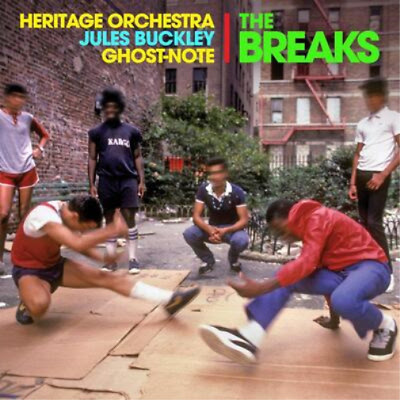
Heritage Orchestra – Jules Buckley – Ghost-Note: The Breaks

I really didn’t catch much new music in 2022. What I did hear was usually more interesting for a listen or two rather than memorable for more than a day or so. Maybe I was too busy catching up. But, in fairness, I’m always late to any party: usually, parties break up before I even show up.

One disc that did catch my attention in a big way this year was neither released in 2022 nor even issued in the United States. But it’s an arresting bit of funk jazz that deserves far more attention than it has, to my knowledge, received thus far or at all.

The disc’s cover alone is disorienting: Break dancers. What? A flip of the disc reveals this disc wasn’t issued in 1984 as it appears – reminiscent of record covers for the Beat Street and Breakin’ soundtracks or the Fuse One release Ice. The Breaks was issued nearly four decades later in 2021.

Glancing over to the label that issued this disc, we don’t find any traditional pop or jazz-label logo. The Breaks was released by the esteemed Decca label, one of Universal Music’s classical (or classical crossover) imprints. What is going on here?

One listen to The Breaks shatters all expectations: here is a disc of seventies-era “break beats” that were frequently – in some cases, often – sampled in eighties and nineties hip hop. The dazzling array of tunes – which digs in to more than a dozen full-length tunes – taps into soundtrack funk, soul, R&B, disco, pop - even a little rock (but surprisingly little jazz).

British composer and arranger Jules Buckley (b. 1980), surely one of the best young arrangers on the scene these days, has nearly no name recognition on this side of the Atlantic. No doubt this is why this disc never found its way over here. But why the conspiracy to keep this guy a secret?

Buckley has conducted the BBC Orchestra, Metropole Orkest and, as on this disc, his own Heritage Orchestra (co-founded with Chris Wheeler). He has also worked with UNKLE, José James, Anoushka Shankar and arranged and conducted the magnificent and Grammy Award-winning Snarky Puppy album Sylva (2015). (My assessment of Buckley as an arranger and collaborator comes from watching and listening to commentary of the DVD of Sylva).

In his native UK, Buckley is known for his work with DJ Pete Tong, Jonathan Jeremiah and Paul Weller (of The Jam and The Style Council).

My hope is that more American musicians discover the wealth of talent in Mr. Buckley. To me, he descends from the great arrangers Nelson Riddle, Percy Faith, James Last and Don Sebesky, all of whom perfectly marry the pop of their day with other genres (jazz, mostly) that crossover to reach listeners of the other – whichever “other” there is.

Additionally, like Duke Ellington, Gary McFarland or even Philip Glass, Buckley weds music to dance in a way that suggests his music is far more dynamic than merely one-dimensional.

The Breaks is based on the show Buckley and Wheeler staged at Royal Albert Hall on September 6, 2019, as part of the BBC Proms (the annual eight-week summer concert and event series staged in and around London). The show featured Buckley conducting the Heritage Orchestra with dancers and singer Vula Malinga and “UK turntable royalty” Mr. Switch (who both appear here).

One thing that distinguishes The Breaks from, say, those funky Percy Faith and Henry Mancini albums from the seventies (namely, Disco Party by the former and The Cop Show Themes by the latter) is its devotion to the groove. For that key ingredient Buckley enlists the brilliant drum duo Ghost-Note, with Nate Werth and Robert “Sput” Searight – both former members of Snarky Puppy – and both on Sylva. They keep this engine humming throughout.

The Breaks is fantastically engaging from beginning to end. Jules Buckley explores 15 break beats – 14 of those in full – with as much dedication to the melody as to the groove. And that one mash-up at the end is a collage of break beats that could have been longer and included even more. Here’s hoping there’s more of The Breaks to come. This is jazz funk at its finest.

What follows is a song-by-song breakdown of the disc, just scratching (he said knowingly) the surface of the wealth of music contained in The Breaks:

1. Apache: Jerry Lordan’s “Apache” goes back to the 1960 hit by Cliff Richard’s backing band, The Shadows. Buckley’s version, however, grooves to the 1973 break-beat classic waxed by the studio group the Incredible Bongo Band, from the first of its two albums, Bongo Rock. The Incredible Bongo Band’s “Apache” has been sampled hundreds of times but its first samplers are the Sugarhill Gang’s “Apache” (1981) and Grandmaster Flash and the Furious Five’s “The Adventures of Grandmaster Flash on the Wheels of Steel” (1981).

2. It’s Just Begun: This 1970 single by the Jimmy Castor Bunch, which riffs on Kool and the Gang’s “Give it Up” (1969), has a strong Sly and the Family Stone vibe. The oft-sampled song, which gave the Jimmy Castor Bunch’s 1972 RCA album its name (and a different version of the tune), was first sampled by Grandmaster Flash and the Furious Five for “She’s Fresh” in 1982. Tenor saxophonist Kamasi Washington dials in a solo from L.A. during the height of the pandemic lockdown.

3. Hot Wheels – The Chase: The studio group Badder Than Evil – which included noted film composer Angelo Badalamenti (1937-2022), writing here as Al Elias…get it? – contributed this song to the Blaxploitation film soundtrack Gordon’s War (1973). It has a very similar groove to Lou Donaldson’s “Sassy Soul Strut,” also from 1973 – and it screams total funk circa 1973. The song was first sampled in 1987 for “Spy in the House of Love (Streetsahead Mix)” by Was (Not Was), a group featuring Don Was, the current president of Blue Note Records (the label that issued the aforementioned Lou Donaldson track). It’s gone on to greater fame from there.

4. Space Funk: The Cincinnati-based Manzel issued a couple singles in the late 70s, including “Space Funk,” their 1977 debut. This little-known gem hasn’t previously received much attention, at least not as much as the drum intro to their “Midnight Theme,” the b-side to the group’s 1979 single “Sugar Dreams.” So, kudos to Jules Buckley for his cover here. The best-known sample of “Space Funk” can be heard on Erik B. & Rakim’s 1988 “No Competition”

5. Think (About It): This 1972 Lyn Collins hit was written, produced and arranged by James Brown and contains a whopping five wildly popular breaks. It’s been sampled literally thousands of times by such hip-hop greats as Rob Base & DJ E-Z Rock (“It Takes Two,” which is how I first heard it), Grandmaster Flash, Kool Moe Dee, Public Enemy, Kid n Play, Snoop Dogg and Kanye West.

6. Forty Days: This little beauty is new to me. Originally known as “Fourty Days” (and also co-credited to trombonist Ray Jackson), a tune hidden on trumpeter Billy Brooks’s sole solo record, Windows of the Mind (1974) on Ray Charles’s Crossover label (Charles also co-produced). “Fourty Days” was first sampled by A Tribe Called Quest for “Luck of Lucien” (1990) and was also sampled by, among others, Greyboy for “Funk on the Brain” (1993). Buckley’s silky yet slinky “Forty Days” features a lyrically gorgeous flugelhorn solo by Gavin Broom.

7. Give It Up Or Turnit A Loose: James Brown’s 1969 hit has been sampled dozens of times by such hip-hop artists as Jazzy Jay, Full Force, 2 Live Crew, N.W.A., Miles Davis (!), Gang Starr and Afrika Bambaataa with JB himself for “Unity” (1984).

8. More Bounce to the Ounce: The Dayton-area phenom Zapp’s 1979 debut single was the inspiration behind the Tom Tom Club’s 1981 hit “Genius of Love,” itself a sampled favorite. (Chris Frantz of the Tom Tom Club said that “Bounce” was “the jumping off point for us, because we loved the groove of that song, and the tempo.”) The synth-heavy talk-box vocal “Bounce” was sampled early on for George Clinton’s “Loopzilla” (1982) and has been sampled hundreds of times by, among others, the Notorious B.I.G., EPMD, LL Cool J, Ice Cube and Eminem.

9. Get on the Good Foot: James Brown’s 1972 hit is more groove than song, with Brown preaching the gospel of good funk, qué pasa people. “Good Foot” was tailor-made for sampling and indeed hundreds have sampled it, including 2 Live Crew, Big Daddy Kane, Ice Cube and even James Brown himself for “I’m Real” with Full Force in 1988. Buckley’s arrangement allows trombonist Alistar White to funk out his best Fred Wesley (who did not solo on the original studio take of the song).

10. Ashley’s Roachclip: Another great break that’s new to me, “Ashley’s Roachclip” factors on the DC-based Soul Searchers’ 1974 album Salt of the Earth. The song, first sampled by Grandmaster Melle Mel and the Furious Five for “Step Off” in 1984, turned out to be such a massively popular break that the UK-based Soul Brother Records issued “Ashley’s Roachclip” on a 45 backed by the group’s - later known as Chuck Brown and the Soul Searchers – disco-y “Blow Your Whistle,” sampled by Public Enemy for “Who Stole the Soul” in 1990.

11. Dance to the Drummer’s Beat: A very happy discovery for me here, “Dance to the Drummer’s Beat” comes from the Miami-based drummer Herman Kelly. Originally featured on Herman Kelly & Life’s album Percussion Explosion, “Dance” likely didn’t become a national hit because it was neither featured on the Saturday Night Fever soundtrack nor issued by the Miami-based TK label, home of K.C. and the Sunshine Band. That didn’t stop clever hip-hop artists from finding this song: two early samplers include “Dopeman” by N.W.A. and “Beats to the Rhyme” by Run-DMC, both 1987.

12. Rated X: Before their 1979 breakout hit album Ladies’ Night New Jersey’s Kool and the Gang was one of the finest and most consistently terrific funk bands - ever. From their 1972 master jam Good Times, “Rated X” was sampled twice by both Queen Latifah (“Dance for Me” and “Queen of Royal Badness” – both 1989) and Ice Cube (“Turn Off the Radio” and “The Product” – both 1990).

13. The Mexican: One of the more unusual breaks featured here is “The Mexican,” a 1972 track from the British Prog Rock band (!) Babe Ruth’s debut album, First Base. “The Mexican” likely became a popular break due to its clever “sampling” – or quotation – of Ennio Morricone’s iconic theme to the film “For a Few Dollars More.” In any event, “The Mexican” was first sampled by Afrika Bambaataa and Soulsonic Force for the legendary “Planet Rock” (1982) and, later, by the Jungle Brothers for “On the Run” (1988) and “The Mexican” by GZA with Tom Morello (2015), among others.

14. Theme from S.W.A.T.: Barry DeVorzon’s theme to the 1975-76 ABC-TV show was made popular by the studio group Rhythm Heritage (led by Michael Omartian and Steve Barri) for their 1976 album Disco-fied. One of a number of great TV theme songs from the seventies – notably including Patrick Williams’s “Streets of San Francisco” and “Starsky and Hutch” by Tom Scott (who also factors in Rhythm Heritage) – “S.W.A.T.” was sampled by LL Cool J for “I’m Bad” (1987), Public Enemy for “Nighttrain” (1991) and a few dozen others.

15. X Breaks: This far-too brief compilation of Jules Buckley’s favored breaks cleverly champions the opening salvos of Bob James’ “Shamboozie” (1982), The Mohawks’ wildly-sampled “The Champ” (1968), Bob James’ beloved 1975 cover of Paul Simon’s “Take Me to the Mardi Gras,” the Sugarhill Gang’s 1980 hit “8th Wonder,” the 1968 James Brown-produced Marla Whitney single “Unwind Yourself,” and the aforementioned Soul Searchers’ 1972 single “We the People.” In all of two minutes and eleven seconds, too. Wow!

Sunday, November 27, 2022

Rediscovery: Larry Coryell – “Fallen Angel”

I.

I wager there is no such thing as a “great” Larry Coryell album. Even on his better records, the guitarist proved uneven, inconsistent or, more often than not, uninteresting. Worse, a bad vocal always threatened to wipe out whatever an otherwise decent Coryell record might promise.

He is chiefly remembered for the funk fusion of his Eleventh House records and the all-star Spaces (with Chick Corea and fellow guitarist John McLaughlin) – all from the early seventies. After being dubbed “the Godfather of Fusion,” Coryell remade himself in the eighties as a straight-ahead jazz standard-bearer on a series of records for the Muse and HighNote labels.

To these ears, Coryell always sounded better on other people’s records. For example, Coryell is heard to superb effect on Chico Hamilton’s “Thoughts” (1966), Chico O’Farrill’s “Green Moss” (1966), Don Sebesky’s “The Word” and “Guruvin” (both 1969, the latter on electric sitar[!]), Wolfgang Dauner’s “Tuning Spread” and “Yin” (both 1972), the little-known and under-revered Mysterious Flying Orchestra’s “Improvisational Rondo for Saxophone and Guitar” (1977), Miles Davis’ Miles-less “Miss Last Summer” (1978) and Joey DeFrancesco’s “JLJ Blues” (2012).

By the early nineties, Coryell was actively touring and recording in a variety of styles for a bevy of independent labels. He never found the renown or the crossover success of his hero and mentor, Wes Montgomery, or his friend and contemporary, George Benson.

Then, out of the blue, producer Creed Taylor – who had much to do with making stars of Montgomery and Benson – recruited Coryell to record and film a concert of Brazilian music in Brazil. The resulting album was the largely re-recorded Live in Bahia, Coryell’s 1992 CTI debut. But it was not Coryell’s first scrape with CTI.

According to the guitarist’s 2007 autobiography, Improvising: My Life in Music, Coryell pitched his 1969 solo debut, Lady Coryell, to Creed Taylor, who, not surprisingly, turned it down. The album was shortly thereafter picked up by Vanguard, where Coryell spent much of the next decade.

Coryell and Taylor’s paths wouldn’t cross again until CTI’s 1980 all-star date Fuse One. While Coryell didn’t factor on CTI’s 1981 Fuse One follow-up, Silk, the guitarist is prominent on the collective’s second – and mostly wonderful – David Matthews-led sequel, Ice, first issued in 1984. Coryell also surprisingly took several nice turns on pianist Roland Hanna’s 1982 CTI album Gershwin Carmichael Cats.

Fallen Angel was the 1993 CTI follow-up to Live in Bahia and the second of Coryell’s three increasingly commercial discs for the label. Although Coryell himself never thought much of his CTI discs, Fallen Angel is among the guitarist’s best, most cohesive discs and ranks high with Live in Bahia among the best of the late-period CTI CDs.

II.

This is a disc that was born in more controversy than is typical for the average jazz record, or even the sublimely well-crafted CTI album.

First, producer Creed Taylor, arranger Don Sebesky and engineer Rudy Van Gelder conspired to build a jazz disc without any sort of a rhythm section. Sebesky “programmed” a bank of synthesizers to fill this void – an innovative (and cheaper) way to make jazz sound and feel contemporary. To my knowledge, Taylor had only done this one time before: on keyboardist Roger Kellaway’s 1984 album Creation.

Second – and most remarkably – the great Wes Montgomery, who died in 1967, makes an unexpectedly star appearance on this 1993 disc. This may not sound like a big deal in the heady days of hip-hoppers sampling older jazz, particularly from the absolutely sample-able CTI catalog. But there is a bit more here than meets the ear.

After the surprising success of the 1991 “virtual duet” singer Natalie Cole shared with her long-deceased father on “Unforgettable,” Creed Taylor made a daring proposal to Larry Coryell: a “digital duet” with Wes Montgomery on the deceased’s iconic “Bumpin’ on Sunset.”

”Initially, I did not want to do this,” said Coryell in his autobiography, “thinking it would be sacrilegious to mess with anybody else.” But Coryell was eventually swayed by the success of the Coles’ “Unforgettable” and fellow guitarist Lee Ritenour’s then-recent tribute to Montgomery, the absolutely terrific Wes Bound (which, notably, does not include “Bumpin’ on Sunset”).

Coryell said “Creed apparently still owned the master to that track, and the original had been on his CTI label when it was a hit in the ‘60s.” Well, not quite. While Taylor may have possessed a master “copy” of the Wes track, he could not have “owned” it as the original was not on CTI. Even at this point, Taylor did not own the bulk of what was actually on CTI.

Coincidentally, however, at the very same time, a series of Taylor-produced discs from his days at ABC-Paramount, Impulse and Verve began appearing in Europe on the “PDCTI“ label – which neatly but incorrectly translated as “Public Domain CTI.” Of course, that wasn’t true. But some three dozen such discs briefly appeared, including the 1966 Verve album Tequila that featured the original “Bumpin’ on Sunset.”

As titled here, “(Angel on Sunset) Bumpin’ on Sunset” sets the tone for much of what Fallen Angel is all about: a sort of greatest-hits tribute; not to the artist under consideration, but rather the producer, Creed Taylor.

While “Bumpin’ on Sunset” is always a pleasure, it would have been better if Coryell had crafted his own take on the tune – as he would do so compellingly a decade later on The Power Trio – Live in Chicago.

Here, Coryell does little more than add Sebesky-like touches of counterpoint on echo-y acoustic guitar. Sebesky himself adds some piano and synth-string washes, giving the song a strangely cantina vibe. The song takes off, though, when Coryell switches to electric guitar and seemingly spars with Wes as though Wes had overdubbed himself.

Things get more interesting on the disc’s opener, Marvin Gaye’s timeless “Inner City Blues.” Of course, “Inner City Blues” was Grover Washington, Jr.’s first CTI-Kudu single and the title track to his 1971 solo debut. Here, Sebesky gives the song a pleasing techno turn, allowing the guitarist to get down and funky on amplified acoustic guitar.

The disc’s ninth track, ”Thus Spoke Z,” is a clever techno update of Richard Strauss classic “Also Sprach Zarathustra,” which, of course, Deodato spun into CTI’s biggest hit in 1972. Deodato’s diabolically clever version, also known simply as “2001” after Stanley Kubrick’s 1968 film, spawned dozens of knock-offs in the mid-seventies. It was long past due for an update.

Here, Sebesky crafts an especially funky backdrop (it might better be titled “Thus Spoke S”), allowing Coryell and pianist Mulgrew Miller – who frankly sounds an awful lot like Bob James here – to spar to great effect. Indeed, “Z” offers some of Coryell’s tastiest playing on the entire disc. And whether he knew it or not, Coryell beautifully quotes Gary McFarland’s “Long Live the King” on the song’s outro.

The jazz standard “Stardust” gets a brief, but beautiful nod by Coryell on solo guitar. The song had previously been visited – in a sort of Brazilian version – by Taylor, Sebesky and Coryell on pianist Roland Hanna’s 1982 CTI album Gershwin Carmichael Cats. Coryell had himself recorded the tune at the Van Gelder studio in 1992 with trumpeter Jack Walrath on an album called Out of the Tradition. Much more should have been made of this. But…

”Stardust” leads here into an unusual take on Erroll Garner’s “Misty.” Sebesky ill-advisedly sets the tune to a reggae-lite backdrop, likely in an effort to contemporize the tune.

It’s an odd choice, particularly in this reading. Mulgrew Miller’s brief Bob James-like flourishes even suggest this track could have been an outtake from a Bob James album of the period. “Misty” was no doubt a concession to the then-popular “NAC” or Smooth Jazz market of the day. But no one at CTI or Smooth Jazz radio made anything of it.

Fallen Angel’s other nods to the contemporary-music market include “Never Never,” the disc’s lone single, and “Fallen,” both featuring Klyde Jones’ vocals and smoothie saxophonist Richard Elliott. Coryell practically disappears on both tunes, making the song’s inclusions too obviously gimmicky attempts at commercialization.

“Fallen,” however, would have made a much better single choice, with or without Larry Coryell’s name. The song, written by Lauren Wood (a.k.a. “Chunky”), was first recorded in 1979 by Nicolette Larson and had recently staged a comeback as Wood’s 1982 recording of the song was prominently featured on the 1990 hit soundtrack for Pretty Woman. This version, too, could have been a contender.

III.

While the above pieces are likely Fallen Angel’s better-known – or more notorious – pieces, the remaining half of the disc is where Coryell owns his own disc. That these tracks comprise roughly the bulk of the second half of the disc suggests the album may have fared better with slightly different programming or better served on or as a separate disc.

Coryell first waxes eloquently on Sebesky’s lovely “I Remember Bill,” offering a nuanced reading that soars lovingly over Sebesky’s subtle strings. Named for pianist Bill Evans – who, surprisingly, never worked with Don Sebesky – and riffing off Sebesky’s earlier “I Remember Wes” (a feature for George Benson), “I Remember Bill” was first waxed for Stanley Turrentine’s Sebeksky-arranged disc If I Could (1993).

I say “first” only because Turrentine’s disc, which was recorded in May 1993, was issued only a few weeks before Coryell’s otherwise undated recording. Sebesky would later record the Evans remembrance on his own 1998 disc-length tribute to the pianist, I Remember Bill (A Tribute to Bill Evans), a disc that features contributions from Larry Coryell on a number of tracks other than that particular song.

Coryell switches to acoustic guitar for the haunting “Pieta,” where he and pianist and fellow CTI recording artist Ted Rosenthal trade fours. “Pieta” is based on Rachmaninoff’s 1915 wordless romance “Vocalise,” which Sebesky first presented as a feature for Milt Jackson and Paul Desmond on his 1973 CTI album Giant Box - remarkably the first and nearly only jazz take of the tune.

Strangely buried in the set list, “Pieta” is among Sebesky’s signature best “jazz classics,” ranking right up there with Jim Hall’s 1975 “Concierto de Aranjuez” (with Chet Baker and Paul Desmond) and in accord with such melancholy Spanish-inflected numbers as his own “El Morro” (notably the 1977 Chet Baker version).

In another nod to Bill Evans – this time specifically to the 1963 landmark Creed Taylor production Conversations with Myself - Coryell beautifully overdubs himself on “Stella by Starlight.” Coryell had previously recorded the tune with Miroslav Vitous on a 1987 Bill Evans-Scott La Faro tribute album. Here, Coryell claims “Stella” as a guitarist’s tune, dressing the lady in shades of Django Reinhardt and Johnny Smith.

Coryell overdubs himself again on the all-too brief “Westerley Wind,” this time, however, alluding again to the guitarist in the title. The remaining Coryell originals, oddly tacked on at the end of this 52-minute program, are the quirky yet playful “Monk’s Corner” (again featuring Rosenthal) and the evocative “The Moors.”

Both of these last pieces, which hark back to the earlier-mentioned Kellaway disc Creation, are interesting as sketches – from a soundtrack or as background music – but don’t necessarily stand up well as full-fledged compositions. As such, they seem like filler the album doesn’t need. But Fallen Angel might have been different, if not a more uniquely Larry Coryell disc, had they gone in this particular direction.

IV.

Fallen Angel was released in October 1993 to surprisingly little notice. Perhaps, though, it wasn’t so surprising after all.

Maybe it was the Larry Coryell album no one was waiting for. Coryell, who was 50 years old at the time, was likely past his prime for crossover success. And Creed Taylor probably overcooked this one, throwing a bit too much in to the mix to make it palatable for most. Still, Fallen Angel has much to recommend it.

“Most of us would agree,” wrote the San Francisco-based music tip-sheet The Gavin Report in 1993, “that, generally, Larry Coryell sits on the more esoteric side of the jazz guitar spectrum, and even though Fallen Angel is, putting it mildly, an about-face, it's not a direction Coryell has taken without deep contemplation. By working with Don Sebesky and Creed Taylor, both exquisite purveyors of commercial jazz, Coryell made [the disc] a direct musical statement as opposed to another happy sax record."

Agreed. Still, a direct musical statement was not what people wanted in 1993.

The disc’s “happy sax” single, “Never Never” – paired with what should have been at least one of the album’s single releases, “Thus Spoke Z” – failed to garner any airplay. Coryell said, however, that New York-area stations picked up on “Angel on Sunset,” attracting attention to the album – and ire. Coryell wrote that “[t]he worst fallout was from [guitarist] Pat Metheny, who really slammed me for doing the Wes thing.”

The great Brazilian guitarist and composer Luiz Bonfá (1922-2001) was sufficiently impressed by Fallen Angel to write “Samblues for Mr. Coryell” for his 1997 album with vocalist Ithamara Koorax, Almost in Love – in a performance that featured Coryell himself.

Coryell would go on to appear on two tracks from the next CTI album, saxophonist Donald Harrison’s The Power of Cool (1994). Then, in 1995, the guitarist’s third and final CTI album appeared, the blatantly commercial and ultimately prophetic I’ll Be Over You (yes, the Toto song), especially notable for “Nightshade,” a terrific pairing of Coryell with Grover Washington, Jr. and, apparently, a lot of unpaid bills.

Several of Coryell’s pieces from Fallen Angel (and “Nightshade”) were sampled by a CTI collective dubbed Thus Spoke Z (a nom de music for Creed Taylor’s son, John) for the 1996 “acid jazz” disc Evolution - curiously excluding the song “Thus Spoke Z” or any samples of it.

From this point forward, CTI Records would struggle to survive, issuing a scant few discs until a CTI All Stars date released (in Japan only) in 2010. Coryell went on to perform and record prolifically until his death in 2017. Indeed, his first post-CTI album, Sketches of Coryell, seemed inspired by the lessons he learned while with CTI. But even the more consistent Sketches of Coryell failed to find much of an audience.

Three decades later – and far removed from the days when smooth jazz battled for significance with the so-called “Young Lions” – this altogether imperfect disc deserves consideration for all it attempts. Fallen Angel is as much a worthy tribute to Creed Taylor’s decades-long genius as it is one of Larry Coryell’s best and most engaging discs in his half-century discography.

Monday, October 17, 2022

Rediscovery: Hubert Laws - “Crying Song”

Over the years, I've fielded many questions about the late, great Creed Taylor's CTI Records. But, much to my surprise, no single CTI album has generated more questions others asked of me than Hubert Laws' CTI debut Crying Song. As a result, I've spent a considerable amount of time listening to, asking, thinking and writing about this one record. It seemed time to put it all together and do a genuinely deep dive into the well of Crying Song. I have had to do more than a bit of speculation here, so it's likely going to stir up some debate. Many of these debates have already happened and, well, here we are. Readers who care enough to read on are welcome to post comments of their own at the end. Now, let's all have a good cry...

I. More Whys Than Wows

Perhaps more talked about than listened to – a folly to which even this writer must concede - Crying Song is the first of flautist Hubert Laws’ seven CTI records. It is also the first album producer Creed Taylor recorded for his newly-independent CTI label. (The first numerical CTI record, singer-songwriter Kathy McCord’s eponymous album, was recorded several months later.)

Crying Song is also the very first album in CTI’s history to get reissued – and almost immediately upon its initial release: the original single-sleeve album with the red-tinted Price Givens photo of Hubert Laws (cat. no. 1002 with a list price of $4.98) was upgraded only several months later to a lavish gatefold sleeve bearing Pete Turner’s dream-like “Blue Horse“ photo (cat. no. 6000 with a list price of $5.98).

Taylor seemed to invest much of himself in the making and releasing of this album. Indeed, there is more “production” present on Crying Song than the unusually sparse early CTI albums on the new independent by, say, Freddie Hubbard, Stanley Turrentine and George Benson. He likewise seemed to believe in its potential, pairing the flautist, as Taylor liked to say, with “Elvis’ rhythm section,” and even nabbing a Beatles tune that had not yet been released.

Recorded over two days in Memphis in July 1969 and two days at Rudy Van Gelder's New Jersey studio two months later, Crying Song ultimately seems like little more than a footnote in the CTI legacy. But the record is best heard neither as a typical CTI album nor as a representative Hubert Laws album. As a whole, it’s not really much of a jazz album either. I think this was the point. Taylor and Laws were likely going for something else – something, perhaps, a bit more experimental.

Sure, Taylor’s 6000-series reissue of the album means to peg it as “jazz” or maybe what was then still evolving as “fusion.” But any hearing of the record suggests a fusion of an altogether different sort: a blend of psych-rock and, well, to be honest, easy-listening.

Call it “psych jazz,” a prefiguration that wends in such later efforts in this mold as Frank Wess’ Wess to Memphis (1971), Yusef Lateef’s The Gentle Giant (1972), Charles Lloyd’s Geeta (1973), Herbie Mann’s London Underground (1974) and Paul Horn’s Visions (1974) – all, like Crying Song, intoxicatingly good and terribly underrated.

Yet while Crying Song ultimately proved to be a miss, the record looms large as the stuff of myth. It spins more with unanswered questions than listeners or fans.

I have spent much time over the last few years going through the vale of tears that makes what we have in Crying Song - to surprisingly little avail. The main participants are either not able to recall much or simply would not say. But in commiserating with a number of CTI sleuths, including Creed Taylor Produced’s Mark Cathcart, there are a number of paths this journey suggests.

The true story of Crying Song may never be known. Half a century later, few may care. But at the risk of doing for Crying Song what film critic Pauline Kael did to Citizen Kane in 1971 – or placing myself or my subject here at such equal footing – there are some things we can reasonably surmise or speculate upon. Here’s my shot at deciphering an unusual, though unusually compelling album.

II. Why Memphis?

In my conversations with Creed Taylor, we talked less about his “hits” (Red Clay, “2001”) than his “misses” (Larry Coryell, Ted Rosenthal). Two reasons for this: (1) Taylor had unusually enormous success in jazz over three decades with such great artists and over many landmark recordings. I was always curious what such a “hands on” producer thought when he came up with a dud. (2) These admittedly unfairly-dubbed duds – Soul Flutes, Pacific Fire, etc. – number among my own favorite CTI records.

Crying Song stands out as one of Taylor’s, well, misses. It is for that reason that one of my earliest questions to the producer specifically regarded Crying Song: “Why Memphis?” I remember Taylor’s genuine enthusiasm when he responded, “Who wouldn’t want to record with Elvis’ rhythm section?”

Indeed, Taylor – in what must have been the first of his very few forays outside of New York or the Van Gelder studio – had recorded part of singer Tamiko Jones’ I’ll Be Anything for You in Memphis the previous year. Despite that record’s lack of success, Taylor still seemed eager to get back to Memphis again.

But, in retrospect, “Elvis’ rhythm section” seems like a bit of legend-building. Memphis truly was a bubbling cauldron of pop music magic at the time. Such hits as the Box Tops’ “The Letter” (1967), B.J. Thomas’ “Hooked on a Feeling” (1968), Dusty Springfield’s “Son of a Preacher Man” (1969), Neil Diamond’s “Sweet Caroline” (1969) and Elvis Presley’s “comeback” hits “In the Ghetto” (released in April 1969) and “Suspicious Minds” (released one month after Crying Song’s Memphis sessions) – to name only a few – all came out of Memphis during this time.

”Elvis’ rhythm section” was, in reality, not the King's rhythm section at all but rather a group of studio musicians based at Memphis' American Sound Studios’ now known as the Memphis Boys: Reggie Young on guitar, Bobby Wood on piano, Bobby Emmons on organ, Mike Leech on bass, Gene Chrisman on drums and Glen Spreen doing arrangements.

Creed Taylor was well aware that the Memphis Boys were behind so many of the pop hits of the day. The producer’s attraction to Tennessee’s second musical capital was more likely than not for Memphis’ seeming capacity for hit-making pop magic. And Taylor needed a hit.

Unfortunately, neither the Tamiko Jones record nor Crying Song turned out to be hits (more on that later). Coincidentally, both these Memphis-recorded discs are among Taylor’s least distinguished recordings and seem to lack much of anything that marks the producer’s aural signature.

Curiously, another huge hit that came out of Memphis in 1969 was Herbie Mann’s “Memphis Underground” – a song that Creed Taylor himself actually passed on during the recording of flautist’s 1967 album Glory of Love on A&M/CTI. “Memphis Underground” hit number 44 on the pop charts, earning both the song and Mann’s Atlantic album of the same name Grammy Award nominations. In what must have really rankled Taylor, Mann’s album also ranks as one of the best-selling jazz albums of all time.

III. Why Hubert Laws?

As Grover Washington Jr.’s solo debut on the CTI subsidiary Kudu, Inner City Blues (1971), is said to be originally intended for the “unavailable” Hank Crawford, Crying Song, is likewise said to have been originally intended for someone other than Hubert Laws.

Legend has it that Creed Taylor called Hubert Laws from Memphis to fill in for tenor saxophonist Stanley Turrentine, apparently a no-show for an already-scheduled session.

Laws had already had three albums of his own released by Atlantic and dozens of sessions – on flute and tenor sax – under his belt. He had first worked with Taylor on Kai Winding’s marvelous and underrated Penny Lane and Time (Verve – 1967 – one of Taylor’s last productions for the label), a number of A&M/CTI sessions and, recently – and most notably – Quincy Jones’ Walking in Space, recorded several months earlier.

Why call Hubert Laws – who was seemingly under contract to another label at the time – and not one of the musicians already contracted with A&M? Why not, for example, George Benson? Or, what about one of the Verve artists Taylor produced between 1961 and 1967?

One reason is surely that the producer was looking for a player who could tackle a pop program and potentially make chart waves. While Laws had no particular expertise in this area, Taylor – who was very likely swayed by the flautist’s notable performance on Walking in Space - astutely discerned Hubert’s potential – and a soloist who would follow his lead.

Their successful union would reap dividends only after Crying Song.

The Stanley Turrentine legend was first widely reported by Didier C. Deutsch in his notes to the 1988 CBS Associated CD release of Crying Song. It all seems, well, a bit unlikely. But we’ll get to that. The flautist happily obliged, abruptly leaving a steady-paying gig on The David Frost Show - an assertion Laws proudly confirmed in a 2009 Wax Poetics interview.

(It has been suggested that before leaving the Frost show, Laws recorded and is pictured on the cover of the 1970 album From David Frost and Billy Taylor – Merry Christmas [Bell]. Rather than Laws, however, it is Frank Wess playing on the record and who is pictured on the cover.)

It’s a bit unclear where the Turrentine claim originated, but it doesn’t hold up well to much scrutiny. During this period, Turrentine was wrapping up a long string of Blue Note records and working in Los Angeles on the 1970 Canyon album Flipped. Those sessions yielded Turrentine’s own cover of “Let It Be,” an appropriately gospel reading, arranged by Monk Higgins, that easily bests Laws’ version heard here.

In his book Friends Along the Way, the writer, editor and critic Gene Lees – a longtime friend and associate of Creed Taylor’s – indicates that the saxophonist’s association with Creed Taylor began around the time of the dissolution of his marriage to Shirley Scott. This puts the producer and musician’s first dealings with each other (apart from a 1964 Donald Byrd session) around the fall of 1970, shortly before the November Sugar sessions – a full year later.

Is it possible that Creed Taylor called Stanley Turrentine to come to Memphis to do the session? Yes, of course. But it’s also just as likely that Turrentine, at that point, could not accept the offer.

While Laws says he doesn’t remember who he stepped in for, it’s quite possible and even more probable that the Memphis sessions were scheduled not for Stanley Turrentine…but rather flautist Herbie Mann.

Both flautists recorded primarily for the Atlantic label and both were featured on Mann’s A&M/CTI album Glory of Love (1967). Both were also scheduled to do their own albums for Creed Taylor at A&M in 1969, yet only Laws’ Crying Song, emerged – albeit on Taylor’s newly independent CTI imprint (more on that later).

At the time, Laws was riding Mann’s coattails – to little avail. Atlantic Records was also doing much more for Mann than Laws: between 1964 and 1969, Atlantic issued some 19 (!) albums by Mann yet only three by Laws. Laws was busy racking up studio credits but little else. Little wonder why he accepted Creed Taylor’s offer.

But this wasn’t the first time Hubert Laws came to Creed Taylor’s rescue when things went south with Herbie Mann. It is likely that “The Fluteman” credited on the anonymous Soul Flutes’ A&M/CTI album Trust in Me (1968) is both Mann – who fell out of the project at some point – and Laws, to a large degree. But that’s another story for another day.

Creed Taylor and Herbie Mann go back to the beginning of both their careers – on Bethlehem in the fifties. But things started falling apart during their reunion on Glory of Love. The success of “Memphis Underground” (on Atlantic) also allowed Mann to set up his own production company and label, Embryo, shortly thereafter, a label which lasted from 1970 to 1977.

It’s therefore easy to imagine that two such individual jazz empresarios as Taylor and Mann, both hit-makers in their own right, would clash over musical ideas, making any further collaboration untenable.

Curiously enough, though, in 1971, a Herbie Mann album appeared on Atlantic titled Memphis Two-Step. The album’s title song was written by CTI’s house arranger, Don Sebesky (who, oddly, was not at all involved in Laws’ finally-issued Crying Song) and recorded in Memphis – though neither Sebesky nor Memphis factored in any of the Mann album’s other tracks.

Atlantic discographies indicate the song was recorded in November 1970 at A&R Recording Studios in New York City. But it’s highly unlikely that the Memphis Boys would have traveled to New York to record. Even the album itself indicates Memphis was the recording location of the song.

It’s possible, even likely, that “Memphis Two-Step” is the sole surviving outtake of a 1969 Taylor/Mann session recorded in Memphis. The 1970 date probably designates when any overdubs or edits occurred.

IV. Why all the AM-radio fare?

Because it worked for Wes Montgomery. But that was then. This approach was no longer selling Taylor-produced albums by the Soul Flutes, George Benson and Kai Winding nor was it working elsewhere for Bud Shank, Gabor Szabo, Cal Tjader, Gary McFarland or any of the other “if you can’t beat ‘em, join ‘em” jazzers trolling the AM-radio hit parade of the day.

The rising popularity of rock surely made jazz takes of pop music sound, well, old-fashioned, quaint and totally uncool: music for your parents. In Memphis, Taylor wasn’t yet aware of this perception. Indeed, Crying Song’s Memphis sessions may be the last time he tinkered with this sort of fare in this way. By the time of Johnny Hammond’s “It’s Too Late,” George Benson’s “White Rabbit” and Hubert Laws’ own “Fire and Rain” (all 1971) – the covers were longer, more thoughtful, more loosely arranged and much more interesting as jazz.

Only part of Crying Song was recorded in Memphis – indeed, not enough to fill an album. This suggests that either more tracks were recorded and, for whatever reason, discarded. Or, there wasn’t time enough to record more.

Considering the radio-friendly brevity of the Memphis tracks – between two and half to three minutes apiece – it’s a bit of a surprise more didn’t come out of Memphis (six of the album’s nine tracks were recorded there).

The Memphis tracks on Crying Song consist mostly of AM hits of the day and include The Dells’ Charles Stepney-arranged “I Can Sing a Rainbow/Love is Blue” – listed here, for some reason, as “Love is Blue/Sing a Rainbow” – The Monkees’ “Listen to the Band,” and the Bee Gees’ first US Top Ten hit, “I’ve Gotta Get a Message to You.”

In all likelihood, it was Taylor who chose the majority of the program here (Laws may well have chosen the more soulful Dells piece – which may also explain why the titling of it was bungled), hedging his bets with Laws in an effort to cross him over, something Atlantic failed to do, much the way the producer did earlier with Wes Montgomery.

But these tunes were hardly among the most notable or memorable pop pieces of 1969 – and not much memorable happens in Laws and company’s handling of the songs. Additionally, these tracks aren’t helped by Taylor’s fish-out-of-water recording. A strong arranging partner, like Don Sebesky, is sorely missed here.

As with the Tamiko Jones record, there’s little if any of a “Memphis feel” to much of this music. Atlantic’s Jerry Wexler and Arif Mardin were a much more natural – and successful – fit for wringing the soul out of Memphis.

Four of the Memphis tracks here feature brass parts written by Memphis Boys Glenn Spreen and Mike Leech but, oddly, overdubbed later by New York session players – suggesting that either Taylor re-recorded the parts for some reason or there wasn’t time to draft brass players in Memphis (Bob James also added string arrangements to two of the Memphis pieces).

V. Why “La Jean”?

Several of the Memphis tracks, however, are indeed remarkable in ways that deserve a bit more thought and consideration. One of Crying Song’s more significant originals is the altogether unfairly unknown “La Jean.”

The song was written by Memphis studio guitarist Johnny Christopher, who was also later known as Jhon Christopher. Christopher was a prolific writer of mostly country hits and a co-writer of Willie Nelson’s Grammy-Award winning hit “Always on My Mind,” originally written in 1972 for Elvis Presley.

Christopher grew up in Atlanta, eventually becoming part of Ronnie Milsap’s group. When Milsap went to Memphis in 1967, so did Christopher. Memphis was just entering its golden phase of hit recordings and Christopher stayed on as a studio musician there through 1972, before moving on to Nashville.

“La Jean,” named for Christopher’s then wife, seems to have originated on the 1969 album Instant Groove by Aretha Franklin saxophonist King Curtis as “La Jeanne.” King Curtis’s version was recorded circa February 1969 and it too was recorded in Memphis (also seemingly without Christopher).

The song was also covered by the British studio group Sounds Nice as “Sleepless Night” on the 1970 psyche-rock easy-listening monument Love at First Sight - produced by Gus Dudgeon and arranged by Paul Buckmaster, both of whom would soon help Elton John to become a superstar. It’s another sleeper that unfortunately got lost in the sands of time.

This haunting and lovely song seems as though it should have had a greater provenance than it has. Laws, of course, is flawless here, treading the edges of jazz and classical as he so often has. Bob James’ overdubbed strings and the subtle Beatlesesque horn flourishes work wonders in collaboration with the flautist’s commanding lead. That said, “La Jean” is an altogether too underwhelming set opener that portends a sort of hippy haze that hangs over far too much of Crying Song.

VI. Why “Feelin’ Alright?”

Dave Mason’s “Feelin’ Alright” originated in 1968 with the band Traffic but found its initial success – as “Feeling Alright” – on Joe Cocker’s 1969 debut With a Little Help from My Friends. It’s worth noting that the song’s original Essex Music publisher somehow changed to Herb Alpert’s Almo Music Corp. when Cocker performed it on the A&M label.

This suggests that Alpert might have been pulling Taylor’s strings a little more than is widely known. As Taylor himself conveyed in a 2009 Wax Poetics interview, “Herb [Alpert] started making suggestions. I told myself, ‘You gotta get out of this situation.’” He did (again, more on that later).

Whether or not the song – here as “Feelin’ Alright?” – was forced on the session, Hubert Laws brings home the bacon, offering a performance that deserves accolades he didn’t get until much later. Laws would equally slay Gary McFarland’s adroit cover of The Beatles’ “Get Back” the following month on McFarland’s similarly easy-styled album Today.

Among the other later overdubs, (then) New York City studio drummer Ed Shaughnessy was brought in to add tabla and “sand blocks” to “Feelin’ Alright?” for some reason. It’s hardly noticed anyway.

Interestingly, Artie Butler – who recorded the Taylor-produced Have You Met Miss Jones? (more easy-listening than jazz) the year before – plays the memorable piano part on Joe Cocker’s version of the song. Butler also recorded a terrific instrumental version of the song for a 45-rpm release in 1971 on Taylor’s former label, Verve.

“Feelin’ Alright" was also superbly covered by Laws’ former boss Mongo Santamaria in 1970 and Laws was featured on a 1971 album by the great arranger Wade Marcus that spotlights the flautist on several tracks other than that album’s righteously funky take on “Feelin’ Alright.”

VII. Why “Let it Be”?

”Let it Be” seems, in retrospect, to be no big deal; one of hundreds of covers of the Lennon-(mostly) McCartney song that have come out over the years. But Laws’ version was surprisingly issued a little more than a week before The Beatles’ original made its initial appearance. While Laws’ version, which never really caught on, was the first jazz cover of “Let it Be” (West Coast saxophonist Bud Shank’s might be the second) – it was not the first cover of the song.

The Fab Four recorded the master take of “Let it Be” in January 1969 (with later overdubs), but the song itself wasn’t issued as a single until March of the following year. During this thirteen-month gap, McCartney apparently shopped the song around to others – through the lawyer-brothers Lee Eastman, McCartney’s father in-law and business manager, and John Eastman, who also represented Taylor.

Among those who covered “Let it Be,” I believe gospel singer Marion Williams may be the first. She recorded the song for Atlantic Records in May 1969, but that recording was never issued.

Laws’ recording of the song came a few months later and is likely the second or third cover recording. Singer Joe Cocker recorded a version of “Let it Be” around the same time as Laws’ for his second album, Joe Cocker!, issued in November 1969, but for whatever reason, Cocker’s cover of “Let it Be” went unissued until 1981.

Aretha Franklin recorded the song around October 1969 for an album, This Girl’s in Love with You, that was issued in January 1970, making her version the first actual release of “Let It Be.” Producer Jerry Wexler even claimed that McCartney wrote the song specifically for the Queen of Soul. But that is likely just another legend. Franklin is said to have been reluctant to record “Let it Be” – for reasons that are probably similar to why Marion Williams’ version never saw the light of day.

It has also been said – not by McCartney – that the songwriter wanted Creed Taylor to have “Let it Be” in appreciation of the producer’s recording of Wes Montgomery’s 1967 cover of The Beatles’ “A Day in the Life.” While the late guitarist’s take on that seemingly un-jazzable song is magnificent, this sounds an awful lot like hyperbole to me.

If that legend was so, why wasn’t Don Sebesky, who provided the pitch-perfect arrangement on Montgomery’s “A Day in the Life,” brought in to spin his tapestry on “Let it Be”? It would have rewarded McCartney’s appreciation and certainly helped Laws’ cause. Curiously, though, Sebesky, who arranged many Beatles covers over the years, never took a swipe that I know of at “Let it Be.”

More strangely, Sebesky is absent from the whole of Crying Song.

A final thought on “Let it Be” before, well, letting it be: In November 1969, the American singer and pianist Buddy Greco recorded a version of “Let it Be” in Memphis with the same Memphis Boys of Laws’ version, for a single that was issued by Scepter in April 1970.

A striking thing about this recording is an anecdote that comes from Roben Jones’s book Memphis Boys: The Story of American Studios. Jones reports that Greco was the first to bring “Let it Be” to Memphis’ American Sound Studios: “The musicians had not heard the song before and Mike Leech remembered the band listening to it for the first time and running it down.”

Had they forgotten the version they recorded with Hubert Laws only four months before?

VIII. Why the long delay between the Memphis and Englewood Cliffs sessions?

Once back at the Van Gelder studio, Creed Taylor was in his element. He was working again with Rudy Van Gelder, his preferred partner in sound, and crafting his aural signature with his new signee, Hubert Laws.

But while the two-month lapse between Crying Song’s Memphis sessions and its Englewood Cliffs sessions allowed Taylor to put the finishing touches on Paul Desmond’s From the Hot Afternoon, it also suggests that the producer may well have considered abandoning the initial Hubert Laws sessions altogether.

With a few exceptions, the Memphis sessions have a suspicious anonymity that is not apparent on many of Taylor’s other productions – notably those, like the Paul Desmond record, with Don Sebesky – or even other producers’ Memphis recordings. Despite whatever misgivings Taylor may have had with the Memphis sessions, however, it was during this time he solidified the idea of leaving the auspices of A&M to take CTI to independence.

The thought seems to energize the Englewood Cliffs sessions. If there is a sense that the producer – plotting to become a mogul – was looking backward in the Memphis tracks, he’s clearly looking ahead in the album’s Englewood Cliffs tracks. Only three tracks emerged from these sessions, but each is meatier – and longer – than any of the Memphis tracks.

These three tracks – Roger Waters’ “Crying Song” and “Cymbaline” (both from Pink Floyd’s soundtrack to the harrowing 1969 Barbet Schroeder film More) and the sole Laws original “How Long Will It Be?” – are the album’s single-most arresting and engaging moments. Here, the flautist finds his niche, holding his own in all-star accompaniment.

These Englewood Cliffs sessions might well be where Laws comes into his own at CTI. The sessions document the birth of the bond, trust and musical collaboration between artist and producer that would endure directly for at least the next seven years and indirectly over the remainder of both careers. Laws came back to CTI on several occasions thereafter and headlined the CTI All Stars during its final tour forty years later in 2009.

Recorded over the same two days in September 1969 that Taylor recorded J.J. Johnson and Kai Winding’s staggeringly good fusion monster Stonebone - which was not issued on vinyl until 51 years later in 2020 – and using the same rhythm section, the Englewood Cliffs tracks are among the record’s best moments. (Drummer Billy Cobham, notable in his very first CTI recording here, replaced Grady Tate on “Crying Song” for some reason.)

This leads me to propose that if Creed Taylor called the tunes in Memphis, then it is more likely than not that Hubert Laws himself called the tunes waxed at Englewood Cliffs. Yes – even the Pink Floyd numbers.

Consider the aforementioned Stonebone: Taylor’s signature – in both the sensibility and literal senses – is all over the trombone duo’s previous albums for Bethlehem, Impulse and A&M. But Stonebone sounds nothing like any of those previous efforts, as though the producer left it up to the artists to do their thing. Taylor seems to offer Laws the same consideration here.

My sense of Taylor during this period, soon to free himself from A&M, is that he was testing the waters by also freeing his artists to more or less craft their own music. In this sense, Taylor ever-so briefly relegated his role of “producer as director” for one of “producer as collaborator.” Even if he went back to directing very shortly hereafter, it was much more as a collaborator than he had ever been before.

Oddly, this parallels the rise of rock music – largely thanks to the Beatles, but also with the emergence of artists such as Jimi Hendrix, Janis Joplin, Santana and others – where popular music went from being producer-oriented (think Phil Spector, for example) to (seemingly) artist-oriented: bands doing their own songs their own way.

But it is also likely that Taylor picked up this new attitude to his work during the Walking in Space sessions for Quincy Jones. Jones, himself a renowned hit producer (and known better at the time as a film and television composer), likely helmed as much of the Space sessions as Taylor.

Their collaboration not only yielded a hit album – to which Hubert Laws contributes, notably on a splendid cover of “Oh Happy Day” – but a superb record that was unlike any previous production Taylor had done for A&M, with longer tracks and more jazz-like explorations of less obvious pop covers from the rock and R&B playlists.

Not only does Q’s influence loom large over Crying Song’s New Jersey tracks – consider, for one, how this album, like Walking in Space, also features two songs from a trippy hippy production – but it is surely Jones who brought Bob James in to the CTI universe. James, here in the first of his many recordings with Hubert Laws, pairs perfectly with the flautist. Both seem to immediately sense their spiritual kinship. Together, they surely deliver the album’s most memorable moments.

IX. Why isn’t “How Long Will It Be?” better known?

Probably because it’s buried on an otherwise seemingly indifferent record.

“How Long Will It Be?,” clocking in at about six breezy minutes, is, to these ears, among the album’s brightest moments and one of the best originals in the vast entirety of the CTI canon. Laws is probably a little underrepresented as a composer in his CTI discography, which is a shame. He doesn’t often get the credit he deserves as a composer – possibly because he seems to shy away from originals on his own records.

”How Long Will It Be?” – until, what, one wonders – is the album’s most obviously jazz-oriented piece and, winningly, one that owes considerably less fealty or concession to popularity than the rest of Crying Song.

Here, Bob James, Ron Carter and Grady Tate set up a hypnotically funky groove. Laws purrs a melody line so melodic as to suggest sexy lyrics that don’t even exist (which possibly suggests the what it is that’s being waited for). George Benson offers one of his greatest solos – and, by my count, he’s done many – followed by a great turn by Hubert Laws himself.

Had Crying Song opened with this elegant piece of funky blues, the whole trajectory of the album might have been altogether different. It might have made a good single, too.

X. Why Pink Floyd?

The feature film More opened in New York City one month before Crying Song’s Englewood Cliffs sessions, to surprisingly favorable reviews. New York Times critic Vincent Canby appropriately hailed the film as a “very beautiful, very romantic film of self destruction.”

Pink Floyd’s soundtrack came out at the same time, and while it was never terribly popular – the way, say, Easy Rider, which opened several weeks earlier, or even the later Zabriski Point were – it has its share of notable moments; namely the two pieces featured here.

Some half century later, it remains difficult to figure why these two songs landed here. At the time, Pink Floyd was little known outside of the UK and no one in the states paid much if any attention to the band until their 1973 mega-hit Dark Side of the Moon. Certainly, no one was taking any of the group’s music and making jazz out of it at the time.

But while Creed Taylor productions often skewed toward European-film rather than American-film themes – think Any Number Can Win (Jimmy Smith - 1963), The Moment of Truth (Gary McFarland - 1965), A Man and a Woman (Herbie Mann – 1967) and, most notably, Mondo Cane, whose 1963 Kai Winding hit theme was coincidentally titled “More” – I don’t think it was the producer who brought Pink Floyd to this mix.

It could very well have been Hubert Laws who heard the potential in these two Roger Waters numbers. Or someone he knew who heard this music as fitting for Laws? Possibly even Bob James: he fully immerses himself on these two tracks, even skewing his performances here toward the early avant-garde stylings heard on his 1965 recordings Explosions and the recently-issued Once Upon a Time.

While Laws and James remain surprisingly true to the Floyd originals, they bring out an unusually loungey soundtrack-like feel in the music, straight out of a Bruno Nicolai score. This aspect did not exist in the Floyd originals. In More, the Floyd pieces are often used as source music – heard by the characters on records, radio or as background music in bars and restaurants. Here, they sound – not unpleasantly – like score cues.

“Crying Song” especially stands out – particularly as a Bob James feature. The song boasts an unusual, nearly baroque melody with a curious but affectingly hypnotic air about it. An uncredited electric vibraphone (which Dave Friedman so memorably helmed on Laws’ next CTI album, Afro-Classic) adds to the pleasurable incantation that James builds on both piano and organ.

This “Cymbaline” – perhaps a descendant of Shakespeare’s King Cymbeline? – seems a tailor-made feature for Laws as though crafted by no less than Bob James himself. The alternating major and minor keys of “Cymbaline” – the record Mimsy Farmer’s character plays in More while rolling her erstwhile wannabe boyfriend’s first joint – has much in common with some of James’ most signature tunes, including “Nautilus” and even “The Chicago Theme,” which James wrote for Laws in 1975.

George Benson helms yet another commanding solo here.

XI. Why CTI?

Crying Song was issued in February 1970 on the newly-independent CTI label to strangely little notice. The record-industry weekly Cash Box aptly summarized the record’s appeal and likely hinted as to why it didn’t connect with many listeners:

Flautist Hubert Laws is showcased on contemporary material such as “Love is Blue,” “Sing a Rainbow” and “I’ve Gotta Get a Message to You.” Basically this is a jazz sound, but with pop overtones, largely due to the presence of a lush instrumental section. Rock numbers, “Feelin’ Alright” and “Let it Be” come together nicely and the whole package emerges as a strong outing for Laws and his group. Album could score with MOR listeners and [sic] well as jazz buffs.

One person, however, surely took notice: Herb Alpert. As previously noted, this album was originally intended for A&M Records and scheduled with the catalog number of A&M SP 3026. During the production of the album, however, producer Creed Taylor grew increasingly disenchanted with A&M’s oversight and decided to take his CTI imprint to independence. He also took Crying Song with him.

Taylor has said he “licensed” Crying Song from A&M. But if he did, it’s not entirely clear how he managed to do this. First, neither the CTI 1002 nor CTI 6000 releases note that Laws’ appearance was “courtesy of A&M Records” – as George Benson is listed….at least on CTI 1002.

(Benson, apparently already part of the CTI family, loses this courtesy altogether on CTI 6000, issued several months later. On CTI 6000, only Billy Cobham gets a “courtesy of Columbia Records” credit, not because of his attachment to Miles Davis, with whom he started playing several months after his Crying Song appearance, but, rather, due to his membership in the Columbia-contracted band Dreams – which came nearly a year after anything having to do with Crying Song.)

Second, none of the Crying Song reissues – including the CTI 6000 reissue that happened mere months after the CTI 1002 issue – were ever issued by A&M. Indeed, when Columbia (now Sony) acquired the rights to the CTI catalog in the early eighties, Crying Song became Sony’s property, while A&M was eventually sold to what is now Universal Music.

What’s more, A&M clearly didn’t see Taylor’s move coming. In their surprise, they also seemed to retaliate. A&M declined to release the Taylor-produced albums by Tamba 4 and J.J. Johnson with Kai Winding – both groups likely not very big sellers anyway. Both records were finally issued on vinyl and digital formats many decades later.

A&M even went as far as removing the CTI logo from the cover of the Taylor-produced Quincy Jones album Gula Matari and both the cover and label of Antonio Carlos Jobim’s Tide. I also have a sneaking suspicion that A&M removed Creed Taylor’s production credit – not to mention the CTI logo – from Paul Desmond’s Bridge Over Troubled Water - on which arranger Don Sebesky is credited as producer.

One month after Crying Song’s Englewood Cliffs sessions, Taylor would wax the controversial George Benson album The Other Side of Abbey Road - already in production during Crying Song’s February release (The Other Side was issued in April 1970), making it A&M’s last officially acknowledged A&M/CTI record.

It’s not at all clear how Taylor wrested both Hubert Laws – who had no real history with A&M, the way, say, George Benson had – and Crying Song away from A&M. But, in a sense, the record is as much Taylor’s resignation notice from A&M as it is his calling card for independence. Crying Song is, therefore, likely pretty special to Creed Taylor.

Appearing in the same month as Taylor’s announcement of independence in the music press, Crying Song came out almost at the same time as James Taylor’s Sweet Baby James, which yielded the singer-songwriter’s biggest hit, “Fire and Rain” – a song that Laws would immortalize later that year on his breakout album Afro-Classic.

Crying Song’s “La Jean” was issued as CTI’s very first independently-issued single, CT 501. That single, surprisingly backed with “Let it Be,” which The Beatles released as a single several weeks later, failed to chart. Several months later, “Feelin’ Alright?” – strangely backed again with “Let it Be” – was issued as CTI 505. Again, that single failed to find an audience and never charted.

XII. Life of Crying Song

Shortly after issuing Freddie Hubbard’s landmark Red Clay (CTI 6001), the album which Creed Taylor - by his own admission - set the template for CTI Records going forward, Crying Song was retrofitted and reissued as CTI 6000 (one number before Red Clay).

The album was re-pressed several times during the seventies, notably during Motown’s notoriously fraught distribution of CTI between 1974 and 1978 – but, curiously, not as part of CTI’s post-Motown 8000-series reissues.

Crying Song was issued on CD in 1988 by CBS, which ended up acquiring the bulk of CTI’s recordings in the early eighties. The CD offered no extra or extended tracks. While that disc is long out of print, Wounded Bird issued its version of Crying Song in 2013 (with track 2 as simply “Love is Blue” and track 5 as “I’ve Got to Get a Message to You”). Of course, this is now out of print as well.

Surprisingly, the British-based BGO Records, which has issued many CTI compilations, including several of Laws’ CTI albums, has not yet put out any version of Crying Song.

Hubert Laws’ career and renown was ignited later in the year with his landmark CTI album Afro-Classic, followed by yet another of the label’s classics, The Rite of Spring in 1972. He was a key player in the CTI All Stars for the next several years, guesting on other CTI records and putting out his own signature albums that expertly mixed jazz with pop and the classics.

CTI issued Laws’ magnum opus, In the Beginning, in 1974 and scored him his biggest hit to that point with 1975’s The Chicago Theme. The flautist would leave CTI for Columbia in 1976, but Taylor’s label would issue one of Laws’ finest of all his CTI records, The San Francisco Concert, in 1977.

Hubert Laws infrequently returned to the label that launched him into the spotlight, but never more notably than on the exquisite Studio Trieste (1982), which the flautist co-led with former CTI stalwarts Chet Baker and Jim Hall, an occasion reuniting all concerned with arranger Don Sebesky.

Little wonder, then, that Crying Song - and, for that matter, Laws’ 1973 sleeper Morning Star - were all too easily forgotten. Laws delivered many great performances on his and others’ CTI records. But Crying Song has more than its fair share of wonderful, even memorable moments; ones well deserving a of fresh hearing and reconsideration.

Thursday, September 15, 2022

Stefano Orlando Puracchio Presents “Gábor Szabó – il jazzista dimenticato” - September 10, Budapest Hungary

In the courtyard of the Virág Benedek: Andrea Parente (left), Stefano Orlando Puracchio (center), Istvan Cobino (right)

Italian-Hungarian author and journalist Stefano Orlando Puracchio presented his new book Gábor Szabó – il jazzista dimenticato at the Virág Benedek house of culture in Budapest, Hungary, on Saturday, September 10, 2022. The bilingual event (in Hungarian and Italian) was moderated by Andrea Parente and translated by Istvan Cobino. The presentation was followed with a musical performance by the Ádám Török & Ádám Fehér Duó with special guest Károly Németh. Stefano transcribed the presentation for me in his native Italian and allowed me to translate in to English. I am pleased to provide here the English translation of this momentous event.

Andrea Parente (moderator): Hello everyone. I'm Andrea Parente. I come from Naples and I write for JAZZIT, one of the most important jazz magazines in Italy. First of all, I wanted to thank the House of Culture Virag Benedek for hosting this presentation and a dutiful thanks to the Italian Cultural Institute of Budapest, the patron of this presentation.

I wanted to kindly ask you all to turn off your mobile phones or put them in "airplane mode" because the presentation will be recorded for all those people who could not come here to attend. Like, for example, the family members of Gabor Szabo. And speaking of which, today we are here to remember a forgotten jazz musician.

The "forgotten jazz musician," as the title of the book by the author Stefano Orlando Puracchio reminds us. A truly formidable jazz musician. A jazz musician who deserves to be much better known than he is: guitarist Gabor Szabo. Thank you.

Stefano Orlando Puracchio (author): Good evening, everyone. Let's say it's evening ... Today, in theory, we should talk about my book. However, we will not talk about it. This is because an author who promotes his book is like an innkeeper who tells the patrons of a tavern that the wine is good. The innkeeper must sell the wine, so the wine will always be good. I have to sell books, so my books will always be good.

But seriously, I would like to dwell more – also to arouse your attention and curiosity – on the subtitle of the book. Why the forgotten jazz musician? I could have used any other title, such as: "the jazz musician of two worlds" or "the best Hungarian jazz musician in the world." The truth is that Gabor Szabo – I say this to Westerners, I know that the name should be read in Hungarian – was a monster.

But not a monster like those of Hollywood: Dracula, Frankenstein or similar. Or, thinking of fantasy, goblins and Kobolds. He was a monster because, inspired by the Italian definition, he was a prodigy. A very talented person in a specific domain. In our case, music. Szabo was a very talented man in the field of music who, unfortunately, the moment he became the leader of a band and found a contract with one of the most important record companies in the industry, was not treated as he deserved.

They treated him as a curiosity. Treated and described, by the managers of Impulse Records, as an “exotic” sorcerer from Eastern Europe. Let's clarify that: the curiosity seen by the Americans in Szabo had nothing curious in hindsight. Szabo combined the American jazz of the 1950s with the lessons of Bartok and Kodaly.

I know I'm simplifying but it's important to make it clear that the fusion of these two aspects has created, through Szabo, a third way. A third way that is original and meritorious. Impulse's decision to focus on curiosity and not on the real merits of Szabo caused his name to go to the top of the public's attention. Let's remember: in the 1960s, Szabo’s name was well circulated.

DownBeat magazine, the jazz bible, also talked about Szabo. However, if you focus on “the curiosity,” the attention rises. But it goes down just as quickly. It would have been better to focus on the merits but the decision of Impulse was made in this regard. Unfortunately, we cannot do anything about it. But we should try to right the wrong.

The first one to ever right the wrong was fellow Hungarian writer Károly Libisch, who is sitting in the audience and whom I thank. The second was me and the first in Italy. And, God willing, a book will also come out in English that both my colleague and I are waiting for anxiously.

The hope is that there will be a return of interest in Szabo's work. We, as authors, put all the good will of this world into it. However, even if we come together, we do not have the power to be able to make a campaign in support of the memory of this great artist.

The hope, therefore, is that the institutions – especially the Hungarian ones, since Szabo was Hungarian – will take this issue more seriously. Also, because, speaking out of line, Szabo represents a cultural asset that could be exploited a lot in terms of advertising and promotion of the country.

I will end with a provocation. Although in reality it is not a provocation. If the Americans manage to build a museum for someone like Buffalo Bill, I do not see why in Hungary you cannot focus on an artist like Szabo. He has provided concrete and proven results.

Before moving on to any questions from the public, I would like to remember a fellow journalist of mine who passed away earlier this summer and who also collaborated on my book, Manuela Romitelli. In the last few months her health had worsened but she really wanted to be able to see at least the video of the concert of Adam and the other musicians. So, I think it's nice to remember it like that. Thank you.

Andrea Parente (l), Stefano Orlando Puracchio (c), Istvan Cobino (r)

AP: [To the audience] If you have any questions, please ask now.

Istvan Cobino (translator): If you will allow me, while the audience thinks about its questions, I would like to say a few words on behalf of the Italian Cultural Institute because the director asked me. [The interpreter speaks in Hungarian, describing the current activities of the Italian Cultural Institute in Budapest, including a further thanks to the Virag Benedek House of Culture]. And, in the meantime, if you have thought about the questions, please...

Audience member 1: A question that should never be asked to composers and performers: "What is the most beautiful record you have made?" But I can put it to a writer who has listened several times, knowing all the work performed by our great guitarist. In your opinion, what is the most representative record, the one that makes the Hungarian soul stand out the most without contamination?

SOP: Coincidentally, I expected such a question from the audience. [Laughs] And, therefore, I prepared myself. [More laughter] I prepared myself because I have here... [Stefano takes from a small table the cover of Dreams and the shows it to the public] ... I have prepared for you a nice advertisement. In my opinion, the album from which you have to start is this. Which is Dreams.

Then, subsequently, I would recommend all the albums released by Skye Records. This is a convenient choice, I admit. But it is also true that the period in which Szabo had more "tranquility" was the period in which he worked for Skye.

Of course, none from the Impulse period. The Skye period was a very interesting period in terms of quality. In addition, with Skye, he released many albums in a very short space of time. Dreams, for sure. Then, everyone goes where they want.

Audience member 2: I have a question about the subtitle, "forgotten." Starting with Chick Corea and many other artists, they cite Szabo as an ideal model or someone from whom they have learned so much. Why was he forgotten?

SOP: Thank you for your question. Because this question is relevant. The problem will be to look for a way to synthesize the answer. An artist who managed to enter the prestigious Berklee school as a self-taught musician... and we know that Berklee has an admission rate of 30%... these are today's data, before they were even more severe ... an artist who was called by Chico Hamilton, one of the greatest jazz drummers there has ever been... a guitarist who was, practically, the mentor of Carlos Santana... and precisely a guitarist who has collaborated with people of merit, as you mentioned, Chick Corea ... with the living legend Ron Carter, one of the best double bass players and bassists.

One would think, after all these things here, that he is the most well-known person in the universe. However, here we are talking about a guitarist who, despite all these things is not known by the general public. The reasons are many. And I'm pickling one: Szabo is accused by many jazz musicians of having made covers of then-recent pop songs. This is one of the problems.

However, in my opinion, the main problem is that he was described by Impulse as an “exotic sorcerer from the East.” … During the writing of the book, I contacted one of the most important Italian jazz musicians to ask him for a comment on Szabo. And he said, "I don't want to express myself on this little character."

This is because he never heard Szabo on a deeper level. And he really thought he was this “sorcerer of the East!” It was enough for me to say "Berklee" to make him change his mind. The same problem always remains: I can say it, Libisch can say it, the people who are writing the book in English can say it, Doug Payne can say it... we are few. We must try to make "more mass". I hope I have been exhaustive.

AP: If Stefano will allow me, I would like to add two small considerations on this subject. Over time, the jazz world has experienced a bit of superficiality. Both with regard to people and with regard to events. Szabo had two peculiarities. The first, as Stefano said, is he was self-taught. The second was his guitar amplification system. For jazz musicians, these two aspects were seen as "bad." And this has caused incorrect information to be created around this "monstrous" jazz musician.

SOP: Incorrect information that, at times, was culpable, sometimes malicious. But let's not delve into it, otherwise this becomes a wrestling match and no longer a cultural event.

AP: On the contrary, we invite the public to deepen the story. Through this book and through the individual research of the jazz musician Gabor Szabo.

Audience member 3: What prompted the author to structure the book in the way he then decided to structure it? What are the motivations?

SOP: This is another question that will practically prevent Adam and the musicians from playing... [Laughter] Here too: extreme journalistic synthesis. A book that speaks in Hungarian for an Italian audience needs to think "as an Italian" and not "as a Hungarian."

So, you reset your cultural background and ask yourself: "But what does an average Italian from Hungary know?" Obviously, he knows: Unicum [a Hungarian herbal liqueur] to drink. Gulyás [Goulash] to eat. Pálinka: entertainment and liquid courage. And so on.

So, in the first thirty pages, I had to tell the Hungarian story from 1936 to 1956. Also, because in Italy, we in high school stop at the end of the Second World War. We don't study the Cold War at school. Imagine if an average Italian can know what the second post-war period meant in Hungary, what 1956 could mean but, even, the post 1918, etcetera, etcetera, etcetera.

I would have liked to do without it. Unfortunately, it is all information that goes to create the cultural background of a Hungarian in general and of Szabo in particular. If you do not know what it means for a Hungarian to have gone through certain historical events you cannot understand why, then, Szabo managed to arrive in the United States, to burn the stages and to sign a contract as a leader with one of the best American jazz record companies.

Here too, to answer, I had to do some flips but I hope I was able to answer the question properly. I would have to say that now is the time for the music.

[Presentation of the band as the three on stage leave to make room for the musicians.]

Performing live: Károly Németh (l), Ádám Fehér and Ádám Török (r)

Gábor Szabó, A Tribute (With Ádám Török & Ádám Fehér Duó – Special Guest Károly Németh):

Musicians:
Ádám Török – flute, percussion
Ádám Fehér – guitar
Károly Németh – electric piano

Set:
1. Mizrab (Gábor Szabó)
2. Sombrero Sam (Charles Lloyd)
3. Evening in the Country (from Bartók)

Monday, September 12, 2022

Ramsey Lewis – R.I.P.

Jazz pianist, three-time Grammy winner, and NEA Jazz Master Ramsey Lewis, who successfully crossed over from the Jazz charts to the Pop charts, most notably with his smash hit “The In Crowd,” died peacefully at his home in Chicago on the morning of September 12. He was 87.

Lewis debuted his famed trio with bassist Eldee Young (1936-2007) and drummer Redd Holt (b. 1932) on the 1956 album Ramsey Lewis and His Gentlemen of Jazz, on the Chess label. Three years later, Lewis was invited to perform with the trio at Birdland in New York. Their three-week gig led to performances at the Newport Jazz Festival and the Village Vanguard, and recordings with Max Roach, Clark Terry, and Sonny Stitt.

Lewis broke through in a big way in 1965 with the trend-setting early crossover smash, “The In Crowd.” The elegantly funky, Grammy-winning song (written by Dobie Gray) was followed by two more chart-toppers, “Hang on Sloopy” and “Wade in the Water.” After Young and Holt left to form their own group, Lewis continued in the trio format with bassist Cleveland Eaton (1939-2020) and future Earth, Wind & Fire eminence Maurice White (1941-2016) on drums. He subsequently experimented on electronic keyboards in more expansive settings. A further hit, Sun Goddess (1974) – with much of Earth, Wind & Fire – later ensued.

My first exposure to Ramsey Lewis came at age 18 with the pianist’s wonderful 1980 Columbia album Routes. The record is a sheer joy. Four decades on, I still feel the same way. The album splits production duties among New Orleans legend Allen Toussaint (who I only knew at the time as the man behind “Lady Marmalade”) and Earth, Wind and Fire co-founder Larry Dunn – a significance I didn’t know anything about at the time. The result makes me happy every time I hear it.

My next notable experience with Mr. Lewis was the title track to his 1983 album Les Fleurs. I had no idea then that this ethereal Charles Stepney (1931-76) composition (originally, and correctly, “Les Fleur”) originated on a 1968 album the composer arranged for Lewis. But it was this one song that I so appreciated hearing Ramsey Lewis perform live at Hartwood Acres, here in Pittsburgh shortly thereafter.

Later, I picked up on the first non-trio Ramsey Lewis album, the positively brilliant Wade in the Water. This one album has lifted me out of more than one funk. There are so many amazing performances here – “Ain’t That Peculiar,” “Message to Michael” and the title track all spring immediately to mind – the world seemed to be Lewis’s for the taking.

Wade in the Water is the album that also introduced me to the brilliance of arranger Richard Evans (1932-2014), who would shortly launch his own exceptional and exceptionally under-rated Soulful Strings.

Eventually I would discover the terrific Goin’ Latin (1967), Up Pops Ramsey Lewis (1967), Maiden Voyage (1968), the absolutely seminal Sun Goddess (1972) – and so many others.

Ramsey Lewis took paths I didn’t always follow, like his recordings on GRP and Narada or his all-star smooth-jazz super-group Urban Knights – as well as reunions with his original trio, gospel recordings – even one or two returns to amplification. But this is a musician who stayed true to the joy, the soul and the love of music throughout an amazing seven decades of performing, recording and podcasting.

Critics have said that all the jazz labels had their “soul jazz” piano trios – as though to disparage the commercial viability of such things (and even if that sort of thing ever existed): Blue Note had The Three Sounds, they said, Prestige had Bobby Timmons (and Red Garland) and Atlantic had Junior Mance. But Ramsey Lewis set the mold and stood the test of time…well beyond many of his peers, imitators and forced-to-be sellouts.

The music Ramsey Lewis left behind continues to engage, entertain and inspire. We haven’t even talked here about his marvelous Beatles covers, which also apparently accounts for a forthcoming new recording of its own.

With great sadness, I send all the love that Ramsey Lewis put out in to the world back to his family, friends and musical associates.