There has been no better or more consistent effort to keep the CTI Records legacy alive and well than what the good folks at Japan’s King Records have done and have been doing since CTI’s inception in 1970. King Records issued all of the original CTI records in Japan right through to about 1984, issuing quite a few that have never been released in the US, and has steadily released dozens and dozens of CTI-themed compilations since 1973 right up through today.
Now, King Records celebrates the four-decade CTI Records legacy by having the editors of Wax Poetics Japan compile three sets of CTI compilations focusing on some of the more significant aspects of the label that also aptly reflect the magazine’s raison d’être.
For those who don’t know, Wax Poetics is one of the finest music magazines currently published. The magazine’s content usually centers on great music makers (musicians, producers, arrangers, writers) from the sixties and seventies – particularly in the soul, jazz, r&b, reggae and world-music genres – loads of rare and ultra-rare vinyl, discographical histories, album cover galleries, coverage on period instruments and recording techniques, and scores of today’s DJs, hip hop artists and producers who reflect on their musical influences. While Wax Poetics also publishes books, produces CDs and makes lots of digital content available, you never get the feeling that you’re swallowing some record company’s press releases or having the “next new thing” being shoved down your throat. It’s a magazine made by music fans for music fans, not shysters who want to convince you that Dylan’s newest album is his very best or that Justin Beiber will restore your faith in something.
In what looks like the first of the “Wax Poetics Japan Compiled Series,” the Japanese editors of the magazine have conceived three sets focusing on CTI music, including Dance Classics of CTI Records, Soulful Vocals of CTI Records and Sample & Breaks of CTI Records. Each set is extremely handsomely mounted, with great cover photos (by Chuck Stewart in two of the three cases), thick 28-page booklets printed on matted stock with full-color reproductions of the album covers for each song featured (plus English and Japanese lyrics for the vocals set) and fairly well-chosen programs of 12 songs each that mostly maximize the limits of CD technology.
Dance Classics of CTI Records: Star Borne - Johnny Hammond (from GAMBLER'S LIFE); Super Strut - Deodato (from DEODATO 2); Boy, I Really Tied One On - Esther Phillips (from CAPRICORN PRINCESS); Baretta's Theme - Ron Carter (from ANYTHING GOES); You Keep Me Hanging On - David Matthews (from SHOOGIE WANNA BOOGIE); Sugar Free - Hank Crawford (from I HEAR A SYMPHONY); Turn This Mutha Out - Idris Muhammad (from TURN THIS MUTHA OUT); Stanley's Tune - Airto (from VIRGIN LAND); Macumba - Lalo Schifrin (from TOWERING TOCCATA); Corazon - Hank Crawford (from WILDFLOWER); Hard To Face The Music - Idris Muhammad (from HOUSE OF THE RISING SUN); Nights In White Satin - Deodato (from DEODATO 2).
Dance here means disco and there are surprisingly few real classics on tap. Still, it is a surprisingly well-programmed set that holds up remarkably well when heard over its 72-minute playing time. The majority of this music comes from the later period of CTI’s legacy, when disco forced changes on jazz that have yet to be forgiven by jazz audiences but loved by DJs and rare-groove seekers. CTI produced a lot of decent music during this period, but the producers seem reluctant to give over completely to it, adding some cop-show funk (“Sugar Free”), some up-tempo funk (“Super Strut,” “Stanley’s Tune”) and some truly wacky disco-nnects that aren’t very danceable (“Boy, I Really Tied One On,” which was issued as a 12-inch dance single back in the day, and “You Keep Me Hanging On,” which exploited the semi-successful 70s trend of turning old Motown hits into new disco). “Star Borne” is certainly essential, even if it sounds like nothing else in the CTI catalog, and it’s good to hear “Sugar Free,” “Turn This Mutha Out” and “Corazon” here.
Soulful Vocals of CTI Records: Say You Love Me - Patti Austin (from END OF A RAINBOW); Home Is Where The Hatred Is - Esther Phillips (from FROM A WHISPER TO A SCREAM); Rich Girl - Nina Simone (from BALTIMORE); You Got Style - Phil Upchurch/Tennyson Stevens (from UPCHURCH/TENNYSON); More Today Than Yesterday - Patti Austin (from END OF A RAINBOW); California Dreaming - David Matthews (from SHOOGIE WANNA BOOGIE); I Hear A Symphony - Hank Crawford (from I HEAR A SYMPHONY); Baltimore - Nina Simone (from BALTIMORE); Little Baby - Patti Austin (from HAVANA CANDY); Shoogie Wanna Boogie - David Matthews (from SHOOGIE WANNA BOOGIE); House of the Rising Sun - Idris Muhammad (from HOUSE OF THE RISING SUN); Unforgettable - Esther Phillips (from FOR ALL WE KNOW).
Despite the prominence of Esther Phillips (on CTI’s soul subsidiary, Kudu) and Patti Austin, CTI has more vocal music in its legacy than is often credited. Certainly Esther Phillips is the label’s best-known and most-recorded vocalist but for all the music she waxed for the label, only two of her songs are featured here and only one of which could be considered a classic (“Home Is Where the Hatred Is”). Patti Austin, who shows up three times here under her own name, is one of CTI’s great stylists – a beautifully distinctive vocalist (who also features – without credit – on this set’s “I Hear A Symphony,” “California Dreaming” and “Shoogie Wanna Boogie”) and a remarkably good songwriter (“Say You Love Me,” which here oddly features the strings intro from the original album’s next track “In My Life,” and “Little Baby”), but recorded her best-known music for Quincy Jones after she left CTI. Nothing from Austin’s brilliant 1980 album Body Language album is here either! Soulful Vocals also includes two songs from Nina Simone’s lone CTI album, 1978’s Baltimore, the great title track and the insipid cover of Hall & Oates’ “Rich Girl” (which she detested). The set also includes the little known Phil Upchurch/Tennyson Stephens single “You Got Style” (vocals by Stephens) and several needless soul-disco numbers covered on David Matthew productions. Soulful Vocals is probably the weakest collection of the lot and over its endless 55-minute playing time, really doesn’t hold up as a decent compilation worthy of repeated listens.
Sample & Breaks of CTI Records: Canned Funk - Joe Farrell (from CANNED FUNK); September 13 - Deodato (from PRELUDE); Power of Soul - Idris Muhammad (from POWER OF SOUL); I Had A Dream - Hubert Laws (from THE CHICAGO THEME); Rhapsody In Blue - Deodato (from DEODATO 2); Sister Sanctified - Stanley Turrentine (from CHERRY); Ziggidy Zag - Gabor Szabo (from MACHO); People Make The World Go Round - Freddie Hubbard (from POLAR AC); Olinga - Milt Jackson (from OLINGA); That's All Right With Me - Esther Phillips (from FROM A WHISPER TO A SCREAM; Rock Steady - Johnny Hammond (from WILD HORSES ROCK STEADY); Wildflower - Hank Crawford (from WILDFLOWER).
For better or worse, none of the sets here try to banner their originality or lack thereof with the oft-sampled CTI “hit” (“Red Clay,” “Sugar,” “Also Sprach Zarathustra”). But this oddly-titled set wallows in one CTI’s best and most notable realms, jazz funk, and picks out some of its tastier nuggets. Some are well-known and expected (“September 13,” “Rock Steady”) and some are really nice surprises (“I Had A Dream,” “Sister Sanctified,” “Ziggidy Zag”). It should be said that the predominant “jazz-funk” element is tempered on this set, especially during the first half, by plenty of rock elements (heavy backbeat, fuzzy guitars) that give an edge to the music to dissuade any “jazz” critic or nay-sayer. This is good, tough creative music: plugged in and turned on. Wax Poetics Japan makes some decidedly odd choices here, though, including Freddie Hubbard’s nice, little known and hardly funky take on “People Make the World Go Round” rather than opting for the better known and funkier take by Milt Jackson, which also features Hubbard. Instead, Milt Jackson is represented with a rather un-funky take of a Dizzy Gillespie dusty groove called “Olinga” (Dizzy’s version was considerably more spacey and groovier). And this series’ continued insistence on including anything by the excessively iconoclastic (and, to me, irritating) Esther Phillips yields one of her downbeat wasters, “That’s All Right With Me,” rather than something kicking like “Disposable Society” or “Hurtin’ House.” Finally, the inclusion of Hank Crawford’s “Wildflower” ends the mostly enjoyable program on a low note that “Sugar Free” (on the Dance Classics set above) or any number of the saxist’s funky pieces wouldn’t have. Still, the 70-minute Sample & Breaks of CTI Records is the one to get if you can only afford one of the excessively expensive Wax Poetics Japan Compiled Series of CTI Records sets.
When Quincy Jones teaches, he starts with the classics
By DeNeen Brown Washington Post Staff Writer Sunday, November 14, 2010; E01
"Youngblood," the jazz greats would whisper in whiskey-smooth voices to a young Quincy Jones, "step into my office." The office could have been a backstage hallway anywhere with musicians practicing bebop. Or a juke joint in downtown Seattle, where Billie Holiday had to be helped onstage. The office might have been a jazz club corridor with broken lights and a 17-year-old Ray Charles, who "might as well have been 100 because he had his own girlfriend and apartment." The office might have been a seat on a bus traveling with the Lionel Hampton Band.
In the "office," the older musicians would educate Jones about music and life.
"Youngblood, you gotta . . ." Jones recalls them saying as he sits at a corner table in the bar lounge at the Ritz-Carlton in Northwest Washington. Jones has come to town to promote his new book, "Q on Producing." In the book -- the first of three in "The Quincy Jones Legacy Series," written with Bill Gibson -- Jones dispenses advice to a younger generation, which he says doesn't seem to understand its music history or recognize its musical heroes.
The book is Jones's "step into my office" lesson for younger musicians.
"I talk a lot now," he says, "but I used to sit down, shut up and listen."
Jones was only 14 in 1947 when he joined a jazz band in Seattle. Throughout his career, there was always someone older on the scene to "school" Jones.
Jones pauses. Ice cubes clink in glasses at the bar. "Count Basie practically adopted me when I was 13. I would play hooky and go down to [Seattle's now-defunct] Palomar Theatre."
The jazz tenor saxophonist Ben Webster would say, "Step into my office. Let me pull your coat for a minute," Jones recalls. "That is the way they would say it then: Let me pull your coat for a minute. Come over here. I want to teach you something."
Basie would tell him, "This business is all about hills and valleys. You find out what you're made out of when you're in the valleys," Jones says. "That's why it comes easy for me to help young guys, because I was given a hand up when I was young."
John Coltrane reminded Jones to study Nicolas Slonimsky's "Thesaurus of Scales and Melodic Patterns," which Jones read in school. "Coltrane always had Slonimsky's book with him," he says.
Nadia Boulanger, a famous composition teacher in France, told him, "Quincy, your music can never be more or less than you are as a human being."
For more than six decades of his life, Jones has worked with music's greats: Duke Ellington, Coltrane, Basie, Miles Davis. His hits as a producer range from Lesley Gore's "It's My Party" to Michael Jackson's "Off the Wall," "Thriller" and "Bad," and Frank Sinatra's "Sinatra at the Sands." Jones's latest album, to be released this month, is "Q: Soul Bossa Nostra," which features contemporary artists such as Usher, Ludacris, Jennifer Hudson and Amy Winehouse singing Jones's hits.
Jones has won 27 Grammy Awards, the most of any living musician, and garnered 79 Grammy nominations, the most in music history. His influence on the entertainment industry is almost omnipresent: He helped Michael Jackson start his solo career; persuaded Davis to give a concert in Montreux, Switzerland; chose Oprah for a starring role in "The Color Purple," which he produced with Steven Spielberg. He also produced "The Fresh Prince of Bel-Air," which starred Will Smith. It was Jones who had the star power to put 46 celebrities in one room to sing "We Are the World" to raise money for famine relief.
It's a still day outside, but in the Ritz lounge, it might as well be around midnight. The light is low. Jones sits in a booth orchestrating the conversation, talking about his childhood, his passion for music. A parade of people recognize the producer. They reach over the table and he reaches out with his right hand, the one with the golden pinky ring Sinatra gave him. Jones is gracious, a silky man in a silky black suit, a gold earring in one ear. He acts like a man who has nothing to lose and a lot to teach. Everybody, Jones says, is interesting. Everybody has a story to tell. Everybody needs music and the life lessons music can teach.
What the greats do
A few years ago, Jones was visiting his high school alma mater in Seattle. Garfield High was renaming the performance arts center after him. Some students gathered around Jones after the ceremony. One youth told Jones he wanted to be a rapper and asked what he needed to do. Jones asked him, "Do you know who Louis Armstrong was? . . . Do you know who Duke Ellington was? . . . Do know about Dizzy Gillespie?"
The kid said no.
Did he know Davis, Coltrane, Thelonious Monk?
No, the kid said. The incident disturbed Jones. The student was there to help name a building after Jones, but "the young man had no idea who the men were who put me on their shoulders and helped me as a young musician."
For this lack of knowledge, Jones mostly faults public education, which he says does a poor job these days of teaching students the history of music in the United States. But he also says parents of children interested in music should "force-feed" them music, making them practice their scales at least four hours a day so they become proficient in music and eventually "have something to work with."
When young people ask Jones how they can break into the music industry or get better, he advises them to choose 10 songs they like best and play them repeatedly. Often, he gives them a copy of Davis's "Kind of Blue," telling them to "Take this every day, like it's orange juice."
Listen, he tells them, to Miles and Coltrane. Listen to Bill Evans and Cannonball Adderley. The legendary musicians are important, he tells them, because everybody from "Marvin Gaye to Earth, Wind & Fire to Stevie Wonder to Michael Jackson, owes a debt to that tradition."
Listen, he tells them, to the song "Baby Be Mine" on the album "Thriller," which Jones produced in 1982 with Jackson. "Thriller" became the best-selling album in U.S. music history. "The song," Jones says, "has pop lyrics and a beat, but that's Coltrane, baby, Coltrane all the way."
The new book includes practical advice: "You have to develop your skills until you really know what you're talking about -- really know deep down inside."
That's what the greats do, he says. Herbie Hancock, Sinatra, Marvin Gaye, Aretha Franklin, Patti Austin. "I've seen Aretha sit at a piano and sing a line over and over again," Jones says. "She might sing it 20 or more times, exploring her voice, developing it, finding out what its capabilities are."
Music is "a science, too, and if you don't deal with the science, the soul can't play or sing the way it should."
'In my DNA'
When Jones was 11, music became his mother. You can still see the pain in his face 66 years later. As a child, Jones watched as his mother, Sarah, who was suffering from dementia, was sent away to a mental institution. "They put her in a straitjacket," he says, the expression in his eyes deepening. The loss of his mother was profound.
"For me that was the end of what mother meant. Whoever has had a mother does not know what I am talking about. And I don't know what they are talking about."
After his mother was hospitalized, Jones and his younger brother Lloyd were sent to Louisville to live with their grandmother, a former slave. She used to send them to catch river rats. And she would fry them.
In 1943, the boys went back to Chicago to live with their father, Quincy Delight Jones Sr., who worked as a carpenter for the Jones Boys, one of the most notorious black gangs in Chicago.
"Chicago had the biggest black ghetto in America," he says. "It made Compton and Harlem look like Boys Town." The city's African Americans "were buying music before they bought clothes or food, just to keep their souls together."
Gangsters controlled every block. One day Jones ended up on the wrong street and some gangsters grabbed him. "They put my hand up against a fence and stabbed it with a switchblade." Then, he said, they took an ice pick "and stabbed it into my temple." Quincy thought he would die.
Jones's father found the young Quincy and beat off the young criminals. The gang situation heated up in Chicago, Al Capone's gang members put pressure on the Jones Boys, and Quincy's father, who was not a gang member, left town because his name was associated with the Jones Boys. The family headed by bus to the state of Washington, settling in Bremerton near Seattle.
"Lloyd and I had a stepmother that I don't even like to think about," he says. "She was illiterate and mean. . . . Daddy was working all the time. He did the best he could."
The hard life shaped him, he says. "If I had a good family, I might have been a terrible musician," he says.
In Bremerton, Jones says, he and Lloyd were "baby gangsters." "We were stealing everything in sight." One night they heard about a shipment of lemon pies coming into the armory. They broke in, ate pie and then, "just for the hell of it," Jones recalls, he broke into other rooms. Inside one room was a spinet piano.
"I almost closed the door," Jones says. "But God said, 'Go back in that room!' And that saved my life." Jones walked over to the piano and touched it. "Every cell in my body, every drop of blood said, 'This is where you will live the rest of your life.' "
He went back to school and studied piano. Before long he had learned all the instruments in the band. At 12, he could hear the roles of different instruments in a song. "That's when I knew it was in my DNA to be an arranger and composer."
Jones stops his story and shakes someone's hand and hugs a skinny woman in a red dress. He continues.
At Garfield High, Jones wrote his first composition, "Suite to the Four Winds." He sent a copy to the Schillinger House, now called Berklee College of Music, where he was given a scholarship. A year later he left school to tour with Lionel Hampton. Jones began his producing career, rising in 1961 to become vice president of Mercury Records. He won his first Grammy in 1963.
He left the record company and went to California, where he wrote scores for film, including "The Pawnbroker," "In the Heat of the Night" and "The Color Purple." In 1967, he received two Oscar nominations, for Best Original Score for "In Cold Blood" and Best Original Song for "The Eyes of Love" from the film "Banning." He composed the themes for "Ironside," "Sanford and Son" and "The Bill Cosby Show," and wrote the score for "Roots."
Working with Michael
In 1977, Jones was asked to work on the score for "The Wiz."
This time it would be Jones's turn to ask a younger artist to step into his office.
Michael Jackson had been cast in "The Wiz" to play the part of the Scarecrow. Jackson's character pulled pieces of paper out of his chest and read quotes from philosophers.
"He'd say the quote and then the philosopher's name," Jones recalls.
Jackson would read the quote, then say "Confucius." Then he'd read the next quote. When Jackson got to Socrates, he pronounced it "So-KRAY-teez."
"He kept saying 'So-KRAY-teez.' Diana didn't interrupt him," Jones says, referring to Diana Ross. Neither did Sidney Lumet, nor Nipsey Russell. The second day, Jones asked Jackson to step into his office.
"Michael, it's 'SOCK-ra-teez,' not 'So-KRAY-teez.' "
Jackson said, "Really!"
And Jones saw "the sweetest look" on Jackson's face. "I saw something in him I'd never seen before: a special kind of innocence and sensitivity."
In that moment, Jones saw more potential in Jackson. He says, "Everybody said, 'You can't make Michael any bigger than he was in the Jackson 5.' I said, 'We'll see.' "
Jones told Jackson he'd work with him on an album. But Epic Records said no -- "Quincy's too jazzy. He's a jazz arranger and composer," he recalls. But Jackson's managers insisted on Jones producing the album.
Jones was interested in Jackson singing in a lower key. He had seen Jackson on the Oscars singing "Ben," a love song about a rat. "I said, 'Let's try a woman.' . . . I'd been hanging onto a song called 'She's Out of My Life.' " "Off the Wall" became one of the top-selling albums in music history.
Jackson was one of the hardest-working musicians he had ever seen, Jones says. In the studio, he let Jackson dance and perform while he was recording. They would dim the studio and put a pin light on Jackson, who would dance. Jones left the sound of Jackson's dancing on the recordings.
What is the music industry like without Jackson?
"There is a spiritual energy and a chemical energy," Jones says. "The chemical energy leaves you. We are left with his creative spirit." He stops as if on cue. An assistant breaks in and tells him a children's choir is waiting to meet him. The producer rises, blows kisses, makes his way through the crowd at the Ritz, heading for his "office." He has more young people to school.
Surprisingly, this remarkable and magnificently captured performance has never been issued on LP or CD before. Sun Ra and his larger than usual Arkestra are caught live here – dancers and all – sometime during 1971 at the Théâter du Châtelet in Paris, France for what is surely one of the Arkestra's finest concert happenings – particularly during this period.
While Ra's Arkestra was recorded live several times during 1971, the personnel and the instrumentation presented here are closest to a October 14, 1971, performance that was captured in Helsinki, Finland and issued on a CD/DVD I have not heard called Helsinki 1971 – The Complete Concert & Interview (Transparency, 2009). So it's a reasonable guess that The Paris Tapes were probably made around the same time, even though the Helsinki disc dubs the Arkestra as "Sun Ra and His Intergalactic Solar Research Arkestra" while the Paris disc credits "Sun Ra and His Mythic Science Arkestra." (Notes writer Chris Trent indicates that the Paris concert came six weeks after the Helsinki concert, but that's probably not right.)
What is here is simply stunning. Ra's El Saturn Records must have had some intention of issuing this exceptional performance, or parts of it, at one time or another because the sound is stunningly well realized. The presumption is that someone in the Arkestra's camp recorded the concert. It surely doesn't sound like a bootleg. Someone recorded this music quite beautifully, stored it especially well and somehow, some four decades later, we can now hear what must have amazed that Parisian audience in 1971.
Here, London's Art Yard label collaborates beautifully with Amsterdam's Kindred Spirits to issue The Paris Tapes, a spectacular addition to the already massive Sun Ra discography. The Kindred Spirits LP features two Arkestra standards from the concert, "Space Is the Place" and "Watusi" and the rather too repetitive and dull Latin-based "Somebody Else's Idea" (an extremely obscure Ra number featuring June Tyson's lead vocal). The Art Yard CD presents the full two-hour and twenty-minute concert over two discs, jam-packed with some of the Arkestra's most compellingly captured and lively music.
Live in Paris is the Arkestra at its most percussive. From the very first notes of the generically titled "Introduction," we're on another aural plane of Ra's multi-visional musical multiverse. As Dusty Groove aptly notes, the effect is more spiritual than avant garde. Perhaps liner notes writer Knoel Scott's one-track script, which proposes among other things, that "Introduction" is the musical soundtrack to racial savaging, is one way to experience Ra's unique musical achievement here. I don't hear it that way at all and I don't believe it was formed or fashioned with that in mind. The pervasive percussion and spacey sounds probably had more to do with Ra's sci-fi positivity: lift yourself up and you can go to outer space.
There are three drummers credited here (Clifford Jarvis, Lex Humphries and Tommy Hunter) and percussionist Nimrod Hunter and nearly everyone else in the Arkestra doubles up on percussion when they're not doing their thing. Over nearly two and a half hours, the percussive force neither wanes nor wavers. It becomes hypnotically more compelling, grounding even the freest exchanges of Arkestra soloists in a rhythmic orgy that will make sense to jazz listeners who have trouble accepting or understanding music that goes somewhere out there ("Discipline 27," "Discipline Number Unknown").
A strong rock sensibility is present here as well that isn't as obvious elsewhere in Ra's music. It's as if Sun Ra – like Miles Davis – took in Jimi Hendrix, the Grateful Dead and Santana and worked their thing into his own (The Paris Tapes even suggest that Miles Davis was listening closely to what Sun Ra was doing too). Part of that comes out of Ra's helming of the organ and Farfisa keyboard (to wit, the exciting two-part "Love in Outer Space" and the second of the two untitled pieces). But he's played those instruments elsewhere and the effect was not quite like this. Perhaps it's the combination of Ra's electric eclectics and the powerful surge of percussion that make The Paris Tapes feel like the Arkestra's "rock" album.
The entire concert is invigorating from start to finish, but there are several highlights that make The Paris Tapes an essential Arkestra listening experience. The tremendously performed "Third Planet," which the Arkestra also performed at the 1971 Cairo concert captured on Horizon (a Saturn LP also issued on CD by Art Yard), is one of Ra's best and, amazingly, very little known. As a composition, it harks back to the classics of Jazz in Silhouette and Supersonic Jazz. As a performance, it is a reminder of the section work this group was always capable of and, more importantly, the terrifically proficient soloing each and every one of these guys could do – particularly within the stratosphere.
"Watusi," a Ra favorite first heard on the 1970 Fondation Maeght Nights set as well as on the Helsinki and Cairo concert recordings, is an amazing percussion workout that – surprisingly – never gets tired or stale over its mind boggling 23-minute performance. This makes you wonder whether a DVD of this concert, like the Helsinki performance, wasn't somehow available. No doubt this would have been spectacular to watch. It makes for quite a listen as well.
Finally, there is the unusually and unapologetic African variation of "Angels and Demons at Play," where a lone flute floats magnificently for much of the time above layers of dense percussion that tells the story of the song's title better than nearly all of the variations ever waxed of this song. Things get livelier when Sonny comes out to play, blazing his electrified Farfisa organ for a brief respite. It's hard to say who the Farfisa represents. But maybe that's the point. It's a truly wondrous performance; one of the best on record.
The Paris Tapes: Live at le Théâter du Châtelet 1971 is an unexpected pleasure and a valuable addition to the many live Arkestra recordings out there. This is a side of the Sun that isn't very well known and stands among the Arkestra's best captured performances.
(Art Yard has very kindly provided an Adobe Acrobat PDF of the booklet from The Paris Tapes: Live at le Théâter du Châtelet 1971 CD containing Knoel Scott and Chris Trent's illuminating liner notes, the set's track list and musician credits as well as many of Jörg Becker's black and white pictures (presumably) from this performance.)
Neal Hefti (1922-2008) is best known to many jazz listeners today as Count Basie’s “favorite” arranger. But the remarkably versatile composer and arranger contributed terrifically – and memorably – to a handful of film and television soundtracks during the 1960s that deserve to be much better known today.
Born in Hastings, Nebraska, in October 1922, Neal Hefti took up the study of the trumpet in the sixth grade, playing in the high school band and orchestra. Upon moving to New York after graduating high school, Hefti got his first big break playing with Charlie Barnet. By 1942, he played with or made arrangements for Muggsy Spanier, Earl Hines and Bobby Byrne, later joining Charlie Spivak’s orchestra. During this time he scored “Pin-Up Girl,” and played with Horace Heidt on his radio program.
In 1944, Neal Hefti joined Woody Herman and turned in such vivid arrangements as “Caldonia,” “The Good Earth,” “Wildroot,” “Apple Honey,” “Northwest Passage” and others that have since become classics. Hefti later moved to Los Angeles where he worked with Bob Chester and Frank DeVol, but rejoined Herman’s Herd – where he met and married singer Frances Wayne, then vocalist with the orchestra. Hefti worked for two years with Harry James and his orchestra, while providing some of the historic orchestral backgrounds that brought Charlie Parker, Mel Torme and Clifford Brown to wider audiences.
From 1951 until late 1953, Hefti led his own group, the Hefti-Wayne orchestra, often recording under his own name and becoming one of the most sought-after arrangers in jazz. By the mid-fifties, Hefti had begun working with Count Basie, perhaps his best known association. Hefti arranged the Count’s famed April in Paris (Verve, 1956) and provided the entire programs for E=MC2 (aka The Atomic Mr. Basie: Roulette, 1957) and Basie Plays Hefti (Roulette, 1958), yielding several jazz standards in the process, including “Cute,” “Duet,” “Splanky,” “Cherry Point” “Plymouth Rock” and, of course, “Li’l Darlin.” (Hefti later reunited with Basie for the 1962 Verve album On My Way & Shoutin’ Again!).
By 1960, Hefti had become an executive and artist for Frank Sinatra’s Reprise label, helming the notable Sinatra and Swingin’ Brass (Reprise, 1962) and several of his own albums (Themes From TV’s Top 12, 1961, and Jazz Pops, 1962). He also waxed another album of his own compositions for Harry James called Harry James Plays Neal HeftI (MGM, 1961 – reissued as Harry, Not Jesse for the Metro label in 1965, at the height of Neal Hefti’s film success). Shortly thereafter, Neal Hefti left jazz to quickly earn a reputation as a composer for motion pictures.
What follows is an overview of the music that came out of this period, roughly from 1964 to 1968. It’s a lot of music for such a short span of time – and a lot of incredibly good music at that.
For whatever reason, Neal Hefti didn’t stay long in the Hollywood studios. By 1970, he was working on several television programs and then in 1973 he took a “sabbatical” to undertake concert tours and personal appearances with his own orchestra. During this time he lectured at leading universities as well. He returned to score the completely unknown TV film Conspiracy of Terror (1975) and Won Ton Ton: The Dog Who Saved Hollywood (1976) only to disappear from Hollywood and the music scene forever.
Despite the occasional appearance of an arrangement on record (and bands still performing his old arrangements), Neal Hefti never again composed or recorded under his own name after the records presented here, even though he died some three decades later on October 11, 2008, in Los Angeles, California, a mere 18 days before his 86th birthday.
Sex and the Single Girl (LP = Warner Bros., 1964/CD = Film Score Monthly, 2007): Neal Hefti’s first film score - not counting his contributions to the 1957 film Jamboree - was for this forgotten “sex comedy” based on Helen Gurley Brown’s 1962 book (which, inexplicably, inspired the 2003 Ewan McGregor/Renee Zellweger film Down with Love that gets a zingy Marc Shaiman score that has its roots in Hefti’s sparkly jazz), starring Tony Curtis, Natalie Wood, Henry Fonda, Lauren Bacall and Mel Ferrer. The breezy soundtrack, as per usual for the time, is presented completely out of order for the film, but unquestionably shows how the great jazz composer/arranger Neal Hefti was not only perfectly well suited to light Hollywood fare but magically able to take this sort of thing up a notch or two with his superb sense of melody and jazz fortitude.
Director Richard Quine (1920-89) provides the title song, voiced – startlingly well - by the film’s star, Fran Jeffries (vocalist of Mancini’s “It Had Better Be Tonight” from The Pink Panther, married to former Harry James vocalist and actor Dick Haymes at the time and later to become, for a period of time, Mrs. Quine – also the ex-mother-in-law of my favorite wordsmith, Bernie Taupin!), and given a swinging big-band arrangement by Neal Hefti. Ms. Jeffries also features on the Al Jolson standard, “Anniversary Waltz,” on which she is backed in the film by the orchestra of Hefti’s former boss, Count Basie. But it’s unlikely that the Count or his Orchestra is performing the music heard in the film or the soundtrack.
While Buddy Collette (1921-2010) is credited as the swinging, effervescent flautist here, there is a prominent use of harpsichord throughout which helps keep the mood jaunty and light, yet never ironic or jokey. The unnamed guitarist helps set an appropriately “delightful” mood as well. Highlights are plentiful and include “Midnight Swim,” the Odd Couple-template of “City Style” (also a great feature for Buddy Collette), the great “I’ve Got Love,” the charming source cue “I Must Know” (offering a scintillating use of strings) and the instrumental version of the title track, which seems to be the foundation for Hefti’s forthcoming “Girl Talk.”
Novelist Joseph Heller was one of the writers of this film’s script and the director, Richard Quine, would go on to direct a TV film version of Heller’s well-known Catch-22 (1973). Hefti would also score go on to score Quine’s films How To Murder Your Wife (1965), Synanon (1965) and Oh Dad, Poor Dad, Mamma’s Hung You in the Closet and I’m Feeling So Sad (1967), all of which had soundtrack releases. Film Score Monthly’s 2007 CD release of Sex and the Single Girl also includes Leonard Rosenman’s notable and somewhat related 1962 soundtrack to The Chapman Report.
How To Murder Your Wife (LP = United Artists, 1965/CD = Film Score Monthly, 2008; Kritzerland, 2009): In his second film for director Richard Quine, Neal Hefti comes up with a superbly sparkling and entrancingly jazzy score filled with memorable moments and what amounts to no less than a signature sound. It’s what Henry Mancini might have come up with had he taken things in more of a jazz direction in his own films. Yes, there is jazzy instrumentation present here and even an unbelievably large quantity of interesting improvisation. But there is also a lot of music in How To Murder Your Wife, writer/producer George Axelrod’s surprisingly sexist and mostly misogynist story starring Jack Lemmon as cartoonist Stanley Ford – famed puzzler of the Bash Brannigan comic strip series – who accidentally and drunkenly marries the beautiful Virna Lisi after seeing her pop out of a cake at a friend’s bachelor party. The story is preposterous on so many levels that it can be nothing more than a male’s revenge fantasy. Unfortunately it leads to a bit too many unrealistically goofy sequences, scored appropriately enough by Hefti in too much of a Keystone Kops manner (“Suspicion,” “Stag Party Blast,” “Bash Brannigan,” “Cartoon Capers”). Several themes on the soundtrack album get unnecessary vocals they do not have in the film (“Here’s To My Lover,” “Stag Party Blast,” the absolutely goofy “How To Murder Your Wife,” which is otherwise scored gorgeously by Hefti, and the strangely drunken “Requiem for a Bachelor” which has only a brief instrumental respite in the film).
The delightful main title sequence, narrated (at length) by Terry-Thomas’ surprisingly over-devoted manservant “Charles,” is tremendously scored by Hefti as a medley of no less than six of the composer’s themes for the film. The original soundtrack album, re-recorded by the composer for LP release (and issued on CD by both Film Score Monthly and Kritzerland), captures a five-and-a-half minute rendition of this suite. The Kritzerland CD, which adds the film’s original score to the LP soundtrack that was released at the time, stretches this suite to the six minutes (!) that the titles unwind during the film – showing one of the most magnificent New York City townhouses ever captured on camera.
How To Murder Your Wife Is positively brimming with highlights and includes the classy and superbly melodic “Here’s to My Lover,” which has not gotten the due in jazz that it truly deserves (the Kritzerland CD includes the film’s beautiful instrumental version of this tune), the fantastically swinging and resourcefully jazzy “Scene of the Crime” (my favorite moment here - a jazz version of the main theme that’s heard during the film’s party sequence – the original take is included as part of the long cue called “The Party” on the Kritzerland CD), “Virna,” the dreamy theme named for the film’s Italian star that reveals the not-too-future “Mrs. Ford” emerging from a cake wearing strategically placed whipped cream, and even the re-recorded “Comic Capers” has much worthy Mancini-esque melody to offer soundtrack listeners.
The original soundtrack of How To Murder Your Wife was issued by Film Score Monthly in 2008 as part of their 12-disc The MGM Soundtrack Treasury along with Hefti’s soundtrack for Duel at Diablo. In 2009, Kritzerland, issued the full 54-minute score to How To Murder Your Wife - which had never been issued before – along with the (re-recorded) music from the 29-minute soundtrack album, paired, more logically, with Hefti’s soundtrack for Lord Love A Duck, also written and produced (and, in this case, directed) by George Axelrod.
Synanon (Liberty, 1965): The third of director Richard Quine’s five collaborations with composer Neal Hefti is this unusually sober (pardon the pun) account of the famed Synanon House in Santa Monica, California, a rehabilitation home for victims of heroin addiction, alcoholism and juvenile delinquency. It was the Betty Ford Clinic of its day and one of the first places that heroin addicts could even go for help with recovery from “dope” addiction.
Quite a few jazz artists came and went through Synanon House, famously called “a tunnel back to life,” and, of course, jazz came to be film and TV’s musical shorthand for drug use before rock came along in the psychedelic sixties. Jazz is how filmmakers conveyed their (or their audience’s) disapproval of drug use, allowing improvisation and wildly out of control saxophones or drums to provide the sense of unbalance and discord of the drug user. I guess I disapprove of jazz being tied to drug use or out-of-control lifestyles. At best, I sense a justification with these sorts of associations to put down jazz and, at worst, a bizarre sense of racism, discrimination or even disapproval of some sort.
It’s something of a surprise to find Neal Hefti providing a jazz score to this film. It suggests that he either agreed with the negative musical stereotype (which I can’t believe) or was just doing what he was asked to do. The music Hefti provides is better-than-average small-group jazz, helmed in most cases by one or more unnamed Hammond B-3 organists. But whatever the tempo, it all stays within the melodic framework Hefti’s compositions are known for. They swing, they just swing. And the soloists barely wander beyond the melody. There’s no wild life here.
The main theme, “Zankie,” given three performances here (the jazz version toward the end of side two is the one to hear), suggests the unfunny side of “The Odd Couple” while “Blues for Hopper” and the orchestral “Tonight’s the Night” display initial signs of the go-go rock Hefti would soon perfect with the “Batman Theme.”
While the dreadful and drunken-sounding pieces vocalized by the choir, “Main Street” (with lyrics probably by Hefti himself) and “The Whiffenpoof Song,” are regrettable inclusions, Synanon includes several remarkable Hefti highlights including “The Perfect Beginning,” the lovely “Hope” (which deserves to be much better known) and “Open House,” on which I swear organist Shirley Scott, long a fan and performer of Count Basie and Neal Hefti tunes, is playing. Neither essential nor easy to find, Synanon still provides these several moments that rank high among Neal Hefti’s musical output.
Harlow (LP = Columbia Masterworks, 1965/CD = DRG, 2003): This big-budget Hollywood epic has everything: a terrific cast of b-listers and great character actors, the always engaging behind-the-scenes glimpse of Hollywood hucksters and wannabes behaving badly, terrific sets on a ridiculously grand scale and the absolutely terrific music of Neal Hefti. If you can get past the camp and enjoy the trashy, sugar-coated Hollywood myth-making/heart-breaking machinery and the stilted acting forced on the cast by scriptwriter John Michael Hayes’ (probably required) sanitizing of some pretty awful stories (making the story anything but biographical), Harlow is a true delight of Mommie Dearest proportions. What stands out in particular, though, is Neal Hefti’s remarkable score. As the LP jacket says, “[h]is music evokes the gaiety and sadness, the golden triumph of success, the tinsel and the tears that were so much a part of Harlow’s meteoric career.” Indeed. It is a score of prototypical Hollywood glitz and glamour with a substantial undertow of exceptionally strong melodies and remarkably engaging orchestration.
Harlow is home to Hefti’s now-standard “Girl Talk.” The song, which briefly accompanies a glamour montage in the film, got a set of amazingly sexist lyrics from pianist Bobby Troup and has since become a jazz standard covered by nearly everyone including Hefti’s former employers Harry James (The Ballads and the Beat!) and Count Basie (Basie Swingin’, Voices Singin’).
The main theme, the extraordinarily lovely “Lonely Girl,” deserves to be as familiar as “Girl Talk.” It has received far too little jazz coverage but worthy versions have been recorded by the likes of Harold Vick (Straight Up), Pete Jolly (Herb Alpert Presents Pete Jolly), Francy Boland/Kenny Clarke (Griff ‘n’ Bags, credited to Johnny Griffin, and Going Classic), Dorothy Ashby (Afro-Harping), Tony Bennett & Bill Evans (Together Again) and Earl Klugh (The Earl Klugh Trio Volume 1). The soundtrack provides the initial track “Lonely Girl – Main Title,” voiced by a typically Mancini-esque Hollywood choir, but the actual track that is heard during the main titles is titled simply “Lonely Girl” on the album (track 8 on the CD). The bossa nova rhythm underpins a sumptuous melody that unfolds slowly and plaintively and blazing with drama, much like the flower of the character Hefti is writing for.
A number of other terrific Hefti moments are also present here: “Blues for Jean,” “Scrambled Eggs” and the terrifically titled “Carroll Baker A Go Go” in particular. The weakest link here, though, is Hefti’s embarrassing lyric to the otherwise decent “Waltz for Jeannie,” sung to excess by the choir. No doubt Hefti was positively inspired by Jean Harlow – and Carroll Baker’s touching performance – enough to compose “Lonely Girl.” It’s a shame to hear it put into words for a song.
The 2003 DRG CD release of Harlow adds an alternate vocal version of “Lonely Girl,” delivered in a slightly more bossa-nova style (mixing the “Main Title” vocal version with the actual main title version) but, surprisingly, does not add the Bobby Vinton version of the song which played over the film’s end credits. Vinton’s version, for whatever reason, was also not included on the original Columbia soundtrack but rather issued on an Epic 45 that reached 61 on the Billboard Hot 100 in 1965 (it also appears on the Vinton album Drive-In Movie Time). Vinton was probably chosen as the vocalist for “Lonely Girl” as he was known at the time for hits like “L-O-N-E-L-Y,” “Mr. Lonely” and a 1965 album of tunes about loneliness called Bobby Vinton Sings For Lonely Nights. We can only imagine what would have happened had the crooner of Frank Sinatra Sings for Only the Lonely crooned this one.
The Leisurely Loveliness of Neal Hefti and his Orchestra (Movietone, 1965): This excellent yet too little-known record of Neal Hefti compositions “featuring two dozen violins, troops of flutes & a hip harpsichord” was recorded around 1964 or 1965 while the composer was firmly ensconced in Hollywood, doing scores for major motion pictures.
Issued for some reason on the nearly unknown Movietone Records label, a budget division of 20th Century Fox Records - whose music is now owned by Universal Music - The Leisurely Loveliness shows both sides of Hefti’s magnificent significance – first as a composer of notable and memorable tunes and, second, as a terrifically inventive orchestrator of music that really sparkles. If sparkling music needs clarified for any reason, let me add that I find music that “sparkles“ like this enchanting enough to revisit time and again and appreciate each time as a new journey into sound. It’s meant, for purposes of clarity, as a complement, not as something derogatory. It sparkles with wit and verve and musical invention that are all too rare.
While no one will mistake these performances for jazz, it doesn’t much matter or make this lovely music, intended to sound lovely, any less worthy or satisfying. The album is crafted in the manner of many of Henry Mancini’s many RCA albums of the period, with a thematic disposition (jazz originals) and a certain musical flavor (in this case, strings, flutes, harpsichord and percussion – a captivating combination). It’s one way some of the more clever music producers introduced jazz into many American households at the time.
Here, Hefti provides a cross-section of some of his well-known originals from the Count Basie book like “Cute,” “Duet,” “Li’l Darlin’,” “Late Date,” “Scoot,” “Pensive Miss,” “Nice To Be With You” (known otherwise as “It’s Awfully Nice To Be With You”) and “Rose Bud.” Additionally, Hefti contributes a new take on his classic chart “Repetition,” which Charlie Parker wanted to be a part of and, naturally, later immortalized.
There’s also a piece Hefti provided to Harry James, the great “Sunday Mornin’” (for whatever reason, the “g” at the end of “Morning” was dropped from the tune’s first appearance) and one new track on the collection, the exquisite and exceptional “Should I Or Shouldn’t I,” a gorgeously romantic offering for which Hefti actually wrote (quite good) lyrics that are not performed here. “Should I Or Shouldn’t I” deserves to be much better known. In the hands of a great vocalist it could be quite striking – and in the hands of a contemporary orchestra, would revive another great Hefti number worthy of great attention.
The difficult-to-find The Leisurely Loveliness of Neal Hefti and his Orchestra, none of which, to my knowledge, has ever seen the light of day on CD, is an absolute gem and will be appreciated by those who admire Neal Hefti’s musical jazziness, jazzy film music and the swinging sultriness of Neal Hefti.
Boeing, Boeing (RCA, 1965): Neal Hefti’s music for this Jerry Lewis/Tony Curtis sex comedy is the closest the composer ever came to sounding like Henry Mancini, whose comedy scores of the time were the classy standard of sparkling invention – seriously hip and brimming over with musical misadventure. What separates the two composers most, perhaps, is that the Mancini-scored comedies, while probably not considered too terribly funny today, are not as dated and as sexist as the more suggestive Hefti-scored sex comedies. Maybe that is why Neal Hefti got out of film. He was definitely becoming typecast into this sort of thing.
The preposterous film, which (seriously) lists the actresses’ physical measurements as part of the credit sequence, takes place for the most part in Paris. As a result, Hefti provides a number of comically French cliché motifs to go along with the action. Commendably, though, Hefti traverses the road less travelled by providing a worldly musical travelogue without using the standard instrumentation – something which raises this music a few bars above forgettable or regrettable. In this case, he presents an American organ tuned to sound European, much like an accordion, and a steely guitar to suggest everything from a zither to a bouzouki. It’s a nice touch that allows some of the music to stand nicely on its own, apart from the dreadful film it’s a part of.
Even with 12 tracks, though, there’s only about 25 minutes of music here; most of it on the comic-movie side with regrettably little to recommend the soundtrack album other than “Vikki (We Are Engaged, Aren’t We?),” the very Mancini-esque waltz “Champagne Promises (Embracing With The Moon)” and the dark and brooding “Bavarian Pipe Dream (Happy Titfallgit-Luganandeplatz),” which, surprisingly, prefigures both Mancini’s 1968 Wait Until Dark theme “Theme for Three” and, more notably, the 1971 theme to The Night Visitor.
Batman Theme and 19 Hefti Bat Songs (Razor & Tie, 1997): In 1965, producer William Dozier commissioned composer Neal Hefti to conceive the theme to a new TV show he was developing based on the Bob Kane comic strip Batman. "(It was the) hardest piece I ever wrote," Hefti commented in retrospect. Try as he might, for six weeks he couldn't find a tune catchy enough. He never had an inspirational moment. When he finally brought the score to the show's producers, he said he went into the meeting "... reluctantly, apologetically, shuffling my feet and looking like Tom Sawyer. I thought they would throw it back in my face."
Hefti's fears were unfounded. The pulsating, powerful "go-go" style big-band piece was a hit with the producers. Even better, the song won the Grammy award for Best Instrumental Song in 1966. The “Batman Theme" turned into a top-10 instrumental hit for the Marketts and even Hefti’s version cracked the Billboard Top 40.
For whatever reason, Hefti was only asked to provide the theme for the show. The great Nelson Riddle provided the underscore to the series as well as the 1966 Batman film, utilizing the primary style of Hefti’s main theme and enhancing it with his own jazz-inflected touches.
An album of Hefti originals called Batman Theme and 11 Hefti Bat Songs (RCA, 1966) was issued to take advantage of the theme’s success. But while the record is too often dismissed as “not the soundtrack” to the show, it does provide a brilliantly re-recorded jazz version of “Batman Theme” and “The Batusi” – both used in the show – and ten very similarly conceived themes that sure sound as if they could have come from the show.
It’s hard to dismiss the brilliant blend of go-go rock and brassy jazz that Hefti conceives here and not appreciate the perfect marriage of music he creates. Prior to the “Batman Theme,” rock-n-roll scoring in TV and film was pretty anachronistic and probably few rock listeners would have taken the music very seriously even though, admittedly, this particular music has its tongue firmly in its cheek.
Not surprisingly, the “Batman Theme” changed the way film and TV composers incorporated rock sounds into their scores. Overall, the album varies the style and the mood enough to stay interesting. I swear keys, time signatures and beats per minute are all the same throughout, though! Highlights here include “Evil Plot to Blow up Batman,” “Sewer Lady,” “The Mafista,” “Just A Simple Millionaire,” “My Fine Feathered Finks,” “Mr. Freeze,” the great Booker T-like “Jervis” and “Batman Chase,” a great theme-based groove featuring a funky organ solo.
A second album followed shortly thereafter, Hefti in Gotham City (RCA, 1966), to help exploit Hefti’s hit theme (not included here) and the show’s unbelievable, though short-lived success. Titles notwithstanding, the music here is only conceived as Batman-like music or music inspired by the show as the theme’s suddenly popular composer was being billed now as Neal “Batman Theme” Hefti. I’m sure he loved that as much as a fellow trumpeter – also recording for RCA at the time – loved being called Al “He’s The King” Hirt.
This second Hefti-oriented Batman album differs quite a bit from the first. Things are just as swinging and jazzy as before, if not more so, with an electric bass and an aggressive drummer providing the propulsive four-on-the-floor rock groove throughout. But, Hefti shifted here into more of the orchestral thought pattern he knew best here.
In general Hefti’s probably a far more interesting tunesmith than Nelson Riddle - though both successfully arranged for Frank Sinatra. Riddle provided, perhaps, more of the “underscoring” the singer needed than did Hefti, who was interested in more orchestral inflections than a strong leading vocalist would allow.
One could surmise this is how Neal Hefti might have crafted the Batman underscore or the caped crusader’s movie had he desired or been given the opportunity. It’s more melodic, brassier (Riddle focused on winds) and allows considerably more space for musical invention than Riddle is known for. Maybe this is why Hefti was perfect for scoring a memorable TV theme but wrong for scoring a TV show (though, to be fair, Hefti was musical director onThe Kate Smith Show, The Fred Astaire Show and scored several episodes of The Odd Couple).
Highlights here include “Honorable Batman” (getting an Asiatic twist via a strategically utilized gong), the groovy “Robin’s Egg Blues,” the great “Mother Gotham,” which is as close to a marriage of “Batman” and “The Odd Couple” as anyone is likely to ever hear, “Fingers” (great organ) and the groovy “Soul City.”
In 1997, Razor & Tie combined these two LPs to form the CD Batman Theme and 19 Hefti Bat Songs, more or less mimicking the unbelievably generic cover art of the first of the two RCA LPs. But, sadly, now even this disc is out of print – an undeserving fate to some typically terrific music Neal Hefti laid down, regardless of whether or not this music is “official” soundtrack music. A CD of Batman Theme and 11 Hefti Bat Songs is probably still easy to find at a pretty reasonable price.
Lord Love A Duck (LP = United Artists, 1966/CD = Kritzerland, 2009): George Axelrod’s bizarre satire of the mid 1960s Southern California lifestyle (and, probably more disturbingly to many, contemporary middle American values) is one of those now forgotten oddities that those few of a certain age either love (like other such satires of the time as Dr. Strangelove or the great The Loved One) or hate. On the other hand it reunited the producer/director with his How to Murder Your Wife collaborator, Neal Hefti. Oddly, the composer is called upon to come up with a relentless rock-n-roll soundtrack filled with twangy guitars, comping organs and three-chord vamps. It’s an unexpectedly inelegant assignment for a gifted composer capable of elegantly mixing jazz with orchestral music so effortlessly.
The intent was probably to provide a parody of rock music, otherwise any number of legit surf bands, The Ventures or even Booker T. and the M.G.’s could have contributed something more appealing to the audience the film intended to reach. Here, Hefti provides a remarkably annoying main theme (“hey hey hey”) that gets some truly awful lyrics by Ernie Sheldon (recommended to Hefti by Elmer Bernstein after Baby, The Rain Must Fall and composer of the lyrics to Hefti’s Duel at Diablo theme) and voiced by 1960s one near-hit wonder The Wild Ones. A secondary theme, the equally repetitious “The Wedding,” is, like the main theme, repeated endlessly throughout the film and the soundtrack too. Curiously, hypnosis is one of the film’s subtle and more interesting themes and Hefti’s repetitious and (too) oft-repeated musical motifs drive this home. The film’s only other notable themes are the similarly devised “Balboa Blast” and “All Night Long (Part I)” (both from the beach party dance scenes), “The Year of the Duck” and “All Night Long (Part II).”
Although Batman debuted on television a month before Lord Love A Duck was released in movie theaters, it’s a safe bet that Hefti wrote the Duck score before the Batman theme. Duck has much of the comic edge of Hefti’s Batman theme but little of Batman’s wit or sense of rock invention. The Lord Love A Duck soundtrack – which sounds like the film’s actual score, such as it is, not a then-typical re-recording – was issued on CD in 2009 by Kritzerland on CD with Hefti’s score and soundtrack for How To Murder Your Wife.
Duel at Diablo (LP = United Artists, 1966/CD = Film Score Monthly, 2008): While nearly every film composer in the 1950s and 60s was required to score at least one anachronistic and bewilderingly popular Western-oriented film, many made not only a career out of it (Dimitri Tiomkin) but some even did something new and different with this genre music (Ennio Morricone, Jerry Goldsmith). Composer Neal Hefti scored only one Western film in his entire career, director Ralph Nelson’s 1966 film Duel at Diabo, a seemingly timely ode to racial intolerance, starring the superb James Garner and – inexplicably – the always great Sidney Poitier, previously in Nelson’s Lilies of the Field. Hefti, too, offered something different.
Duel at Diablo director Ralph Nelson formerly helmed the award-winning TV film Requiem for a Heavyweight (1959) and directed films that often got the best from such jazz-oriented composers as Henry Mancini (Soldier in the Rain), Lalo Schifrin (Once a Thief, The Wrath of God), Roy Budd (Soldier Blue, Flight of the Doves) and Tom McIntosh (A Hero Ain’t Nothin’ But A Sandwich). This particular Western, aside from the charismatic performances of strong leads including Garner, Poitier, Bibi Andersson (just before she made Ingmar Bergman’s timeless Persona) and Dennis Weaver, tackles racism and sexism in fascinating ways that don’t stint on the sort of action that most film viewers would have wanted to see in this sort of film.
Hefti’s score hardly ever resorts to the typical “wild wild west” film music either. The main theme is wistful and Western without ever sounding clichéd or self-mocking. There’s plenty of electric guitar and motivating percussion throughout and particularly notable is the poetic use of the vibraphone. Duel is certainly not as jazzy as the music Hefti had previously contributed to film. But this music is also considerably darker and more dramatic than any of the lighter fare proffered on previous Hefti scores, something certainly in keeping with the film’s serious themes.
Hefti does an excellent job providing the right musical mood and atmosphere for the film. It is probably Hefti’s least appreciated score. But it is absolutely right for the film and very highly regarded by many of the film’s fans who know nothing of Neal Hefti or his other musical work. It also provides a number of interesting moments including the galvanizing “Main Theme,” which gets a number of variations throughout, including “Ellen’s Theme,” “Bullets and Beans,” which may be said to foreshadow Lalo Schifrin’s “Burning Bridges” (from Kelly’s Heroes), the jazz-rock of “Rescue From Ritual” and the dramatic, though very filmic “Fight at Diablo Pass.”
The soundtrack of Duel at Diablo was issued by Film Score Monthly in 2008 as part of their 12-disc and now out-of-print The MGM Soundtrack Treasury along with Hefti’s soundtrack forHow To Murder Your Wife.
Definitely Hefti! (United Artists, 1967): A compilation of previously released Neal Hefti themes from three United Artists film soundtracks: How To Murder Your Wife (“Here’s To My Lover,” “Requiem For A Bachelor” and “How To Murder Your Wife”), Lord Love A Duck (“Lord Love A Duck,” “The Wedding” and “All Night Long (Part 1)”) and Duel at Diablo (“Ellen’s Theme,” “Rescue From Ritual,” “The Earth Runs Red,” “Dust to Dust” and “Duel at Diablo”). Not the most cohesive collection to be sure and, not surprisingly, never issued on CD.
Oh Dad, Poor Dad, Mamma’s Hung You In The Closet And I’m Feelin’ Sad (RCA, 1967): This film, based on the surprisingly successful 1962 Off-Broadway play of the same name, was apparently completed in 1965 but not released until early 1967 – owing to the studio’s indecision to properly market the off-off-beat comedy.
Directed by Richard Quine (with uncredited additions from the great Alexander Mackendrick, who probably directed the Jonathan Winters scenes added later), the odd Oh Dad, Poor Dad stars Rosalind Russell, Robert Morse (best known today from Mad Men) and Barbara Harris. It’s hard to say at what point Neal Hefti’s fun little score was added – but it was clearly after Batman as such themes as the last third of “Home Movies,” “The Revolt of Jonathan Rosepettle III” and “This is Mother” will attest (the music also predates the Sesame Street motif occasionally heard throughout).
The film’s main theme, voiced nicely by a children’s choir, is a rather fun little romp of delightful melody (and sparkling counter melody) paired with comic sensibility (repeated on the second third of “Home Movies,” “Oh Dad Calypso” and “Oh Dad, Poor Dad”). The film is inexplicably filmed in picturesque Montego Bay, Jamaica and inspires Hefti to provide some nicely tropical music, including the wonderful secondary theme “Boy-Girl Calypso,” hardly a calypso, but nevertheless a great melody reprised on the first third of “Home Movies,” the charming samba variation of “Theme for a Boy and Girl” and “Spooky Coffins.”
This is one of Neal Hefti’s scores that I really love, though some may take exception to the repeated thematic variations and the occasional Batman vibe. The themes are terrifically engaging and varied enough to stay interesting. And who wouldn’t want to hear Hefti do more of his Batman thing? Highlights of the score include the Batman sounding “This is Mother” and, one of my Hefti favorites, the delightful flute-led “Oh Dad Calypso.” Reissued on CD in 1999.
Barefoot in the Park (Dot, 1967): Of the two Neil Simon film adaptations directed by Gene Saks that composer Neal Hefti did the theme for, the first of them, Barefoot in the Park, is the least known (The Odd Couple is the other). Barefoot in the Park, like The Odd Couple, was even turned into a TV show in 1970, though it only lasted for less than one season and is also as forgotten as the film that starred young up and comers Robert Redford and Jane Fonda. Like The Odd Couple, the briefly-aired Barefoot in the Park TV series also used Hefti’s movie theme as the series’ theme.
Here, Hefti conceives a theme in jazz-waltz time that’s especially light on its feet. That may be due to the gently comic lyrics provided to the tune by the legendary Johnny Mercer and vocalized three times by an anonymous choir (“Main Title,” “Barefoot in the Park (Vocal)” and the 30-second “End Title”) on this soundtrack album. The theme has all the grandeur of any of Mancini’s lighter fare of the period (Breakfast at Tiffany’s, Charade) that a romance of a newly wedded couple of opposites would inspire to a great musical thinker like Neal Hefti.
Lovely as it is, though, the main theme (which has been covered by Horst Jankowski, Charlie Byrd and Earl Klugh) is reprised a bit too often for an album that plays for under half an hour. Still, it receives some particularly lovely adaptations (“Barefoot in the Park (Instrumental),” the brief orchestral version “The Barefoot Stumbler” – my favorite – the symphonic bossa version “Mom Arrives for Dinner,” the bachelor-pad take of “New Home Up-A-Stairs,” “Journey to the Four Winds” and the spy jazz take of “A Nut on the Roof”), most often voiced exquisitely by the alto sax of the great Bud Shank, often heard on many film soundtracks of the period. The saxophonist is also nicely featured on the brief “Two O’clock Capers” and “Blues for Paul” as well.
Hefti’s musical genius is especially apparent throughout this brief but engaging album on the lovely orchestration of the “Main Title,” “A Nut on the Roof,” the lullaby-like “Corie Grows Up” and “Six Flights Up,” the story’s running gag.
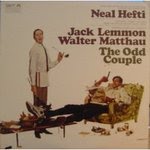
The Odd Couple (Dot, 1968): One of Neal Hefti’s two best-known tunes is his delightfully rollicking theme to this 1968 Gene Saks-directed film starring Jack Lemmon and Walter Matthau (based on the successful 1965 stage play directed by Mike Nichols and originally starring Art Carney and Walter Matthau), which became the theme to the incredibly popular TV series of the same name, starring Tony Randall and Jack Klugman, who replaced Matthau in the stage play, which ran on ABC-TV from 1970 through 1975 (and helped nab Neal Hefti two Grammy Award nominations).
There’s not much to the 1968 Dot soundtrack album other than the theme and a number of variations, including a bizarre vocal version with surprisingly off-beat lyrics provided by the otherwise brilliant Sammy Cahn (and featured on the great CD The Mad, Mad World of Soundtracks Volume 2), and a bunch of “excerpts of comedy” allegedly taken from the film. I have never seen the film, but the audience sounds – laughs and cheers – make the whole thing rather perplexing.
It’s a shame there’s just not more music here. Unfortunately, this album contains less than 20 minutes of Hefti’s gloriously constructed compositions, including the great main theme, its variations, the sinewy film funk of “Metropole,” the bouncy “Tomatoes” and the jazzy bossa of “Man Chases Man,” offering a great organ solo that promises more than the album delivers. Hefti varies the theme a number of times here, but the exceptional “Down with the Lights” changes up the tempo and the time signature enough to suggest how amazingly adaptable it is to other considerations (a Hefti trademark).
Not sure how much Hefti music was provided for the film – he actually scored several episodes of the TV show as well – but it would be nice to hear more Hefti and less comedy here.
Neal Hefti’s terrific main titles sequence for the 1968 George Peppard thriller P.J.
Sometimes it’s enlightening to consider the passage of music time in human terms. For example, kids conceived during their parents’ grooving to Fourplay’s first album in 1991 – a classic of its kind – have probably all left the nest for college as the indefatigable Fourplay’s twelfth album, Let’s Touch The Sky, heads out into the world in 2010.
Once and probably always considered a “smooth jazz” collective, this daddy of what’s now known as “contemporary jazz” presents founders Bob James on keyboards, Nathan East on bass and occasional vocals, Harvey Mason on drums and the group’s newest addition, Chuck Loeb, replacing Larry Carlton on guitar. Each boasts an impressive résumé as a studio musician and accompanist while perhaps only James and Mason have had notable, nee legendary, front-line success in the jazz world. But together, this foursome produces its very own sound, a tight lock of four like-minded musicians fronted by James’ varying keyboards (mostly piano) and the guitarist’s mellifluous counterpoint.
Each member of the group contributes material to the program, but usually the best material emanates from Bob James, a much stronger and more prolific writer than any of the other Fourplay members with the exception of former player Lee Ritenour. That’s true of Let’s Touch the Sky too. Here, James contributes the nicely conceived title track, the lovely “Gentle Giant (For Hank),” a warm and loving tribute to the late pianist Hank Jones offering superb commentary from all involved, and the album’s jazziest and very best track, “Golden Faders.”
Just as the group’s album titles have evolved from suggestive puns to motivational platitudes, James has provided compositions to Fourplay that raise the bar a bit more each time too. Ever since 2002’s Heartfelt, James has seemingly endeavored with his compositions to push the group beyond its smooth expectations and rather by-the-book delivery, the unfortunate byproducts of a successful synergy.
Too often elsewhere, there’s a tendency for complacency, as the group wallows in Fourplay retreads (Loeb’s ironically titled “Above and Beyond” is this disc’s seemingly obligatory “Bali Run” rerun) or crowd-calming sound-alikes (Loeb’s “3rd Degree,” East’s “I’ll Still Be Loving You” and “A Night in Rio” are all signature Fourplay forays).
Harvey Mason, on the other hand, provides two particularly nice compositions that evoke more of the drummer’s work back farther in time with James, with the lovely “More Than A Dream” recalling 1979’s Bob James/Earl Klugh classic One on One and the breezy fusion of “Pineapple Getaway” suggesting the underrated 1982 Bob James/Earl Klugh follow-up Two of a Kind.
Chuck Loeb is an inviting, though hardly unpredictable, addition to the group, adding quite a bit more spark of personality than Larry Carlton provided on nearly all of the previous seven Fourplay albums. Loeb, who is frequently associated with Bob James elsewhere, often recalls Lee Ritenour here. He is especially fleet fingered and surprisingly, given his admittedly pretty tone, adds a little more spice of the jazz fire to Fourplay.
This is particularly evident on the guitarist’s post-fusion redux “3rd Degree” (a reference to the place Loeb plays in the group's guitar chair), “Gentle Giant,” “A Night in Rio” and the excellent “Golden Faders.” On acoustic guitar, Loeb suggests a cross between the pretty sound of Earl Klugh and the slightly meatier approach of Lee Ritenour, a perfect foil for James, who has worked extensively with all three guitarists, and most notable on “Let’s Touch the Sky,” “More Than a Dream” and “Pineapple Getaway.”
Nathan East – whose bass solos are captivating on all three of the Bob James pieces – vocalizes in his inimitable Fourplay way on his own “A Night in Rio,” briefly during his solo on the title track and sings his own lyrics to his own very Stephen Bishop-sounding “I’ll Still Be Lovin’ You.”
Second season American Idol winner Ruben Studdard is featured on the group’s agreeable cover of “Love TKO,” a nicely considered tribute to the late Teddy Pendergrass, while Anita Baker takes a smokey and especially winning vocal on the particularly torchy sounding “You’re My Thrill,” perhaps the single best vocal piece ever heard on any Fourplay album (the singer appeared with the quartet at the JVC Jazz Festival in Oakland in 2009).
If more Fourplay albums sounded like what the group and Anita Baker achieve together on “You’re My Thrill,” I wouldn’t mind such vocal intrusions to these discs. More often than not, the Fourplay vocal songs are commercial distractions which seemingly have nothing whatsoever to do with the remainder of the record. Not so with “You’re My Thrill.”
After twenty years and a dozen albums, Let’s Touch the Sky may prove that Fourplay still has something left to say. Longtime Bob James fans will certainly appreciate some of the composer’s better recent compositions and the hefty dose of fine acoustic improvisation he provides.
Fans of Fourplay will hear plenty here to like too, including a higher-than-average abundance of notable music. And the addition of Chuck Loeb to the group signals what drummer Harvey Mason hopes “opens up new opportunities and new potential” for the group. If they don’t quite touch the sky here, they’re certainly headed in the right direction.
Composer, conductor and pianist Lalo Schifrin presented a concert of film music for the Festival du Film Jules Verne Aventures (aka Festival Jules Verne) on April 23, 2007, at Le Grand Rex theatre in Paris, France – the city’s biggest movie theater – that was caught superbly by Festival leaders for this 73 and a half minute CD presentation.
It’s a pristine recording of an above average performance that captures Schifrin in a rare “Jazz Goes to Hollywood” concert mood. It also evinces several rarely heard nuggets that the composer’s fans will want to hear.
While Le Concert à Paris bears many signs of illegitimacy (no label, no catalog number, limited pressing, no press), it sounds official, it looks official (the nice digipak sleeve bears the concert poster’s artwork) and it bears an introductory note by the Festival’s co-founders, Jean-Christophe Jeauffre and Frédéric Diedonné.
The Los Angeles-based Jules Verne organization’s web site also lists a heady honorary board including Buzz Aldrin, Tippi Hedren, William Shatner, Ernest Borgnine, Patrick Stewart, James Cameron, Patrice Leconte, Christopher Lee, Harrison Ford, Malcolm McDowell and Jane Goodall. But, oddly, the site has no readily apparent listing for this CD.
Schifrin’s program expectedly covers his own well-known film and TV themes (“Mannix,” “Bullitt,” “The Fox,” “The Cincinnati Kid” and, of course, two versions of “Mission: Impossible”) as well as the equally well-known Monty Norman James Bond theme (which, oddly, suggests what might have happened had Neal Hefti scored Goldfinger). While Schifrin’s piano factors heavily on many of these pieces, the arrangements of “The Fox” and “The Cincinnati Kid” heard here, and the soloing Schifrin provides, are surprisingly fresh and wonderfully inventive.
Schifrin premieres a suite for his “Enter the Dragon” score here (something he had done earlier for Cool Hand Luke) as well as a suite I’ve never heard before for the “Dirty Harry” themes, prominently featuring the electric bass work of none other than Clint “Dirty Harry” Eastwood’s son, Kyle.
Several extremely nice surprises appear as well in the form of “Concorde: Airport 79,” aka “Theme From ‘The Concorde – Airport ‘79’” (only issued on a long-forgotten 45 in 1979 and hardly ever performed by Schifrin in concert); “Rollercoaster Park Theme,” a lovely waltz, better known as the secondary “Magic Carousel” theme from the 1977 film Rollercoaster; “Cotton Club (Echoes of Duke Ellington),” reprised for the first time since Schifrin’s first Jazz Meets The Symphony studio recording in 1993; and a great version of the famous secondary Mission: Impossible theme, “The Plot,” recalling the version heard on the 1968 album issued on Dot Records.
Due to the limitations of CD space, the concert’s performances of “The Four Musketeers” and “The Cat (Les Félins)” were omitted from this presentation. That’s a shame, as both pieces rank highly among the composer’s film work. But one can hardly dispute the high quality of great music present on Le Concert à Paris. It’s a terrific performance that reveals the too-little known caliber of music Lalo Schifrin delivers on the concert stage.
Masterworks Jazz continues its celebration of the 40th Anniversary of CTI Records with the most complete version of the legendary California Concert: The Hollywood Palladium ever heard, newly re-mastered from the original eight-track masters. The new two-CD set doubles the content of the original five-song, two-LP release with five additional tracks – three of them never-before released – and restores the original concert sequence for the very first time ever. It also represents the best sound these performances have ever had. (As an aside, astute viewers will note that Sony restored the LP's beautiful cover art with the original typography, but the restored CTI logo has been moved for some strange reason outside of the sun.)
After CTI Records became independent in 1970, founder Creed Taylor celebrated the label’s early success by collecting a group of musicians actively recording for the label at the time for summer tours. These tours were package deals highlighting the label’s records and its best-known music. Billed as the “CTI All Stars,” the varying collective assembled each year between 1971 and 1975 playing stadiums and large venues like rock bands and reaching larger audiences than any one of the CTI artists could ever hope to reach on their own.
For this particular occasion, Taylor handpicked a dream team of CTI artists for what would become California Concert: The Hollywood Palladium, one of the label’s first all-star live assemblages. The concert was an absolute success, featuring George Benson on guitar, Freddie Hubbard on trumpet, Hubert Laws on flute, Stanley Turrentine on tenor saxophone, Hank Crawford on alto saxophone, Johnny Hammond on organ and electric piano, Ron Carter on bass, Billy Cobham on drums and Airto Moreira on percussion.
It is one of the finest recordings in the whole CTI catalog and it contains all of the label’s star performers of the time at their very best, in often exciting interplay with one another, playing their CTI hits. Each was as likely as not to be on the other’s studio recordings too. That means great players at the top of their game playing with other great players at the top of theirs. Too few recordings in the whole of jazz have this much star power, this much great - and label-specific - music and this much great playing.
This definitive document of the first and best-known of the CTI All Stars concerts contains nearly all of the entire performance including all of the original 1971 LP’s five tracks, “Fire and Rain,” “Red Clay,” “Sugar,” “Blues West” and “Leaving West,” which though left off the 1987 CD issue of California Concert was included on the 1990 Epic/Legacy CD The Best of Stanley Turrentine.
The new two-disc set is also enhanced with other performances from the concert issued elsewhere, including Freddie Hubbard’s lovely take on “Here’s That Rainy Day” (previously issued on the 1990 Epic/Legacy CD The Best of Freddie Hubbard) and Johnny Hammond’s utterly riveting take on Carole King’s “It’s Too Late” (previously issued on the 2002 CD reissue of Johnny Hammond’s Breakout) as well as three never-before released tracks including “Impressions” (which introduces the entire all-star line up), George Benson’s marvelous take on Miles Davis’ “So What” and Freddie Hubbard’s funkier than expected “Straight Life” (with a great number of soloists including George Benson, offering a snatch of the groove the guitarist laid down for 1973’s “Dance”).
Also on the concert program was Hank Crawford’s never-before issued performance of “Never Can Say Goodbye,” but even though Sony mastered the song with every intention of including it on the two-disc program, it simply didn’t fit. Disc one amounts to 77:50 of playing time and disc two tops out at 76:06.
This sort of all-star jazz concert was not only the exception to the rule back in 1971. It is nearly unheard of today. There are probably quite a number of reasons for this, chief among which is probably the lack of true jazz stars still alive and labels such as CTI Records that house so many prominent jazz recording artists. It’d be hard to gather a comparable line-up of jazz stars on the level of what CTI did for their all-star dates in general and California Concert: The Hollywood Palladium in particular (indeed only Laws, Carter, Cobham and Airto are still with us today). Sure, Hubert Laws and Airto Moriera showed up for several recent CTI All Stars dates in Europe. But it’s not the same anymore.
And many CTI fans may wonder whether Sony will ever release the 1972 Hollywood performances issued on three 1977 CTI LPs, the remainder of the July 19, 1971, concert in Los Angeles that have yielded several bonus tracks on other CDs or other well-recorded, though bootlegged recordings of the CTI All Stars captured live in Munich (1972), Seattle (1973) or New York City (1975). All of these are especially unlikely to ever see official release from Sony or Sony-licensed labels. So I would suggest enjoying California Concert: The Hollywood Palladium, not only the pinnacle of the CTI All Stars, but also the only recording of this assemblage we’re likely to enjoy on an official level.
The masterful California Concert: The Hollywood Palladium is an absolute classic, filled not only with great players playing at or above their best, but also brimming with some of the era’s most definitive music. This is an essential addition to any jazz collection and a strong argument for just how good jazz could be in the early 1970s – especially for those who think otherwise: proof positive that CTI Records not only had much to say to jazz listeners of the day but to true music lovers of all generations.

 There has been no better or more consistent effort to keep the CTI Records legacy alive and well than what the good folks at Japan’s King Records have done and have been doing since CTI’s inception in 1970. King Records issued all of the original CTI records in Japan right through to about 1984, issuing quite a few that have never been released in the US, and has steadily released dozens and dozens of CTI-themed compilations since 1973 right up through today.
 Dance Classics of CTI Records: Star Borne - Johnny Hammond (from GAMBLER'S LIFE); Super Strut - Deodato (from DEODATO 2); Boy, I Really Tied One On - Esther Phillips (from CAPRICORN PRINCESS); Baretta's Theme - Ron Carter (from ANYTHING GOES); You Keep Me Hanging On - David Matthews (from SHOOGIE WANNA BOOGIE); Sugar Free - Hank Crawford (from I HEAR A SYMPHONY); Turn This Mutha Out - Idris Muhammad (from TURN THIS MUTHA OUT); Stanley's Tune - Airto (from VIRGIN LAND); Macumba - Lalo Schifrin (from TOWERING TOCCATA); Corazon - Hank Crawford (from WILDFLOWER); Hard To Face The Music - Idris Muhammad (from HOUSE OF THE RISING SUN); Nights In White Satin - Deodato (from DEODATO 2).
 Soulful Vocals of CTI Records: Say You Love Me - Patti Austin (from END OF A RAINBOW); Home Is Where The Hatred Is - Esther Phillips (from FROM A WHISPER TO A SCREAM); Rich Girl - Nina Simone (from BALTIMORE); You Got Style - Phil Upchurch/Tennyson Stevens (from UPCHURCH/TENNYSON); More Today Than Yesterday - Patti Austin (from END OF A RAINBOW); California Dreaming - David Matthews (from SHOOGIE WANNA BOOGIE); I Hear A Symphony - Hank Crawford (from I HEAR A SYMPHONY); Baltimore - Nina Simone (from BALTIMORE); Little Baby - Patti Austin (from HAVANA CANDY); Shoogie Wanna Boogie - David Matthews (from SHOOGIE WANNA BOOGIE); House of the Rising Sun - Idris Muhammad (from HOUSE OF THE RISING SUN); Unforgettable - Esther Phillips (from FOR ALL WE KNOW).