Showing posts sorted by relevance for query Joe Farrell. Sort by date Show all posts

Sunday, January 09, 2011

Joe Farrell CTI Classics Now on CD

During the 1960s, reed player Joe Farrell (born Joseph Carl Firrantello) had logged many hours and waxed many sides with Maynard Ferguson, Charles Mingus, Jaki Byard, the Thad Jones-Mel Lewis Orchestra and Elvin Jones, with whom he had the greatest opportunity to prove his mettle as a fine soloist. Still, despite these notable associations, hardly anyone outside of New York music circles knew who he was.

Farrell (1937-86) had also made the rounds as a New York studio musician in the sixties, playing on sessions for jazz stars like Stanley Turrentine, Jimmy Smith, James Moody and Herbie Hancock and even on many popular albums by Santana, the Rascals, The Band and Aretha Franklin.

The legendary producer Creed Taylor had already recorded albums by George Benson (Tell It Like It Is, I Got A Woman (And Some Blues)) and Antonio Carlos Jobim (Tide, Stone Flower) that featured Joe Farrell in the section and must have heard something special that no other producer or record company had before. My guess is twofold. Perhaps Taylor heard not only a “sleeping giant” of a saxophonist in Joe Farrell but recognized a fluent flexibility in the reed player to adapt his style – and his instrumentation – to the musical needs at hand.

Creed Taylor produced Joe Farrell’s debut solo album, Joe Farrell Quartet (aka Song of the Wind, Super Session) for CTI Records in 1970 and produced something unique and very special. Coming off the failure of launching the careers of Kathy McCord, Flow and Fats Theus, Taylor launched into Joe Farrell Quartet at the same time he waxed the classic CTI debuts of both Freddie Hubbard (Red Clay) and Stanley Turrentine (Sugar).

Notable for pairing the nearly unknown Farrell with four avatars of Miles Davis’ contemporaneous and controversial electric group – pianist Chick Corea, guitarist John McLaughlin, bassist Dave Holland and drummer Jack DeJohnette - Joe Farrell Quartet is an excellent example of surprisingly straight-ahead jazz that showcased Creed Taylor’s belief in the reed player to hold his own as a leader among distinguished personnel, all of whom were or would be prominent leaders in their own right.

“Mr. Farrell,” wrote critic John S. Wilson, “builds broiling, jabbing solos that flow in an essentially melodic fashion despite a steady interjection of startling turns and quirks. At times, his lines pile up in such quicksilver fashion that he sounds like an entire band in himself.”

While Farrell never became the jazz star he deserved to be, he went on to record six more albums as a leader for CTI records including Outback (1971), Moon Germs (1972) and Benson & Farrell (1976, with George Benson), all of which have been issued at one time or another on CD, and features on 21 other CTI titles including Airto’s Free (1972), a template for Chick Corea’s Return to Forever, of which Farrell was an early member, while continuing a steady stream of session work throughout the early 1970s.

But three of Joe Farrell’s consistently excellent CTI albums have somehow been forgotten about, completely eluding release on CD, even in Japan, and considered lost to the saxophonist’s fans. Until now.

Wounded Bird, the great cult CD reissue label that has issued Freddie Hubbard’s forgotten CTI albums Polar AC (1974) and The Baddest Hubbard (1975) as well as Joe Farrell’s two post-CTI albums for Warner Bros., La Catedral Y El Toro (1977) and Night Dancing (1978), has released on CD for the very first time Joe Farrell’s CTI classics Penny Arcade (1974), Upon This Rock (1974) and Canned Funk (1975). All three albums, licensed from Sony Music, owners of the 1970-80 CTI catalog, are superb examples of first-class small-group jazz in the seventies, expertly recorded by legendary engineer Rudy Van Gelder and each cover featuring one of photographer Pete Turner’s striking images.

Penny Arcade showcases Joe Farrell with Herbie Hancock, who featured on Farrell’s previous CTI album Moon Germs and would come back for two numbers on Farrell’s 1978 album Night Dancing, on piano and electric piano, Joe Beck on guitar, Herb Bushler on bass and Steve Gadd, who first played with Farrell on several Gap Magione dates and would go onto play with the saxist on several Chick Corea albums and on Farrell’s La Catedral Y El Toro, on drums . The five-song program includes Joe Beck’s frenetic title song, which was edited for issue as a promotional single, Farrell’s “Hurricane Jane” and “Geo Blue” (all with Farrell on tenor sax), Farrell’s lovely Latinate “Cloud Cream” (with Farrell on flute and Don Alias added on percussion) and the album’s signature piece, a wondrous and definitive 13-minute reading of Stevie Wonder’s “Too High” (featuring Farrell on soprano sax). With great solos by Farrell, Hancock on electric piano and Bushler, “Too High” is not only one of the very best covers of this well-covered gem, it surely ranks as one of CTI’s finest moments. Hancock also solos magnificently on acoustic piano for “Cloud Cream” and on the “Maiden Voyage”-like derivation “Geo Blue.” Beck takes a rockish solo on “Penny Arcade” and beautifully trims “Geo Blue” with a lush solo that is jazzier than anything the guitarist was known to do at the time. Joe Farrell’s playing throughout is superb and reveals, yet again, that he could construct very interesting jazz compositions that inspire notable improvisation. “I Won’t Be Back,” a terrific Joe Beck bossa fusion that features Joe Farrell on flute (quoting “A Love Supreme”!), was recorded during these October 1973 sessions, but appears on Farrell’s next CTI recording, Upon This Rock.

Upon This Rock captures Joe Farrell on record with his own 1974-75 quartet, featuring guitarist Joe Beck, bassist Herb Bushler and drummer Jim Madison. The piano-less assemblage is considerably more rock oriented than previous Farrell outings, no doubt inspiring the album’s title, and driven home by Joe Beck’s consistently rock-edged guitar attack. Still, it’s a quartet that not only sounds comfortable mixing good rock ideas with solid jazz figures, but one that coalesces especially well together. Assembling at Rudy Van Gelder’s studio in March 1974, the quartet waxes three numbers included here, the leader’s “Weathervane” (featuring Farrell on soprano sax), the 12-minute funk-rock opus “Upon This Rock” (featuring Farrell on tenor sax and Beck, channeling Jimi Hendrix, overdubbing guitar parts) and Beck’s boogaloo “Seven Seas” (again with Farrell on tenor sax). The album’s title track in particular allows all four of the quartet’s members to contribute interesting commentary and is probably a highlight on an album brimming over with highlights. Upon This Rock is rounded out by Beck’s excellent 10-minute bossa fusion, “I Won’t Be Back,” recorded during the Penny Arcade sessions and nicely featuring Farrell on flute, Hancock sublime on piano and Beck, splendid on guitar.
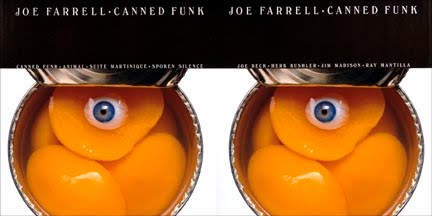
Canned Funk finds Joe Farrell and his quartet, enhanced by Ray Mantilla’s percussion, providing the funk-rock sequel to Upon This Rock. While the “funk” in the title is as apt as the “rock” in the previous title was, the groove here is a bit more forced, or “canned” than it was before too. Whether by choice or by force, Farrell and company still lean heavily toward the rock side of things here. But the music, recorded at Rudy Van Gelder’s during November and December 1974, is a little less imaginative than it was before. Curiously, too, it is Farrell’s first full album of Farrell originals. But the rock back-beat takes over here and renders the music into near total dullness until the soloists come in to liven things up with a little interesting improvisation. The oft-sampled title track is probably familiar to anyone who knows anything about Joe Farrell or even CTI. The tune itself is not much, but the improvisations provided by Farrell (on tenor sax) and Joe Beck (on guitar) are worthy enough. “Animal” too has a clunky riff-based melody that the leader plays on tenor and overdubbed baritone sax that eventually yields to decent solos. Farrell, who never got the recognition he deserved as one of jazz’s finest and most distinctive flautists (check out Benson & Farrell and George Benson’s own CTI classic Good King Bad for further proof), doubles up flute parts for the looping “Suite Martinique,” but here again the overpowering backbeat nearly completely overwhelms the flautist’s fine solo. Things take a slight turn toward the “Midnight at the Oasis” pop-disco of the day with the album’s closer, “Spoken Silence.” Farrell returns here to tenor sax, very strongly suggesting another Farrell, Pharoah Sanders, in full spiritual regalia. That is until Beck and company chime in with a regrettably dated wakka-wakka rhythm guitar part and lots of stick work on the high hat. Beck does get inspired to provide his own spiritually beautiful solo here, though; something that brings him – and Canned Funk - back to the jazz these guys could do so well.

In all fairness, jazz music was experiencing a major shift in May 1975, when Canned Funk was released. Rock based jazz fusion had said just about all it was going to say – to be sure, Joe Farrell didn’t record this way again – and disco was then driving the market. Sure enough, the Joe Farrell quartet disbanded and Joe Beck successfully (or popularly) helped CTI go in that direction. Farrell himself would go this way when he accepted a million-dollar contract with Warner Bros. in 1977, recording disco and covering pop tunes by the Bee Gees and Rod Stewart, something he’d never done before. Canned Funk surely marks the end of an era.

Tuesday, November 30, 2010

Three of Joe Farrell's Lost CTI Classics Finally Coming to CD in January

During the 1960s, reed player Joe Farrell (born Joseph Carl Firrantello) had logged many hours and waxed many sides with Maynard Ferguson, Charles Mingus, Jaki Byard, the Thad Jones-Mel Lewis Orchestra and Elvin Jones, with whom he had the greatest opportunity to prove his mettle as a fine soloist. Still, despite these notable associations, hardly anyone outside of New York music circles knew who he was.

Farrell (1937-86) had also made the rounds as a New York studio musician in the sixties, playing on sessions for jazz stars like Stanley Turrentine, Jimmy Smith, James Moody and Herbie Hancock and even on many popular albums by Santana, the Rascals, The Band and Aretha Franklin.

The legendary producer Creed Taylor had already recorded albums by George Benson (Tell It Like It Is, I Got A Woman (And Some Blues)) and Antonio Carlos Jobim (Tide, Stone Flower) that featured Joe Farrell in the section and must have heard something special that no other producer or record company had before. My guess is twofold. Perhaps Taylor heard not only a “sleeping giant” of a saxophonist in Joe Farrell but recognized a fluent flexibility in the reed player to adapt his style – and his instrumentation – to the musical needs at hand.

Creed Taylor produced Joe Farrell’s debut solo album, Joe Farrell Quartet (aka Song of the Wind, Super Session) for CTI Records in 1970 and produced something unique and very special. Coming off the failure of launching the careers of Kathy McCord, Flow and Fats Theus, Taylor launched into Joe Farrell Quartet at the same time he waxed the classic CTI debuts of both Freddie Hubbard (Red Clay) and Stanley Turrentine (Sugar).

Notable for pairing the nearly unknown Farrell with four avatars of Miles Davis’ contemporaneous and controversial electric group – pianist Chick Corea, guitarist John McLaughlin, bassist Dave Holland and drummer Jack DeJohnette - Joe Farrell Quartet is an excellent example of surprisingly straight-ahead jazz that showcased Creed Taylor’s belief in the reed player to hold his own as a leader among distinguished personnel, all of whom were or would be prominent leaders in their own right.

“Mr. Farrell,” wrote critic John S. Wilson, “builds broiling, jabbing solos that flow in an essentially melodic fashion despite a steady interjection of startling turns and quirks. At times, his lines pile up in such quicksilver fashion that he sounds like an entire band in himself.”

While Farrell never became the jazz star he deserved to be, he went on to record six more albums as a leader for CTI records including Outback (1971), Moon Germs (1972) and Benson & Farrell (1976, with George Benson), all of which have been issued at one time or another on CD, and features on 21 other CTI titles including Airto’s Free (1972), a template for Chick Corea’s Return to Forever, of which Farrell was an early member, while continuing a steady stream of session work throughout the early 1970s.

But three of Joe Farrell’s consistently excellent CTI albums have somehow been forgotten about, completely eluding release on CD, even in Japan, and considered lost to the saxophonist’s fans. Until now.

Wounded Bird, the great cult CD reissue label that has issued Freddie Hubbard’s forgotten CTI albums Polar AC (1974) and The Baddest Hubbard (1975) as well as Joe Farrell’s two post-CTI albums for Warner Bros., La Catedral Y El Toro (1977) and Night Dancing (1978), has announced that in late January it will release on CD for the very first time Joe Farrell’s CTI classics Penny Arcade (1974), Upon This Rock (1974) and Canned Funk (1975). All three albums, licensed from Sony Music, owners of the 1970-80 CTI catalog, are superb examples of first-class small-group jazz in the seventies, expertly recorded by legendary engineer Rudy Van Gelder and each cover featuring one of photographer Pete Turner’s striking images.

Penny Arcade showcases Joe Farrell with Herbie Hancock, who featured on Farrell’s previous CTI album Moon Germs and would come back for two numbers on Farrell’s 1978 album Night Dancing, on piano and electric piano, Joe Beck on guitar, Herb Bushler on bass and Steve Gadd, who first played with Farrell on several Gap Magione dates and would go onto play with the saxist on several Chick Corea albums and on Farrell’s La Catedral Y El Toro, on drums . The five-song program includes Joe Beck’s frenetic title song, which was edited for issue as a promotional single, Farrell’s “Hurricane Jane” and “Geo Blue” (all with Farrell on tenor sax), Farrell’s lovely Latinate “Cloud Cream” (with Farrell on flute and Don Alias added on percussion) and the album’s signature piece, a wondrous and definitive 13-minute reading of Stevie Wonder’s “Too High” (featuring Farrell on soprano sax). With great solos by Farrell, Hancock on electric piano and Bushler, “Too High” is not only one of the very best covers of this well-covered gem, it surely ranks as one of CTI’s finest moments. Hancock also solos magnificently on acoustic piano for “Cloud Cream” and on the “Maiden Voyage”-like derivation “Geo Blue.” Beck takes a rockish solo on “Penny Arcade” and beautifully trims “Geo Blue” with a lush solo that is jazzier than anything the guitarist was known to do at the time. Joe Farrell’s playing throughout is superb and reveals, yet again, that he could construct very interesting jazz compositions that inspire notable improvisation. “I Won’t Be Back,” a terrific Joe Beck bossa fusion that features Joe Farrell on flute (quoting “A Love Supreme”!), was recorded during these October 1973 sessions, but appears on Farrell’s next CTI recording, Upon This Rock.

Upon This Rock captures Joe Farrell on record with his own 1974-75 quartet, featuring guitarist Joe Beck, bassist Herb Bushler and drummer Jim Madison. The piano-less assemblage is considerably more rock oriented than previous Farrell outings, no doubt inspiring the album’s title, and driven home by Joe Beck’s consistently rock-edged guitar attack. Still, it’s a quartet that not only sounds comfortable mixing good rock ideas with solid jazz figures, but one that coalesces especially well together. Assembling at Rudy Van Gelder’s studio in March 1974, the quartet waxes three numbers included here, the leader’s “Weathervane” (featuring Farrell on soprano sax), the 12-minute funk-rock opus “Upon This Rock” (featuring Farrell on tenor sax and Beck, channeling Jimi Hendrix, overdubbing guitar parts) and Beck’s boogaloo “Seven Seas” (again with Farrell on tenor sax). The album’s title track in particular allows all four of the quartet’s members to contribute interesting commentary and is probably a highlight on an album brimming over with highlights. Upon This Rock is rounded out by Beck’s excellent 10-minute bossa fusion, “I Won’t Be Back,” recorded during the Penny Arcade sessions and nicely featuring Farrell on flute, Hancock sublime on piano and Beck, splendid on guitar.

Canned Funk finds Joe Farrell and his quartet, enhanced by Ray Mantilla’s percussion, providing the funk-rock sequel to Upon This Rock. While the “funk” in the title is as apt as the “rock” in the previous title was, the groove here is a bit more forced, or “canned” than it was before too. Whether by choice or by force, Farrell and company still lean heavily toward the rock side of things here. But the music, recorded at Rudy Van Gelder’s during November and December 1974, is a little less imaginative than it was before. Curiously, too, it is Farrell’s first full album of Farrell originals. But the rock back-beat takes over here and renders the music into near total dullness until the soloists come in to liven things up with a little interesting improvisation. The oft-sampled title track is probably familiar to anyone who knows anything about Joe Farrell or even CTI. The tune itself is not much, but the improvisations provided by Farrell (on tenor sax) and Joe Beck (on guitar) are worthy enough. “Animal” too has a clunky riff-based melody that the leader plays on tenor and overdubbed baritone sax that eventually yields to decent solos. Farrell, who never got the recognition he deserved as one of jazz’s finest and most distinctive flautists (check out Benson & Farrell and George Benson’s own CTI classic Good King Bad for further proof), doubles up flute parts for the looping “Suite Martinique,” but here again the overpowering backbeat nearly completely overwhelms the flautist’s fine solo. Things take a slight turn toward the “Midnight at the Oasis” pop-disco of the day with the album’s closer, “Spoken Silence.” Farrell returns here to tenor sax, very strongly suggesting another Farrell, Pharoah Sanders, in full spiritual regalia. That is until Beck and company chime in with a regrettably dated wakka-wakka rhythm guitar part and lots of stick work on the high hat. Beck does get inspired to provide his own spiritually beautiful solo here, though; something that brings him – and Canned Funk - back to the jazz these guys could do so well.

In all fairness, jazz music was experiencing a major shift in May 1975, when Canned Funk was released. Rock based jazz fusion had said just about all it was going to say – to be sure, Joe Farrell didn’t record this way again – and disco was then driving the market. Sure enough, the Joe Farrell quartet disbanded and Joe Beck successfully (or popularly) helped CTI go in that direction. Farrell himself would go this way when he accepted a million-dollar contract with Warner Bros. in 1977, recording disco and covering pop tunes by the Bee Gees and Rod Stewart, something he’d never done before. Canned Funk surely marks the end of an era.

Friday, October 09, 2009

Joe Farrell “Sonic Text”

This superb album finds multi-talented reedman Joe Farrell (1937-86) paired with trumpeter Freddie Hubbard (1938-2008) and an outstanding rhythm section featuring George Cables on piano, Tony Dumas on bass and Peter Erskine on drums. The mostly straight-ahead set was recorded in 1979 and ranks among Farrell’s very best and probably best-known work – probably because it’s one of the few of Farrell’s albums that made the transition to CD and stayed in print long enough to get noticed.

Farrell spent much of the 1960s as a “section” man, working in the bands of Maynard Ferguson, Charles Mingus, Slide Hampton and the Thad Jones/Mel Lewis Jazz Orchestra, elevating to feature spots later in the decade with Jaki Byard, Chick Corea, Elvin Jones, James Moody and Andrew Hill.

After sessions on CTI with George Benson (Tell It Like It Is) and Antonio Carlos Jobim (Tide, Stone Flower), producer Creed Taylor gave Farrell his first solo recording opportunity, Joe Farrell Quartet (later reissued as Song of the Wind), a remarkable album that featured the reed man with pianist Chick Corea, guitarist John McLaughlin, bassist Dave Holland and drummer Jack DeJohnette, all of whom were part of Miles Davis’ band at the time.

Farrell recorded six more albums for CTI through 1976, all featuring outstanding groups and some of his best music, followed by two somewhat commercial albums for Warner Bros. (recently reissued on CD by the Wounded Bird label) and two more straight-ahead ventures on the small Xanadu label in 1979.

Sonic Text, originally issued on the Contemporary label in 1980, is a beautifully programmed set of mostly modal originals, highlighted by Freddie Hubbard’s “The Jazz Crunch,” a typical Hubbard-like jam tune that combines the best of Hubbard’s own “Happiness is Now” with “Straight Life,” and George Cables’ excellent signature piece “Sweet Rita Suite (Part 1): Her Spirit.”

Farrell is on tenor sax for the exhilarating post-bop of the title cut, the lovely “When You’re Awake” (with Hubbard on flugelhorn), the exciting “The Jazz Crunch” and the engagingly exploratory “Malibu” (at nearly 12 minutes in length, it is the album’s centerpiece) and soprano sax on the sprightly mid-tempo “If I Knew Where You’re At” (with Cables on electric piano and Dumas on electric bass). Farrell’s always invigorating flute work is heard only on Cables’ “Sweet Rita,” in which Farrell casts a net that suggests some of the work he was doing with Chick Corea at the time.

The musicians here work particularly well together. Farrell is in especially fine fettle, leading a cast of heavyweights with democratic authority and a unifying team spirit that gives this studio grouping the feeling of a solid working unit.

Another element of the group’s success is the dynamic Hubbard, who was coming off a period of fusion playing to prove he still had the jazz chops to make a session like this sound interesting. Freddie Hubbard, who like Farrell had also relocated to California by the late 1970s, is a significant part of the album’s success. Hubbard was part of the CTI stable at the same time Farrell was and the two toured together as part of the CTI All Stars (CTI Summer Jazz at the Hollywood Bowl, for example). Hubbard and Farrell are also heard on Don Sebesky’s 1973 CTI album Giant Box, but not together and Farrell was in the studio orchestra that backed Hubbard on the trumpeter’s The Love Connection, recorded earlier in the year that Sonic Text was made.

Cables, of course, can do no wrong, whether as a leader or, as he is here, a sideman. He is pitch perfect throughout Sonic Text. Like Herbie Hancock, Cedar Walton or John Hicks, he is a sideman who thinks like a leader, guiding with the perfect combination of rhythm and melody, and contributing just enough to frame a soloist in the most individual of ways. Farrell had already played with George Cables on two tracks from the pianist’s album Circle (Contemporary), recorded nine months earlier, and the two would later reunite for two 1982 recordings on the RealTime label, Darn That Dream (which was issued on CD) and Someday (parts of which were included on the Drive Archive CD titled Darn That Dream, which only included parts of the original album with that title).

Like nearly all of the CTI albums Joe Farrell made prior to Sonic Text, one yearns to hear more of this group doing more music together. Sadly, that was not to be (Farrell died of bone cancer on January 10, 1986, at the age of 48). The rhythm section (Cables, Dumas and Erskine) – minus Farrell – would reunite with Hubbard (and Bobby Hutcherson and Ernie Watts) three weeks later for the pianist’s terrific Cables’ Vision (Contemporary). But no more was heard from this ideal grouping other than the six scintillating and timeless tracks which appear on Sonic Text.

Wednesday, April 29, 2009

David Matthews on CTI

While Don Sebesky often receives the credit - or the blame - for "the CTI sound," he was not the only arranger who shaped that sound which has come to dominate not only 1970s jazz, but that noise that is now highly revered among crate diggers, samplers, DJs and fans of the last great wave jazz has experienced.

Bob James and Joe Beck, too, have arranged their share of CTI classics. But it is David Matthews who came to define the last half of CTI's glory years, 1970-1978. Beginning in 1975, after a stint behind James Brown, Matthews was brought to CTI and almost immediately began to make a noticeable impact.

David Matthews was born on March 4, 1942, in Sonora, Kentucky, but grew up in several different places in Kentucky, mostly in and around Louisville. As a child, he started playing trumpet and developed an interest in jazz during his teens. He attended The College Conservatory of Music, which is now part of the University of Cincinnati, and received a Bachelor's degree in composition.

After a stint playing military bases in Europe, Matthews established himself in Cincinnati, where he eventually met James Brown, who offered Matthews his first recording gig, something "underground" (or "psychedelic"), which became known as The Grodeck Whipperjenny - the title was supposed to sound meaningfully meaningless.

Matthews went on to replace Pee Wee Ellis (who also went onto to work at CTI) as Brown's arranger and musical director until 1975. During this time, Matthews also arranged albums for Buddy Rich, Mark Murphy, O'Donell Levy, Blue Mitchell and David Sanborn.

Creed Taylor brought David Matthews, who is now often confused with another popular musician of the same name, to CTI in 1975. There, he crafted a notable body of work that probably reflects the era's musical flavors (disco, etc.) more than the work his predecessors provided for the label.

Even though no slur is intended by this author, that factor probably dates more of Matthews' work for CTI than the other arrangers' who crafted charts for CTI. But there's no doubt that this is exactly what Creed Taylor wanted: the musical and saleable funk Matthews brought to the James Brown band. Indeed, much of Matthews' best work successfully combines a love of jazz with an ability to craft a good groove.

After leaving CTI in 1978, when the label was undergoing burdensome financial troubles that would more or less finish it, Matthews went onto record a slew of records for mostly Japanese labels under a variety of guises including Japan's number one selling jazz group, the Manhattan Jazz Quintet, the Manhattan Jazz Orchestra, Electric Birds, The First Calls, David Matthews Orchestra, N.Y. Friends and, of course, those under his own name.

These are David Matthews' CTI masterpieces, which live on among his greatest all-time work.

Good King Bad by George Benson: My introduction to David Matthews, and also one of George Benson's finest albums, bar none, if for no other reason than the mesmerizing take on Vince Guaraldi's "Cast Your Fate To The Wind." Jazz just doesn't get better than this, with signature and utterly memorable solos from both Benson and flautist Joe Farrell. Two strong Matthews compositions are featured here, "One Rock Don't Make No Boulder" and "Siberian Workout." Philip Namanworth's "Em" - which comes out of a band called the Electro-Harmonix Work Band (that includes someone named Mike Matthews…a relation?), is another high point. So is Matthews' arrangement of Eugene McDaniels's "Shell of a Man." With no slight intended toward Don Sebesky, Claus Ogerman or Quincy Jones, no other arranger has ever inspired Benson to this high level of creativity. Truly an unequivocal masterpiece, Good King Bad seems to represent all that George Benson stands for as a musician - and all that Matthews can do as a musical conceptualist. Also just as good is the album full of outtakes from these sessions that Creed Taylor issued in 1983 as Pacific Fire (never on CD), which features an alternative take of "Em." He thought it was a mistake. I think it's all just as brilliant as Good King Bad.

Benson & Farrell by George Benson and Joe Farrell: This beautiful, near-perfect pairing of guitarist George Benson, in his last CTI recording, and flautist Joe Farrell, is sumptuous fusion jazz at its very best. Benson and Farrell are matched so perfectly here, it’s a wonder it didn't happen sooner - or more frequently (despite their beautiful collaborations on Benson's previous Good King Bad). Matthews wrote five of the six songs, including the bracing "Camel Hump" (with Farrell adding a soprano solo) and an above-average arrangement of "Old Devil Moon," on this regrettably forgotten album. All are worth hearing. But "Flute Song," which can also be heard in a slightly different Matthews arrangement on Art Farmer's 1977 CTI album Something You Got, is pure magic. A keeper.

Tico Rico by Hank Crawford: Hank Crawford recorded many albums for the Atlantic, Kudu and Milestone labels during his career, but very few on any label that had more than one or two great tunes. This is one that is terrific from start to finish, with Crawford in perfectly bluesy and swinging form, driven by Matthews's superb, yet simplified, electrifying charts. If a soloist is only as good as his arranger, then Matthews is probably the best Crawford ever had (and Crawford was the guy who arranged for Ray Charles!). Tico Rico - which has never been issued on CD - is undoubtedly their best work together. There is a high quotient of Matthews originals here, all quite good too: "Tico Rico," "Lady Soul," the late-night blues of "Lament" and the grooving drive of "Funky Rooster." Eric Gale, a perfect compliment to many a Hank Crawford record, solos magnificently on the title track, the sensational take on the Beatles' "I've Just Seen A Face," "Lament," "Funky Rooster" and pretty much throughout the rest of the record. Cliff Carter is on keyboards here, but sounds an awful like Gale's Stuff-mate Richard Tee. Flautist Jeremy Steig is featured on the title track and the invigoratingly funky, yet too-silly titled "Funky Rooster" (a follow-up to the pair's earlier "Funky Pigeon," but probably meant to have some corollary with the era's "Disco Duck"). Matthews and Crawford deliver two terrific covers here, a lovely reggae take on The Beatles' "I've Just Seen A Face," which must have seemed an odd choice to cover in 1977, and one of the least corny takes of "Teach Me Tonight" ever heard. Matthews provides an alluring, romantic underscore that Crawford simply sets alight. A fine achievement for both Hank Crawford and David Matthews.

Dune by David Matthews: This 1977 album is, perhaps, Matthews's most singular statement of artistic greatness. You probably don't know anything about it because of producer Creed Taylor's insistence to tie the album to Frank Herbert's 1965 book Dune (which hadn't been turned into a film until 1984) - using Star Wars-styled typography. Matthews objected. But Taylor insisted. And Herbert, who died in 1986, sued this brilliant musical journey right out of existence - despite the music having absolutely nothing whatsoever to do with Herbert's work other than some obscure title cops. Dune, though, is magisterial; undoubtedly one of composer, arranger and producer David Matthews' very best. Side one is a tremendously exciting Matthews suite featuring excellent turns by star soloists such as Grover Washington, Jr. (the oft sampled "Sandworms"), David Sanborn ("Song of the Bene Gesserit"), Hiram Bullock and Eric Gale. The original LP's second side features several space-related covers, all expertly, if not astoundingly, arranged by Matthews, the surprisingly sumptuous "Silent Running" (the 1972 movie theme by Peter Schickele, aka P.D.Q. Bach, and host of NPR's Schickele Mix), the odd-choice of Bowie's "Space Oddity" (featuring the negligible Googie Coppola on vocals and Matthews's remarkably beautiful string work, which must be heard to be believed) and two inevitable covers from John Williams' Star Wars, both of which were issued on 45 at the time - and both far more engaging than the huge Meco single of the time. An absolutely essential part of CTI's iconography and David Matthews' vast discography.

Senor Blues by Urbie Green: By this time, Urbie Green had recorded countless sessions, quite a few solo albums on the Command and Project 3 labels (including a 1974 album arranged by Claus Ogerman) and was Antonio Carlos Jobim's trombonist of choice (he's spectacularly subtle on all of Jobim's Creed Taylor productions on Verve, A&M and CTI). But by the time of his second and last CTI album, he remained unknown - even to hardcore jazz fans. Senor Blues should have changed all that. But tremendous as it is, it didn't. David Matthews provides sterling charts for Green, but sadly no originals. Whether guided by his artistic temperament or Taylor's command, Matthews was trying his hand at a large scale jazz sound that harked all the way back to the early 1960s dates Taylor helmed at Verve (check out Art Farmer's less successful Something You Got for additional evidence). By 1977, these sorts of things had completely gone away, sublimated by electrified fusion (at the major labels) or acoustic small group jazz (at the small labels). Green and Matthews concocted a menu that doesn't sound appetizing at first, but is scintillating upon listening, including jazz classics like Corea's "Captain Marvel," Mingus' "Ysabel's Table Dance," Silver's "Senor Blues" and recent pop covers of "You Are So Beautiful," "I'm In You" and a stunning take of Stevie Wonder's "I Wish" (featuring an early cameo by John Scofield), which is easily enjoyed over and over again. Grover Washington, Jr. is beautifully positioned throughout to compliment Green's munificent and mellifluous stylings. It's a shame that Senor Blues didn't make Urbie Green the star he deserves to be. This is a buried treasure in David Matthews' catalog as well.

Other CTI or Kudu albums featuring David Matthews as player, arranger or composer: Anything Goes (1975) by Ron Carter, I Hear A Symphony (1975) by Hank Crawford, House of the Rising Sun (1975) by Idris Muhammad, The Main Attraction (1976) by Grant Green, Shoogie Wanna Boogie (1976) by David Matthews with Whirlwind, End of A Rainbow (1976) by Patti Austin, Capricorn Princess (1976) by Esther Phillips, The Fox (1976) by Urbie Green (featuring Matthews' "Mertensia"), A Secret Place (1976) by Grover Washington, Jr., Hank Crawford's Back (1976) by Hank Crawford (featuring Matthews' "Funky Pigeon"), Turn This Mutha Out (1977) by Idris Muhammad (featuring Matthews' "Crab Apple," "Moon Hymn" and "Say What"), We Belong Together (1977) by John Blair, Firefly (1977) by Jeremy Steig, Something You Got (1977) by Art Farmer, the GREAT Autophsyiopsychic (1977) by Yusef Lateef (featuring Matthews' excellent "YL"), Boogie To The Top (1977) by Idris Muhammad, Baltimore (1978) by Nina Simone, the LOVELY Big Blues (1978) by Art Farmer and Jim Hall, Cajun Sunrise by Hank Crawford and, oddly, In My Life (1983) by Patti Austin.

Thursday, July 14, 2011

Return to Forever – The Complete Columbia Albums Collection

After a prodigious session career in the 1960s, several solo albums that toyed with both the traditional and freer forms of jazz and a mercurial period of experimentation with Miles Davis between 1968 and 1972, pianist and composer Chick Corea crystalized the notion of his first “group” endeavor, to be known as Return to Forever.

Corea recorded his blueprint for the concept with his tremendous Return to Forever album for ECM Records in February 1972. The album collected the talents of reed player Joe Farrell (1937-86), who featured on the pianist’s 1967 Tones For Joan’s Bones (Corea is also heard on Farrell’s first two CTI records, Joe Farrell Quartet and, brilliantly, on Outback), young up and coming electric bassist Stanley Clarke, percussionist and former Miles mate Airto Moreira and Airto’s wife, Flora Purim, on vocals and percussion. and yielded three near standards in Corea’s “Crystal Silence,” “What Game Shall We Play Today” and “La Fiesta.”

The following month, Corea, Clarke and Moreira backed Stan Getz for the saxophonist’s terrific album Captain Marvel, which wasn’t issued until 1975, and then all five of the Return to Forever musicians collected (with others) to wax Airto’s CTI classic Free. Corea, Clarke, Farrell, Moreira and Purim finally reconvened in October 1972 to record Return to Forever’s Polydor debut, Light as a Feather, which includes Corea’s now standard “Spain.”

Airto and Flora left shortly thereafter to form their own group, Fingers, as did Joe Farrell, who formed his own quartet. Guitarist Bill Connors, drummer Steve Gadd and percussionist Mingo Lewis were added to the group, but Gadd’s studio duties prevented him from staying. By the time of the group’s second album, Hymn of the Seventh Galaxy (featuring Corea’s well-known “Señor Mouse”), Corea, Connors and Clarke were joined by drummer and percussionist Lenny White.

Tired of touring and the required adherence to his electric instrument, Bill Connors left the group and was replaced by recent Berklee School of Music alum Al Di Meola. The Corea/Di Meola/Clarke/White configuration then recorded 1974’s Where Have I Known You Before and 1975’s No Mystery for Polydor.

In 1976, Chick Corea took Return to Forever to the mighty Columbia Records label, where the group waxed only three releases in an 18-month period. One of these recordings is the group’s most significant recording and yet another represents one of the group’s best recorded performances. One is an under-appreciated gem that deserves more appreciation.

Under the direction of reissue producer Richard Seidel, Sony has done a masterful job collecting Return to Forever’s three Columbia recordings on this lush six-CD box set called Return to Forever – The Complete Columbia Albums Collection.

The set is packaged in a handsome, sturdy box that fits easily on most CD shelves with each individual album packaged in replica mini LP sleeves, reproducing the original record’s exact graphics, and a 27-page booklet with complete discographical information, photos and new liner notes by Chick Corea and musician/historian/producer Bob Belden. It’s a treasure trove of music, immaculately packaged and beautifully presented, well worth reconsidering for the surprisingly timeless surplus of artistry it contains.

Romantic Warrior (1976): After four albums on Polydor, Chick Corea’s Return to Forever moved to Columbia Records, even though Corea the solo artist remained with Polydor for the better part of the decade. Columbia was home to other fusion leaders of the day like Miles Davis, Weather Report, John McLaughlin’s Mahavishnu Orchestra and Herbie Hancock. Note here that all, including Corea, were connected to the trumpeter’s electric phase. Little wonder that Columbia should have named their reissue line “Legacy.” And this is just the jazz fusion portion of Columbia’s holdings.

In February 1976, Corea and company headed to Chicago producer James Guercio’s popular and isolated Caribou Ranch in a remote part of Colorado to wax what was to become the group’s definitive musical statement, Romantic Warrior. Without a doubt, the album is the pinnacle of the group’s creative and artistic vision. It’s a fusion classic and, coming out of 1976, surely one of the music’s final highlights. Placing their musical topography somewhere in the middle ages, RTF rethinks its strategy to be more large scale and consciously more musical; an electrically-charged Ellingtonian statement that is like a soundtrack for a non-existent film or an electronic symphony for a post-jazz age.

With Chick Corea (piano, electric piano, clavinet, synthesizers, marimba and percussion), Al Di Meola (electric guitar, guitar, soprano guitar, hand-bells and slide-whistle), Stanley Clarke (electric bass, piccolo bass, bass, bell-tree and hand-bells) and Lenny White (drums, timpani, congas, timbales, hand bells, snare drum, suspended cymbals, alarm clock) in a formation that has since become known as “RTF 2” – the same group waxed the group’s previous Where Have I Known You Before and No Mystery - Romantic Warrior features strong originals from all principals, including Lenny White’s “Sorceress” (my vote for the album’s best track), Al Di Meola’s “Majestic Dance,” Stanley Clarke’s “The Magician” and Chick Corea’s “Medieval Overture,” “The Romantic Warrior” and “Duel of the Jester and the Tyrant.”

Romantic Warrior has been rightly available in one form or another almost consistently since its original 1976 release and, in addition to its inclusion on Return to Forever – The Complete Columbia Albums Collection, can also be heard in its entirety on the 2008 Concord set Return to Forever – The Anthology. No matter where it appears, it’s important music well worth hearing.

Musicmagic (1977): This surprising turnabout must have surprised many Return to Forever fans in 1977, even those Chick Corea fans willing to follow the bandleader down just about any long and unyieldingly winding path. Long derided and dismissed altogether by even the most devoted Return to Forever fan, Musicmagic really has much musical magic to offer, even if it isn’t served up like previous RTF albums.

The sound is remarkably more orchestral than anything the group had previously done, with a heavy dose of vocal leads and vamps that veer dangerously close to pop territories and, most surprisingly, solos on primarily acoustic instruments. It’s as vexing as it is bewitching and probably the intention all along.

Only Chick Corea and Stanley Clarke remain from the previous edition of RTF, gathering a larger-than-usual group that became known as “RTF 3” including Corea (piano, Fender Rhodes, Minimoog, Hohner clavinet, Moog 15, Polymoog, ARP Odyssey and vocals), Clarke (electric bass, piccolo bass, bass, vocals), Gerry Brown (drums), original RTF reed player Joe Farrell (tenor saxophone, soprano saxophone, flutes, piccolo), Chick Corea’s wife Gayle Moran (Hammond B-3 organ, Polymoog, piano, vocals), John Thomas (trumpet, flugelhorn), James Tinsley (trumpet, piccolo trumpet), Jim Pugh (tenor trombone) and Harold Garrett (tenor and bass trombone, baritone horn).

Again recorded at the Caribou Ranch in Colorado in January and February 1977, Musicmagic seems to celebrate the pure joy of music with contributions from Corea (“The Musician”), Moran (the existential jazz ballad “Do You Ever”), Corea and Moran together (“Musicmagic,” and the most typically RTF-sounding piece here, “The Endless Night”) and Clarke (“Hello Again” and the album’s single greatest moment, “So Long Mickey Mouse,” offering particularly great spots for Farrell’s flute and soprano, Corea’s keyboard kaleidoscope and Clarke’s entrancing bass-ics).

Adventurous and enjoyable as it is, Musicmagic seemed to suggest that the Return to Forever concept had effectively run its course. The ever restless Corea was probably bored with the whole thing at this point, either not coming properly to terms with his new RTF experiment or looking forward to other challenges altogether. This particular musical model was fascinating and new in 1972, when RTF waxed its first album, Light as a Feather, but after 1976’s masterful Romantic Warrior, there was only one direction left for the group.

A monumental, but little-known, live album followed and shortly thereafter, Corea disbanded the group. Not too long after this, Chick Corea abandoned electric keyboards altogether. Corea reunited with Clarke, White and guitarist Al Di Meola for one song (“Compadres”) on Corea’s 1983 album Touchstone.

Then, many years later in 2008, Chick Corea, Stanley Clarke and Lenny White came back together for a RTF reunion tour and in June 2011 issued a double-disc set of acoustic studio tracks and electric live tracks (with guests, including former RTF members) on Concord called Forever under the suspiciously non-RTF moniker of “Corea, Clarke & White.”

Originally issued in March 1977, Musicmagic quickly disappeared before finding its way onto a limited-run, long out-of-print CD in 1990. Its inclusion in Return to Forever – The Complete Columbia Albums Collection is the album’s first domestic CD release in over two decades and a most welcome “return” it is.

Return to Forever Live – The Complete Concert (1978): This is effectively the final Return to Forever album released and, perhaps, one of its most significant. It was recorded live at the Palladium in New York City on May 20 and 21, 1977, as part of the Musicmagic tour, which led the group to meet President Jimmy Carter the following month.

The performers here more or less match those heard on Musicmagic and include Chick Corea (Minimoog, Fender Rhodes, Moog 15, Oberheim 3 Voice, Hohner Clvinet, ARP Odyssey, MXR Digital Delay, Steinway piano), Stanley Clarke (Alembic basses, piccolo bass, bass, vocals), Joe Farrell (tenor saxophone, soprano saxophone, flute, piccolo), Gayle Moran (vocals, Hammond B-3 organ, Yamaha electric piano, Mellotron, Minimoog), Gerry Brown (drums), John Thomas (trumpet, flugelhorn, piccolo trumpet), James Tinsley (trumpet, piccolo trumpet, flugelhorn), Jim Pugh (tenor trombone, baritone horn), Corea’s manager at the time and later president of Corea’s Stretch Records, Ron Moss (tenor trombone) and Harold Garrett (bass trombone, baritone horn, tuba).

Needless to say, there is a plethora of fantastic playing to be heard here that RTF’s studio albums probably prohibited, with inventive interjections from almost all concerned, waxing eloquently over some very long passages that are sufficiently more worthwhile than their studio counterparts.

Return to Forever Live has an unusually peculiar history, though. It was originally issued as single LP release (Columbia JC 35281) in late summer 1978, with a cover featuring Picasso's “Three Musicians” and the following line up:

Side 1
1. "So Long Mickey Mouse" (Stanley Clarke) – 6:53
2. "The Musician" (Chick Corea) – 7:03
3. "Chick's Piano" (Corea) – 4:35
4. "Musicmagic" (Corea, Gayle Moran) – 6:29

Side 2
1. "The Moorish Warrior and Spanish Princess" (Clarke) – 6:39
2. "Come Rain or Come Shine" (Harold Arlen, Johnny Mercer) – 3:19
3. "The Endless Night (Part I)" (Corea, Moran) – 8:00
4. "The Endless Night (Part II)" (Corea, Moran) – 7:14

For some strange reason, a greatly expanded version of the album was released in October 1978 on four full LPs in a generic-looking box set as Return to Forever Live - The Complete Concert (Columbia C4X 35350), showcasing two and a half hours of music recorded over two nights. The four-disc version of the concerts contains the entirety of pieces that had been edited down for the original single LP release, many additional pieces and lengthy spoken introductions.

A two-CD version of Return to Forever Live was issued by Columbia’s reissue imprint, Legacy, in 1990 with several strange edits to be found. Missing are four of the spoken introductions, while “Chick’s Piano Solo” (featured on the single LP) and “Spanish Fantasy” are rolled into one long marathon performance and, strangely, “The Musician” and “So Long Mickey Mouse” get their original single LP edits rather than a full airing – probably to fit the program on to two CDs. A Japanese release over three CDs in 2000 changed the color of the cover from red to blue and restored all the music heard on the original four-LP box set. This is the version of the recording included within The Complete Columbia Albums Collection.

While there’s little argument for including the rather lengthy spoken introductions, it is fair to say that Return to Forever Live – The Complete Concert makes The Complete Columbia Albums Collection box set an indispensible part of any Chick Corea or Stanley Clarke collection (I would count Joe Farrell in there too) and worth every penny for the magisterial music and its gloriously loving presentation here.

Saturday, September 03, 2022

Rediscovery: Joe Beck – “Watch the Time”

”Beck is power music which threatens as much throbbing vengeance as Zep or The Who. In fact, Joe, who used to work in the studio with Frank Sinatra and Burt Bacharach, is still hungry enough to sound like a Jimmy Page reborn…”

So says Perry Meisel of the Village Voice on the promotional sticker originally affixed to Joe Beck’s album Watch the Time. But any one expecting something like the name drops there will be disappointed by what’s here. Chances are, though, hardly anyone noticed anyway.

This schizophrenic record came out in March 1977 after a pair of hit albums Joe Beck arranged for Esther Phillips and in between two especially disparate albums the guitarist waxed with fellow guitarist Larry Coryell. In that year, Beck also produced and arranged music for Frank Sinatra and Gloria Gaynor. That’s a crazy catalog of recordings in and of itself.

Taken together, this group of recordings – none of which is especially memorable – reflects the way the music industry was struggling to find meaning and relevance at the time. It also paints yet another murky portrait of a particularly talented musician and composer who couldn’t figure out how or where he belonged in any of it. While most were looking for a hit, Joe Beck seemed in search of a fit.

In broad terms, Watch the Time comes off as a pop-rock and fusion hybrid. The pop seems informed by the prog-turning-pop of Kansas, Styx, Journey and, umm, Pablo Cruise (remember them?). The fusion seems to come out of period Santana and Return to Forever. If this band of influences suggests something potentially compelling, Joe Beck doesn’t find a way to harness it to good effect.

Throughout, Beck assays the multiple facets of his brand of guitaring. But it’s only on the all-too brief “Dr. Lee” where Beck’s once-familiar Hendrix-isms rise to the fore. Otherwise, Beck’s guitar competes with rock vocalist Tom Flynn, who sounds a lot like labelmate Rainbow’s Graham Bonnet, leaving Beck to sound like a session player on his own album.

Produced by rock producer Jack Richardson (The Guess Who, Alice Cooper, Bob Seger’s 1976 hit “Night Moves” and, surprisingly, the Brecker Brothers’ 1977 album Don’t Stop the Music), Watch the Time seems calculated for crossover success. But it’s hard to hear exactly what Joe Beck was crossing over to.

Unfortunately, there’s little if any consistency among the radio-friendly numbers here. There’s the blue-eyed soul of Bobby Scott’s “Happy Shoes,” the album’s first of two singles. Beck seemingly pulled the song from an obscure 1966 Gloria Lynne album, which Scott partially produced and arranged (Beck would later cover Scott’s better-known “A Taste of Honey” on 1991’s The Journey).

Then there’s the power pop of the anthemic “Stand Up and Be Somebody” (the album’s second single and the first of two Michael Brecker appearances here on “saxaphone” [sic]) and “Now’s the Time,” which is anything but the Charlie Parker standard. Then there’s the funky “L.O.V.E.” and the disco-rock of “Watch the Time,” neither of which is particularly dance-worthy yet both are surprisingly earworm-y.

Beck’s guitar wanders in and out, often much like the guitar on Rupert Holmes’ “The Pina Colada Song,” as though called to provide scenic or sonic backgrounds.

The album’s highlights are surely those fleeting moments when Beck (finally) puts himself up front. Chief among these is Beck’s bluesy “Ain’t it Good to Be Back Home.” Here, he seems to deliver a one-two punch of Carlos Santana trading fours with Jimi Hendrix. For my money, “Ain’t it Good” is Beck’s single best composition. It’s certainly one that he played with more frequency than any other.

Beck would later re-record the tune as “NYC” for his 1984 disc Friends, on which Michael Brecker takes the lead. Apparently, Beck first waxed the tune as “Ain’t it Good” – with David Sanborn in the lead – in 1975: it was added as an extra to the 1987 domestic CD reissue of Beck & Sanborn.

”Polaris” is an astute fusion burner that may well showcase Beck’s best performance on the album. The song crosses early Mahavishnu Orchestra with later Return to Forever and yields engaging performances from both Beck and Brecker, who solos on an electric sax that sounds as though it’s filtered through a guitar synthesizer.

Finally, “Dr. Lee” is a funky rocker that gets closer to what this listener wanted to hear from Watch the Time. But it comes at the very end – and at an even three minutes, its duration is shorter than any of the album’s pop tunes. There are echoes here of Max Middleton’s ode to Led Zeppelin, “Led Boots,” heard on Jeff Beck’s 1976 classic Wired (1976), seemingly one-upping Beck by taking these boots to eleven. But then it ends before Beck can take it to more interesting places.

(Curiously, the cover images of Joe Beck on Watch the Time seem to look an awful lot like Jeff Beck as pictured on Wired. Coincidence?)

Watch the Time “(l)acks personality,” wrote the AOR radio tip-sheet Walrus! at the time. “Joe Beck, fine studio player, has yet to decide who he is musically. R&B and blues based rock & roll and various jazz ideas are simply to [sic] broad a gap to be housed on one album, even when the tracks are good enough individually.” Indeed.

After Watch the Time, Joe Beck paired with Hungarian guitarist Gabor Szabo in a dynamic quartet that was captured live at Montreux in 1979 – a recording that has, sadly, yet to be released.

Beck also waxed duo discs with Hungarian guitarist Attila Zoller and American bassist Red Mitchell – both of whom, like Szabo, were ex-pats at the time. Joe Beck was not a literal ex-pat as those three were, but certainly a musical one, then only occasionally returning to the jazz home he wouldn’t find a place in till years later.

He would go on to work in the lucrative world of commercial jingles, where he wrote and recorded for such brands as Panasonic, Chevy, Durkee and Lysol. This gave him the freedom to more or less discover himself by gigging around New York City with others or on his own.

Joe Beck wouldn’t release an album under his own name again until 1984’s Friends (DMP), which reunited him with Michael Brecker, keyboardist Don Grolnick and drummer Steve Gadd (who played on the CTI Joe Farrell albums that featured Joe Beck). Beck waxed a string of discs for DMP that found a focus, consistency and even an energy that finally hit its stride with Beck’s 1991 disc The Journey.

Beck landed another fine disc with Finger Painting in 1995 and recorded a series of sublime trio outings for the Japanese Venus label and, later, Whaling City Sound, which issued his final recordings, including a marvelous duo album with fellow guitarist John Abercrombie.

Watch the Time is a time capsule marking an especially strange period in jazz. That’s hardly the fault of Joe Beck. Rock had lost much of whatever edge it gave to the fusion movement in the early seventies. Much of what was then called “jazz” was increasingly fusing with the rising popularity of disco – which Beck exploited himself in his 1975 Esther Phillips hit “What a Diff’rence a Day Makes.”

Despite coming out in the shadow of George Benson’s phenomenally popular 1976 hit Breezin’ - which Beck nods a bit toward on “Stand Up and Be Somebody” – Watch the Time is hardly alone, splashing about in the deep end of what passed for jazz in 1977.

Tellingly, nothing fellow former CTI hit-makers Freddie Hubbard, Joe Farrell, Johnny Hammond or Deodato put out in 1977 matched the success, savvy or mere interest of their earlier work on CTI – putting Beck in storied and, likely, equally baffled company. (Notable exceptions to that 1977 rule are Stanley Turrentine’s Nightwings and Chet Baker’s You Can’t Go Home Again - both, to these ears, superb studio records.)

Perhaps the only memorable – or easily recalled – “jazz” that came out of 1977 is Chuck Mangione’s “Feels So Good,” which hit number 4 on Billboard’s Hot 100 in June of that year. Mangione’s breezy confection also laid the ground for the onslaught of what later came to be known as “smooth jazz” – a road travelled far less successfully by Beck himself in his earlier Beck.

Little wonder, then, that Watch the Time fell through the cracks. The disc, despite its brief pleasures, bides its time as much as mistook the times. But Watch the Time is a record that successfully shows all the directions a guitarist who could hold his own in rock, pop, jazz and fusion could take. One could merely wish he zeroed in on just one or two such directions here.

Wednesday, October 13, 2010

CTI That's Not On CD

With Sony celebrating the 40th Anniversary of CTI Records by reissuing an even dozen newly re-mastered CTI classics, a deluxe four-disc retrospective of the label, a near complete issue of a historic CTI All Stars concert and six newly-minted CTI LPs, it’s fair to wonder whether some of CTI’s long-neglected legacy will ever see the light of day on CD in America.

Since the late 1980s, Sony has made several attempts to reintroduce CTI’s analog heritage into the digital age, often overlapping itself along the way - with promises of newer, better sound or never-before released bonus tracks. It usually means another copy of Deodato’s Prelude (1972) or Freddie Hubbard’s Red Clay (1970), both inarguably historic and pivotal in CTI’s history, becomes available when the previous version is still readily accessible.

Why doesn’t Sony release more of the CTI catalog that hasn’t yet seen the light of day on CD? There are several reasons. The folks assigned to the project are required to consider the sales potential of any release. Sony is hardly a boutique label concerned with artistry. It’s a business; a big business. Profit and loss must be considered.

Names like Freddie Hubbard, Stanley Turrentine and Antonio Carlos Jobim are guaranteed to sell records. Maybe not like another pointless Michael Jackson anthology. But these things are virtually assured to sell well enough by jazz expectations.

Another major label consideration is often akin to an “if-then” threat. The argument goes like this: if the releases we’ve chosen to issue do well enough (note the various levels of subjectivity involved there), then we’ll release more just like them.

Sadly, this argument is almost always doomed to fail. Either the record company puts out more of the same old thing so that no one buys it (thus proving their theorem that there’s not enough interest) or they wait so long to hit some unreachable goal that they forget all about following it up with anything or justify their point that something just doesn’t sell. The latter has probably killed the continuation of each previous “CTI on CD” launch Sony has attempted.

There’s also a lot of subjectivity involved in the decision to release what gets released. I think Sony would probably endorse this theory. Formerly, the CTI catalog (and many of the releases in Sony’s Legacy division) was overseen by Didier Deutsch, who was once the publicity director for CTI. While there are few people with the knowledge of the catalog as Didier, most titles chosen for release were probably among his favorites and the ones he knew best (plus those too-obvious choices that would help his bosses at Sony recoup their investment in the music).

Most of the people in charge of the CTI catalog today were probably not even born when the music was made. But they know enough to bring in people who do know something about CTI.

There are probably a myriad of other issues which prevent Sony from considering certain CTI titles to issue (questionable ownership, litigation potential – particularly with artists and/or their estates, etc.). But it’s unlikely that Sony would ever make these sorts of concerns public.

While CTI fans like me are pleased to get whatever they can get on CD, it might be interesting to note those titles that have not yet found attention on American CD. This list does not include CTI-issued repackages or compilations consisting of music available on other CTI releases. It also does not include CDs of CTI albums that several smaller labels of American and European origin have licensed for CD release from Sony Music (in case that wasn't obvious enough, that's meant as a hint to any label out there interested in restoring any of the following albums to CD).

On CTI:

Kathy McCord - Kathy McCord (1970 – although the album was issued in full on the recent British compilation titled New Jersey to Woodstock)

Flow - Flow (1970)

Oklahoma Toad - Dave Frishberg (1970)

Black Out - Fats Theus (1970 – while this has been however legitimately reissued on domestically available vinyl in recent years, it has also never even been issued on CD in Japan)

Blue Moses - Randy Weston (1972)

Carnegie Hall - Hubert Laws (1973)

Mizrab - Gabor Szabo (1973)

Penny Arcade - Joe Farrell (1973 – also never issued on Japanese CD)

Rambler - Gabor Szabo (1974)

All Blues - Ron Carter (1974)

A Wilder Alias - Jackie Cain & Roy Kral (1974)

Upon This Rock - Joe Farrell (1974 – like Penny Arcade, never issued on Japanese CD either)

The Baddest Turrentine - Stanley Turrentine (1974 – never issued on Japanese CD)

The Sugar Man - Stanley Turrentine (1975 – like The Baddest Turrentine, never issued on Japanese CD either)

Canned Funk - Joe Farrell (1975 – like Penny Arcade and Upon This Rock, never issued on Japanese CD either)

The Chicago Theme - Hubert Laws (1975)

The Rape of El Morro - Don Sebesky (1975)

End of the Rainbow - Patti Austin (1976)

The Fox - Urbie Green (1976)

We Belong Together - John Blair (1977 – never issued on Japanese CD)

CTI Summer Jazz at the Hollywood Bowl Live One/Live Two/Live Three - CTI All-Stars (1977 – none of these three records is ever likely to be issued on CD in America)

Crawl Space - Art Farmer (1977)

Dune - David Matthews (1977)

Señor Blues - Urbie Green with Grover Washington, Jr. & Dave Matthews’ Big Band (1977)

Something You Got - Art Farmer with Yusef Lateef & Dave Matthews’ Big Band (1977)

Yama - Art Farmer with Joe Henderson (1979)

In A Temple Garden - Yusef Lateef (1979 – never issued on Japanese CD)

Art Farmer Live In Tokyo - Art Farmer meets Jackie McLean (1979 – this LP was never released in the US)

Studio Trieste - Chet Baker/Jim Hall/Hubert Laws (1982 – it may not be easy to determine who actually owns the American rights to this music but if it is not Sony, then it is unlikely that this will ever see American CD release)

Gershwin Carmichael Cats - Roland Hanna (1982 – same problem as Studio Trieste)

In My Life - Patti Austin (1983 – never issued on Japanese CD)

Pacific Fire - George Benson (1983 – this exceptional album, a personal favorite, contains outtakes from the 1975 Good King Bad sessions but Sony does not believe it retains the rights to this particular album and Creed Taylor was never very fond of the release, so it is unlikely this album will ever see the light of day on CD in America or Japan)

Creed Taylor launched the Greenestreet label in 1984, issuing several albums that, for the most part, have not been issued on CD: Claudio Roditi with Kenia’s Red on Red, Les McCann with Houston Person’s Road Warriors, Roger Kellaway with Houston Person’s Creation and Jack Wilkins’ Captain Blued (much of which found life on a later Jack Wilkins CTI CD). In Japan, these – and several other albums not issued in the US – were all issued by King Records on the CTI label. Very little of this music has ever appeared on Japanese CD.

On Kudu:

Mama Wailer - Lonnie Smith (1971)

Wild Horses Rock Steady - Johnny Hammond (1972)

Help Me Make It Through The Night - Hank Crawford (1972)

The Prophet - Johnny Hammond (1973 – never on Japanese CD)

Forecast - Eric Gale (1973)

Performance - Esther Phillip (1974)

Don’t You Worry ‘Bout A Thing - Hank Crawford (1974 – never on Japanese CD)

Anything Goes - Ron Carter (1975)

I Hear A Symphony - Hank Crawford (1975)

For All We Know - Esther Phillips (1976)

Shoogie Wanna Boogie - David Matthews with Whirlwind (1976)

Hank Crawford’s Back - Hank Crawford (1976)

Turn This Mutha Out - Idris Muhammad (1977 – never on Japanese CD)

Tico Rico - Hank Crawford (1977 – a personal favorite, never issued on Japanese CD either)

Boogie to the Top - Idris Muhammad – like Turn This Mutha Out, never on Japanese CD either)

Cajun Sunrise - Hank Crawford (1978 – like Tico Rico, never issued on Japanese CD either)

CTI’s subsidiary labels have nearly been all but forgotten in the CD age, many in Japan too. On Salvation, there’s been no sign on CD of B.C.&M. Choir’s Hello Sunshine (1972), Airto’s Virgin Land (1974), The New York Jazz Quartet’s LP version of In Concert In Japan (1975) and three Roland Hanna LPs issued in Japan. And a temporary relationship with the Swedish Metronome label yielded three terrific Jayson Lindh records, none of which have seen CD release anywhere.

Saturday, August 13, 2022

Rediscovery: Joe Beck - "Beck"

Mark Cathcart’s Creed Taylor Produced site recently and memorably celebrated the life and legacy of the vastly under-appreciated guitarist, composer and arranger Joe Beck (1945-2008). Beck, a prominent yet little-known jazz contributor and a brief but successful part of the Creed Taylor legacy, had a fascinating career and, in Beck, an unusually strong record. After some discussion with Mark about Beck and Beck, I realized I may have disregarded both for a number of reasons. I went back to Beck, the guitarist’s all but forgotten 1975 CTI/Kudu album, and discovered much that I had not heard – or listened for – before.

I.

Guitarist Joe Beck’s 1975 album Beck is pure curio. The record is named for the guitarist, yet it is dominated by alto saxophonist David Sanborn. In Beck’s own discography, it sounds like nothing that came before and nothing he did after. Even as a CTI/Kudu album, Beck sounds different; as though the classic “CTI sound” was beginning to transition in to something else, something new.

Surely, an easy case could be made that Beck is one of the first Taylor-produced – if not one of the first, period – “smooth jazz” albums ever recorded.

Although Taylor is often criticized for the smoothing of jazz from the very beginning – especially during the Wes Montgomery days – much of what he was producing then and during this period sound nothing like the radio-friendly pretty music heard in the eighties and beyond.

Taylor’s productions at the time for, say, Bob James and Grover Washington, Jr., while surely popular crossover successes, were still pretty strong on meaty jazz content. Beck, too, is strong on jazz – but it is a smoother, more radio-friendly brand of jazz: one that strangely featured no single releases.

Beck seems to want to make more of a case for Beck the composer while keeping mostly mum – especially for this guy – Beck the guitarist. This is pretty amazing for a guitarist who always stood out elsewhere, as much for his well-rounded adaptability as for his amplification. But there may be a reason for this. More on that later.

A blindfold-test listener would surely recognize that this album belongs firmly to alto saxophonist David Sanborn – heard here several months before the release of his own solo debut, Taking Off. Indeed, this album was released several years later as Beck & Sanborn (with a different cover), which, thanks to its sole domestic CD release in 1987, is how it’s known today. Changing the title was obviously done to cash in on the saxophonist’s then-growing popularity but it really is as much Sanborn’s record as it is Beck’s.

Whether Sanborn’s star turn here was intentional or not, the album is properly considered the result of the man whose surname is prominent on the original album cover, Joe – not Jeff – Beck. That particular surname further begs the question: is the title an accidental coincidence or sly marketing gimmick? (Jeff’s Blow by Blow was released two weeks after Joe’s Beck was recorded.)

II.

Joe Beck (1945-2008) had gigged around New York City since at least the mid-sixties. He also factored on several early CTI sessions from this period, including Paul Desmond’s classic Summertime and J &K’s Betwixt and Between (both 1969).

This Beck had the distinction of being the first guitarist ever employed by both Gil Evans and Miles Davis. Still, Beck’s recordings with Davis, from 1967 and 1968, were considered failures (although they are not). These recordings, including the epic drone “Circle in the Round” and Evans’ ethereal “Falling Water,” were not released until many years after the fact, leading many to believe that John McLaughlin was the trumpeter’s first guitarist.

While Beck’s star was likely dwarfed by yet another British guitarist, he seemed more obviously to come up in the shadow of fellow American guitarist Larry Coryell. Although the two guitarists paired up on two albums in the late seventies, the late-sixties belonged to Coryell, credited at the time for being among the first to popularize the injection of the youthful rock sound in to the staid sense of jazz.

Beck was doing his part to update the old-fashioned sound of jazz with the new-fangled jangle of rock. Indeed, his approach arguably bests Coryell’s in passion, fire and grace and adapted particularly well to the front or back of any progressive band.

Myth has it that Beck got so sick of the business in the early seventies (code for something else?), he “retired” from music for farming. But scrolling through his discography finds no such break.

Beck was an active studio musician during these years, essentially serving as house guitarist for both the Prestige and Flying Dutchman labels. Indeed, it was for Bob Thiele’s Flying Dutchman that Beck waxed the Richard Davis Trio’s remarkable 1973 album Song for Wounded Knee (with Jack DeJohnette), which remains one of the guitarist’s finest moments on record.

It was also in 1973 that Beck joined saxophonist and flautist Joe Farrell’s band. Farrell (1937-86) was recording for CTI Records at the time. While Creed Taylor had previously captured Farrell in all-star settings (his 1970 CTI debut, Joe Farrell Quartet, featured both the aforementioned McLaughlin and DeJohnette, himself a CTI All Star at the time), the reed player – like fellow CTI All Star Freddie Hubbard – wanted to record more with his own band. It was this Joe’s wish that brought that Joe to CTI.

Beck, the guitarist and the composer, features prominently – practically as co-leader – on Farrell’s rightly-titled Upon This Rock (whose title track is a bravura moment for Beck and numbers among this listener’s favorite CTI moments) and Penny Arcade (both 1974) as well as the 1975 album Canned Funk.

But it was probably Beck’s appearance on Idris Muhammad’s 1974 Kudu classic Power of Soul that really caught Creed Taylor’s attention. Among this album’s many notabilities is Beck’s memorable composition “The Saddest Thing.”

What likely struck a real chord with Taylor during these sessions, however, is the profound spell Beck weaves on Muhammad’s Bob James-arranged cover of Jimi Hendrix’s “Power of Soul.” Here, Beck spins gold by nearly singled-handedly turning Jimi Hendrix’s soulful rocker into a powerful jazz statement.

Not even The Gil Evans Orchestra Plays Jimi Hendrix - from the same year and notably featuring David Sanborn – had anything this powerful or inspired to say on Hendrix’s value to jazz (later Evans covers of Hendrix would vastly improve on what I consider to be an otherwise tepid and otherwise indifferent record).

Surprisingly, nothing on Beck compares with what Beck brought to either “Upon This Rock” or “Power of Soul.” But that may well have been the point.

By the mid-seventies, the guitar gods were tiring of the loud and showy pyrotechnics of whatever constituted rock guitar. By 1975, Jeff Beck was leaning in to fusion (brilliantly on 1976’s Wired) while Eric Clapton was headed straight over to pure pop. Even John Mclaughlin swapped out his electric axe for an acoustic one for his Indian fusion band Shakti. At the same time, Joe Beck seems here to have wanted to focus his writing and playing on melody. It’s fair to say, on Beck, he succeeds.

III.

Recorded in March 1975 and released in May of that year, Beck comes between the guitarist’s only other major-label offerings: 1969’s mod-rockish Nature Boy (Verve Forecast) and the about-face of 1977’s disco-y Watch the Time (Polydor). Neither of those other records have ever appeared on CD and feature precious little that could be considered jazz.

Both, however, offer something of musical interest: the former with “Spoon’s Caress” and “Please Believe Me,” displaying Beck’s Lindsey Buckingham-like pop finesse and prowess on guitar and the latter with exceptional electric fusion turns on “Polaris” and “Dr. Lee.”

Kismet is hardly at work here. But consider this: whoever conspired to team Beck with Sanborn (obviously Creed Taylor – or someone advising him) could only cite Gil Evans as the through-line for this paring.

Beck was with the bandleader from 1967 to 1971, while Sanborn served in Evans’ orchestra between 1973 and 1975. Both appeared sporadically in the Evans orchestra thereafter. Additionally, Taylor himself worked with Evans from the late-fifties through the mid-sixties, notably waxing the landmark Out of the Cool for Impulse in 1960.

During this period, Beck and Sanborn both worked on Hubert Laws’ CTI album The Chicago Theme, recorded and released around the same time as Beck, and would go on to work on such CTI/Kudu fare as Esther Phillips’ Beck-arranged hit What a Diff’rence a Day Makes, Don Sebesky’s “The Rape of El Morro, and a couple of the better tracks off Idris Muhammad’s House of the Rising Sun - all 1975. Then, remarkably, nothing else together ever again.

Beck features the same core rhythm section that factors on Sanborn’s own Taking Off: guitarist Steve Khan, keyboardist Don Grolnick, bassist Will Lee and drummer Chris Parker. Beck even appears – almost as anonymously – on that album’s “Funky Banana.”

Interestingly, Sanborn’s Warner Bros. album was mostly arranged by former James Brown-arranger David Matthews, who himself would join the CTI family several months later, arranging Ron Carter’s sole Kudu outing, Anything Goes (also featuring Sanborn and Grolnick). Matthews’ signature is all over CTI for the next few years after that.

Beck opens with the familiar “Star Fire,” originally heard as “The Saddest Thing” on the Idris Muhammad album. It’s a lovely, though particularly melancholy song – especially here – that deserved much better than it ever got. David Sanborn delivers his finest signature brand of soul, but his domination tends to undermine Beck’s own musical signature. Surprisingly, this song, in either iteration, received no single release and never saw much in the way of covers or samples.

What follows is surely among the disc’s highlights. Don Grolnick’s sinewy “Cactus” – another ideal single choice that never was – brings Beck back to the fore: the guitarist takes the lead (while Sanborn takes on the refrain) and offers a commanding guitar solo that suggests the direction session contributor Steve Khan would pursue several years later in his own solo career. To these ears, “Cactus” would have made a much stronger set-opener than “Star Fire.”

“Cactus” did get covered later by guitarists Hiram Bullock (1986 – also with Will Lee) and Drew Zingg (2012 - again with Lee). It was additionally covered by the Brecker Brothers in a live recording from May 1976 with composer Grolnick, Khan, Lee and Parker in attendance but not released until nearly four decades later, in 2015. Curiously, Sanborn factors on both the Bullock and Brecker Brothers discs noted here but in neither case on “Cactus.”

Grolnick himself would come back to Beck for the guitarist’s 1984 humdinger Friends, the closest thing to a Beck sequel there is in all of Beck’s discography. In other words, Friends is worth tracking down.

Beck’s other contributions include the bluesy “Texas Ann,” the funky “Red Eye” (boasting Beck’s adroit compositional flair, something akin to fellow guitarist John Scofield) and the swampy “Brothers and Others” (with pianist Grolnick sounding like a cross between Dr. John and Richard Tee). Each is well conceived and performed, but sound positively underwhelming as presented.

Perhaps it’s merely a matter of programming: if you shuffled the place of “Brothers and Others” with “Red Eye,” which has a stronger set-closer vibe, things might have made more sense.

Beck stripped these tunes bare on later recordings, revealing a particularly melodic beauty beneath: “Texas Ann” and “Red Eye” on Beck’s lovely Finger Painting (1995) and “Brothers and Others” on Joe Beck Quartet with Lou Marini Recorded Live in Biel, Switzerland (2001).

One of the more interesting features here is the funky blues of tenor saxophonist Gene Dinwiddie’s “Café Black Rose.” Guided by Steve Khan on steel guitar (!), this, too, is dominated by Sanborn – who likely brought the tune to the date, suggesting a surprising prominence in the planning of the record.

”Café Black Rose” originally appeared on proto-rapper Lightnin’ Rod’s 1973 album Hustler’s Convention (which featured CTI contributors Eric Gale and Richard Tee on other tracks). It’s a surprising inclusion, but one that works especially well under the circumstances.

IV.

Beck performed, well, poorly. It likely got lost in the glut of albums CTI/Kudu was issuing at the time (Hubert Laws’ better-known The Chicago Theme - its title track was something of a minor disco hit – and Paul Desmond’s well-regarded Pure Desmond were issued around the same time). And all evidence points to the fact that nothing much was done to promote it. Perhaps that new “smooth” sound worked against its easy acceptance.

While Beck deserved no such fate, David Sanborn, of course, went onto a highly successful solo career – at another label that itself would come to bedevil Creed Taylor. Beck went on to score the forgotten 1976 film Goodbye Norma Jean and work with Michel Legrand, Lena Horne, Frank Sinatra and Gloria Gaynor – mostly as accompanist, arranger, producer or all three.

Indeed, Beck scored several hits with fellow Kudu artist Esther Phillips, notably on her chart-topping disco take of “What a Diff’rence a Day Makes.” But he showed no appetite for working under someone else’s expectations. Beck abandoned CTI almost as quickly as he showed up. Even on Beck, one senses Beck sought to find the right place to fade.

In 1979, CTI reissued Beck, with its unusual (for CTI) and intriguing cover art by Abdul Mati Klerwein (the artist behind the iconic covers for Miles Davis’ Bitches Brew and Santana’s Abraxas, among many others), as Beck & Sanborn, replaced by a Pete Turner-like cover image by color photographer Mitchell Funk.

It’s difficult to say if this reissue did much to change the original album’s status or popularity, but its retitling had much to do with making Sanborn at least the co-star of the show; something Sanborn would have appreciated much more than Beck.

Eight years later, Beck & Sanborn was reissued in the US and Europe on CD, with two unissued tracks added to the original LP’s six-track line up. One or both of these tracks likely account for the June 25 recording date listed in that CD’s liner notes.

(My CTI discography erroneously indicates Don Sebesky’s overdubs on three tracks account for the June date – an impossibility as the Beck album had already been issued several weeks before.)

Was CTI planning a Beck or Beck & Sanborn sequel? Possibly. But it’s impossible, at least at this point, to know why such a project was considered and abandoned, with only two additional Beck and Sanborn songs making it out of the gate. But they’re absolutely worth hearing and knowing a little more about.

First up is the outstanding Beck original “Ain’t it Good.” If this was recorded during the March sessions, it is unconscionable that it was left off Beck. It would have made a sufficiently compelling single release from an album that amazingly yielded no single at all.

The guitarist wound up re-recording the song as “Ain’t it Good to Be Back Home” for his 1977 Beck follow-up, Watch the Time - itself a noteworthy performance, yet one that, too, never found its way on to a 45 release.

The other previously unissued track here is “Spoon’s Theme,” another of Gene Dinwiddie’s tunes from Lightnin’ Rod’s Hustler’s Convention (known there simply as “Spoon”). These ears don’t hear Grolnick doing Richard Tee, but Richard Tee doing Richard Tee – likely aligning the song with the June date.

It may be of interest to some that another of Dinwiddie’s songs, “Love March,” was covered in 1972 by the Swedish flautist Jayson Lindh (a.k.a. Björn J:son Lindh) on his CTI-distributed album Ramadan (it was also a single release).

“Love March” was originally written for the Paul Butterfield Blues Band, which at that time featured Dinwiddie and no less than David Sanborn himself. The song originally appeared on the group’s 1969 album Keep on Moving and was performed on August 18, 1969, at the Woodstock Music Festival by the Butterfield Blues Band with Dinwiddie and Sanborn in tow. Clearly, by Beck, Sanborn was headed in a different direction.

I confess this is a long road to take in appreciating an album I never really paid much attention to. Perhaps it is my way of atoning for my negligence. In my defense, I let the contrived “sound” of Beck crowd out the more meaningful music of Beck.

Beck “sounds” like other CTI records RVG recorded around this time – maybe even more so. It is a signature RVG devised specifically for CTI around 1974 that severely muffled acoustic instruments such as piano, bass and drums – and the exact opposite of the annoying echoey sheen RVG would hone for other labels in the 90s and beyond.

But it is the music and its makers that make Beck, or, if you like, Beck & Sanborn matter. It is one of guitarist Joe Beck’s most enjoyable yet accomplished records – and it stands as one of the finest showcases for saxophonist David Sanborn outside of his own records.